If you haven't yet, follow us on X (Twitter), Mastodon, or Bluesky to know when we post new articles, and join our Reddit or Subscribe to us on YouTube to check out our content and interact with our awesome community. Thank you for supporting us!
Tomb Raider: Legacy of Atlantis is a full reimagining of Lara Croft's 1996 debut, and I had a chance to sit down with the PC build at Summer Game Fest, not quite sure what to expect from a remake of a game I've already played to death. The Lara Croft of yesteryear didn't need a waypoint, a glowing ledge, or a survival-instinct prompt; all she needed was to read the room, and that's what I was hoping to see with this new take on the original game. In the end, I came away genuinely liking it and happy with the direction Crystal Dynamics took, even if, by definition, this is ground we've already covered.
Legacy of Atlantis comes from Crystal Dynamics and co-developer Flying Wild Hog, published by Amazon Game Studios, and it's built in Unreal Engine 5. The pitch is a new take on Lara's 1996 debut, and what won me over before I even put my hand on the mouse is that it rewinds the character. This is Lara at the top of her game, a deliberate break from the shaken, learning-to-survive version we've followed since 2013. There's a new voice found in Alix Wilton Regan, taking over from Camilla Luddington, who carried the Survivor trilogy.
The story turns on the Scion, an artifact of the lost civilization of Atlantis, broken apart and scattered across the world. Crystal Dynamics has mapped out a globe-hopping hunt for the pieces that's meant to run from Peru on to Greece, Egypt, and a Mediterranean island. Notably, this is the same four-stop structure as the original, and in my demo, I stuck to that opening leg in Peru.
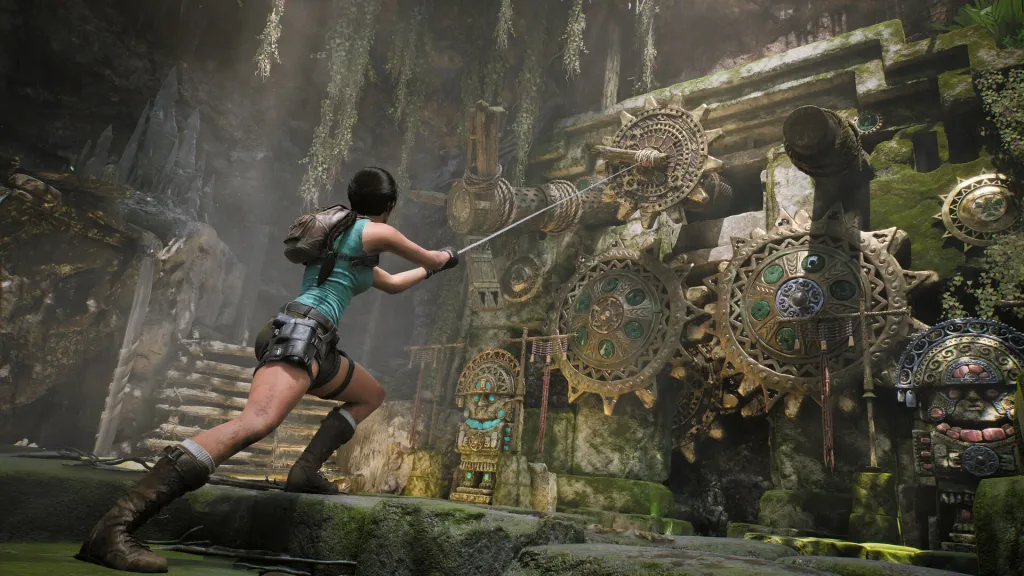
The demo dropped me into Peru's Lost Valley with one goal: open the way to the Tomb of Qualopec. The headline obstacle is a rebuilt version of the original's infamous waterfall-and-cog puzzle, and the puzzle itself was pretty straightforward. For me, the challenge in these games has always been the bit between the puzzle steps: reading the environment and working out how to physically get up there.
That's where the demo genuinely surprised me; Legacy of Atlantis trusts you to look. There's no garish yellow paint slapped across every climbable surface, just the odd scratch worn into a rock face or a natural scramble point, cues subtle enough that they never felt out of place. Once I tuned into that visual language, the traversal became second nature, almost trivial, and not having my hand held the whole way was a real breath of fresh air.
It isn't all smooth, and the rough edge is the one I'd most like to see sanded down before launch: precise movement. Big, sweeping leaps are fine, but the second the game asked for finesse, like lining Lara up during the cog puzzle, she had a habit of jolting and overshooting the exact spot I wanted. There was also a wide gap to clear, with a fast river churning below, and missing it would wash me all the way back to the start of the demo. I kept measuring the jump until one of the reps pointed out I could simply use a running jump. It worked, but the gap read wide enough that a standing leap felt like the natural call, which, in hindsight, is more my own than the game's fault.
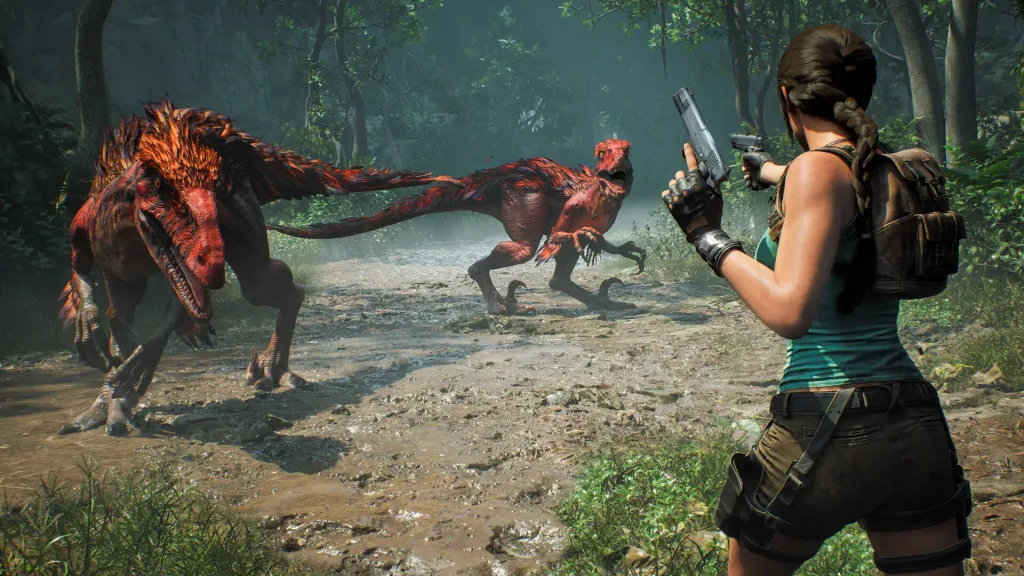
Combat is where Legacy of Atlantis showed me its hand, and it's built entirely around movement. The Raptors were the real gut-check. One is manageable, but the demo set three on me at once, and the full game will surely pile on more. That's where Focus stopped being a flashy toy and turned into something I leaned on to survive. Focus is a slow-mo meter that fills as you fight, and when I popped it, time dropped into a crawl just long enough to read the pack, roll clear of a lunge, and place my shots. Without it, the window to dodge was so narrow that I'd get pounced on the instant I turned to deal with another Raptor. It felt less like an optional flourish and more like the mechanic the whole encounter is balanced around.
The gunplay leans hard into that fantasy. You carry dual pistols with unlimited ammo, true to the originals, and the shooting is about volume over precision, less careful marksmanship and more spraying lead while you cartwheel through a pack. Pair that with the slow-mo, and it's pure John Woo, who made the dual-wielding, slow-motion gunfight his signature in films like Hard Boiled; just swap the doves for raptors.
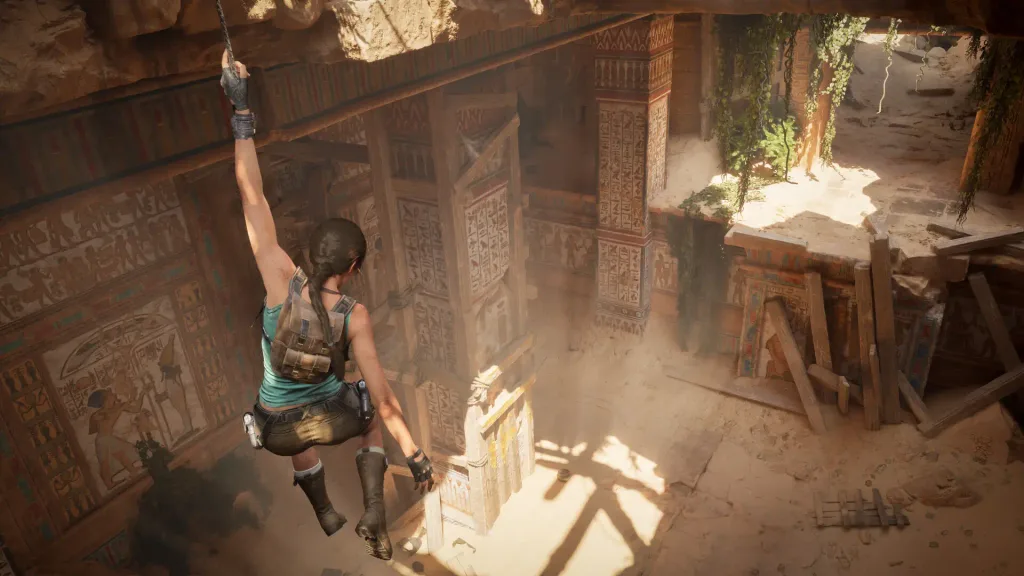
Then there was the T-Rex encounter. It was more like a cinematic chase than a fight, but what stuck with me is how the game steers you through it without a single flashing prompt. No red icons, no "press X" overlays, just the camera doing the work: as Lara slides down a slope, the shot rolls with her, and the new angle reveals the next branch to rappel to, and you connect the dots from there. Rinse and repeat, and it feels like you're directing the set-piece instead of obeying it.
If I had to boil the whole demo down to one line, it has the graphical fidelity of a 2027 release with the jank of a much older one, and oddly, that's a compliment. I had a blast, and what blew me away wasn't how it looked, but rather, how it felt like the classic Tomb Raider.
Steam Deck Performance?
There's no word just yet on how it will play or run on the Steam Deck, but there are a few things we can infer. The game is built on Unreal Engine 5, which is known to have issues with optimization and stuttering, and will have Denuvo DRM. Along with the relatively high system requirements, this could lean towards it being unplayable on the Deck.
However, Legacy of Atlantis is confirmed for PS5, Xbox Series X|S, Steam, and Nintendo Switch 2, and it's that last console that catches the eye. If a game is optimized for the Switch 2, it means the team is optimizing it enough to work in handheld mode, which is less powerful than the Steam Deck. If these optimizations make their way to the PC build, we could see it being very playable on the Deck.
So far, I'm sold on the direction of a confident Lara, environmental design that respects your eyes, and a slow-mo gun-fu loop I didn't expect to enjoy as much as I did. The precise movement needs a pass before February, and I won't pretend one show-floor session is the full picture. But this is the first Tomb Raider in a long time I'm genuinely itching to play more of, and the first I'm hoping plays nicely on a handheld.
Tomb Raider: Legacy of Atlantis can be wishlisted on Steam ahead of its February 12th release date, and it can also be pre-ordered for $59.99.
If you enjoyed this article, check out the rest of the content on SteamDeckHQ! We have a wide variety of game reviews and news that will help your gaming experience. Whether you're looking for news, tips and tutorials, game settings and reviews, or just want to stay up-to-date on the latest trends, we've got you covered!

RECENT NEWS
Categories
Accessories
Anbernic
Android
ASUS ROG Ally
ROG Xbox Ally
Classics on Deck
Community
Cryobyte33
Deals
Deck Mods
Emulation
Events
Featured Post
Game News
Game News
General Game News
HandheldHQ
Hardware
Lenovo
Linux
MagicX
MSI
Nintendo
ONE-NETBOOK
Opinion
Other Reviews
Accessory Reviews
Handheld Reviews
PlayStation
Proton
Retro Handhelds
Anbernic
AYANEO
AYN
GPD
MagicX
MANGMI
Miyoo
Retroid
Rumors
TrimUI
SDHQ
Steam
Steam Controller
Steam Frame
Steam Machine
SteamOS
The Unsupported Report
Uncategorized
Uncategorized
VR
Recent Tips & GUIDES
recent reviews