The Retroid Pocket G2 was provided by Retroid for review. Thank you!
Over the past few months, there have been some amazing announcements in the handheld space, and it’s been very exciting to watch. Two of these announcements came from Retroid, who announced their Pocket G2 and Pocket 6 handhelds, with the G2 being released and the Pocket 6 coming in January. It was a little weird to me to announce both of these handhelds at the same time, especially as the Pocket 6 is a sizable upgrade over the G2. Still, the Pocket G2 is a solid performance increase over the Pocket 5, and overall, it's a fantastic handheld, let down only by the next handheld from Retroid coming so soon.
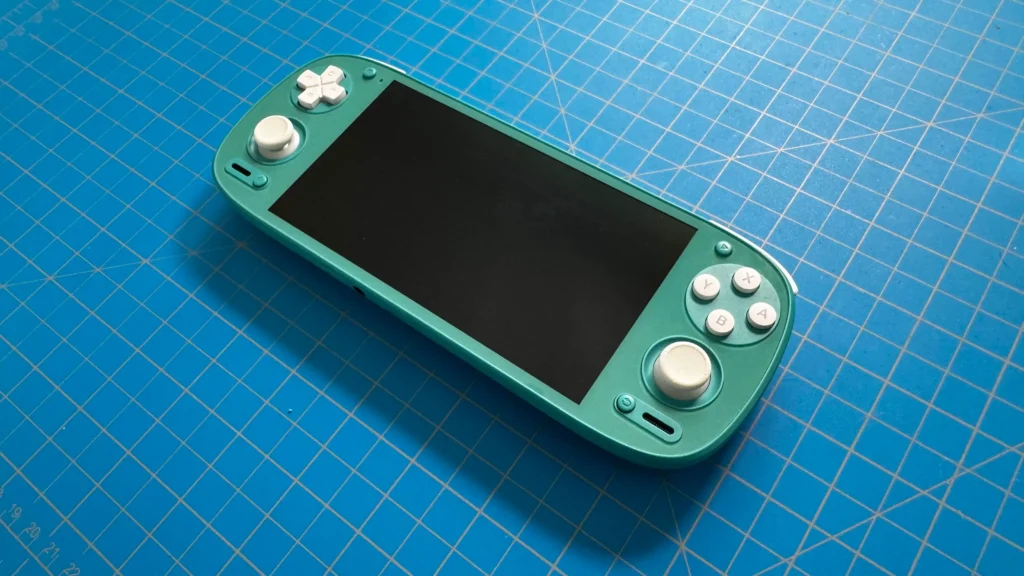
Models and Specs
Before getting into my review, I want to talk about the model I have and the specs that the Retroid Pocket G2 will be carrying. While there are five different colorways, there is only one internal configuration for the device, which means the performance on one should be relatively the same as the others. Here is the spec sheet provided by Retroid on their website:

I was sent the Turquoise model from Retroid with all of the same specs above.
The Pocket G2 Vs. Pocket 6
When Retroid announced the Pocket G2, they also announced the Pocket 6, their next big handheld coming in January. This was a joy to see, and while there were some design changes with the Pocket 6, it is still on track to be released in two months. However, as I mentioned above, this also poses an issue. The Pocket G2 is a solid upgrade over the Pocket 5, and if you are looking for a decent increase in performance with better Switch and PS3 emulation compatibility, thanks to the Snapdragon G2 Gen 2 chip, as well as faster RAM, this is going to be the perfect handheld for you.
However, what holds me back from fully recommending it is the Pocket 6. The handheld is releasing in two months, and it's around the same price (technically cheaper at the time of writing due to its sale), but has an even better chipset (Snapdragon 8 Gen 2) that can push even more power, a larger battery, and options for more RAM.

The Pocket G2 is a more than capable handheld that I would recommend easily, but the Pocket 6 is just an overall better deal with more power and similar pricing. If you are looking for an upgrade for the Pocket 5, both of these handhelds will do the job and feel worthwhile, but the sheer increase in power for around the same price is just a great deal.
Even still, I would consider the Pocket G2 a worthwhile purchase for those who don't want to wait and aren't planning on using the handheld for Switch emulation and above. It's nice to have that option, but as someone who sticks to emulating older games from the PSP and GameCube era, the Pocket G2 satisfied me completely. But if you are okay waiting and want that extra power, which will be worth the wait, the Pocket 6 is the way to go.
Ultimately, if you have a Pocket 5, upgrading to the Pocket G2 will be a sizable jump for PS3 and Switch emulation, while still keeping the great form factor, weight, and joystick layout. But waiting a little can get you an even more powerful device that costs around the same. Personally, I would say waiting makes more sense since you will get more for the same price, but if you don't care much about playing more PC/Steam games or PS3/Switch emulation, the Pocket G2 is wonderful.
Build Quality and Ergonomics
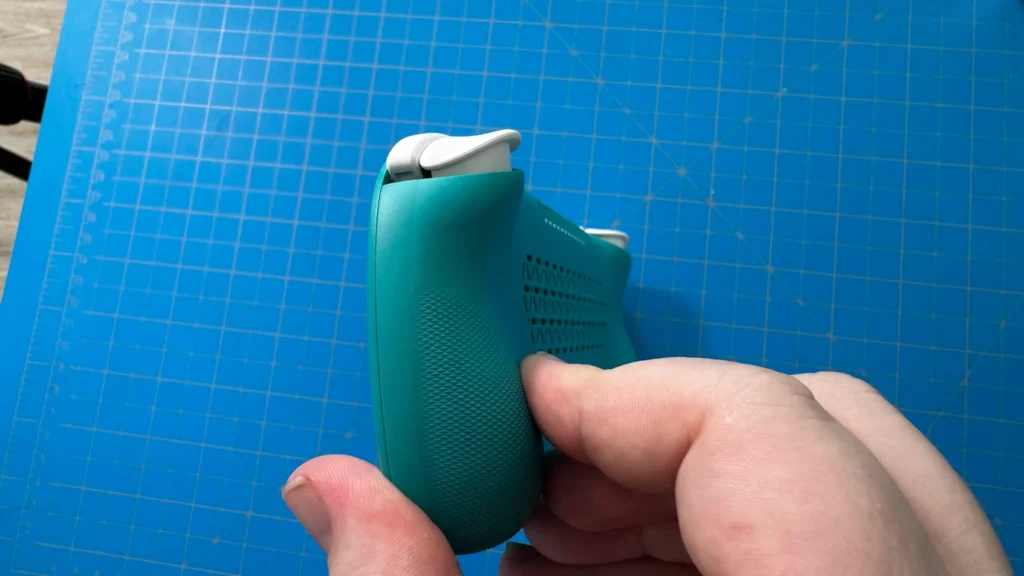
The actual build quality of the Pocket G2 is quite solid. Everything feels tight and well put together. I don’t really have many notes here; it just feels like a well-built device. The plastic that covers the back and sides feels great on my hands, not slippery. It’s rough and easy to grab onto, which is extremely pleasant when using it.
The handles themselves are also just pronounced enough to feel comfortable to game on, but are just a little too small for my hands when moving around. The handles have a great rough texture that keeps my grip, and when I’m sitting down, it’s perfect to hold and use. It isn’t big enough to allow my entire hand to grip onto it, but it’s very comfortable to use regardless. My ring and pinky fingers rest nicely below it, and the top half of my hand is able to wrap around nicely.
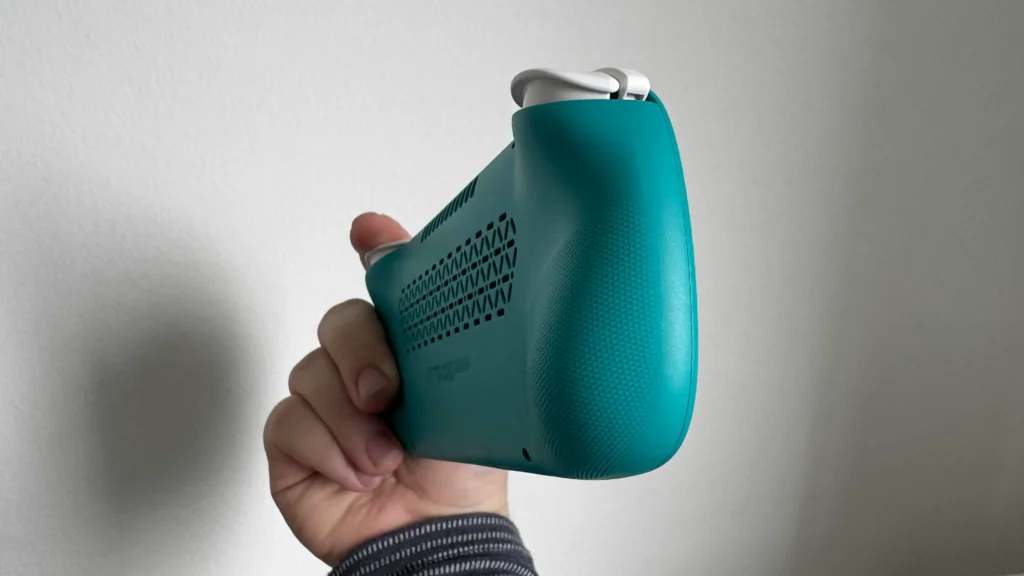
This grip also makes my thumbs rest perfectly in between the buttons and joysticks, and my index finger on the triggers, so it’s extremely easy to hit everything I need to from the start/select buttons on towards the top to the joysticks towards the bottom. I never felt like my thumbs were strained trying to hit anything, and that’s always a nice bonus.
However, my hands are fat, and even though I think these ergonomics are great, it’s not enough for me. Yes, my hands can get to all the buttons I need, but sometimes, I just feel the Pocket G2 slip out of my hands and make me need to readjust it. This wasn’t as much of a problem when sitting stationary, though it did happen a few times, but getting up and moving around while holding it was tougher. When I was traveling, I had to get up and let my wife pass me to go to the bathroom, and each time, I felt the device slip, making me stop to make sure I didn’t drop it. My wife loves the handles, though, so this is primarily a fat-hand issue.
I also love the weight. Like the AYN Thor, the Pocket G2 strikes a fine line between too light and too heavy. It’s a little lighter than the Thor, which is probably due to it only having one screen instead of two, but it still feels fantastic. I’m still pretty amazed at the weight of these handhelds after using handheld PCs like the Steam Deck as much as I do, so bear with me as I fall in love over and over again with how weightless it feels in comparison.
Design and Screen
The Retroid Pocket G2 is overall designed nicely. Apart from the ergonomics, the button layout is perfectly fitting for the size of the device. All the buttons can be easily smacked with my thumb, and we have all the buttons we could possibly need, from ABXY and the D-Pad to two joysticks and shoulder buttons with analog triggers. I also have to give special mention to the beautiful, symmetrical joysticks that I adore. I’ve fallen in love with them ever since the Steam Deck, and it’s so nice to have them here.
The analog triggers are also simply phenomenal. They have a great size and feel, as well as a perfect amount of tension to push back when I pull it down. Having the right amount of tension makes it feel more impactful to push on and easier to bring it down halfway, which I appreciate. I have no notes here; Retroid created fantastic triggers.
The D-Pad does feel a little too digital to push down on, reminding me of the Nintendo Switch’s Joy-Cons, but every other button feels great. The ABXY buttons and Start/Select/Home/Back buttons are great to push down, and even though the Shoulder Buttons feel digital, they go down a little further than I’d expect and have an extremely satisfying click to them. The joysticks themselves also have a great feel to them, fitting with my thumbs and feeling great to move around in full circles. With no concave design, the joysticks don’t hit anything early and have full range, which is wonderful.
If I had to be nitpicky, I would say the ABXY buttons feel a little too small and spaced out. I prefer them to be a little closer together or bigger, but it’s still very usable and enjoyable. Again, this is another issue with my fat hands, but still something that came up, and I’d like to mention.
The Pocket G2’s size is another high point. Its gorgeous 5.5-inch AMOLED 120Hz screen doesn’t feel too small, and keeps the device relatively small to be perfectly portable. It fits in my pocket without worry, something that I still fawn over when comparing to handheld PCs, and I just love bringing it around. It has everything I need fit into one wonderfully portable package.

Retroid's Launcher
The Retroid Pocket G2 does come with its own launcher, and I actually do like it. There are two modes to it, one that can categorize emulators and their games, and one that shows all apps. The emulator mode is solid, and all you have to do is download an icon, link the directory, and it will sync the games and give them portraits. It does open the game automatically once it detects the emulator, though I didn’t do this for all of my games there. Specifically, selecting any PSP games did load into the app, but not the game. But this is small and works most of the time, which is nice.

And by just pressing the B button, we can go to the “All Apps” mode. Here, we can see all of the apps we have installed and access them. They can be grouped into Games, Emulators, and Other, and while some do automatically get grouped, there will be some manual configuration here. Still, I appreciate and like the layout, as well as just being able to see all the apps immediately.
I love the Retroid launcher and could actually see myself using it instead of the basic Android layout. I like all the info that’s there, and it doesn’t feel like I’m missing out on much. I see all apps clearly, and I can check out my emulated games in a similar way that ES-DE would give me.
However, I have been spoiled by the AYN Thor, and there is one thing missing I would have loved to see: A Quick Access menu. I love being able to access all the settings in an easy way at any time, and the Retroid Pocket G2 doesn’t have it. There is a side menu that only appears in some apps that we can bring over, which gives us the ability to screenshot, record, turn off alerts, livestream, change brightness, adapt key bindings for the controller, check statistics, and close processes to free RAM, but that’s it.
Gaming Performance
Android Gaming
The Pocket G2 should be pretty competent when it comes to Android gaming, which surprised me a little. It was able to handle Wuthering Waves at the highest quality at 60 FPS, though there were some small hitches here and there. It will also be a bit of a battery drain, and I recommend using High Performance mode with Sports fan speed on, but it's playable, and I was having a blast. And since this is a 120Hz screen, I do recommend setting the framerate to 40 FPS in-game for the smoothest gameplay.
As for Genshin Impact, it was able to handle 60 FPS at the highest quality for the most part, but it did start showing some drops when it came to gliding around and traveling across the land. So, I would say 30 FPS at the highest should be solid, or bringing it down to medium quality at 60 FPS could be good as well. Either way, the handheld is very competent for the more intense Android games.
PC/Steam Games (GameHub)
So, while I usually use GameNative, I had to go with GameHub to test PC/Steam games since GameNative wouldn't download anything. However, performance is solid. I was able to play a couple of rounds of BALL x PIT with performance sticking above 40 FPS the whole time. I would say it can play most smaller-scale indie games, but with the power of the G2 Gen 2 chip, and only 8GB RAM, I wouldn't try to play more demanding games or go into the AA space.
Emulation
The Pocket G2 will be able to handle retro emulation with ease, so I won't be going into detail about my testing for consoles for the PS1 era and before.

PSP (PPSSPP) - For PSP, there should be no problem playing at 4x resolution (1080p). There were some small drops here and there from what I saw, but I believe these are mostly from the game and emulator, not the power of the handheld. Daxter and Crisis Core ran wonderfully, as did Final Fantasy Dissidia 012.
PS Vita (Vita3K) - Both Dragon’s Crown and Gravity Rush played quite well at 2x resolution scaling. They’re were some minor stutters here and there, as well as some graphical issues in Gravity Rush, but it’s still very playable. I would play at 1x for the most stable experience, but 2x is solid.
GameCube/Wii (Dolphin) - 2x resolution is where most games will be sitting here. I was getting some hitches when playing Kirby Air Ride at 3x, but switching to 2x completely fixed it. Rogue Squadron 2 does have trouble at 2x, and while it plays better at 1x, there are still some drops here and there. 3x resolution may be possible for much lighter games, but in general, I would stick to 2x for the best experience primarily.
PS2 (NetherSX2) - I was able to play DBZ Budokai Tenkaichi 3 and God Hand at a comfy 3x resolution, but there are some more demanding games like God of War 2 that show some warning signs. I was able to play pretty comfortably at 2.5x resolution, but I would say going to 2x may be needed, which it was for Gran Turismo 4. But 2.5x should be doable for most games.
PS3 (RPCSX) - While I was able to play God of War HD on the G2, it was not enjoyable. There were plenty of drops and moments where sub-60 FPS was prevalent. It’s not enjoyable, and I can’t see more demanding PS3 games running smoothly.
DS/3DS (MelonDS/Azahar) - DS and 3DS are perfectly playable on the G2, and I was comfortably at 8x resolution on DS and 3x resolution on 3DS (with some heavier games showing some performance issues and feeling better at 2x). However, I have been spoiled. The screen of the G2 is a little too small for dual-screen emulation, and it can make one or both of the screens small. It's not enjoyable having to touch the second screen because it is so small, so I would probably avoid playing dual-screen games like this on the G2.
This is less of an issue with the G2 and more of an issue playing dual-screen games on a single screen.

WiiU (Cemu) - With how WiiU emulation performed on the AYN Thor, I had no expectation for it to be enjoyable on a lower power device, and I was right. It has all the same issues, with performance and graphical hiccups, and I would not recommend playing it on the G2.
Battery Life Estimates
If you are going for hardcore emulation like Switch and PS3, I would expect around 2-3 hours of battery life, leaning more towards the 2-hour side. This is also where I would say PC/Steam games and Android gaming will stick as well, with PC/Steam going more to 2 hours and Android going more to 3 hours. For PS2/GameCube, we should see about 5-6 hours of battery life, and for older emulation like PSP, we will be able to get around 9-10 hours of battery life.
For what I would use it for, this is solid battery life. I was on a 4-hour plane trip with the Pocket G2, and I played Final Fantasy Dissidia 012 and Kirby Air Ride the whole time, and still had above 50% battery life. That, to me, is a win.
Conclusion
The Retroid Pocket G2 is a fantastic handheld that feels like a step up from the Pocket 5, only being let down by another Retroid handheld coming soon. Despite its small design, the handles feel great with their solid build quality and unbeatable symmetrical joystick button placement. The D-Pad feels a little too digital for my liking, but all of the other buttons are just wonderful, and the triggers are absolutely incredible. It also holds strong with power, being able to run most emulation wonderfully, and handle Android gaming with ease.
Normally, I would say this is a fantastic handheld and upgrade from the Pocket 5, but it still feels a little bittersweet when the Pocket 6 is coming so soon and offers an upgrade from the G2 with the same price. It's a little surprising Retroid would announce both of these handhelds at the same time, for the same-ish price, and have them releasing so close to each other. If you can wait, I recommend going for the Pocket 6, but if you don't care for Switch or PS3 emulation, the Pocket G2 is a perfect little handheld that should take care of all your needs.
The Retroid links above are using an affiliate link, which gives us a little back from sales at no extra charge to you. All proceeds go back into SDHQ and its development.
If you enjoyed this article, check out the rest of the content on SteamDeckHQ! We have a wide variety of game reviews and news that will help your gaming experience. Whether you're looking for news, tips and tutorials, game settings and reviews, or just want to stay up-to-date on the latest trends, we've got you covered!

RECENT NEWS
Categories
Accessories
Anbernic
Android
ASUS ROG Ally
ROG Xbox Ally
Classics on Deck
Community
Cryobyte33
Deals
Deck Mods
Emulation
Events
Featured Post
Game News
Game News
General Game News
HandheldHQ
Hardware
Lenovo
Linux
MagicX
MSI
Nintendo
ONE-NETBOOK
Opinion
Other Reviews
Accessory Reviews
Handheld Reviews
PlayStation
Proton
Retro Handhelds
Anbernic
AYANEO
AYN
GPD
MagicX
MANGMI
Miyoo
Retroid
Rumors
TrimUI
SDHQ
Steam
Steam Controller
Steam Frame
Steam Machine
SteamOS
The Unsupported Report
Uncategorized
Uncategorized
VR
Recent Tips & GUIDES
recent reviews