まだの方は、X(Twitter)、Mastodon、Blueskyでフォローし、新しい記事が投稿されたらお知らせください。また、Redditに参加したり、YouTubeに登録して、私たちのコンテンツをチェックしたり、素晴らしいコミュニティと交流してください。応援ありがとうございました!
I've been a fighting game player for over 20 years now. I've had my competitive era, my professional era, and these days, I'm completely retired from that scene. But fighting games have always stuck with me.
Back when I was playing roguelites like The Binding of Isaac and FTL, I always had this idea in the back of my mind: what if we had a fully fledged roguelite built around actual fighting game fundamentals? Not a beat 'em up with some fighting game influences, not an action roguelite borrowing a few mechanics, but a complete roguelite where the core gameplay is a proper fighting game.
That was basically my childhood dream.
And now, years later, as a washed-up, relatively old, retired fighting game player, I finally have the genre mashup I've wanted for so long with Poly Fighter.
I recently had the chance to play an extremely limited early demo, so let's take a look at what Poly Fighter has to offer, whether these first impressions are promising, and, most importantly, whether it does justice to the fighting game roguelite I've been waiting all these years to play.

First of all, from the bottom of my heart, I can proudly say that Poly Fighter is a fighting game. It's not a lighter version of the genre or a simplified take on it. It's a complete fighting game, just like Street Fighter and The King of Fighters.
Juggle counts, motion inputs, OTGs, frame data, invulnerability frames, anti-airs; everything you would expect is here. And that's easily one of the most beautiful aspects of Poly Fighter.
Whether I was putting together combos, experimenting with different moves, or fighting bosses, I never felt alienated from the gameplay. It immediately made me feel right at home. So if you're already a fighting game player, you'll experience that same familiar feeling the moment you start playing.
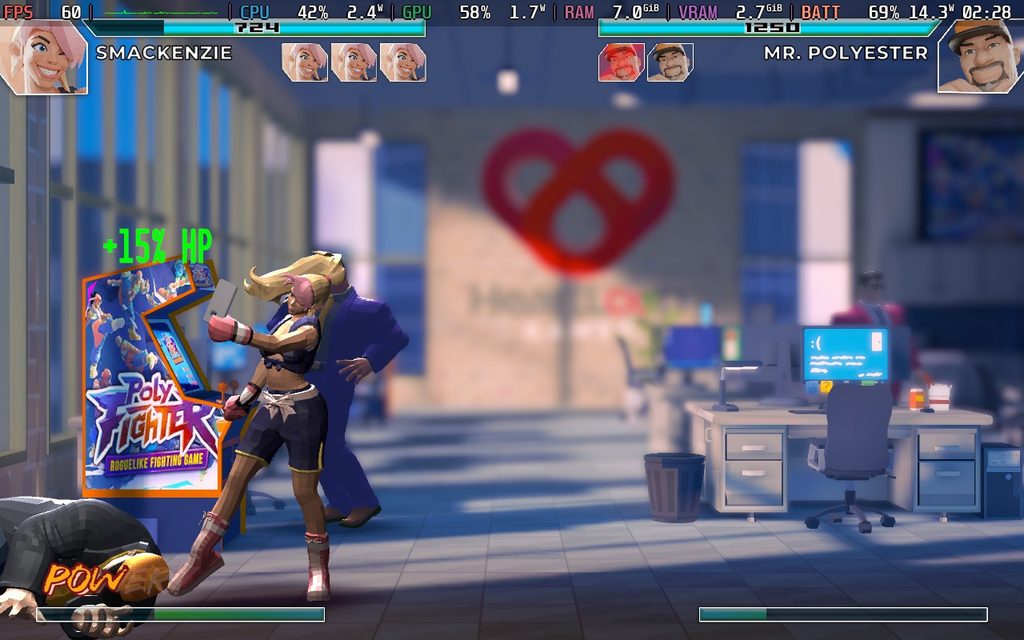
But that authenticity comes with consequences. From what I've seen so far, I don't think Poly Fighter will have much appeal for casual indie or roguelike fans. To fully enjoy what the game is doing, you need at least some familiarity with fighting games.
Almost every upgrade, perk, and decision you make is tied directly to fighting game fundamentals. This isn't Hades, where you can dodge out of an AoE, throw together a decent build, and have a good time without necessarily understanding every system underneath it. Poly Fighter asks for commitment. It expects you to understand how a fighting game works and, more importantly, why certain moves and upgrades are valuable in the first place.
And that's where things get complicated. Fighting games have always been a notoriously difficult and somewhat niche genre to get into. Sure, anyone can mash buttons through a story mode or have fun randomly pressing buttons against a friend on the couch, but actually learning fighting game fundamentals is an entirely different commitment. Historically, one of the biggest incentives to overcome that barrier has been the competitive appeal of 1v1 fighting another human being, improving, adapting, and eventually outplaying them.
Poly Fighter doesn't have that incentive. At least in this demo, you're learning those same fundamentals for a single-player roguelite experience.
So, the game doesn't seem to be for everyone. If you've spent a lot of time playing 2D fighters and also happen to love roguelites like Slay the Spire or Hades, this feels like a match made in heaven. But if you're only coming from one side of that equation, or neither, I think you may struggle to find what makes it so special.
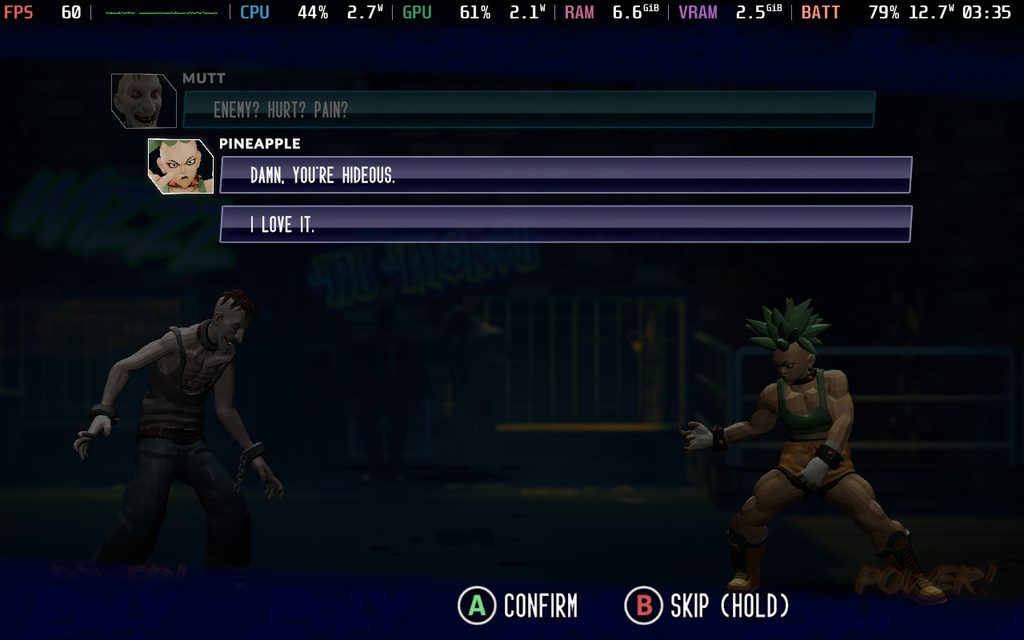
There are a fair number of relatively bare-bones characters to start your run with, and surprisingly, they already feel quite distinct from one another. Each character has a clear direction for the playstyle they can eventually develop into. You have zoners who can inflict elemental debuffs, grapplers with massive health pools and unblockable attacks, and fast fighters who are rewarded with critical hits and powerful combos. There are also some more unconventional characters who can switch between different stances, have their own unique power gauges, or even come with specific quests and conditions you need to fulfill.
I really like this approach. Every character starts with a very limited moveset built around solid fundamentals, but you can immediately see the potential for what they might become as you progress through a run.
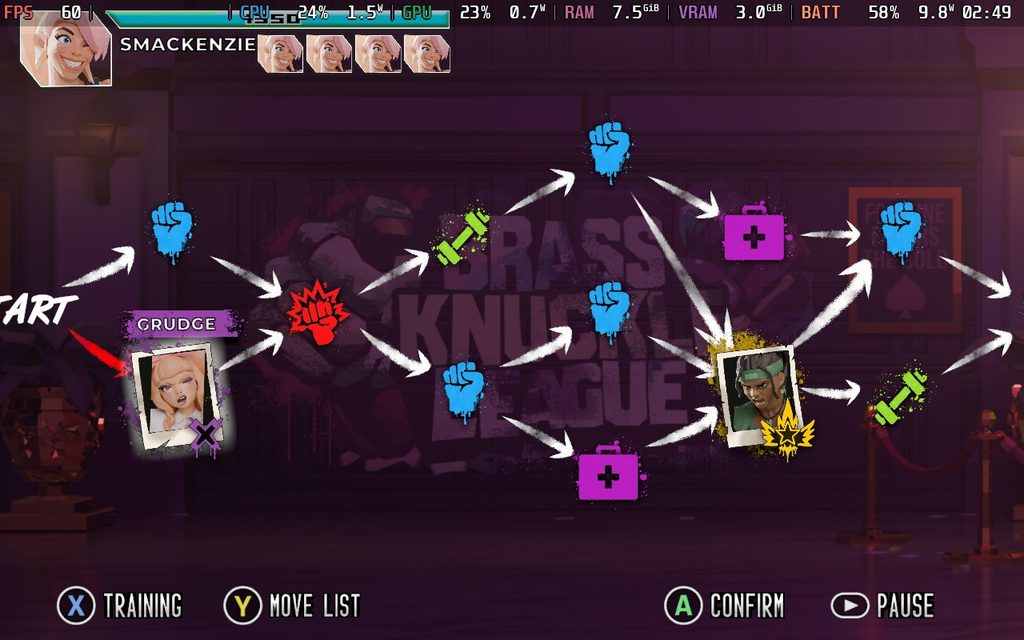
Once you've chosen your fighter, you head into the map and start making your way toward the act's main boss. Along the way, you'll fight regular opponents and elites, while other encounters can reward you with health upgrades, new moves, and other improvements to your build.
And this is where the roguelite side of Poly Fighter really starts to shine. Your attacks can gain all kinds of additional properties throughout a run: lifesteal, burn, critical hits, stuns, slows, and pretty much everything else you'd expect from the genre. Suddenly, a basic move you started the run with can become an important part of your build depending on the effects and upgrades you attach to it. Mixing those roguelite systems with an actual fighting game moveset is where a lot of the fun comes from.

It's not all sunshine and rainbows, however. There are two major issues with Poly Fighter's roguelite approach, and unfortunately, they are directly connected.
The first is the overwhelming variety of rewards. There are so many different moves and upgrades in the reward pool that it can become surprisingly difficult to build toward the playstyle you actually want. I don't want Poly Fighter to lose the RNG or the "play with what you're given" charm that defines the genre, but there were far too many situations where an extremely powerful move or reward had absolutely nothing to do with my character's intended playstyle, yet was simply too good to pass up.
As a run progresses, the importance of that initial character select screen slowly fades. The archetype you originally chose gets diluted until you eventually end up with a random, unsynergistic abomination of a moveset. It also takes away some of the excitement of going into training mode and discovering new combo routes, because instead of developing the tools that made me choose that fighter in the first place, I suddenly find myself using a command grab simply because it applies an absurd burn effect.

And that leads directly into my second major issue: character identity.
At least in the demo I played, the additional special moves you progressively learn are moves taken from other characters. I spent most of my time playing a character named Smackanzie, and I really enjoyed the rapid-fire, "brrrrr" machine-gun-style punches that define her default special moves. Naturally, I wanted to lean further into that identity. I wanted to find more moves that complemented that style, expand her existing combo routes, or meaningfully improve the special moves she already had.
But that's not really what happens. Instead, the game gradually pushes you toward becoming either a different character entirely or a jack of all trades. And eventually, poof, most of the character's identity is gone.
The easiest comparison I can make is to imagine playing Slay the Spire without character-specific card rewards, where every reward screen simply pulls cards from every other character's color and card pool. Sure, you would have an enormous number of possibilities, but the character you picked at the beginning would start to mean significantly less.
For a roguelite, that's already a problem. For a fighting game, where character identity, archetypes, movesets, and individual playstyles are such fundamental parts of the genre, I find it difficult to accept.

As the name suggests, Poly Fighter intentionally adopts a low-poly visual style reminiscent of older Virtua Fighter or Tekken games, and I think it's a fun, nostalgic aesthetic choice.
Art is obviously subjective, and with a game like this, there's little point in discussing raw visual fidelity or trying to objectively decide what looks "good" or "bad." That being said, I found the overall presentation surprisingly lifeless. The colors, stages, fonts, and general presentation all feel like they could use significantly more polish. A low-poly aesthetic can still be incredibly expressive and visually striking, and right now, I don't think the game is quite there yet.

The sound department is one of the weakest parts of the demo as well, and unfortunately, this directly affects how satisfying the combat feels. Impact sounds are almost nonexistent. Landing a punch or kick sometimes feels like hitting your opponent with a piece of cotton candy, and for a fighting game, that's a massive problem. Good impact sounds are such an important part of selling the weight and power behind every attack, and their absence took away a surprising amount of my enjoyment. In fact, this was probably my least favorite aspect of the entire demo.
There isn't much voice acting so far, but what's there is actually quite good. The performances don't come across as cheap or emotionless, and the music and overall ambiance are enjoyable as well. Hopefully, the sound effects receive a lot more attention before release, because with stronger hit feedback, I think the combat could immediately feel significantly better.
Poly Fighter - Steam Deck Performance So Far
Poly Fighter runs on Unity and is a relatively lightweight game. On the Steam Deck, it can run at the native 1280 x 800 resolution with maximum settings while maintaining a perfectly stable 60 FPS.
The only strange issue I encountered was power consumption. At maximum settings, each fight would usually start at a fairly reasonable 12-13W, but as the fight went on, the power draw would climb, sometimes reaching a whopping 22-23W. I tried limiting the TDP to keep the power consumption under control, but unfortunately, that also caused the frame rate to struggle.

Luckily, lowering the graphics settings completely solved the issue. At the lowest preset, Poly Fighter runs at around 8-9W while still maintaining 60 FPS, and surprisingly, the visual difference compared to the maximum settings isn't particularly noticeable.
So, I wouldn't necessarily recommend dropping everything to the lowest settings by default. But if you're playing unplugged and want to conserve battery life, lowering the graphics settings is an easy way to significantly reduce power consumption without sacrificing much in visuals.
Poly Fighter - Steam Machine Performance So Far
Poly Fighter is a flawless experience on the Steam Machine. You get a perfectly stable 60 FPS at maximum settings, even at a native 4K resolution. It's a walk in the park for the hardware, and the game is essentially perfect straight out of the box, regardless of the display you choose to play it on.

Poly Fighter is still extremely early in development, and it shows. There are plenty of things that need to be changed, reworked, and heavily polished, especially when it comes to character identity, presentation, and sound design.
But the core idea and direction are fantastic. Building a proper roguelite around genuine fighting game fundamentals is something I've wanted for years, and even in this limited demo, I can already see enormous potential. There is still a long way to go, but the foundation is absolutely there, and I'm incredibly excited to see where Poly Fighter goes from here.
この記事を楽しんでいただけたなら、SteamDeckHQ の他のコンテンツもチェックしてみてください!あなたのゲーム体験に役立つゲームレビューやニュースを幅広く取り揃えています。ニュース、ヒントやチュートリアル、ゲーム設定やレビュー、最新のトレンド情報など、あらゆる情報をお届けします。 カバーしています!

最近のニュース
カテゴリー
Accessories
Anbernic
Android
ASUS ROG Ally
ROG Xbox Ally
Classics on Deck
Community
Cryobyte33
Deals
Deck Mods
Emulation
Events
Featured Post
Game News
Game News
General Game News
HandheldHQ
Hardware
Lenovo
Linux
MagicX
MSI
Nintendo
ONE-NETBOOK
Opinion
Other Reviews
Accessory Reviews
Handheld Reviews
PlayStation
Proton
Retro Handhelds
Anbernic
AYANEO
AYN
GPD
MagicX
MANGMI
Miyoo
Retroid
Rumors
TrimUI
SDHQ
Steam
Steam Controller
Steam Frame
Steam Machine
SteamOS
The Unsupported Report
Uncategorized
Uncategorized
VR
Xbox
最近のヒント&GUIDES
新着レビュー