Donkey Kong Bananza was provided by Nintendo for review. Thank you!
I've got to say, I was pretty worried about Donkey Kong Bananza. I couldn't see how it could ever compare to 2017's Super Mario Odyssey, a personal highlight of mine in the 3D platforming genre. I couldn't see how it could replicate the precise and hugely enjoyable platforming, the character-rich environments, and the stellar soundtrack.
The worry remained with each new trailer or additional tidbit of would-be enticing information, having my many concerns unceremoniously reinforced. The otherwise impressive destruction, while wholly remarkable, was my primary concern: How would the "pure" experience of finding the Moons in Mario Odyssey, specifically how all are obtained in the "correct" manner, be affected by the destruction, and the possibility of clumsily and haphazardly stumbling across one in a fit of DK's newly-found want of fist-enduced defacement? And would that unsystematic, bumbling approach make the platforming aspect feel less refined and aimless?

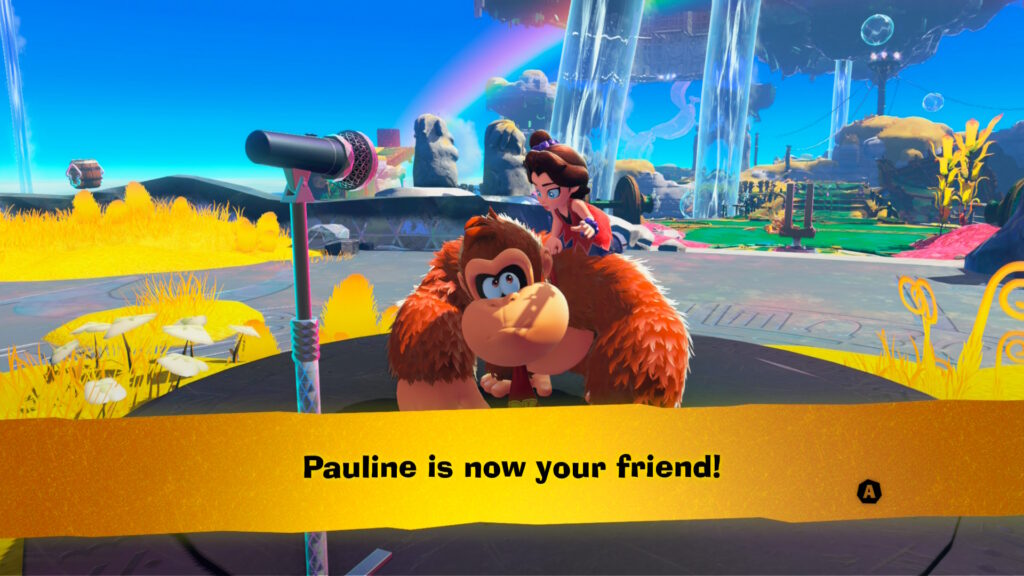
Donkey Kong Bananza has the honour of being only the second 3D platformer since the character's inception in 1981, with his first 3D offering being 1999's Donkey Kong 64 on the Nintendo 64. With such an impressive and storied history of sublime 2D experiences under DK's belt, Bananza had immense pressure placed upon it, returning to such a much-requested genre, especially one that Nintendo excels at. With a whimsical, unassuming tale starring Donkey Kong and a younger Pauline (yes, that Pauline) as its lovable protagonists, Bananza tasks the titular would-be hero with achieving both his and Pauline's dreams: To collect Bananas (Banandium Gems) and to become a world-class singer, respectively.
The larger plot itself is, expectedly, unimportant, with the more minor, moment-to-moment advances in the story carrying the necessary heart to keep us ambling onwards. With both a stunning aesthetic and the graphical prowess that only Nintendo manages to milk out of each console generation, such an adventure truly comes alive. Donkey Kong's new(ish) design oozes personality and charm, with Nintendo's innate ability to extract character in every frame paramount in achieving such an impressive feat. Pauline, too, manages to feel as essential to the experience as DK himself, providing that ever-appreciated human element to the story.
And, to not give anything away, that human je ne sais quoi certainly elevates the already impressive ending, for reasons best discovered and experienced yourself. It alone exalts the profuse moments of unmitigated joy, heightening the impact even the smallest moments had retrospectively with such finesse and wonder... it really is the big N on another level. Again, Nintendo's mastery of creating lovable characters and worlds is renowned, a fact known for many a decade, so it then falls to the gameplay itself to be equally raised, so as not to be left wanting in the wake of this magnetism.
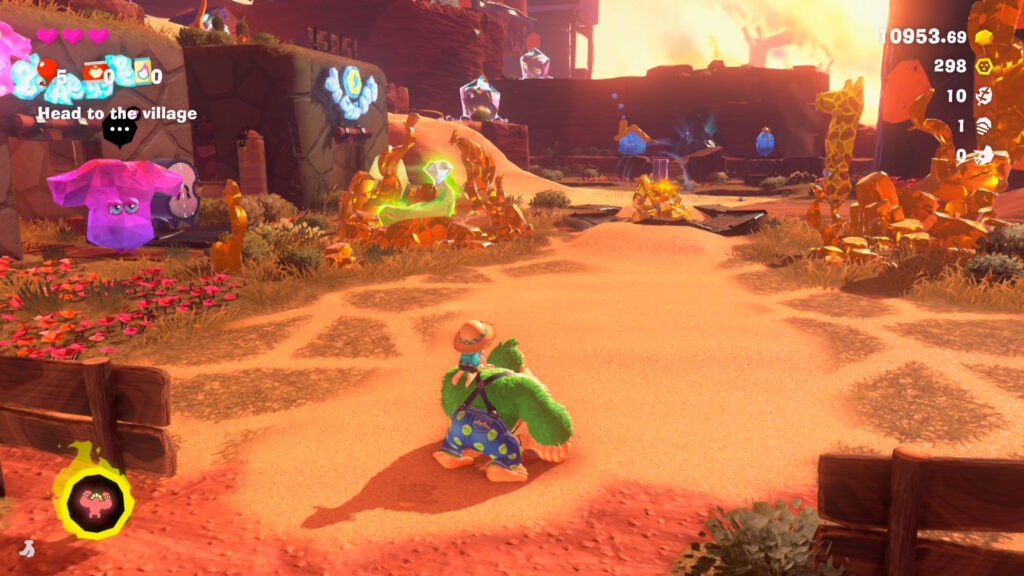
The destruction is the primary focus of Bananza, forming the core DK doctrines to which he has to adhere this time. The various levels and locales can be molded and shaped to how you see fit, bar the various core foundations of the level, represented in unbreakable girders synonymous with the ape itself. The many layers, both in terms of the distinct worlds and the layers of dirt and so forth, hide many a cavern, collectible, and general experience that all beg to be discovered.
However, the unadulterated freedom granted by such a mechanic and design choice does somewhat play against what a Nintendo 3D platformer needs to convey: a sense of purpose and clear direction. It's incredibly easy to destroy the environment to the point of being unrecognisable, and in doing so, lose your sense of direction and goal-oriented intent entirely. Granted, it is, admittedly, just as easy to reset the environment, but when the effort taken to achieve both destruction and reconstruction is nigh-on the same, it certainly feels at odds with itself, knowing that the former can be taken a step too far.
It's far too easy to circumvent the "designed" paths for the optional Banana or Fossil by punching in whichever direction takes your fleeting fancy, and happening upon said collectible by chance, and only seeing the path in which you *should* have taken after the fact. It cheapened the intentional highs so easily felt in other platformers of a comparable ilk. It felt like the trinkets that littered my digital pockets were not earned, but merely bumped into. Conversely, many optional curiosities require an impressive amount of skill, with an intentional mechanic that must be effectively utilised to obtain them.
Whether this speaks to ensuring a challenge for all players of all ages and skill levels, a known core Nintendo tenet, or the lack of confidence of the approach absolute destruction garners, it's difficult to say. Should you choose to refrain from the total annihilation of your surroundings, it is possible to play with the seeming set paths and such that each objective has been laid out before you, but by playing with such a self-imposed restriction, you fight at odds with the game itself more often than not.
With the inclusion of a relatively robust Skill Tree, with each Skill Point being earned after obtaining 5 Bananas, and Ancient Bananza transformations, it's clear that destruction isn't the only way in which Nintendo bucks their own, self-imposed 3D platformer rule book. The former is paramount in enhancing your various skills, capabilities, and health capacities, be it unlocking a Spin Jump that can be performed by rotating the Left Stick and pressing A, or increasing the Hand Slap's sonar range, allowing you to detect hidden items from farther away. Only a few offer true core gameplay additions, such as performing a double jump by holding a chunk of material and using that to catapult yourself further, but the agency felt that selecting your wanted upgrades helps shape how you want to interact with the world itself.
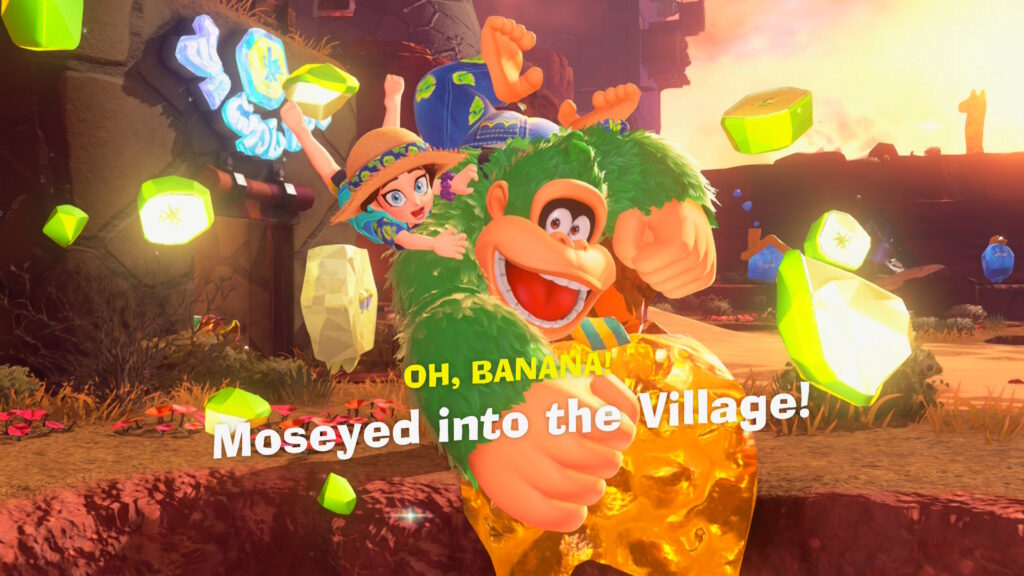
The Ancient Bananza transformations further enhance this experience, with the five available: Kong, Zebra, Ostrich, Elephant, and Snake, granting distinct and enhanced mechanics, with various challenges in the game suited to one or another of these available animalistic adaptations. The Kong Bananza, for example, can easily punch through harder objects and release a shockwave of energy after charging a punch. The Zebra, meanwhile, boosts your movement speed, making it easier to traverse unstable terrain and walk on ice without slipping. With the transformations readily available to you once obtained, you only need to collect the ever-abundant gold to charge your meter. Thankfully, it's a welcome addition not gated behind unnecessary complications or undue restrictions.
With each transformation, specifically the method in which they are obtained, being intrinsically linked with music, it would be amiss of me not to mention the outstanding soundtrack. Donkey Kong has always had some of the most memorable soundtracks to date (obviously, otherwise Donkey Konga wouldn't have been used as the medium in which you could smack Bongos to the tune of R.E.M.'s Losing My Religion), and Bananza is no exception. With both memorable new tracks and modernised takes on the copious classics that litter DK's many other outings, it not only heightens the experience further, but manages to do so more than, dare I say it, Mario's soundtrack ever could. Take that, Jumpman.
Conclusion
Harkening back to my opening statements and concerns, I was indeed worried, at least until I realized my lack of utmost acceptance in approach was, simply put, a me issue. I viewed Bananza as an experience akin to that of Odyssey, with set paths and design choices that fed such curiosities within the more restricted philosophies set out. Bananza both begs and consequently deserves to be viewed through more of an interactive guise than the more refined, albeit restrictive, outfits worn so many times before it.
That all being said, it's not necessarily going to be everyone. There's a sense of chaos brought about by the ceaseless destruction that weakens the cohesiveness of such an impressive platformer, even though some elements of said destruction, surfing on a recently-ripped slab of rock, as but one example, are both hugely enjoyable and crucial to progression. Destruction with pre-ordained limits sounds less exciting and inviting, but a slightly reigned-in approach may have alleviated my various uncertainties.
Ultimately, even after my 16 or so hours completing the game, with many a Banana left to find, I'm still not entirely sure how I feel about the freedom said destruction feels, and whether the various trade-offs were worth it. There's a lack of purposefulness when the many apparent and deliberate paths are eschewed in favour of wanton destruction, despite the enjoyment that such creative freedom allows, with perceived "shortcuts" galore being created.
Still, despite all the above, Bananza presents a fantastic tour de force from the newly designed Donkey Kong with some of the most rewarding gameplay. Hyperbole, this is not; even despite my early trepidations and latter uncertainty, Donkey Kong Bananza sets a new high for not only the character, one that has so famously stayed (and continuously delivered) in 2D locales, but for the 3D platforming genre as a whole. While my wants and wishes may skew to the more "traditional" side of offerings, ala Mario's many outings in the last two decades, there's clearly a lot for Mario et al to learn from here, too. And that should excite us all.
Our review is based on the Nintendo Switch 2 version of this game.
If you enjoyed this review, be sure to check out the rest of the content on SteamDeckHQ! We have a wide variety of game reviews and news that are sure to help your gaming experience. Whether you're looking for news, tips and tutorials, game settings and reviews, or just want to stay up-to-date on the latest trends, we've got your back.
SDHQ's Review Breakdown
Even after my 16 or so hours completing the game, with many a Banana left to find, I'm still not entirely sure how I feel about the freedom said destruction feels, and whether the various trade-offs were worth it. There's a lack of purposefulness when the many apparent and deliberate paths are eschewed in favour of wanton destruction, even despite the enjoyment that such creative freedom allows, with perceived "shortcuts" galore being created. Still, regardless of all the above, Bananza presents a fantastic tour de force from the newly designed Donkey Kong with some of the most rewarding gameplay around. Hyperbole, this is not; even in spite of my early trepidations and latter uncertainty, Donkey Kong Bananza sets a new high for not only the character - one that has so famously stayed (and continuously delivered) in 2D locales - but for the 3D platforming genre as a whole. While my wants and wishes may skew to the more "traditional" side of offerings, ala Mario's many outings in the last two decades, there's clearly a lot for Mario et al to learn from here, too. And that should excite us all.
Score Breakdown





RECENT NEWS
Recent Tips & GUIDES
recent Nintendo reviews