Voidling Bound was provided by Hatchery Games for review. Thank you!
I’m not sure how it shook out this way, but I ended up getting two different creature collectors to review at the same time. I love the genre, especially as a Pokémon fan, so I was really looking forward to seeing how these two titles differ from the tried-and-true mechanics defined by the most popular games in the genre. However, Voidling Bound takes a very different route, focusing more on third-person action that revolves around getting more powerful with creature collecting. While it can start to feel extremely repetitive when it comes to grinding, the mechanics keep it interesting enough to continue experimenting and getting more powerful.
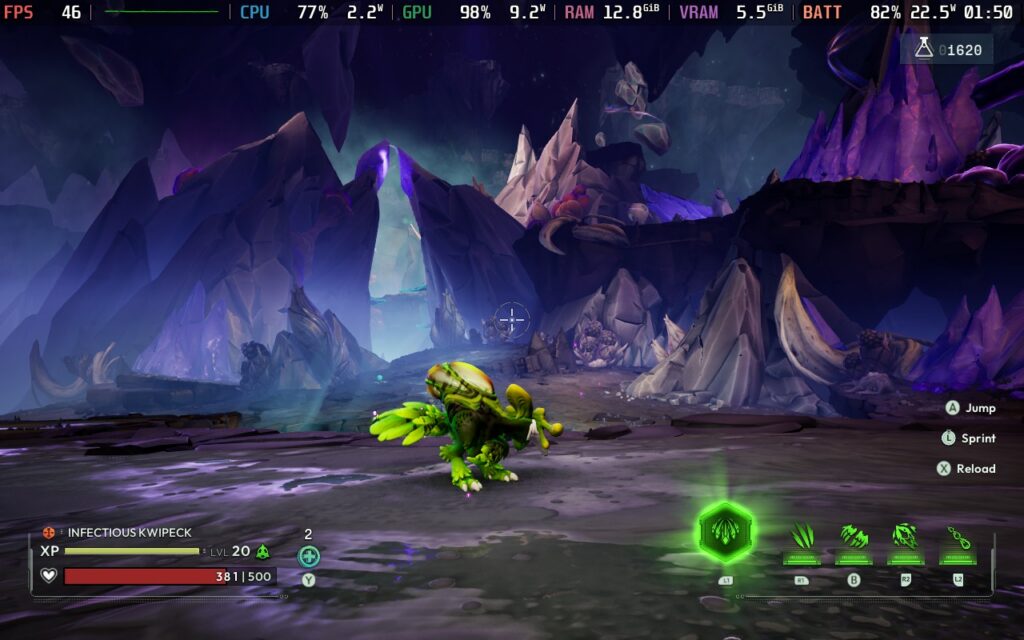
While Voiding Bound’s DNA is rooted in creature collecting, it takes a different approach that sets it apart and keeps it interesting, and it becomes more like a third-person adventure. Instead of the conventional system where there are over 100 creatures to collect that we use in turn-based battles, there are instead only 9 creatures that we take control over in third-person combat.
This ultimately makes the game focus on making these 9 creatures stand out and feel remarkably different, which works extremely well.
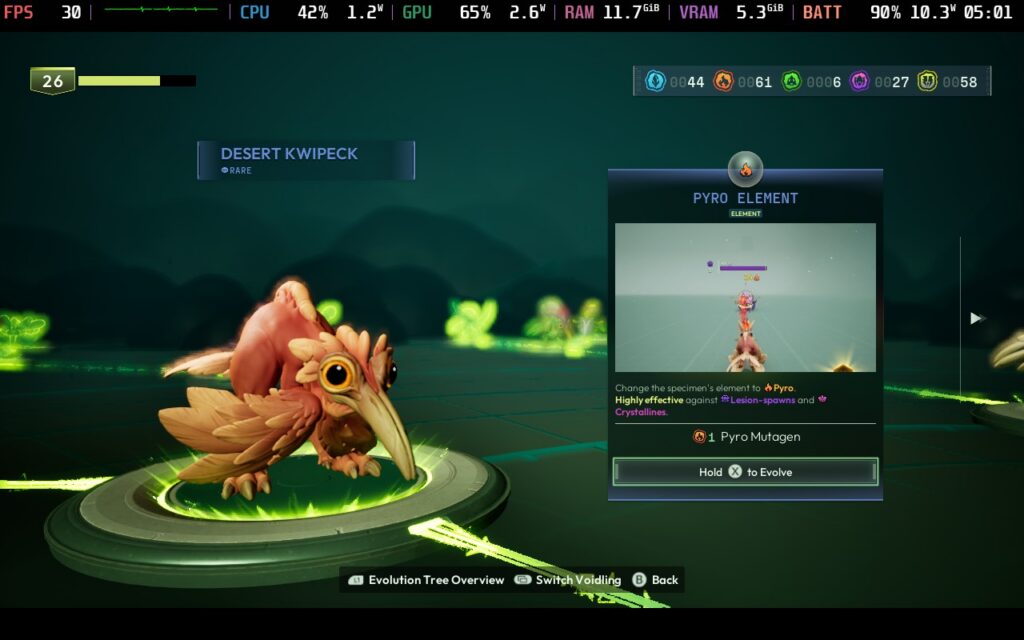
To further stand out, each creature has multiple evolution lines based on two elements that feel remarkably different. For example, the Kwipeck can choose either Fire or Organic, and each has a unique playstyle. Fire can modify the primary attack into a quick machine gun or give them exploding bullets, while Organic can become either a long-range sniper or slower bullets that inflict debuffs. The evolutionary tree spans out with 30 different pathways, all affecting the creature’s abilities and aesthetic, which can completely change its playstyle. And with each type of enemy having different elemental weaknesses, it encourages trying out different evolutionary lines for different situations.
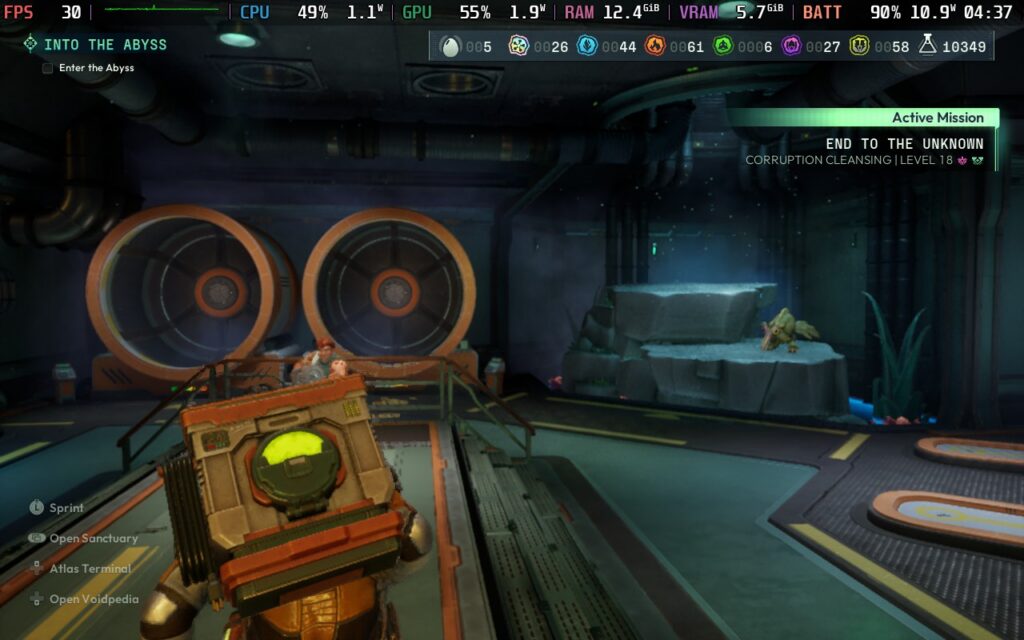
These can directly affect how they play, but then we have a few ways to make them stronger. Every species has a skill tree, which we can use currency to unlock nodes that make every creature in that species stronger. And, as we use the monsters in missions, they will level up, giving us the choice of increasing their stats. There are 5 stats to increase, which can give us more strength, health, elemental damage, and attack speed.
Finally, this brings us to the main way we will grow our creature’s strength: breeding. Monsters can only grow to level 20, which means we can only increase their stats by so much. To mitigate this, we can breed these creatures, bringing in some of their strength to their offspring so they start with higher base stats.
This defines the gameplay loop. Go into missions, grind, level up, and breed to acquire more powerful companions. We can also find eggs in the world, with some being golden that hatch unique monsters, but the best way to get more powerful is going to be by breeding. We also have the chance to splice in new perks to make our creatures way more powerful, but if we do that, we can’t use them to breed anymore. Since each monster gets a level cap of 20, we could use them to breed for better base monsters and then splice new perks to them, so they can still be usable.
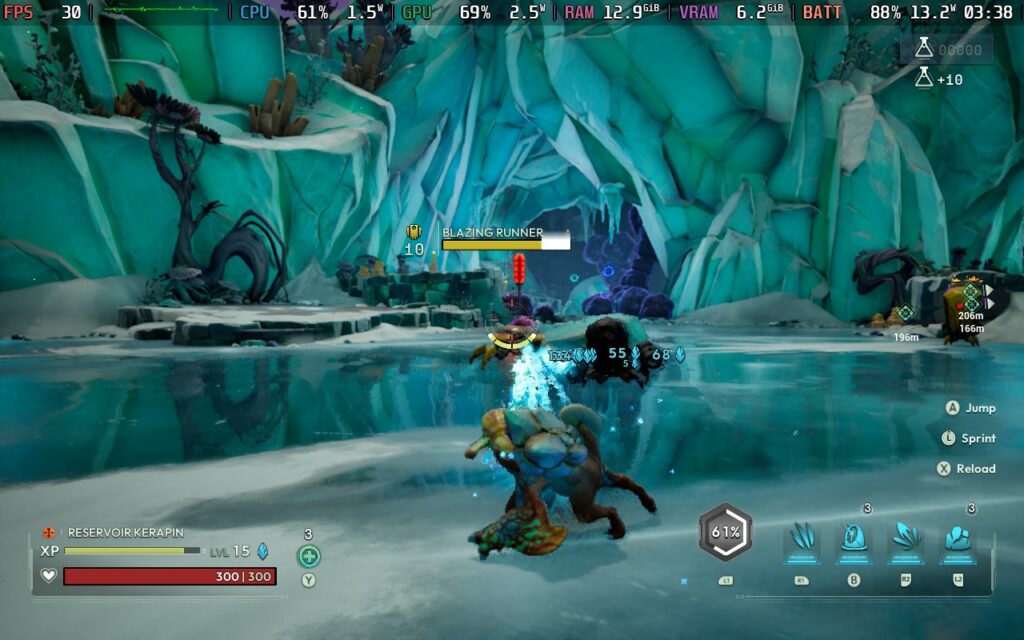
As for the actual combat, it was more enjoyable than I expected. Each of the creatures has their own primary tech, secondary attack, melee, dodge, and ultimate attack. They all feel wildly different from each other, and can be further defined by the evolutionary lines. Still, I was quite impressed by how much I enjoyed how fast and flashy the combat was. Cycling through the abilities to keep myself protected and healed up, while saving up for my ultimate ability that deals massive damage, was very enjoyable. And with each creature having its own playstyle, I had a blast trying all of them out to find my favorites.
As much as the combat is exciting and energizing, I did find myself mostly focusing on one or two creatures instead of constantly swapping between all 9. I loved the Kwipeck, and I focused a lot on breeding it specifically instead of going to each creature. It’s nice to have options and see what each creature is like, but I regularly found myself focusing on one or two primarily.
I love Voidling Bound's unique take on monster collecting, but it can feel quite repetitive towards the later end of the game. There are only a few mission types, and while a lot of them take place in different areas, it still feels like we’re doing a lot of the same. Since they all follow a similar structure, and we have to play those missions multiple times to grind in the beginning, it feels a little stale. And with all the creatures we have, which will need to be used to increase our power and rank, the grinding feels more like a chore to start.
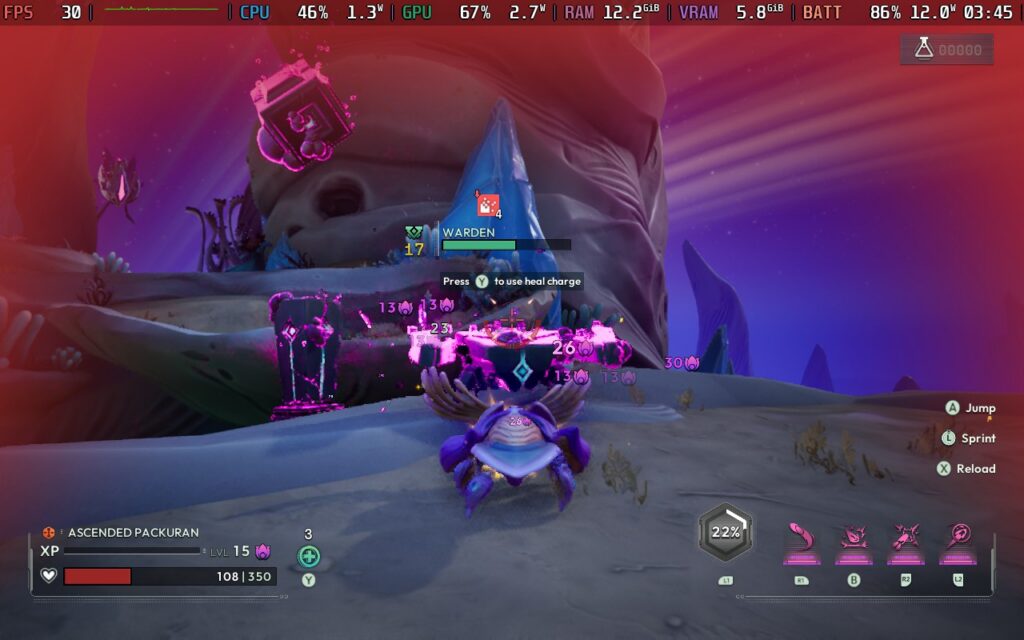
This does get better later on once the Abyss is unlocked, which is an endgame roguelike-esque mode. It can also feel a little repetitive after consistently taking part in it, but it’s definitely a step up from the usual missions.
And it improves further as we unlock more facilities in our hub, with one of them being a training facility to actually increase the level of our creatures without sending them on missions. Being able to train and level up multiple creatures while completing missions makes progress go significantly faster, but it takes some time to get there to the point where it feels like it makes a difference.
The facilities in the hub help a lot and can include upgrades and ways to get materials that we need a little faster. The currency can be used to get elemental nodes for evolutions, upgrade our health charges with how many we can use or how much it heals, decrease the cost of training and increase the cap of how far they can train, and more. It all feeds into helping us during combat or improving our creatures, and it does make a difference.
As for Voidling Bound on the Steam Deck, it is a decent experience. It got rated Playable ahead of its release, and I would agree with the rating. However, after testing, there’s only one way I would recommend playing to enjoy the game on the go.
I recommend sticking to the high-quality setting, but turning down the 3D resolution to 70% with a 30 FPS cap. The game runs quite well in a lot of spots, but as soon as combat gets heavy with tons of effects on the screen, the CPU will get bottlenecked and framerate will dip. Even at the lowest settings, there will be drops below 40 FPS, so it ends up not being viable to play above. And since the game is CPU-bottlenecked, increasing quality that will push the GPU won’t make the game suffer as much in those moments.
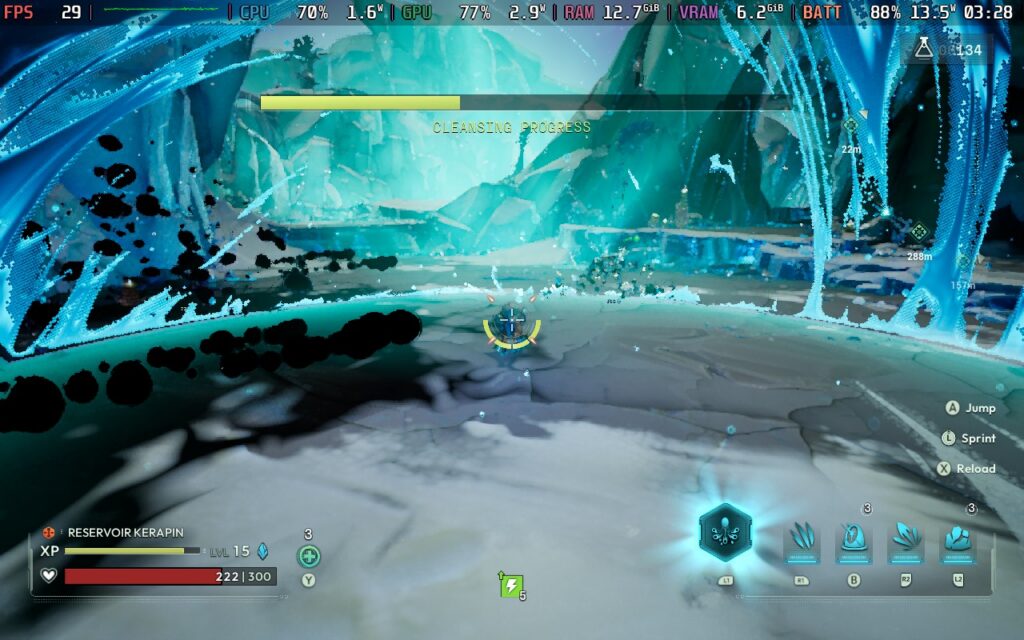
I decided to bring down the 3D resolution a bit to help with stability, since the default High preset will drop below 30 FPS in some of these heavy combat areas, especially in later missions. In the end, the game looks great and plays wonderfully with the controller, but we can’t push the framerate too much.
Voiding Bound is an interesting and unique take on the creature collector style, and its stylized focus helps it stand out from the pack. The decision to only have 9 creatures that can branch out makes each one feel significantly different from each other. The evolutionary lines and progression systems feel rewarding and distinct, and some of the areas in the hub help streamline and speed up the process to make the grind feel less obnoxious. The missions can feel a little bit repetitive, and it’s easy to focus on one or two creatures instead of all of them, but that doesn’t take away from how rewarding it feels to make them progressively stronger.
I was hoping it would perform better on the Steam Deck, but it’s decently playable as it is. It will require 30 FPS, but because the game is mostly CPU-bound, we can push the visual quality higher. It’s definitely playable and enjoyable, but requires some compromise.
このレビューはPC版に基づいています。
このレビューをお楽しみいただけたなら、SteamDeckHQ の他のコンテンツもぜひご覧ください!あなたのゲーム体験に役立つゲームレビューやニュースを幅広く取り揃えています。ニュース、ヒントやチュートリアル、ゲーム設定やレビューをお探しの方も、最新のトレンドを知りたい方も、ぜひご利用ください。
Following on from the great LEGO Star Wars: The Skywalker Saga, I had high hopes for LEGO Batman: Legacy of the Dark Knight, and it didn't disappoint. I had a checklist in my mind of things I wanted to see in the new LEGO Batman game, and it checked nearly all of them.
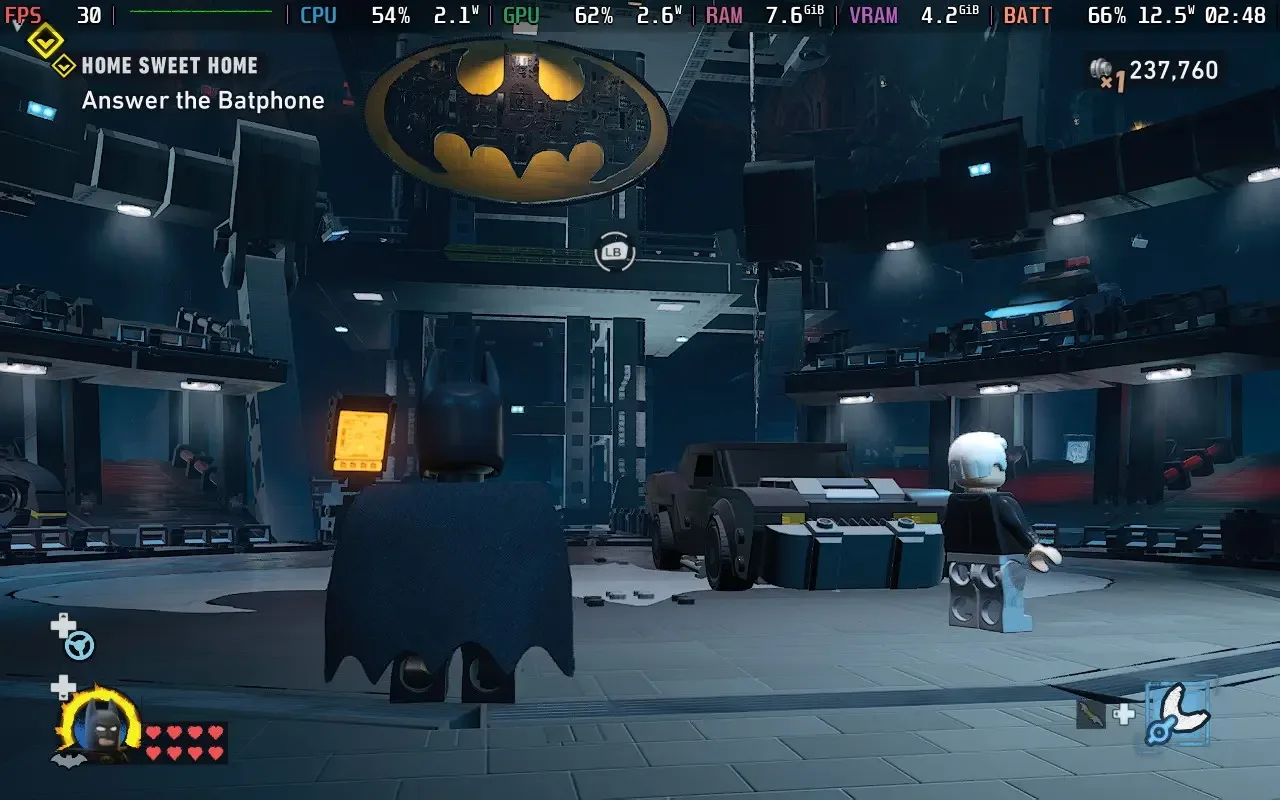
It's always interesting to see how the LEGO games handle the story of the franchise they're taking on. Legacy of the Dark Knight takes some artistic liberties with the retelling of the Dark Knight trilogy. Although the basic plot is largely followed, there are definitely some extras thrown in to pad out the playing time, some lines are kept from the movies, but said by different characters, etc., along with trademark goofs, gags, and references that we've come to expect from LEGO games, and for the most part, they hit the mark to provide a humorous time while still telling the original story.
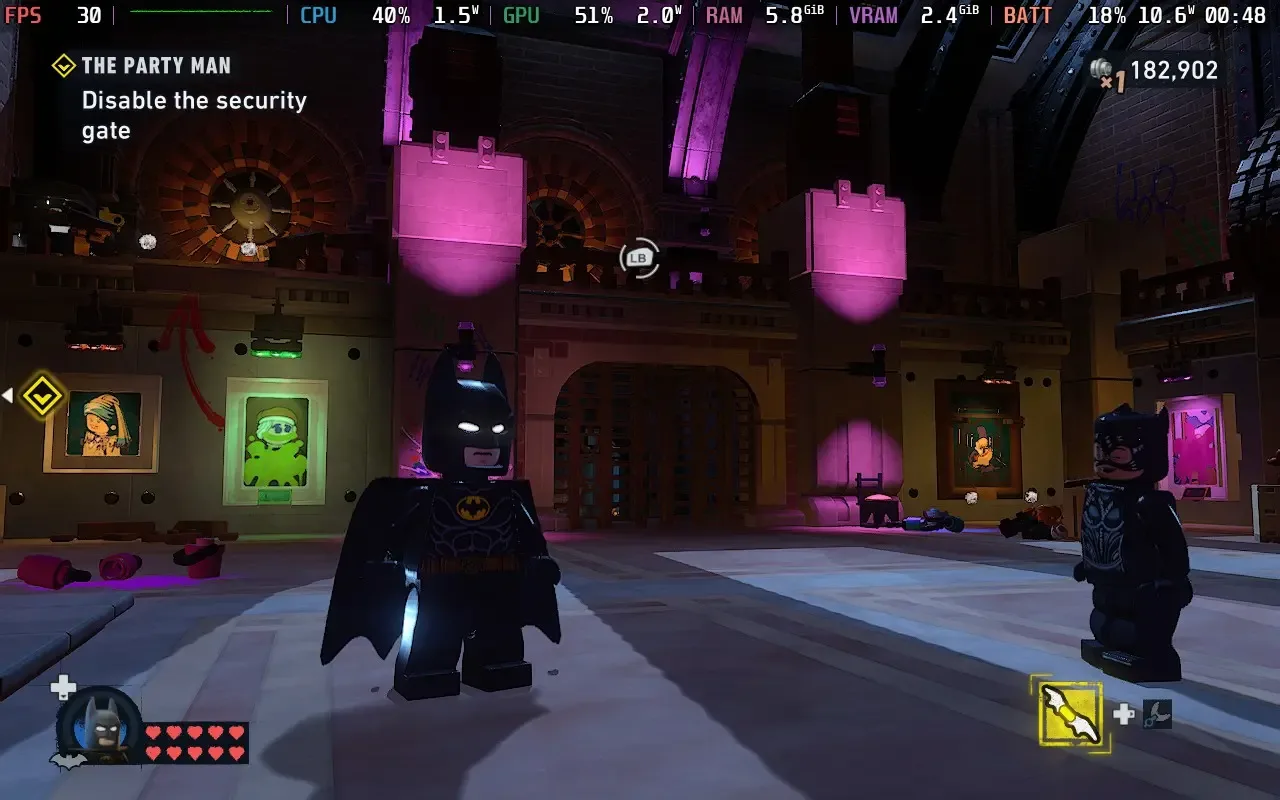
The limited number of characters available in the Dark Knight trilogy helps to make every character feel unique in the game. Unlike LEGO Star Wars, where there are hundreds of characters separated into "classes" that all do similar things, each character in LEGO Batman has its own set of abilities and combat styles, which make them feel different to play. Batman focuses on stealth gameplay, which works surprisingly well; Catwoman can summon cats to explore vents, and Jim Gordon can use his foam gun to interfere with machinery.
The game's combat is rather basic, as you would expect from a LEGO game, but it's still quite engaging. Beyond mashing the X button to punch the heads off of enemies, you'll also need to keep an eye out for button prompts to counterattack enemies as well as dodge incoming unblockable attacks. It feels like they've taken a couple of cues from Soulslikes, just watered them down to make the game much more accessible.
You also have the addition of a stealth system, which allows you to perform quick takedowns of enemies. If done properly, it can make missions much easier, since being detected can trigger additional enemy spawns. I was worried this wouldn't work well in a LEGO game, but they've done a good job of it here, and it does feel satisfying when you take out a group of criminals without being spotted, very in-keeping with the Batman style.
These changes help to make the combat something more than just button-mashing, and the flow of the combat feels great, with the game auto-locking onto enemies and your character smoothly moving across the screen to land the next punch to the nearest enemy. This avoids the disappointment when a punch doesn't land, and eliminates the need for most of your own movement during fights, allowing us to focus on the action.
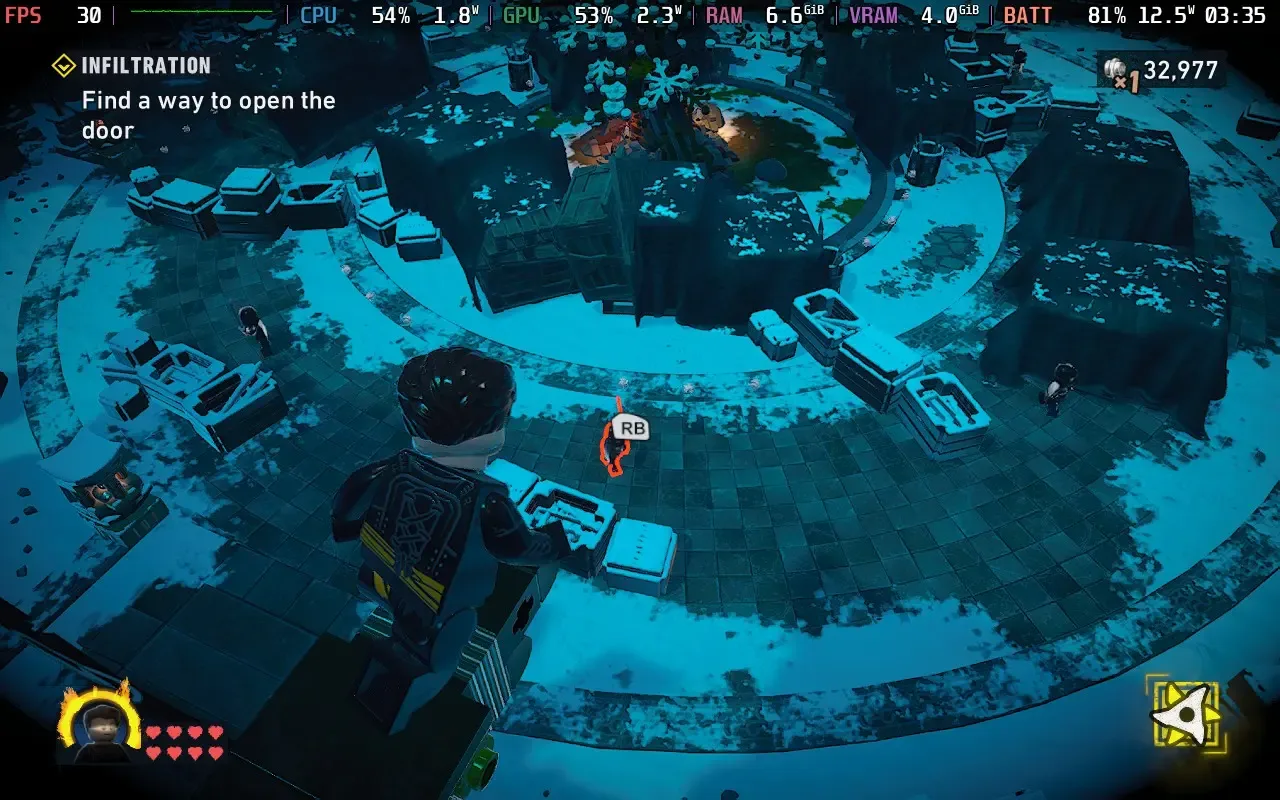
Visually, Legacy of the Dark Knight is quite pleasing. The reflections and rainy streets of Gotham are pulled off surprisingly well for a LEGO title, and the voice acting, while slightly off-kilter compared to the movie's voice actors, captures the general feel of the originals and is decent in its own right.
Being able to explore and drive around Gotham City was a pleasant surprise. I wasn't sure how large the world map would be, given that The Skywalker Saga had many planets with smaller sections, but Gotham City is one sizable map. You'll mostly be gliding or driving around the city to get to your destinations. The driving physics are a little odd, especially certain collision physics that felt very unnatural, but for the most part, it's quite fun to carve a path of destruction on your way to the next mission, or glide along the rooftops to find those sneaky collectibles.
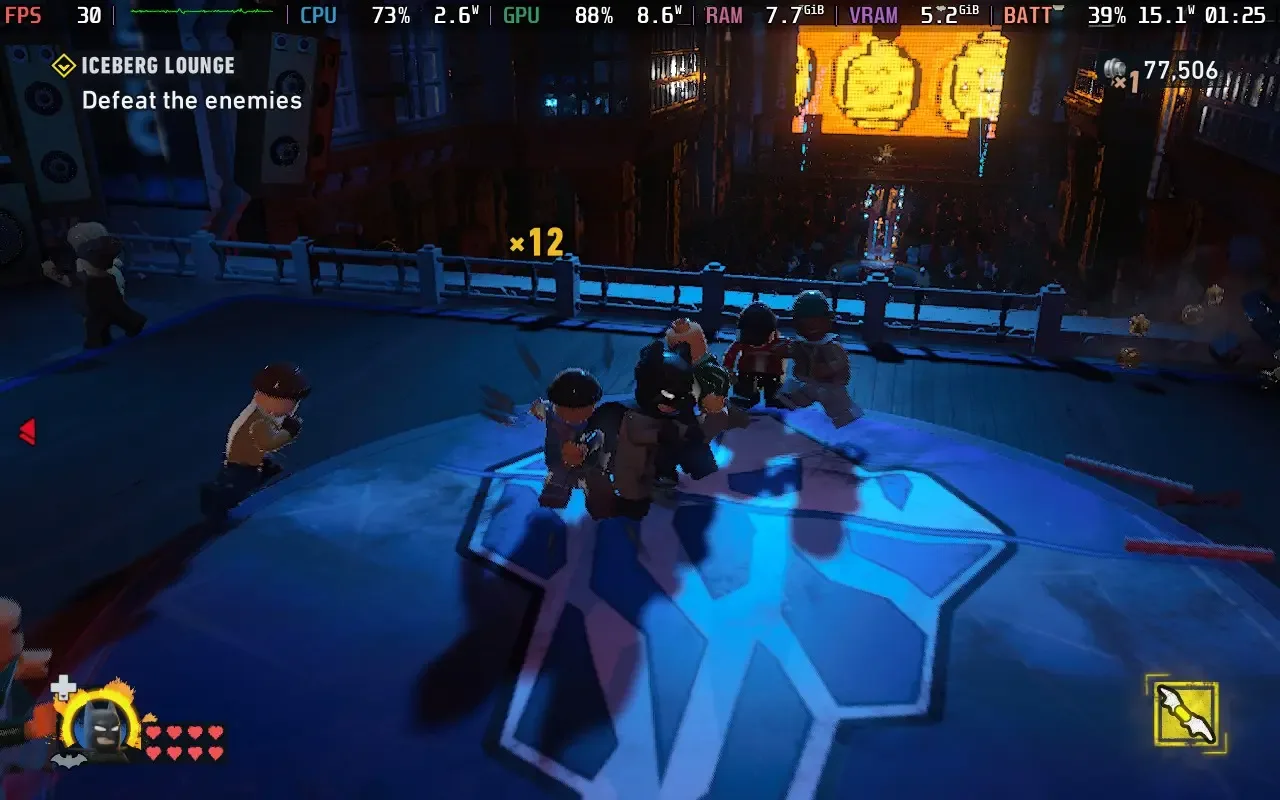
I did try the game briefly in co-op play, which, disappointingly, is still couch co-op only; no online multiplayer here. While it does work well, there are some limitations. The game is permanently split-screen, unlike older shared-screen LEGO titles, which has benefits and drawbacks: it allows for more separation than a shared screen but sacrifices a lot of screen real estate when searching for objects and puzzle solutions.
Vehicles are also oddly limited to only being drivable by the character that owns them, so if you have the Batmobile, for example, only the player playing as Batman can use the vehicle; it seemed like an unnecessary limitation for the game.
I also noticed some issues in this mode. Namely, certain visual elements, such as fog, seemed to display incorrectly on the 2nd player's screen, being too thick or entirely non-existent, and I also encountered an issue where I completely lost control of my character as player 1, requiring a game restart to continue. These issues were not present when playing solo.
LEGO Batman: Legacy of the Dark Knight has great controller support, as you would expect from a LEGO title, and it also supports 16:10 aspect ratios, so we have no black borders around the Steam Deck's display.
Legacy of the Dark Knight defaults to Low settings on the Steam Deck, and we should keep them there, with FSR set to Balanced. I used the SteamOS frame limiter to limit the game to 30 FPS.
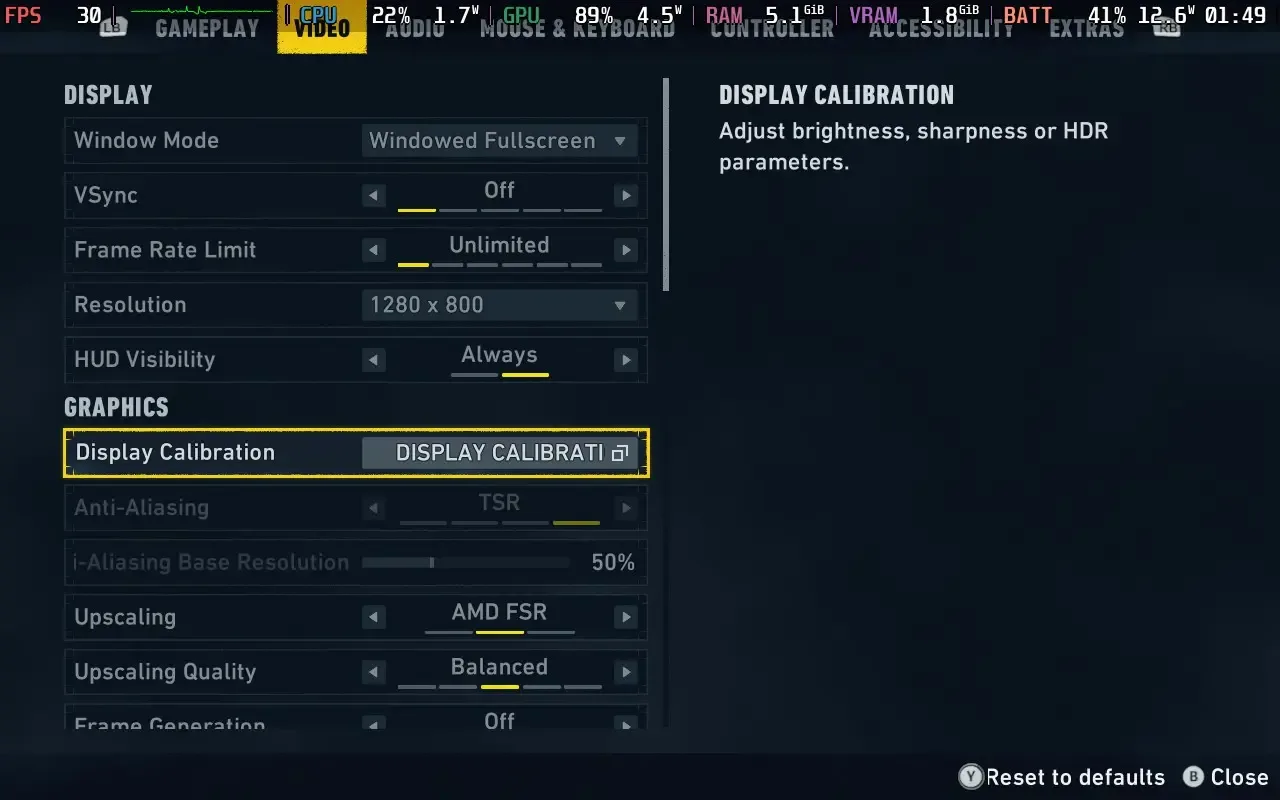
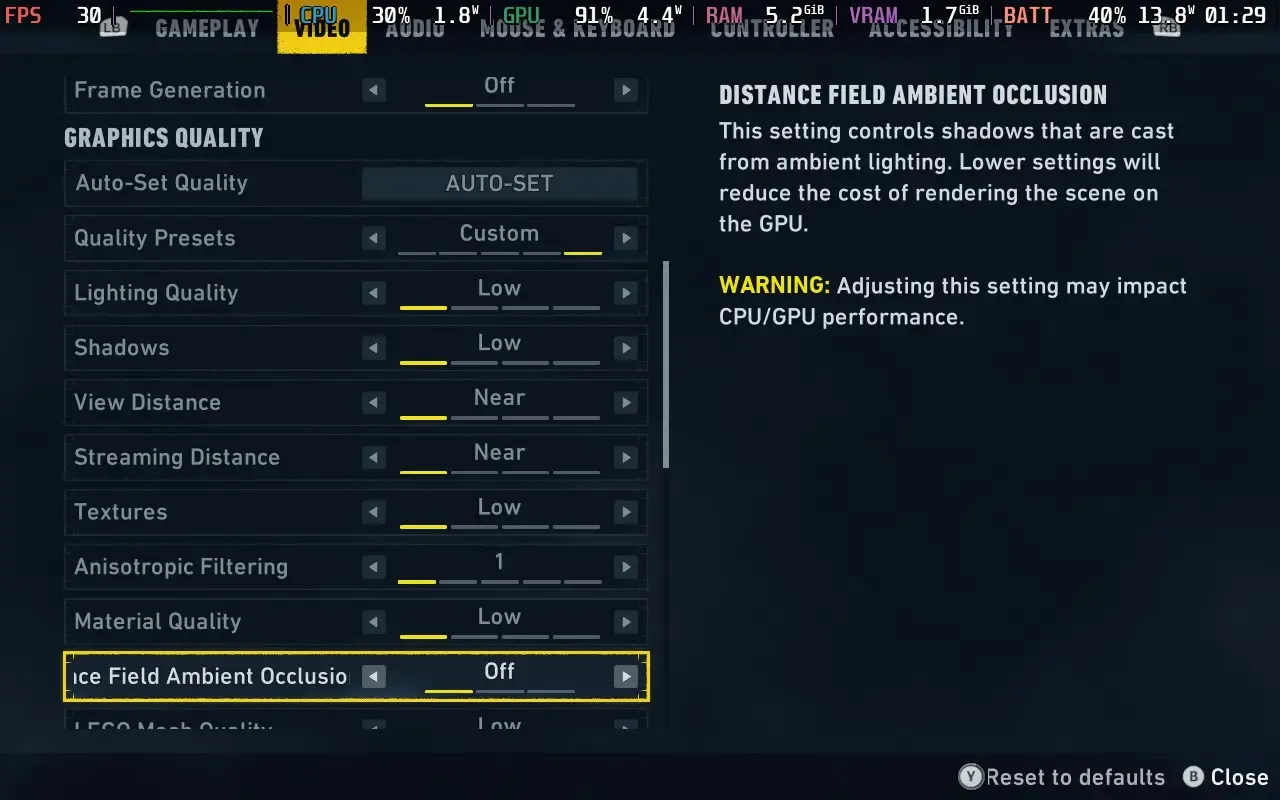
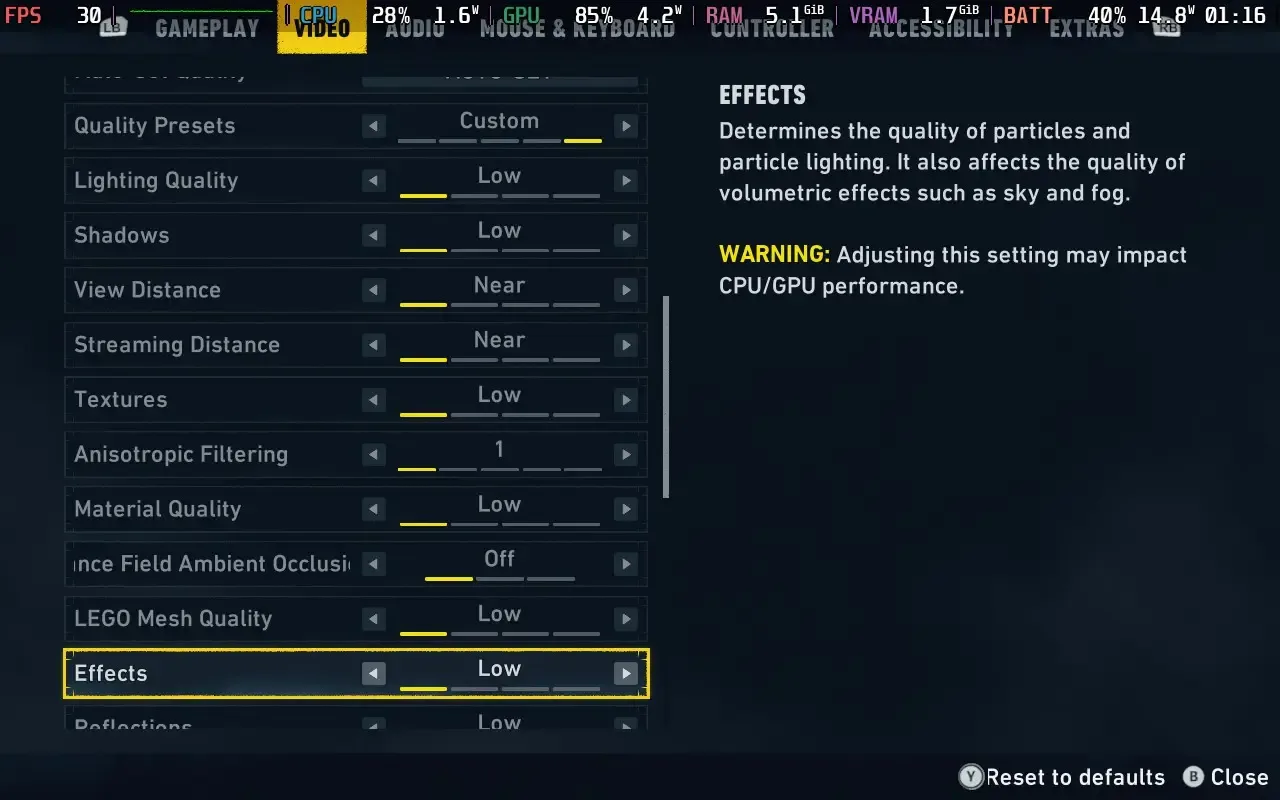
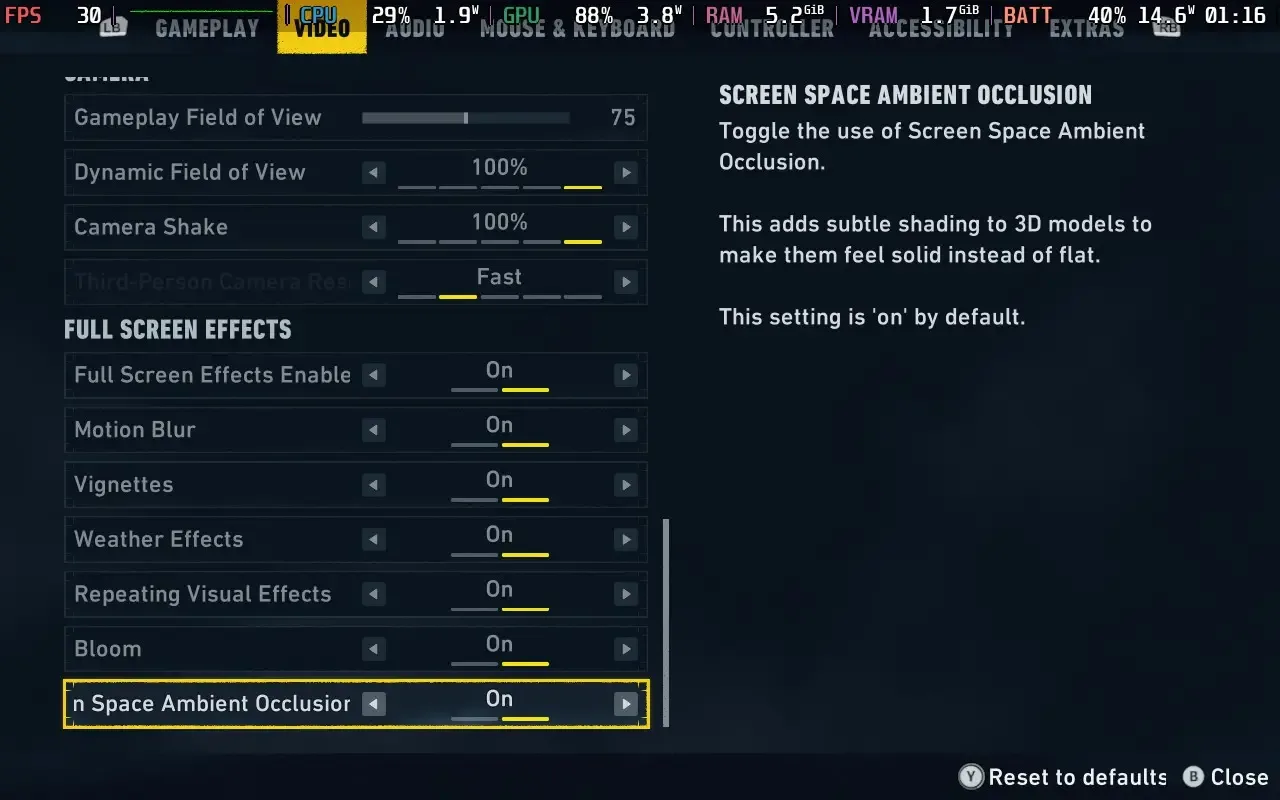
The game largely holds 30 FPS throughout with these settings, even in combat, but do expect the open-world driving portions of the game to dip into the mid-20s. It's still playable, but it may be unpleasant at times.
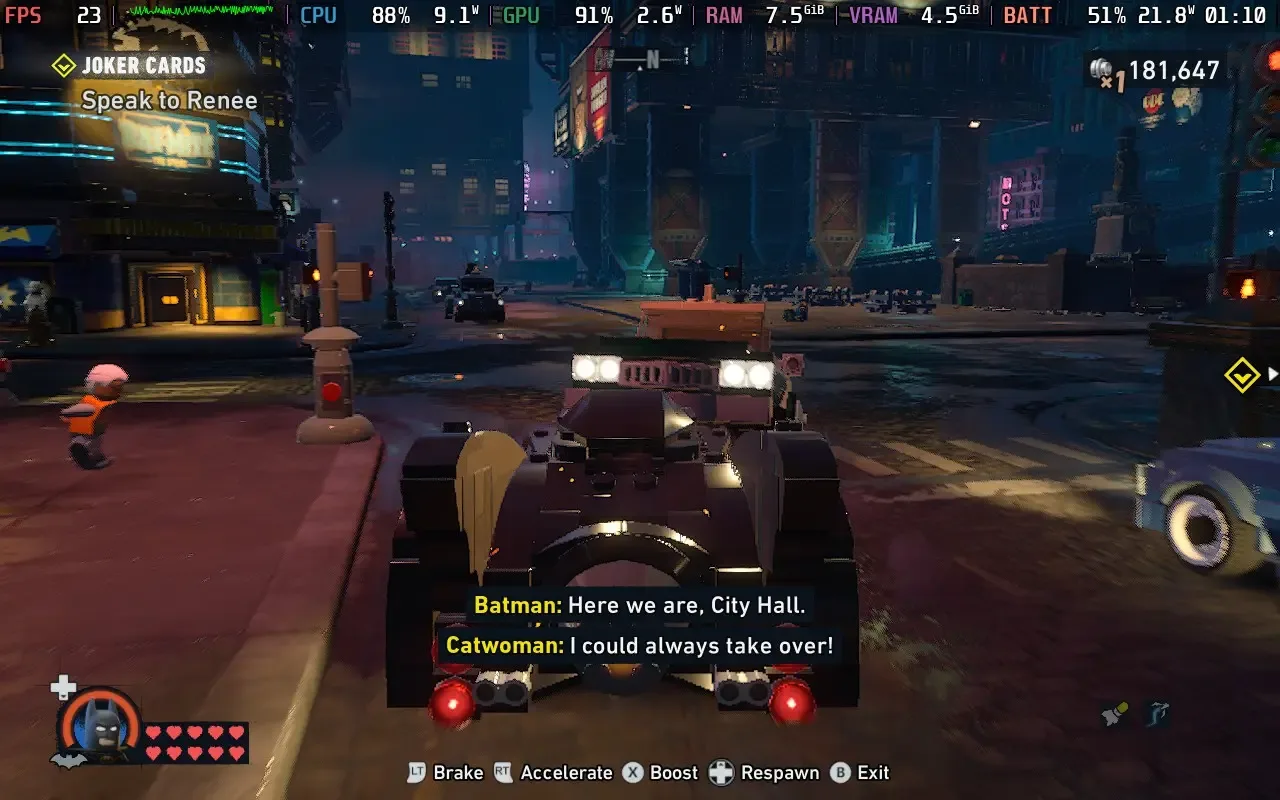
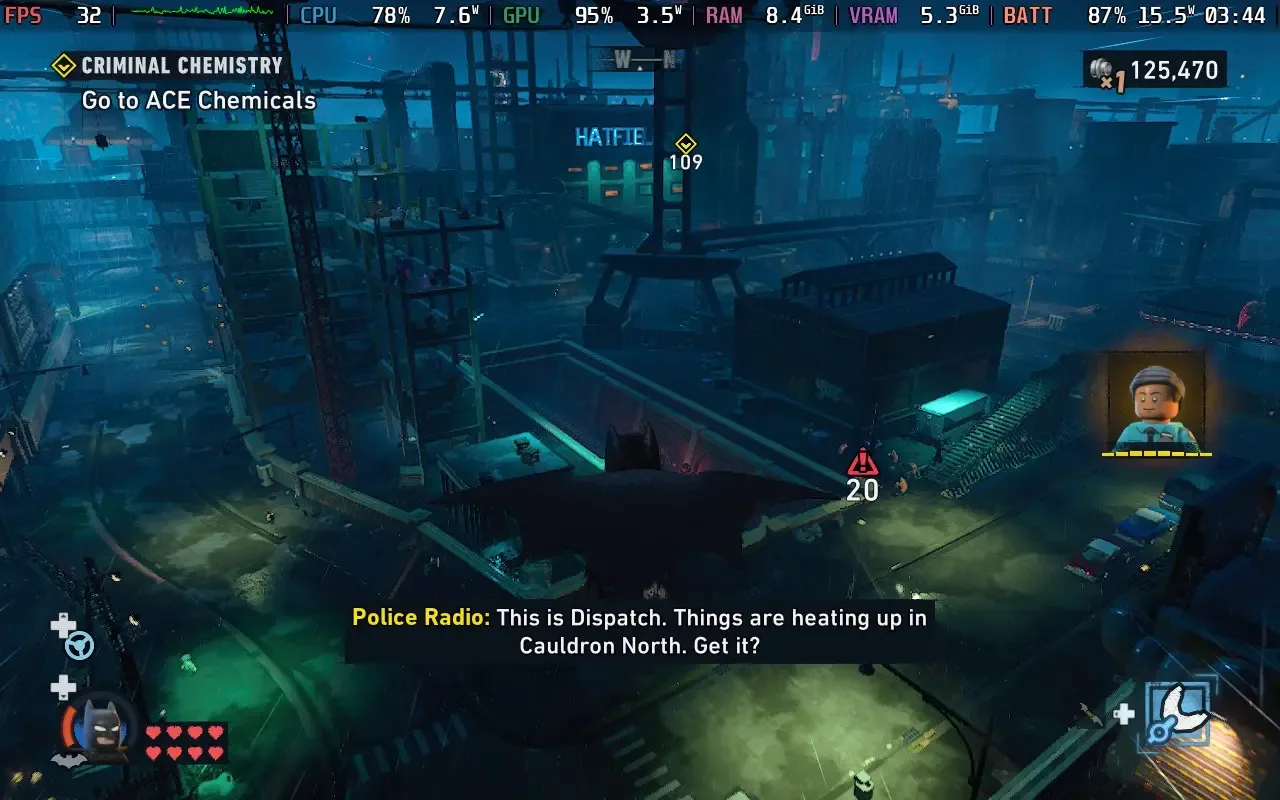
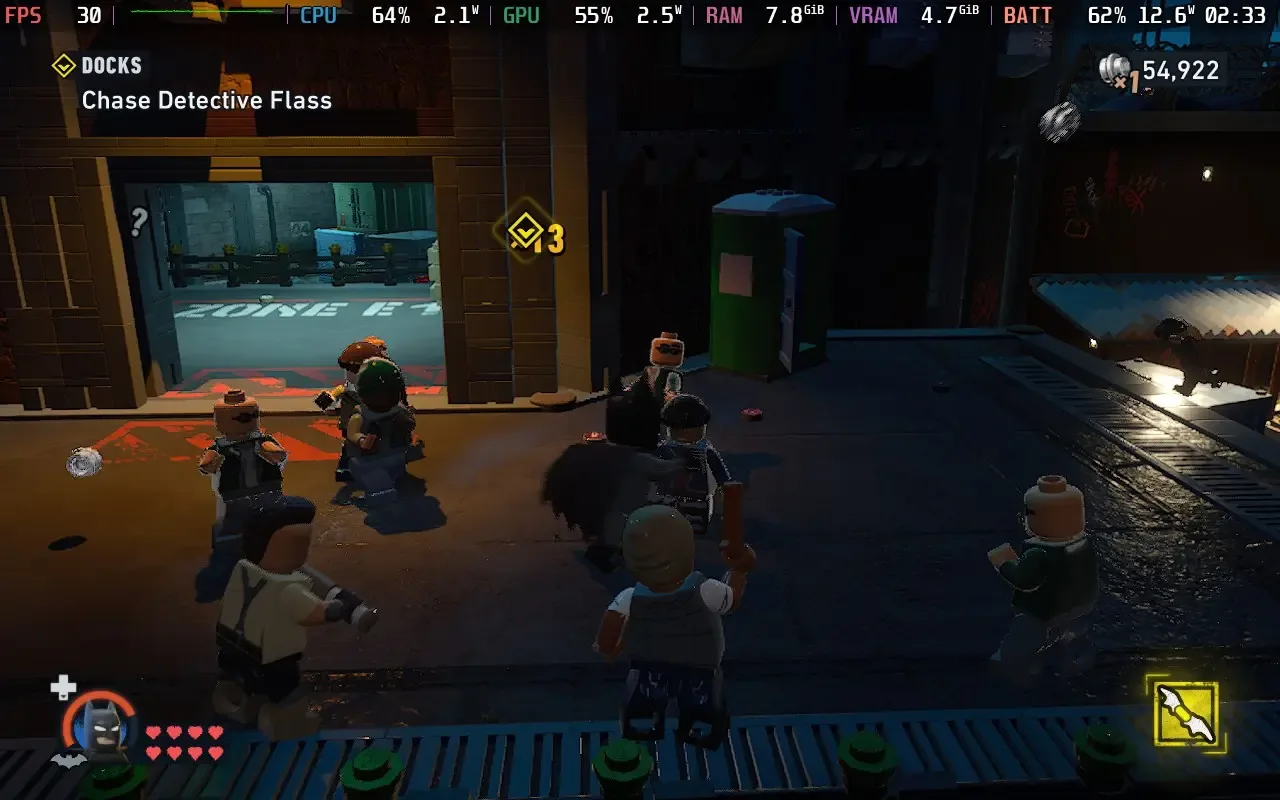
Power draw varies hugely. In indoor areas on foot, expect around 11-15W of drain on the battery; this can leap as high as 18-22W when traversing the city in a vehicle. Expect around 3 hours of battery life from a Steam Deck OLED and around 2 hours from a Steam Deck LCD.
LEGO Batman: Legacy of the Dark Knight allows you to remap controls, adjust the size of text and subtitle text, add closed captions, and lock-on assist.
It also offers options to help with difficulty, such as slowing the game to 50%, not losing studs (currency) on death, and skipping some puzzles and combat.
LEGO Batman: Legacy of the Dark Knight is pretty much what I had hoped for from when I heard the game announced. A humorous retelling of the Dark Knight Trilogy, complete with a sizable recreation of Gotham City filled with collectibles, built-for-fun gameplay, and you can bring a friend along for the ride.
The Steam Deck handles the game quite well for the most part, with an excellent control scheme. Do expect some dips when traversing the city in a vehicle, but by and large, the game remains playable and enjoyable on the handheld.
このレビューはPC版に基づいています。
このレビューをお楽しみいただけたなら、SteamDeckHQ の他のコンテンツもぜひご覧ください!あなたのゲーム体験に役立つゲームレビューやニュースを幅広く取り揃えています。ニュース、ヒントやチュートリアル、ゲーム設定やレビューをお探しの方も、最新のトレンドを知りたい方も、ぜひご利用ください。
007 First Light was provided by IO Interactive for review. Thank you!
When I was a kid, I remember playing the original Max Payne and completely falling in love with it. Years later, in high school, I spent countless hours playing the Uncharted series without ever getting bored, having the time of my life from beginning to end. Unfortunately, linear story-driven action games have become extremely rare these days. Most players now expect massive open worlds, hundreds of hours of side content, and bloated gameplay systems. And while I absolutely love some of those games and often find them more immersive overall, sometimes all you really need is a nonstop cinematic action experience that grabs you instantly and refuses to let go.
It seems IO Interactive felt the same way. Taking a huge risk, the studio behind Hitman secured the legendary James Bond license and attempted to create something truly special. I’ll admit that after watching the trailers and gameplay previews for months, I expected nothing more than a gimmicky mix of Hitman and Uncharted. I thought it would end up being a decent but forgettable action game.
I couldn’t have been more wrong.
007 First Light is an absolute blast from start to finish, hooking the player immediately and never loosening its grip for a single moment.
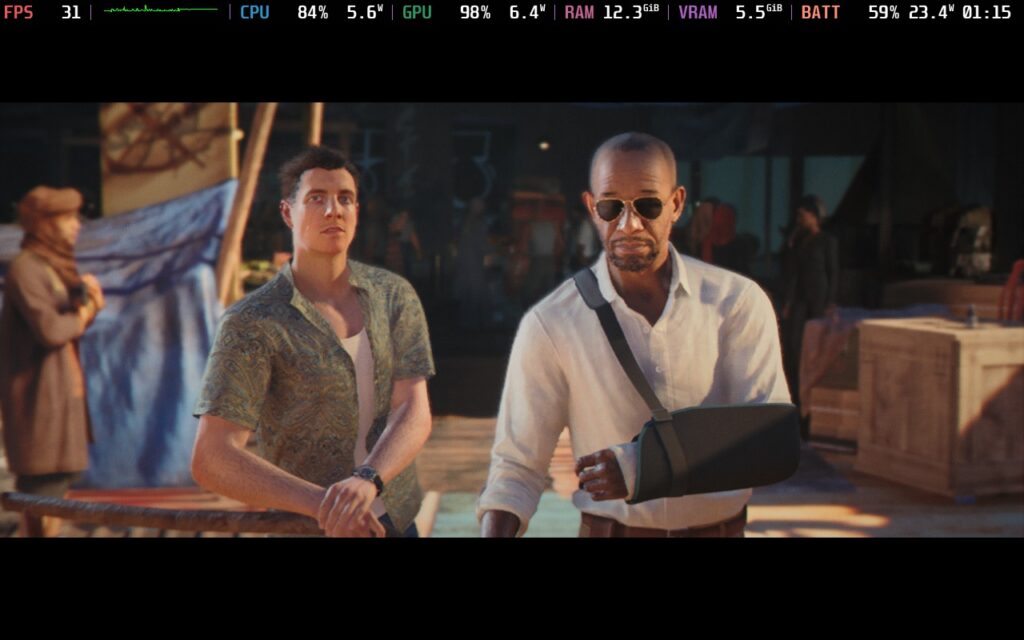
When it comes to James Bond movies, we almost always see the legendary spy at the peak of his career. Experienced, confident, charming, and always in control. The smart one-liners, absurd yet iconic gadgets, and cocky, flirtatious attitude are all there by default. 007 First Light completely changes that formula. Instead of presenting us with the perfected version of Bond, the game focuses on a young and inexperienced version of the character, making the story far more personal and character-driven. We don’t just watch Bond save the world; we grow alongside him.
We open in a military setting where Bond is not yet a spy, but simply an Air Force soldier caught in a disastrous ambush behind enemy lines. As we desperately try to survive and escape, an MI6 agent suddenly reaches our comms and begins guiding us through the chaos. From there, events unfold in a surprisingly compelling way, leading MI6 to consider Bond as a potential candidate for the newly forming 00 program.
What follows is one of the most refreshing parts of the story. Instead of instantly turning Bond into a superhuman agent, the game takes its time. We undergo rigorous training, meet new allies, slowly adapt to this dangerous new world, and begin to appreciate the opportunity and purpose MI6 gives us. It makes Bond feel human, vulnerable, and far easier to empathize with than the untouchable version we are used to seeing on screen.
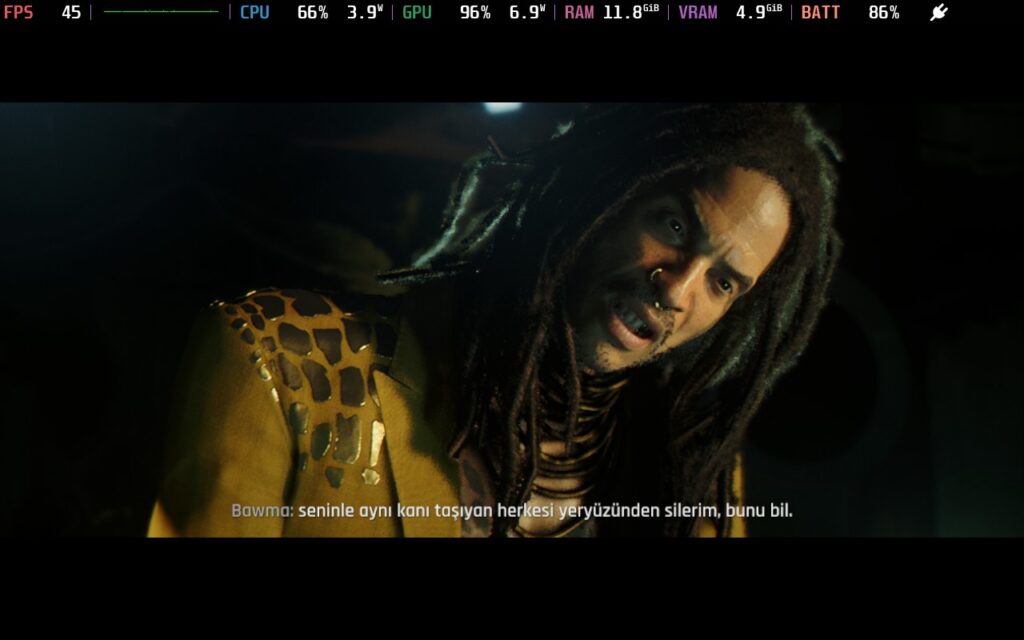
The overall story structure is packed with superb action, mystery, betrayals, humor, and genuine emotional weight. Honestly, I never expected to feel this strongly attached to the narrative of a Bond game. Some players may find the opening hours surprisingly slow, but for me, that slower pacing was where the game excelled. It gives you time to fully immerse yourself in Bond’s world, understand the people around him, and slowly connect with the character on a deeper level. That is easily one of its greatest strengths.
That said, I do think the story starts feeling slightly rushed toward the finale. It almost feels too short by the time everything begins escalating, and I definitely would have loved a few more hours to flesh out certain moments and relationships further.
Another small disappointment was the lack of a truly iconic Bond villain. While the antagonists work well enough for the type of origin story the script is trying to tell, don’t expect a larger-than-life mastermind on the level of classic Bond movies. It feels intentional and understandable, but it still leaves a slight disappointment by the end.
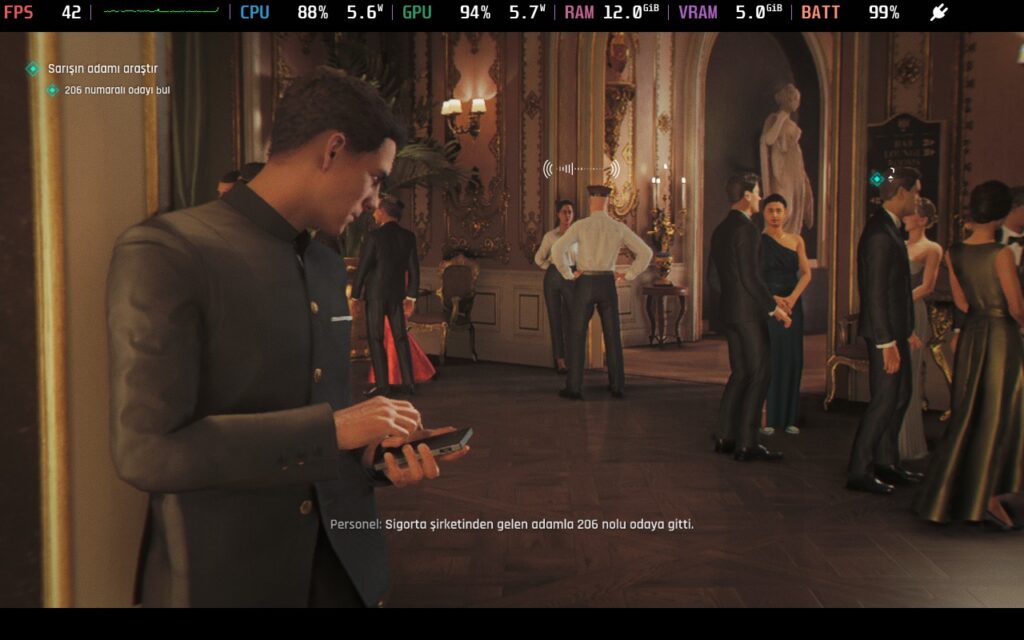
007 First Light has a very unique gameplay identity of its own. In the Hitman games, stealth and methodical exploration are the absolute core of the experience. First Light borrows many of those elements, but never fully commits to becoming a stealth sandbox itself. Instead, it feels like IO Interactive carefully sprinkled the DNA of Hitman in without allowing it to become an actual Hitman game.
During missions, we can take multiple approaches to the same objective. For example, you might infiltrate a VIP area disguised as a waiter, sneak through ventilation systems, use one of your limited gadgets to poison a guard and create an opening, brute force your way inside through combat, or simply bluff and manipulate your way forward with clever dialogue choices.
The rewarding feeling of exploring each mission area and discovering alternative solutions creates a genuine sense of freedom that very few cinematic action games manage to achieve. Even though the experience remains largely story-driven and linear, the missions themselves consistently make the player feel creative and in control.
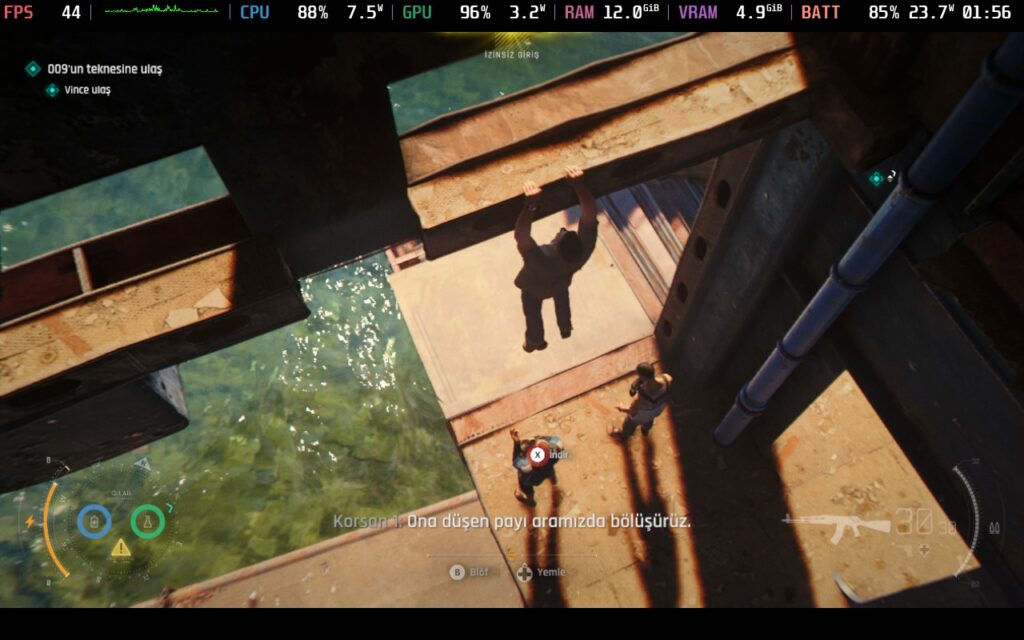
In both combat and optional stealth scenarios, Bond relies on two core resources. Gadget parts and the instinct bar. Gadget parts are used for a wide variety of actions such as stunning enemies, hacking environmental systems, lowering bridges, unlocking shortcuts, disarming opponents, and much more. These tools are incredibly powerful, but also extremely limited, forcing players to think carefully before using them recklessly.
That limitation creates a surprisingly satisfying layer of decision-making throughout the game. Instead of mindlessly relying on gadgets in every encounter, players constantly have to decide whether a situation is truly worth spending resources on. This keeps both combat and stealth scenarios fresh, tense, and far less repetitive than they otherwise would have been.
The instinct bar serves as another brilliant mechanic, essentially acting as a limited get-out-of-jail-free card during stealth sections. It allows Bond to bluff and manipulate suspicious enemies into believing he is not trespassing, while also helping isolate targets from crowded groups by cleverly luring them away. In gunfights, instinct can also slow down time, allowing Bond to land precise shots in classic cinematic fashion.
Together, these mechanics perfectly capture what makes James Bond feel different from a typical action hero. You are not simply overpowering enemies through brute force, but surviving through intelligence, improvisation, and resourcefulness. It genuinely makes you feel like a smart and adaptable spy rather than just another shooter protagonist, and honestly, I found it absolutely incredible.
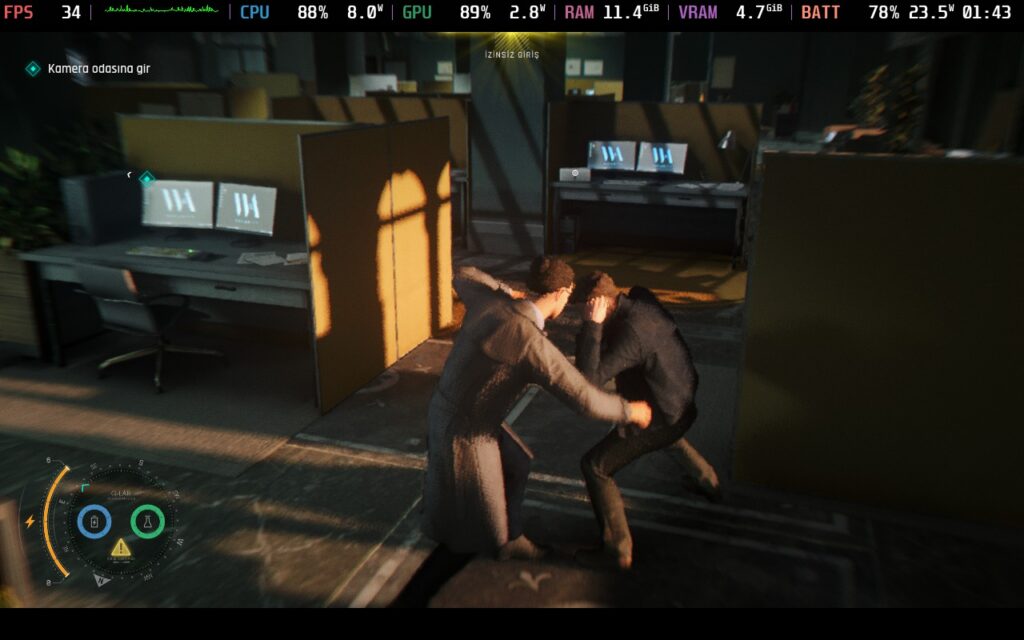
The melee combat in 007 First Light will immediately feel familiar to anyone who has played the Batman Arkham games. Most encounters revolve around parrying, dodging, and counterattacking enemies in rhythmic hand-to-hand fights. To the game’s credit, it introduces a few unique touches, such as throwing objects at enemies, slamming them into breakable machinery or environmental hazards to deal heavy damage, and chaining together flashy cinematic takedowns.
That said, while the melee combat is definitely fun, I also found it to be one of the weaker parts of the overall experience. A lot of these encounters feel more like “last resort” situations after a stealth attempt goes wrong, rather than a fully fledged combat system meant to stand on its own. Because melee is not the primary focus for 007, that becomes somewhat understandable, but even then, many fights ended up feeling a little clunky, overly familiar, and lacking a strong identity of their own.
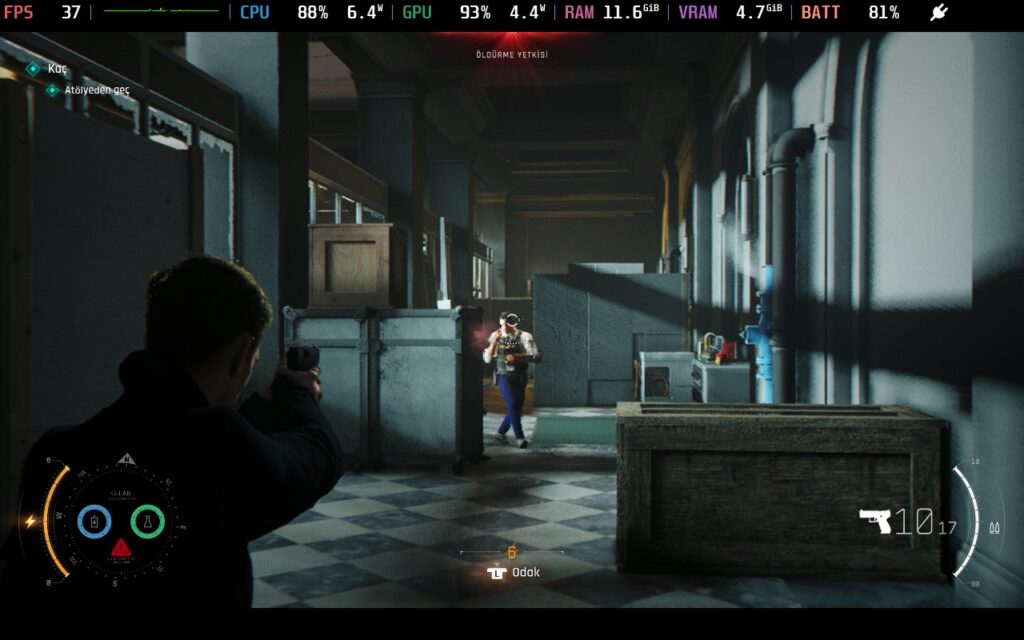
Gunfights, however, are a completely different story.
The shooting mechanics are incredible. As I mentioned earlier, carefully managing your gadgets already adds a huge amount of tension and strategy to every firefight, but the game goes even further by constantly forcing players out of their comfort zone. You cannot simply sit behind cover forever and slowly clear rooms, because nearly every piece of cover in the environment is destructible, and enemies throw grenades at you as if there is no tomorrow. On top of that, ammunition is fairly limited, so you always need to stay mobile, aware of your surroundings, and ready to improvise.
One small example can perfectly summarize why the gunplay feels so satisfying. When you run out of ammo, you can throw your empty weapon directly at an enemy to stun them, rush forward during the chaos, perform a melee finisher, grab their weapon, and quickly reposition into another piece of cover before continuing the fight. Moments like these make the combat feel dynamic, cinematic, and constantly engaging.
These little details add an enormous amount of immersion to the gunfights and prevent them from ever becoming repetitive. Honestly, this is some of the most enjoyable and creative third-person shooter gameplay I’ve experienced in a very long time.
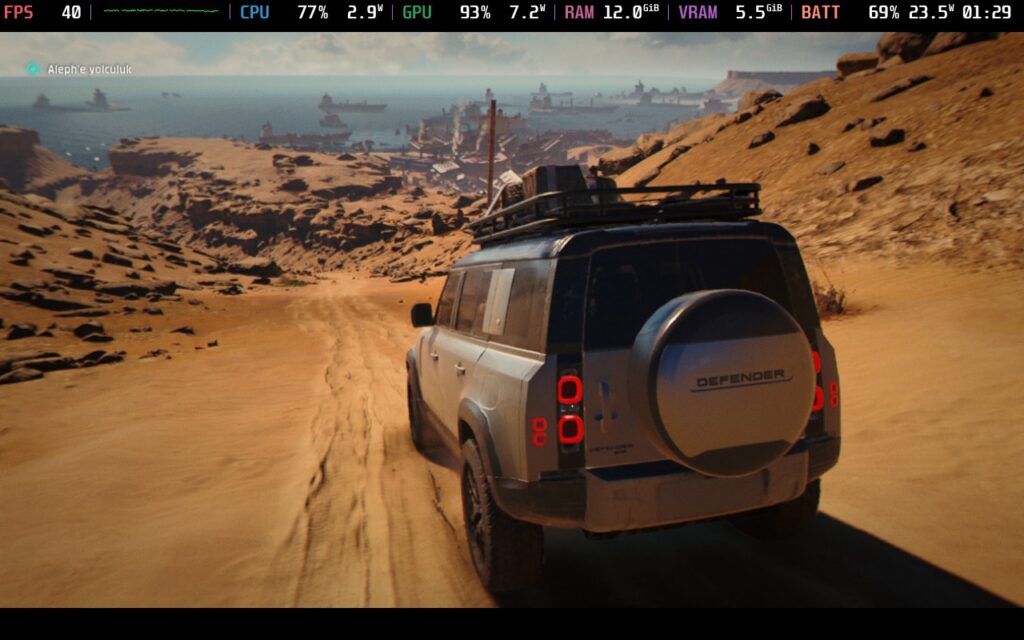
Visually, from a purely technical standpoint, I found 007 First Light to be solid and perfectly acceptable for 2026 standards, but not necessarily groundbreaking. The image quality and lighting effects are undeniably impressive, yet they are the kind of visuals we have already seen executed even better in some other modern AAA titles. Where the game truly stands out is not raw graphical technology, but its artistic direction and overall presentation.
The mission environments are incredibly detailed and atmospheric, constantly feeling alive and believable. Large locations are filled with hundreds of NPCs who all look surprisingly distinct, move naturally, and interact with the world in ways that rarely feel robotic or repetitive. Combined with the clever use of cinematic camera work, seamless transitions, and subtle visual effects, the overall presentation creates an impressive level of immersion throughout the experience.
I did notice a few weaker areas visually. Facial animations can occasionally feel stiff in certain conversations, and the quality of hair rendering is not always on par with the rest of the presentation. Still, outside of those minor shortcomings, it remains consistently gorgeous and visually immersive from start to finish.
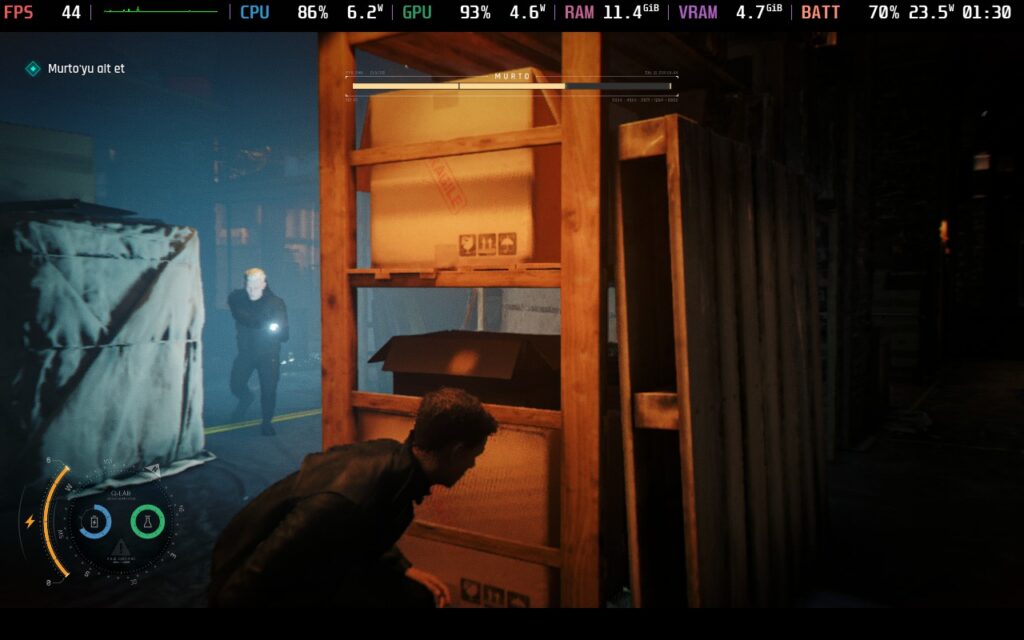
Since the 1960s, music has always been one of the defining aspects of James Bond. From the iconic main themes to the unforgettable movie opening sequences, the franchise’s soundtracks have consistently played a huge role in shaping its identity and atmosphere. Thankfully, 007 First Light understands that formula perfectly and delivers one of the strongest audio presentations I have experienced in a Bond media project.
The opening sequence alone is an absolute work of art. Featuring a stunning performance by Lana Del Rey, the intro instantly captures that classic Bond feeling while still sounding fresh and modern. Honestly, I would go so far as to say it is one of the most memorable and impressive musical pieces ever created for Bond media.
The rest of the soundtrack also does an excellent job balancing traditional Bond-style themes with fantastic new arrangements. Throughout the entire game, the music constantly reinforces the feeling that you are playing a true James Bond experience. Even during quieter moments, the soundtrack subtly elevates the atmosphere and adds a massive amount of immersion to every scene.
The audio design shines outside of the music as well. Strong performances from the cast bring a wealth of personality and emotion to the story, while the sound effects deliver an impactful punch to both gunfights and melee combat. Weapons sound loud and realistic, punches feel heavy, and environmental destruction carries satisfying weight.
Combined together, the soundtrack, voice acting, and sound design create an absolutely phenomenal audio experience. In many ways, the game feels like a love letter to everything that has made James Bond sound iconic for decades.
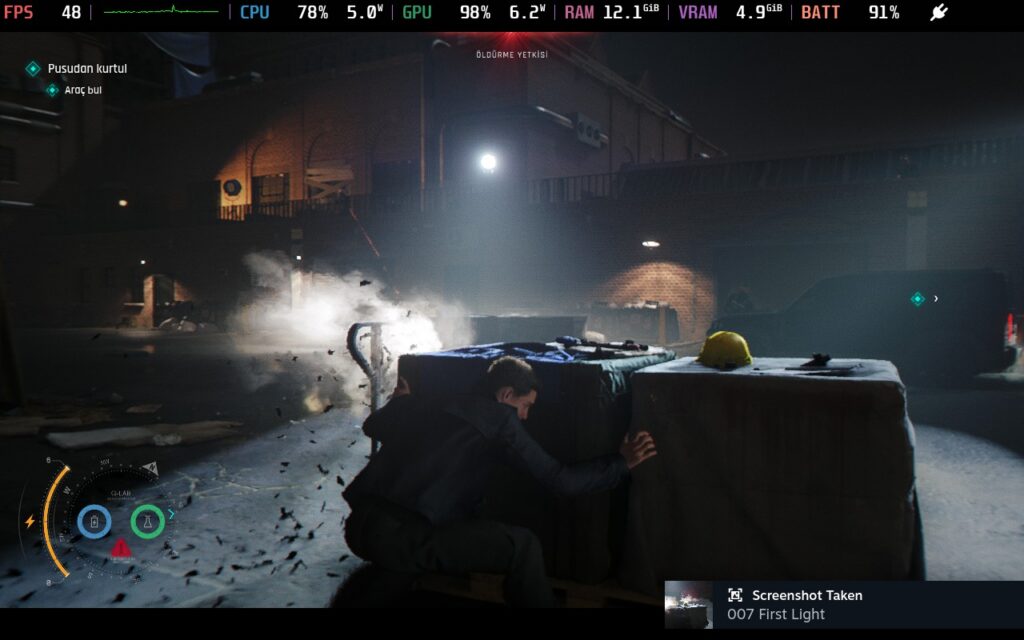
When a new AAA title launches in 2026, we Steam Deck users usually start praying for a semi-decent experience. But every now and then, developers optimize their games so well that we end up asking ourselves, “How does this run so great?” Thankfully, IO Interactive has done a surprisingly solid job optimizing 007 First Light for the handheld, even if the experience is not without some frustrating technical flaws.
When we first booted 007 up, every single setting was pushed to the absolute lowest possible values, with FSR also set to Performance mode by default. Naturally, that made us very nervous at first. But once gameplay actually started, the game immediately surprised me with frame rates hovering between 50-70 FPS in lighter areas, and most of our concerns quickly faded away.
However, after spending much more time with the full game, it became clear that the overall stability is far less consistent than those first impressions suggested. Performance varies wildly depending on the area. Some missions and indoor sections can run incredibly smoothly at near-60 FPS, while heavier environments can suddenly drop into the mid 30s. The Africa region, in particular, is a performance nightmare on Steam Deck, with heavy NPC density and large open environments causing major frame-rate instability, dropping to 22-24 FPS.
Outside those demanding sections, though, the game generally hovers around 40-50 FPS, which is still fairly impressive given the visual complexity and scale.
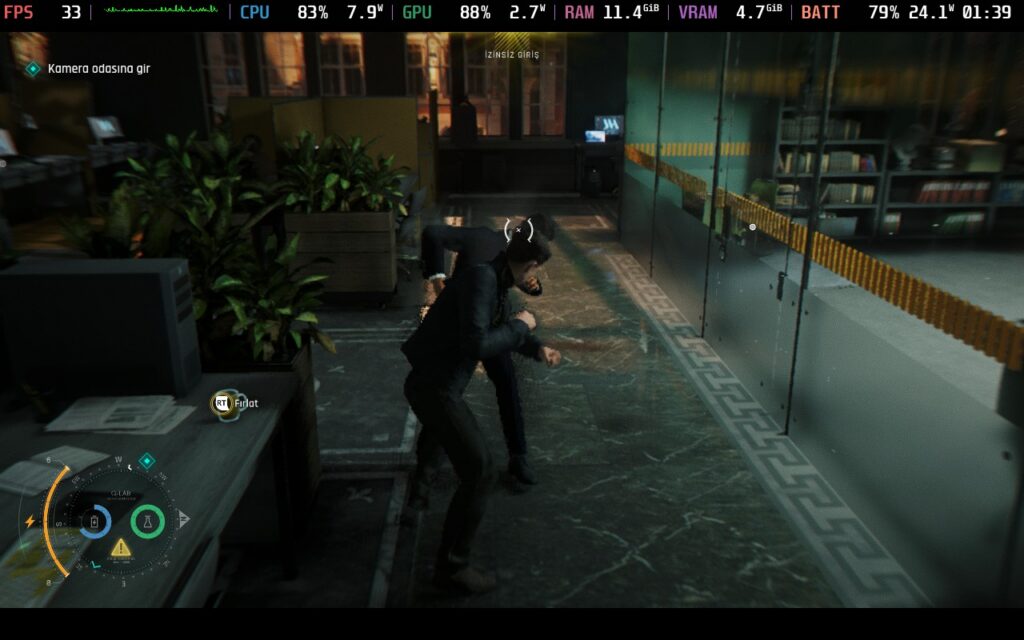
Unfortunately, one of the biggest technical problems comes from the in-game framerate cap system, which doesn't function properly. Even when selecting the 30 FPS option through the v-sync settings, the game often ignores the cap entirely and fluctuates into the low-to-mid 40s on its own. Because of this, achieving a truly stable locked frame rate through the in-game options becomes nearly impossible.
I also experimented with raising several settings, including switching the upscaler to Quality mode and increasing most options to Medium while keeping textures on High. Performance then dropped into the 32-40 FPS range. Still, despite the performance hit, the experience remained visually impressive for a handheld experience and never turned into a completely blurry mess outside of a few demanding effects.
Shadow quality and hair rendering are especially performance-heavy settings and can drastically impact frame rate, but aside from those, the visual presentation is surprisingly good on the Steam Deck.
Interestingly enough, I ended up finding a strange workaround that provided the smoothest overall experience. Instead of using the Steam Deck’s built-in FPS limiter, disabling frame limiting entirely while only setting the display refresh rate to 45Hz somehow resulted in noticeably more stable frame pacing and smoother gameplay. I honestly cannot fully explain why it works better this way, but compared to using either the in-game cap or the Steam Deck limiter, the experience felt significantly cleaner and more responsive.
At the end of the day, while 007 First Light is definitely not a perfectly stable Steam Deck experience, it is still surprisingly playable and visually impressive for such a demanding modern AAA title. With some tweaking and realistic expectations, it can absolutely provide an enjoyable handheld Bond experience. For right now, focusing on mostly medium settings with Volumetric Fog on Low and FSR on Balanced is going to be the best way to enjoy the game.
At the end of the day, 007 First Light is easily one of the best Bond experiences I’ve had in years. IO Interactive perfectly understood what makes James Bond special and combined cinematic storytelling, clever mission design, fantastic gunfights, strong music, and immersive spy mechanics into something that truly feels worthy of the legendary IP.
Despite taking clear inspiration from games like Max Payne, Hitman, and Uncharted, the game still manages to build its own identity instead of feeling like a cheap imitation. Sure, it has some flaws. The melee combat can feel a little clunky, and the ending feels somewhat rushed, but none of those issues stopped me from having an absolute blast from start to finish.
As for Steam Deck, while performance stability can sometimes be rough and certain areas push the hardware very hard, 007 is still surprisingly playable and visually impressive for such a demanding AAA title. With some tweaking and realistic expectations, it delivers a genuinely enjoyable handheld Bond experience that feels great to play on the go.
このレビューはPC版に基づいています。
このレビューをお楽しみいただけたなら、SteamDeckHQ の他のコンテンツもぜひご覧ください!あなたのゲーム体験に役立つゲームレビューやニュースを幅広く取り揃えています。ニュース、ヒントやチュートリアル、ゲーム設定やレビューをお探しの方も、最新のトレンドを知りたい方も、ぜひご利用ください。
Luna Abyss was provided by Kwalee for review. Thank you!
Narrative-focused single-player shooters are some of my favorites. I love the combination of action-packed shooting mixed with an engaging, interesting story. It's even better when the game takes place in a futuristic or sci-fi setting. That's what got me interested in Luna Abyss. The world looked beautiful and haunting, and the combat was filled with action. For the most part, the game holds up to what it was showcasing, especially when it comes to eye candy.
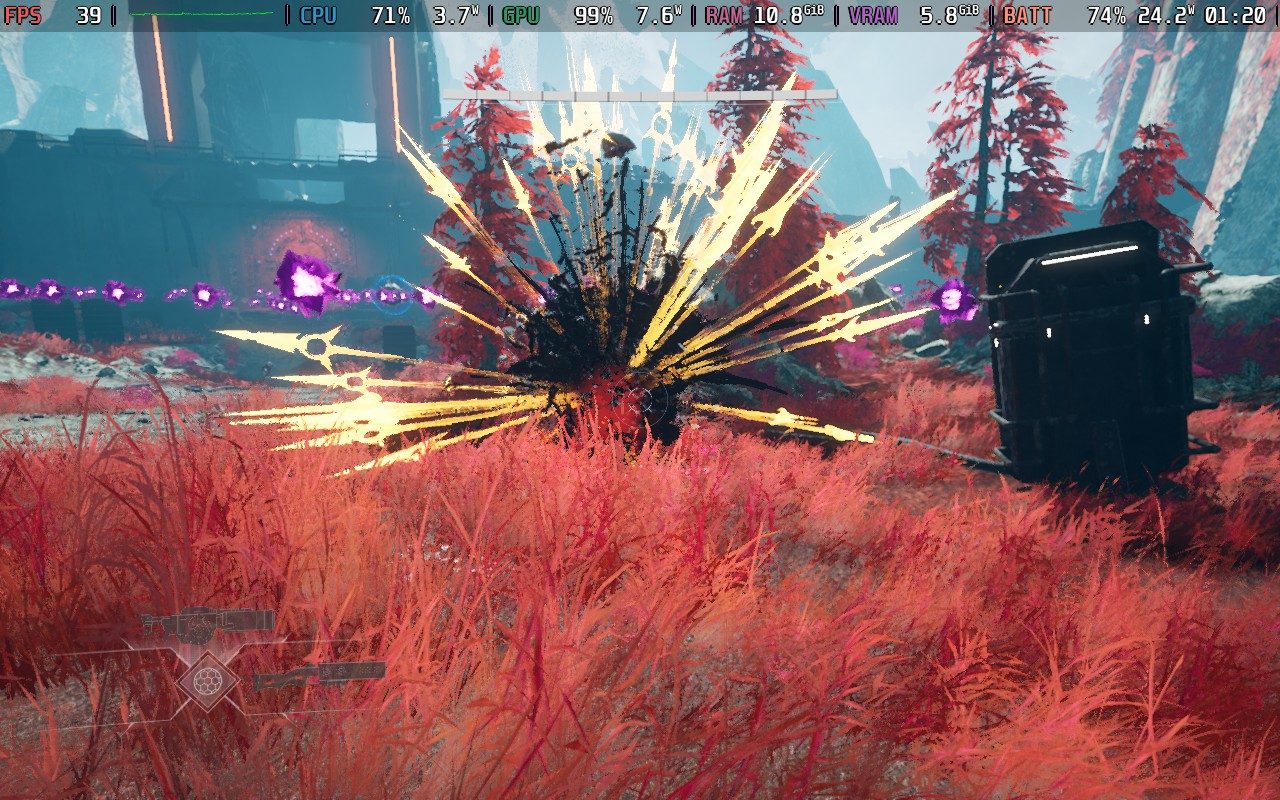
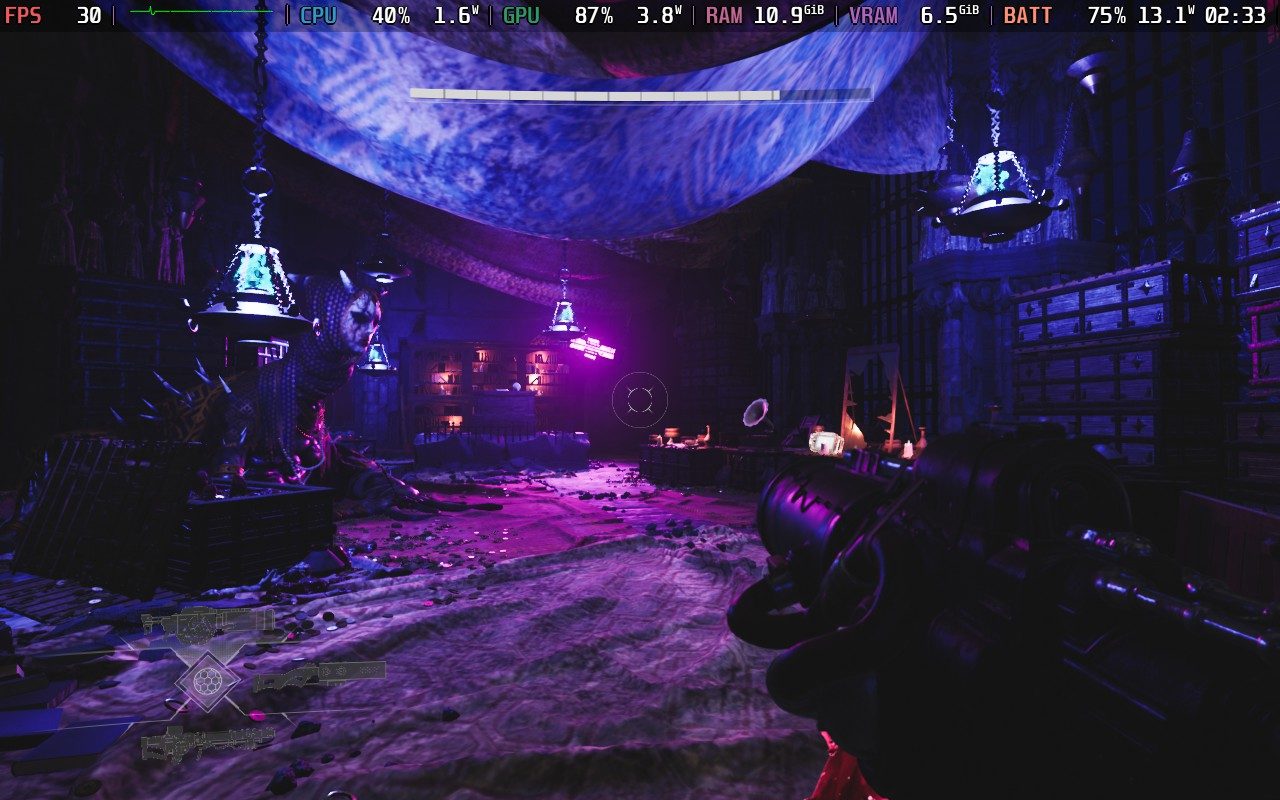
If there’s anything Luna Abyss excels in right off the bat, it’s the visuals. The game is beautiful, with incredible, varied settings doused in colorful lighting that almost perfectly illuminates the world around it. The atmosphere creates a haunting scene, highlighting the gloomy, abandoned mines, reactors, and towns. The use of red, blue, purple, and yellow lights feels like they hit the world just right, making each level look like it's framed in a photo. And while the outside areas don’t benefit as much from the lighting, the use of color in the actual landscape makes up for it.
It all adds to the intriguing world that Luna Abyss takes place in. It’s expertly crafted to highlight the abandoned, apocalyptic nature of the blood moon and its infinite abyss. The atmosphere captures the creepy vibes perfectly with the visuals, and is accompanied by some decent sound effects. It all comes together to create a gorgeously striking visual splendor that is just a treat to see.
Luna Abyss’s story ended up roping me in throughout my time with it. We start out as a prisoner named Fawkes, who is stuck on this moon doing work for the “All-Father” to reduce their sentence. We are managed by Aylin, a floating robot head that gives us orders based on what the All-Father wants. This means we will be descending into the infinite abyss, and in our first run down there, we ultimately awaken the eye and our chosen to fulfill a prophecy. This is what begins our descent into the crazy unknown, where we will have to fight corrupted monsters and complete the missions given to us.
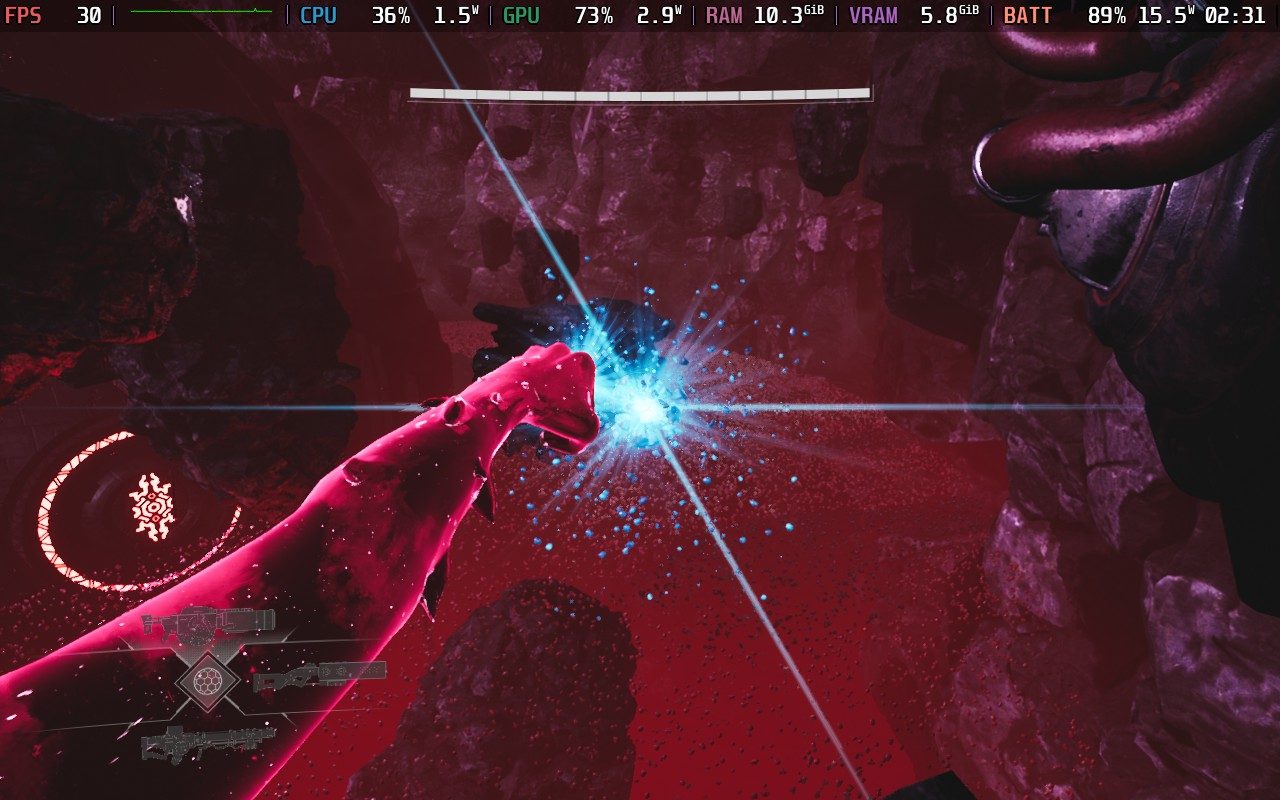
Without spoiling too much, I will say the narrative grew on me, and even surprised me later on. I wasn’t surprised by too many revelations, but it was interesting learning about the All-Father and what truly happened here. What got me the most was the extent of the actions taken in the past that set the events of this game in motion. The voice acting is decent as well, which helps bring it together as we talk with the inhabitants and learn about their stories, while also getting caught up in a gigantic mess that we never made. I was genuinely hooked on the story to the end, and it will be worth sticking through.
As for the general gameplay, there are two parts to it: combat and platforming. I have a love-hate relationship with both of them, making me feel conflicted with the design of each mechanic and the scope of Luna Abyss itself.
The gunplay can be fast-paced and exciting. Just like a lot of bullet hell or boomer shooters, there’s going to be a lot of moving around, and it feels great to do that here. Jumping, dashing, and shooting enemies feels tight and energizing, and it can feel so satisfying to use finisher moves that replenish our health or deal damage to enemies all around them. And I’m really glad that the developers allowed us to autolock onto enemies with the left trigger. This puts a little less stress on actually shooting them and gives us time to focus on dodging the orbs coming at us.
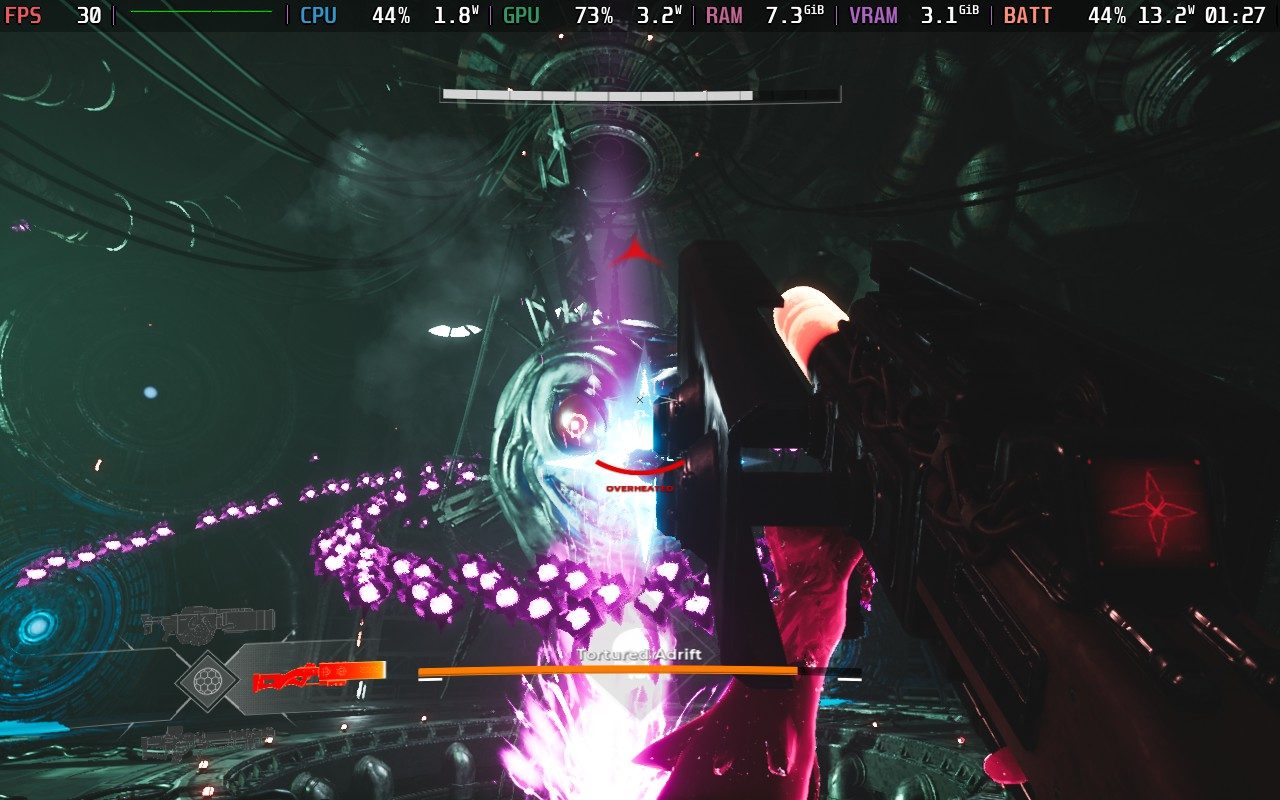
There are some genuinely exhilarating moments, and when it all works, it’s great. With the soundtrack pumping, some of the combat encounters just hit all the right notes. And when that would happen, I genuinely loved it. Providing autolock and making all of the weapons not use any ammo, we need to pick up, keeps us focused on the action, which was a great decision on their part. The autolock is a little clunky, and I noticed the lock could go onto other enemies randomly sometimes, but it is great to have.
However, I was almost always brought back down to reality, which became more and more obvious further in the game. The weapons themselves feel great to use, but they are basic. There are only four weapons that we can use, and there aren’t any other ways to use them. No alternate firing modes or customization, what you see is what you get. This started to feel boring, since the combat encounters weren’t exciting enough to overlook it. And with each weapon only having one upgrade, which didn’t really feel impactful, apart from maybe shortening cooldown times, I just couldn’t enjoy myself fully.
On top of that, some enemies will require specific guns to actually kill them. They will either have blue or purple shields, which require the Shieldbreaker or Monarch’s Lance to dissipate. That brings up the other issue in combat: it’s not great to switch between weapons. There are two ways that we can do it, whether it’s using the Dpad or holding down LB. Using the Dpad is an instant switch, while holding down the LB button will bring up a weapon wheel and slow down time. Using the Dpad in the middle of a fight was uncomfortable when constant movement is needed, and I didn’t like time slowing down since it usually cut off my flow. If you are playing on a Steam Deck or using the Steam Controller, we can essentially fix this by mapping the Dpad to our four back buttons using Steam Input. This was my favorite way to switch between weapons, so I recommended if you’re playing on the Deck or with the Steam Controller. The game really emphasizes switching weapons constantly, and it just doesn’t feel great to do so with the default controls.
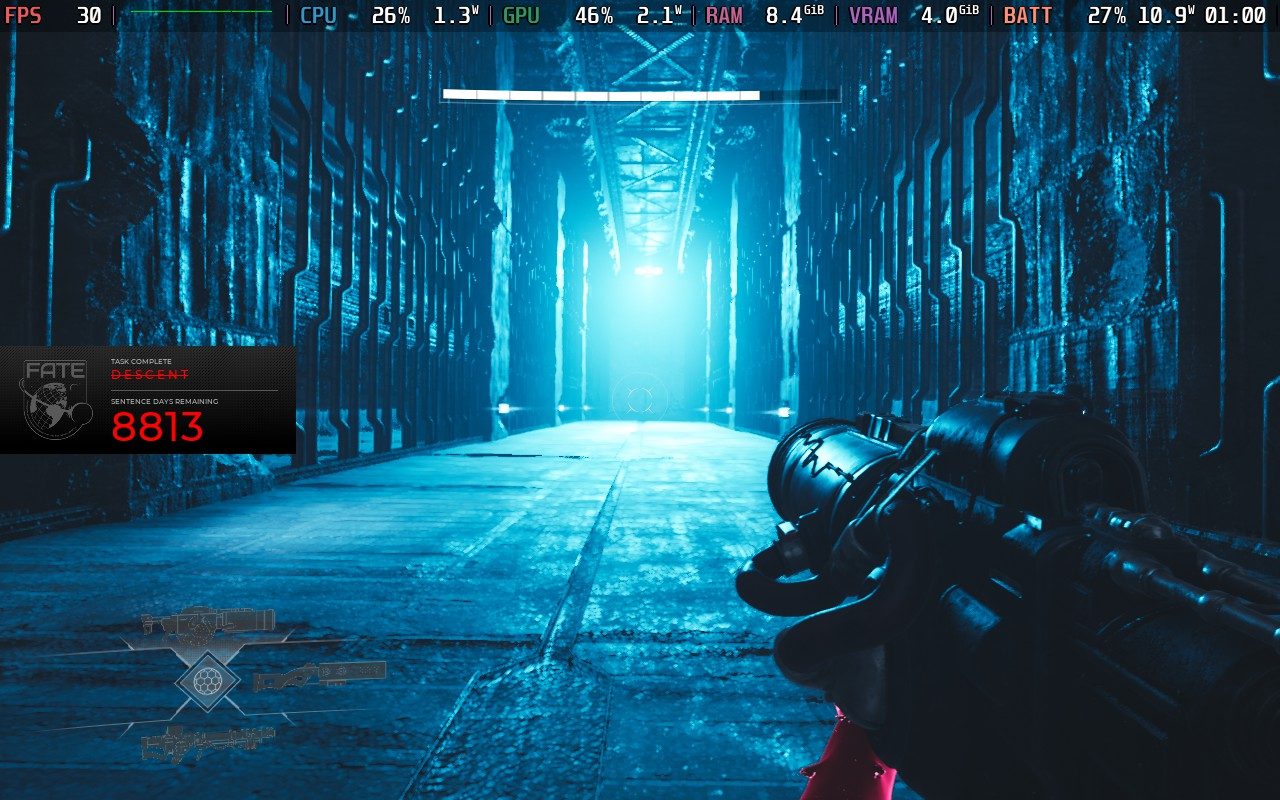
I would also say that the enemies were a little bit on the bullet-spongy side for my taste, but this could also be the fault of the Scout Rifle being a little underpowered. I just didn’t look forward to using it in the slightest, yet it was the main weapon I would switch to after I had gotten rid of the shields on enemies, since the other guns could only shoot 3 to 4 times before going on cooldown. It became a pain to use, especially in boss battles, since it would deal almost no damage.
There is some good to be found in the combat, but it definitely has some major flaws. Thankfully, the platforming is better. Movement in general feels great outside of combat. Jumping to platforms and dashing, while managing to create platforms and tethering ourselves to possess specific robots, was extremely enjoyable. The dashing can feel a little bit loose, but I rarely had any issues when platforming, jumping, and getting from A to B.
A lot of the high points here translated to combat, and moving around, jumping, and strategically putting up a shield to block projectiles felt great. The one big issue that I felt here was dashing. This could be because I have recently just played through another bullet hell game, Saros, but I missed being able to dash through projectiles. While the dash can cover some ground in Luna Abyss, it does not make us immune, so I would regularly still be hit with projectiles. I understand that this is a bullet hell game, but there were a few times where it became a little bit difficult to manage where all of the projectiles were coming from, so having a little bit of immunity during dashing would’ve been nice.
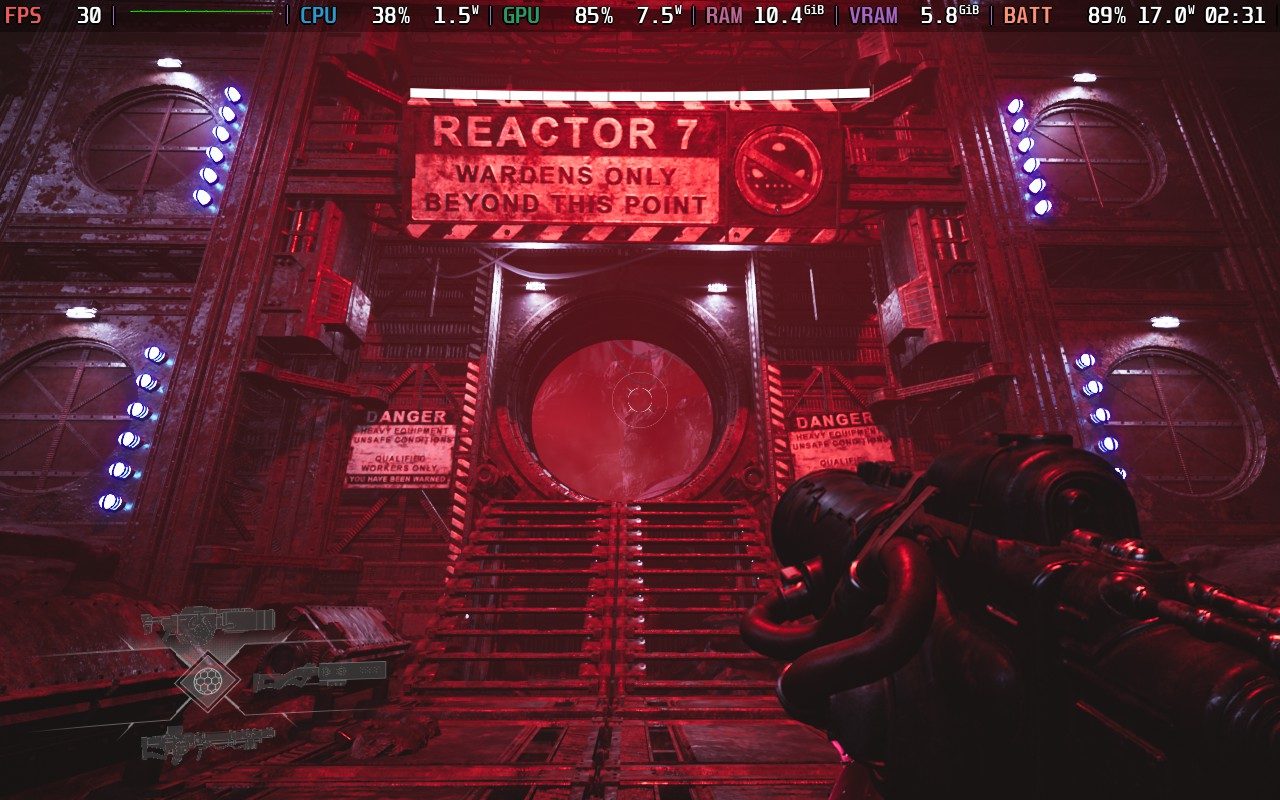
There isn’t much in the way of progression, but there are collectibles to find that pad out the story, crystals we can destroy, and health upgrades. These can all be found within levels, and there’s a nifty level selector that will tell us how many of each of these are in each stage. It will be up to us to actually go out and find them, and they are well hidden throughout the levels, so that is exciting.
Luna Abyss has its graphical settings, locked when you normally play, with only the ability to change resolution. At its default, the game looks great and runs quite well, though it will regularly dip down below 40 FPS in some big fights and open areas. Still, for an out-of-the-box experience, it’s quite impressive that they were able to optimize the game well enough to look this good and still run at a solid framerate.
However, I wanted to find a way to improve the experience, so I did. By using the launch option SteamDeck=0 %command%, we can check the game into thinking that this is not a Steam Deck, which will unlock all the graphical options we can change. The first thing I did was try to find the settings that are being used for the default Steam Deck preset, and it seems like they use medium settings for everything without any upscaling. For what it’s worth, I think the game looks fantastic this way, but there are a few modifications that I would make to enhance the experience a little further.
On the default preset, I noticed that the grass is shimmery, which we can fix by turning the Anti Aliasing quality to High. It isn’t too much of a performance hog, but it does help the world look less pixelated. I would consider this toggle to be a huge help, so I recommend doing this no matter what.
The bigger problem I faced was whether or not to use FSR upscaling. After testing all of the settings individually, I realized two things. First, going from medium to low had almost no change in performance with a worse-looking image, while medium to high had a better-looking image with significant performance drops. The middle ground was leaning towards the medium settings altogether, but FSR changes that. By turning it on High Quality mode, we can play at the high settings without dropping below 30 FPS nearly as much. It sounds like a great trade-off, but FSR upscaling makes the game look blurry. Even on the high-quality setting, the area is very clearly blurry.
So, I recommend playing the game with a few settings on High, but no FSR upscaling and a 30 FPS cap. Even at the lowest possible settings, there are still going to be fights and some areas that drop into the 30 FPS range. The only way out of it is using FSR upscaling, but I could not bring myself to use it because of how blurry it could make this beautiful game. It just wasn’t worth it.
Luna Abyss is a gorgeous and haunting shooter where the story hooked me in. I loved going through the levels and seeing the beautiful lighting and atmosphere, while the narrative hooked me in with some surprising revelations that I had not expected. The combat is a little on the basic side, which becomes more obvious later on, but the platforming is solid and quite enjoyable.
And it’s surprisingly great to play on the Steam Deck. I would consider it surprising since the visuals still look fantastic while holding a stable framerate, and I would say the team did a great job with optimization. I just wish they didn’t lock the quality settings on the Steam Deck by default.
このレビューはPC版に基づいています。
このレビューをお楽しみいただけたなら、SteamDeckHQ の他のコンテンツもぜひご覧ください!あなたのゲーム体験に役立つゲームレビューやニュースを幅広く取り揃えています。ニュース、ヒントやチュートリアル、ゲーム設定やレビューをお探しの方も、最新のトレンドを知りたい方も、ぜひご利用ください。
When Ghost of Tsushima launched in 2020 as a PS4 exclusive, it quickly became one of Sony’s most beloved and successful titles. Players had been craving an open-world samurai experience set in feudal Japan for years, and Sucker Punch delivered exactly that. What’s more interesting is that, compared to other Sony first-party titles, its budget was relatively modest. While it’s still a AAA production, it didn’t rely on massive funding seen in games like The Last of Us: Part II or Horizon: Forbidden West. Instead, Sucker Punch proved that strong artistic direction, a clear vision, and determination can be just as impactful as sheer budget.
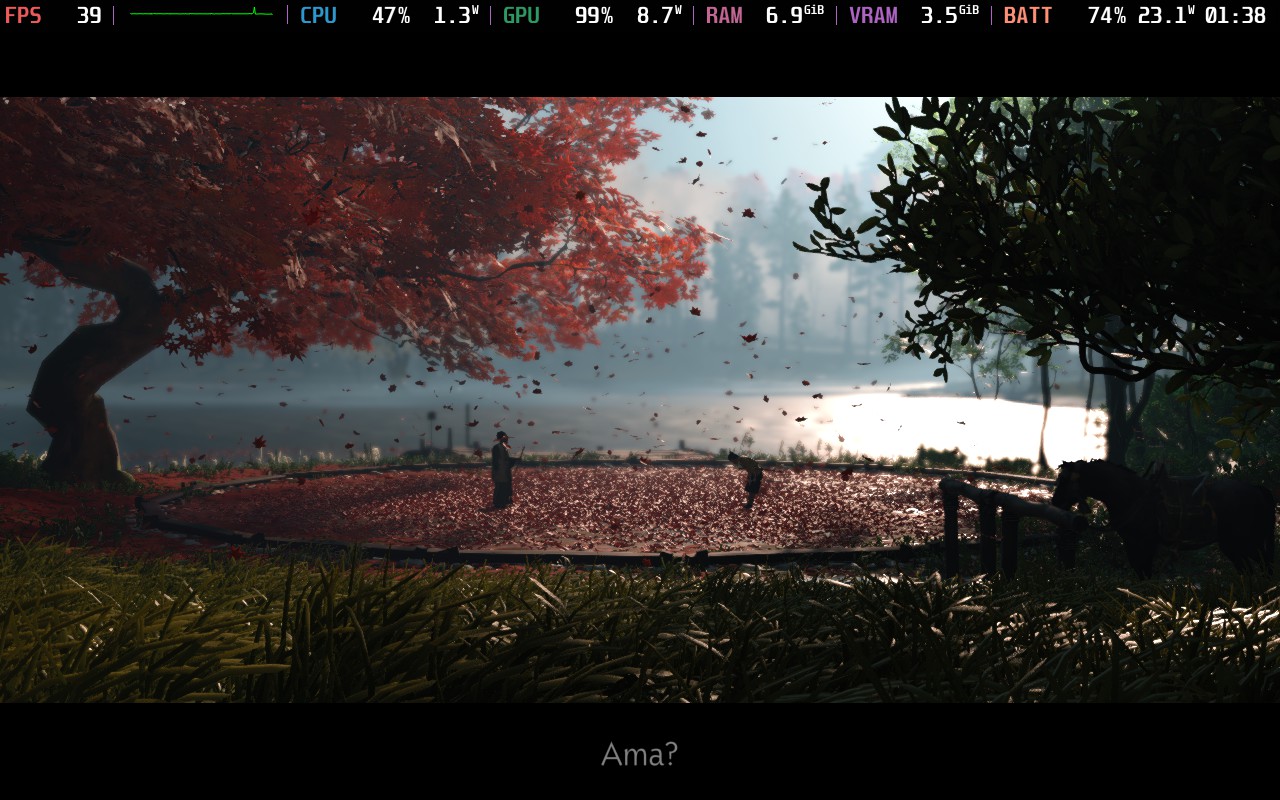
The game follows Jin Sakai, a samurai who loses his father at a young age and is raised by his uncle, Lord Shimura, the leader of Tsushima and a strict believer in the samurai code. The story begins with a large-scale invasion as the Mongol Empire clashes with the samurai of Tsushima. The battle ends in a devastating defeat for the samurai, with most presumed dead and Lord Shimura taken captive.
Jin, however, survives after being rescued by a mysterious woman, becoming one of the few remaining warriors on the island. With all hope seemingly lost, he sets out on a mission to rescue his uncle, forging new alliances and recruiting powerful allies across Tsushima along the way.
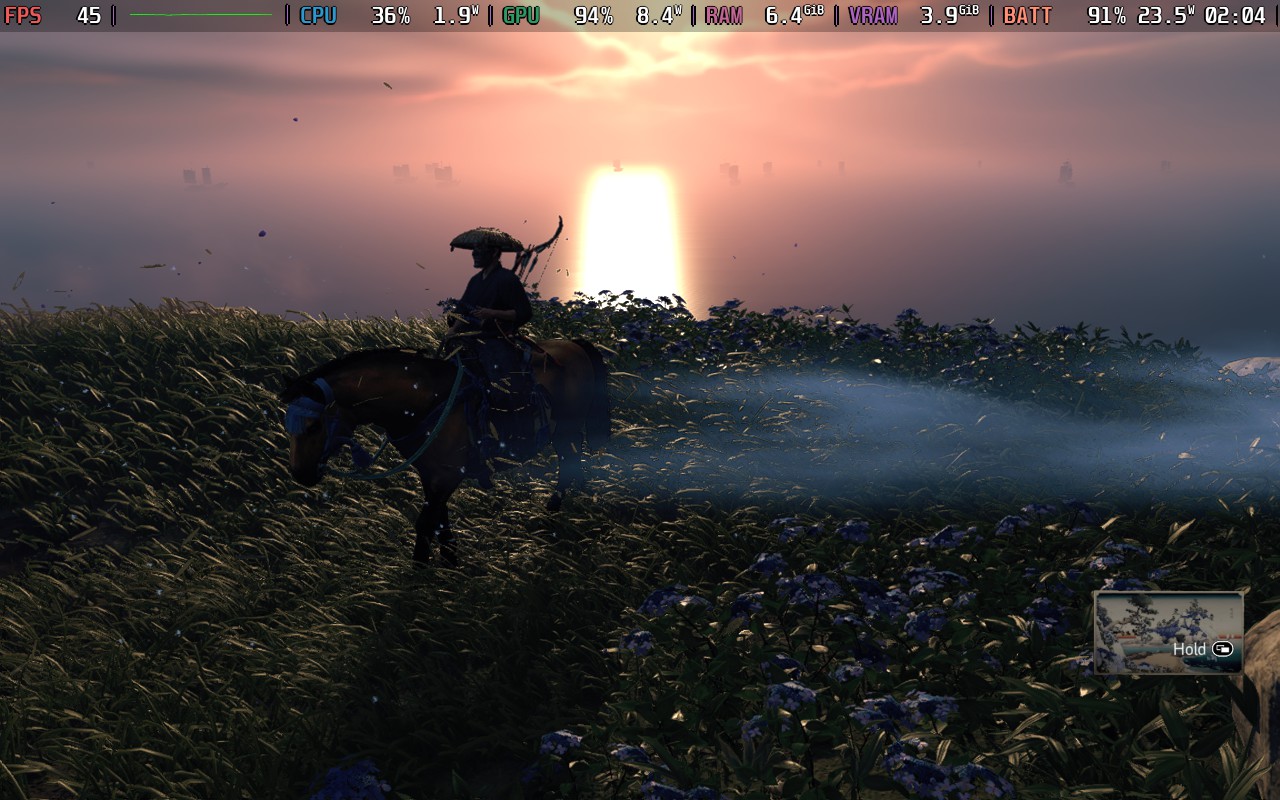
The story starts off strong and highly cinematic. However, it feels as if it deliberately shifts into separate narrative arcs, allowing players to connect with different key characters who share similar goals. While this structural change initially adds to the immersion, it also introduces a major issue: inconsistency. Some storylines are thoroughly engaging and memorable, while others fall into tired cliche territory. At times, certain arcs feel rushed or cut short, preventing them from reaching their full potential.
This issue becomes even more apparent in the side quests. While some offer storytelling that rivals, or even surpasses, the main narrative, others rely on repetitive, uninspired setups like “go kill this” or “they took my brother,” turning them into forgettable chores.
Despite these flaws, the game still delivers several incredibly well-written moments, morally ambiguous themes, and thrilling action sequences. For a historical setting, maintaining this level of narrative engagement is no easy task, yet Sucker Punch manages to shine where it matters most.
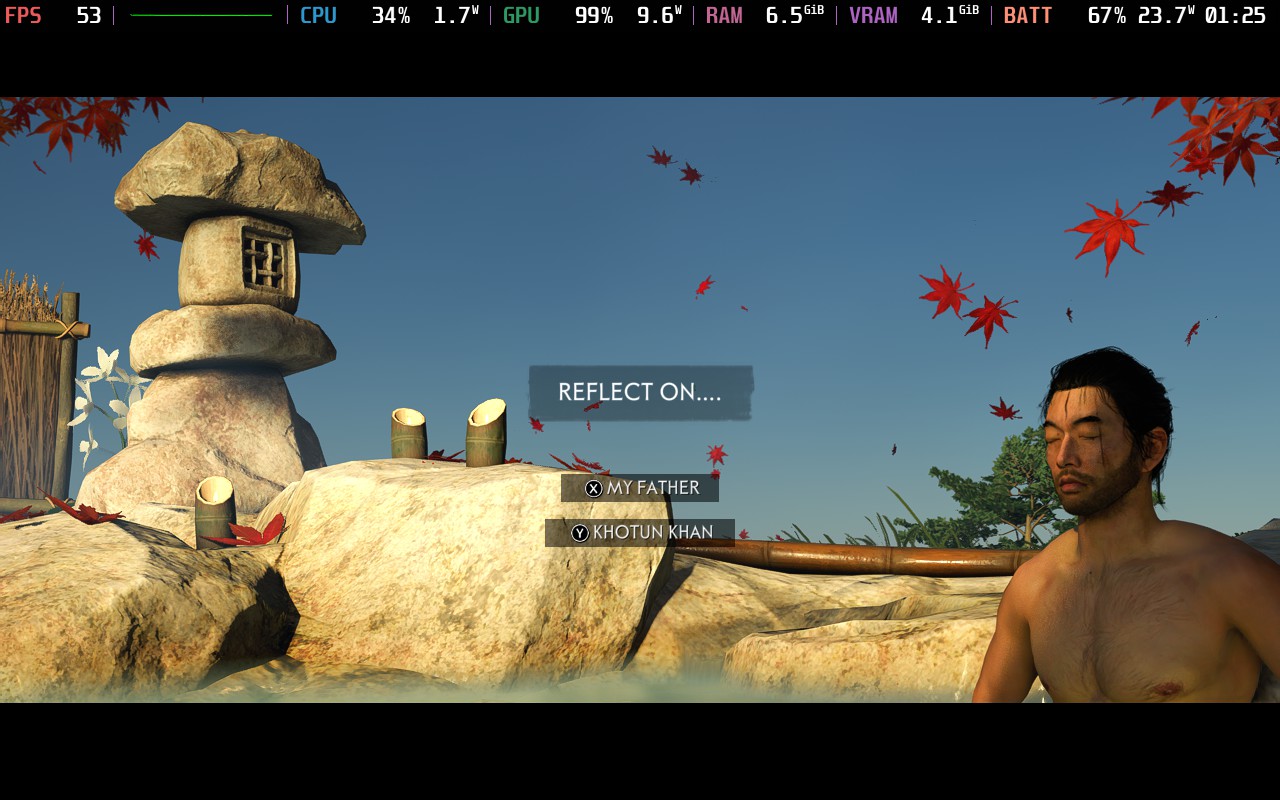
When it comes to gameplay, it's a mixed bag. The game features a vast open world, a beautiful island to fully explore. Yet, it’s full of emptiness and Ubisoft-esque objectives. They managed to make the game feel empty and filled with unnecessary chores and collectibles at the same time.
The game offers a very simplistic upgrade and loot system. You loot components, upgrade your gear. You gain XP to gain new techniques or improve the existing ones. Sadly, to do all these, you have to progress through uninteresting and repetitive side content. At its core, the game does a terrible job at keeping players on track with the main mission while improving their character.
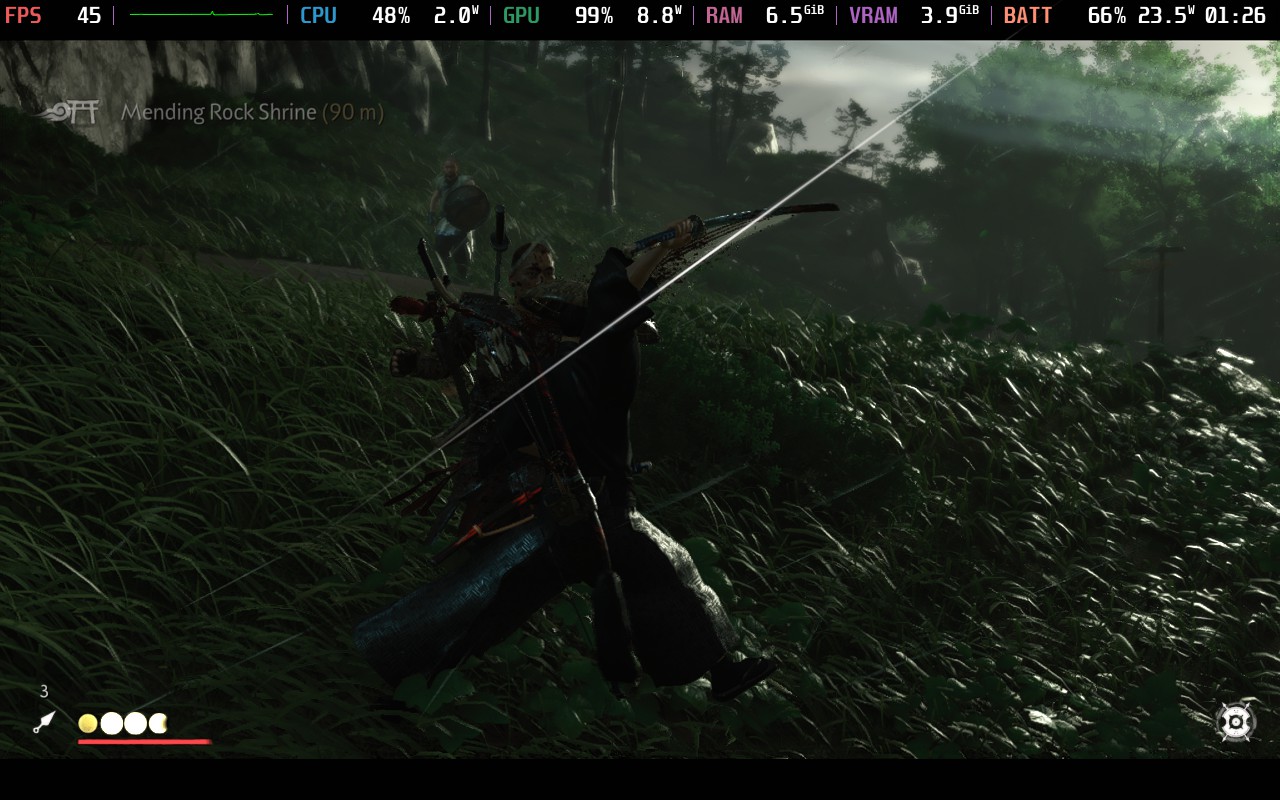
When it comes to combat, Ghost of Tsushima deserves all the praise it gets. It features one of the most satisfying and well-designed combat systems I’ve experienced in an open-world game.
What stands out the most is the variety of mechanics and playstyles, and more importantly, how they are integrated into the game’s overall design. In many open-world games with character customization, players are often pushed into committing to a single build or playstyle. Ghost of Tsushima takes a different approach.
The encounter design constantly encourages you to adapt. You can engage in precise swordplay, take down enemies from a distance with archery, or rely on stealth, and all of them feel essential rather than optional. There are unavoidable duels and ambushes that test your swordsmanship, elevated enemies that demand ranged solutions, and high-stakes scenarios where prisoners' lives force you into stealth. Each situation naturally pushes you toward a different approach.
This constant shift in gameplay keeps combat fresh and prevents it from ever feeling repetitive or forced. More importantly, it all flows seamlessly with the game’s immersion. It’s a complete masterclass in encounter design.
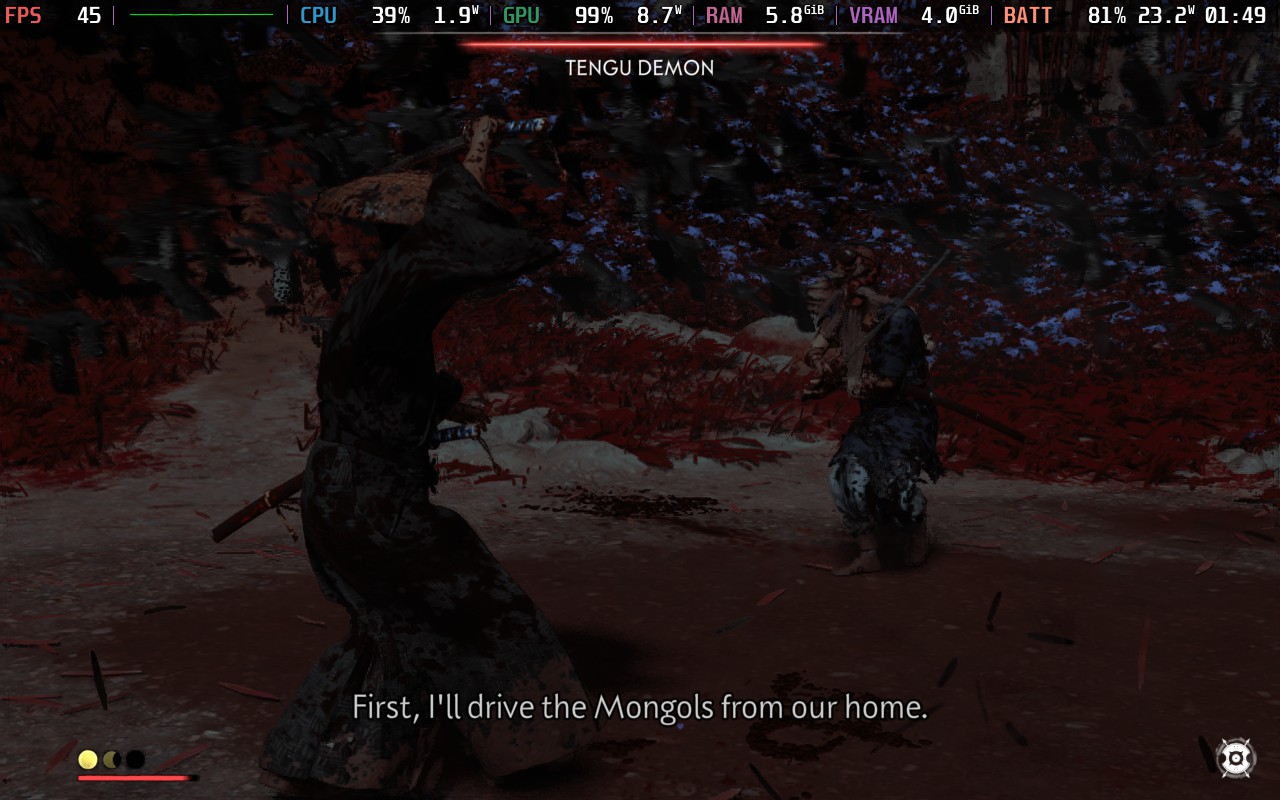
In the early hours of my playthrough, swordplay and the core dodge, hit, and parry mechanics felt flat. However, as the game opens up and you unlock new techniques and stances, combat gradually becomes far more engaging. The introduction of different enemy types, combined with thoughtful encounter design and the important impact of upgrades, elevates the system into something satisfying. Each new tool and ability adds a layer of depth that keeps fights dynamic and rewarding.
I personally leaned heavily into the perfect parry mechanic, building my playstyle around it. On higher difficulties, this approach felt remarkably close to Sekiro, which features one of my personal favorite sword combat systems.
My only real criticism is the lack of impactful sound design. For a samurai-focused experience, the audio feedback, especially during sword clashes and perfect parries, feels underwhelming, and it hinders immersion immensely.
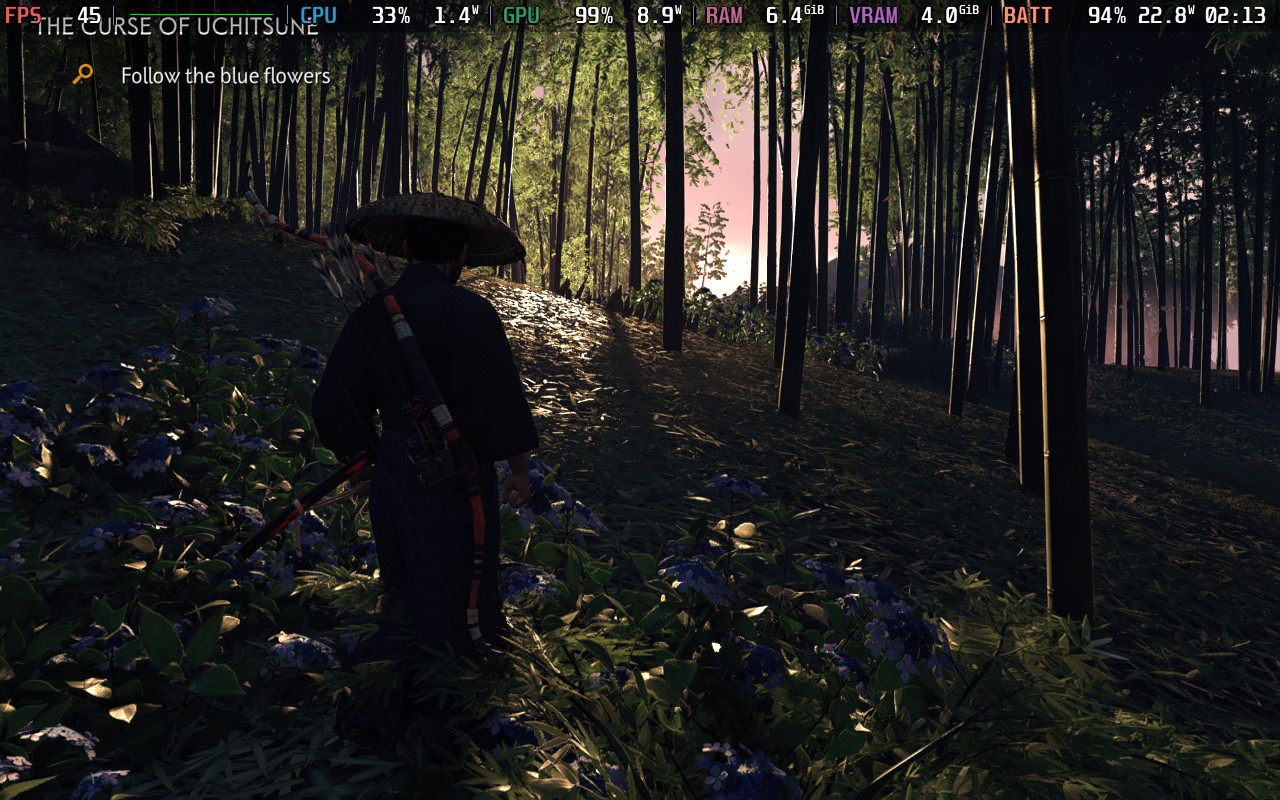
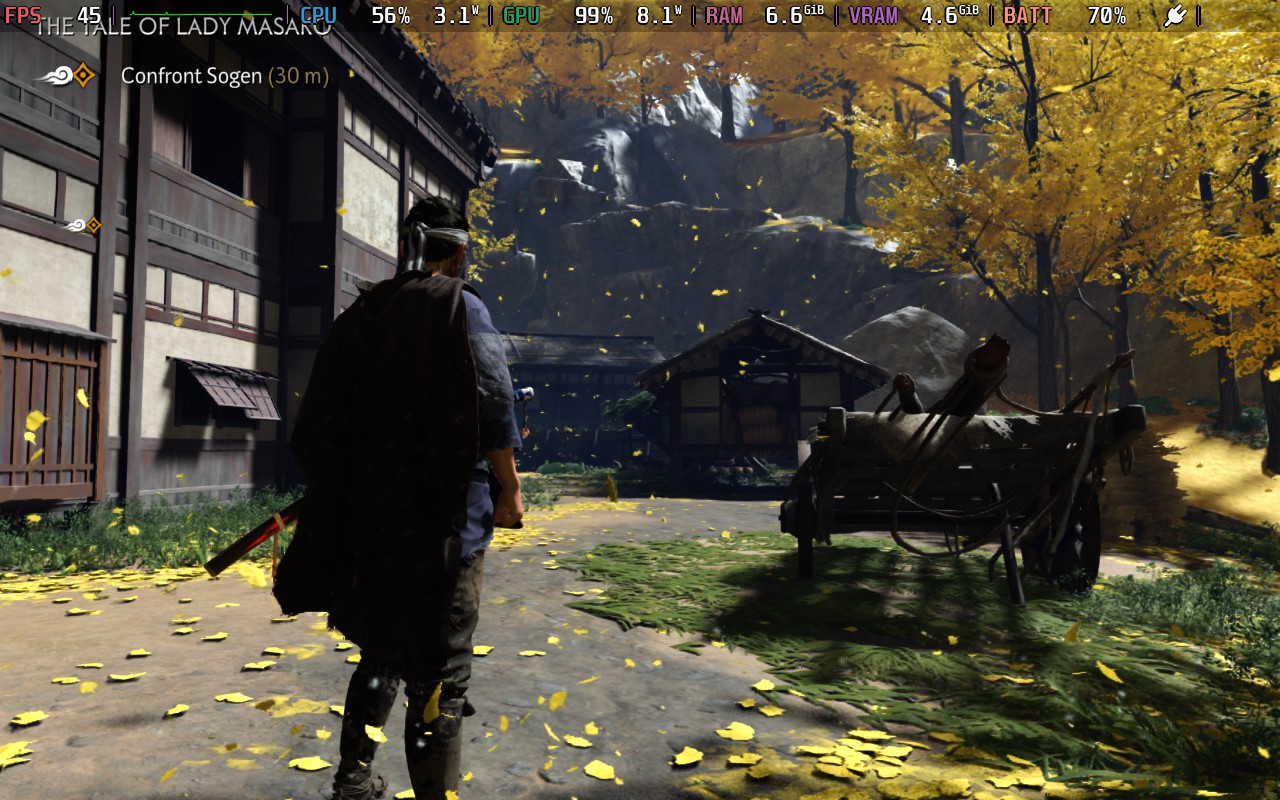
When it comes to raw technical graphical fidelity, the game isn’t particularly impressive on the Steam Deck, which is to be expected, considering it was originally developed for the PS4. However, where it truly excels is in its art direction. The combination of stunning environmental design and masterful use of lighting makes almost every scene feel like it’s pulled straight from a film or a Renaissance painting. Flowing grass fields, vibrant trees, dynamic weather effects, and stylized animations all come together beautifully. These elements elevate the visuals beyond pure technical limitations and give the game a timeless quality.
There are occasional issues, such as stiff or out-of-place facial expressions and lower-quality foliage, rocks, and textures. But overall, these gripes feel like nitpicking, as they rarely detract from the game's immersive qualities.
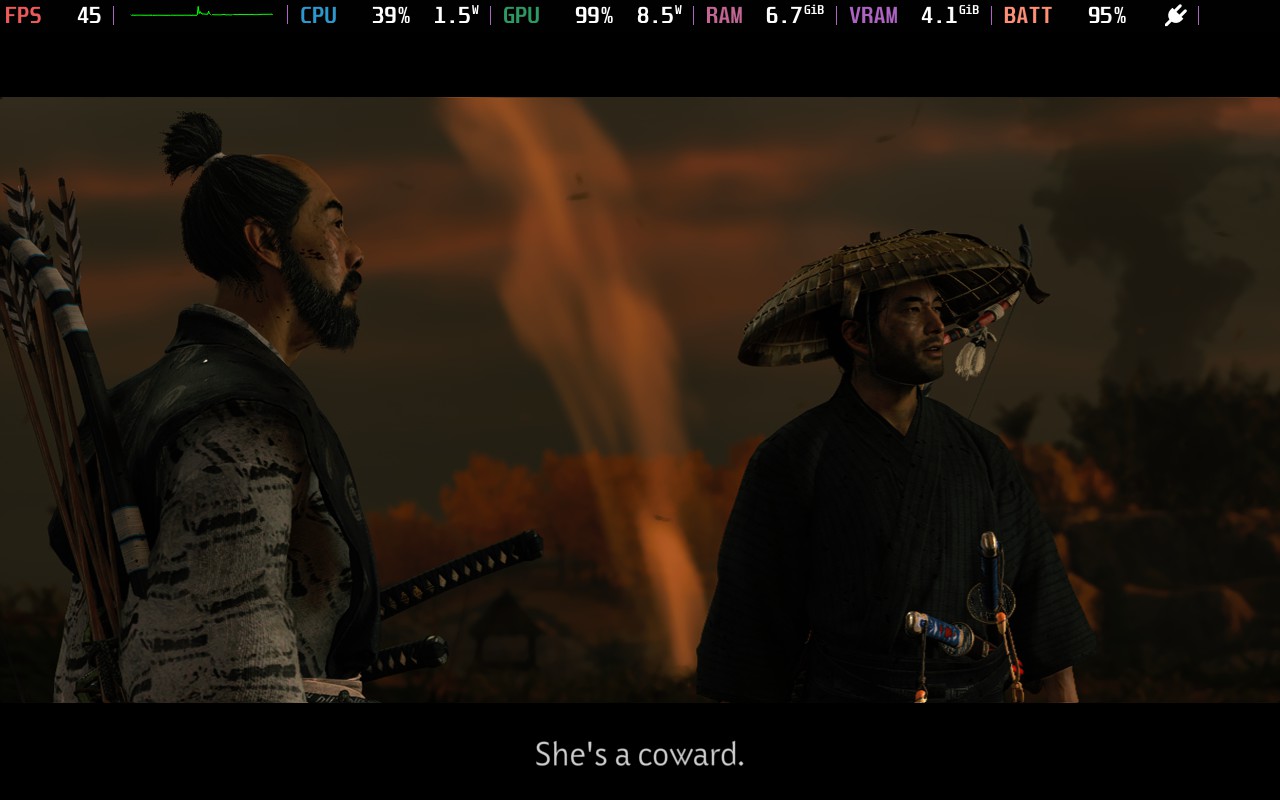
Sound design and music are one of the weakest aspects of the game. It’s surprising to see a title that excels in immersion in so many areas fall short in its audio direction.
From voice acting to environmental sounds, the overall audio experience can feel lacking in impact. As mentioned earlier, even swordplay, one of the game's core elements, often lacks the weight and presence you would expect, which is disappointing for a samurai-focused experience.
The music, while present, rarely leaves a lasting impression. Outside of a few key moments, much of the game feels unusually quiet, especially during exploration. Whether this was an intentional design choice or a limitation of the production, it doesn’t always complement the otherwise rich atmosphere.
That said, it ultimately feels like a missed opportunity. With such a strong visual identity and immersive world, the game deserved a more memorable and impactful audio experience.
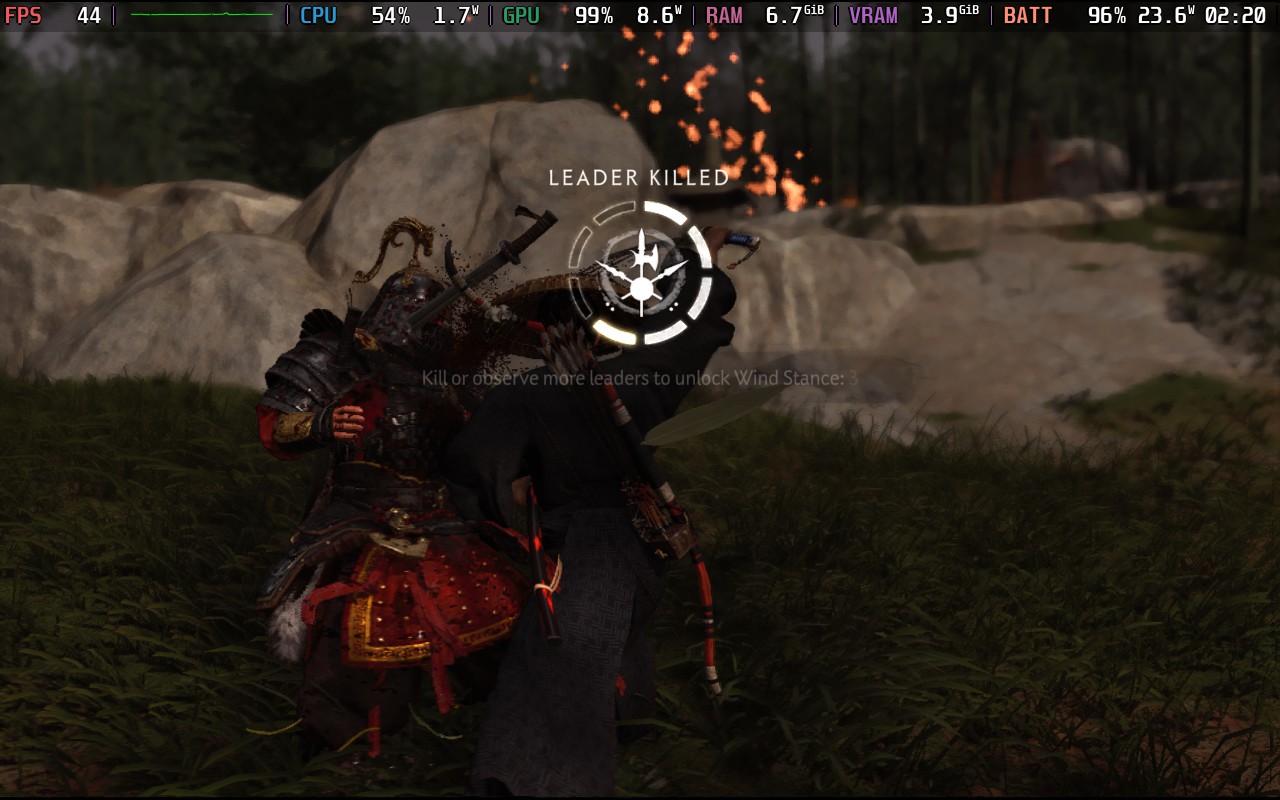
All in all, Ghost of Tsushima runs extremely well on the Steam Deck.
The game includes a built-in Steam Deck preset, but I strongly recommend avoiding it. In my experience, it’s both unstable and visually underwhelming, failing to justify its performance trade-offs. With the default settings, performance fluctuates between 30 and 45 FPS, which feels majorly inconsistent.
With our optimized settings, you can achieve a stable 45 FPS experience with minimal visual compromise. Throughout testing, I encountered no stutters, performance drops, or noticeable input lag. Interestingly, this result was largely made possible by the dynamic resolution upscaler. Ironically, I generally dislike variable resolution or scaling techniques, since they often introduce unwanted blur or general inconsistencies. However, in this case, it delivers a surprisingly clean and stable image.
No matter how much I tweaked the graphical settings alone, I couldn’t achieve a consistent 45 FPS lock. The game would either dip into the high 30s or introduce slight input lag when relying on Steam’s frame limiting instead.
The only issue I could find was HDR. I don’t tend to use HDR in my playthroughs, both personal and professional, so I usually keep it disabled, but this game is unplayably dark without HDR, and I couldn’t find a fix. Even at max brightness, the game looks extremely dark.
Setting dynamic resolution to target 45 FPS allows the game to intelligently adjust its internal resolution during demanding scenes, maintaining a stable frame rate without introducing any noticeable input lag.
My previous experience with dynamic resolution in Horizon: Forbidden West was far less positive. There, aggressive scaling often resulted in a blurry, almost cloud-like streaming image. In contrast, Ghost of Tsushima handles it remarkably well. I experienced consistent 45 FPS gameplay from start to finish, with no significant visual compromises and surprisingly strong image quality.
For the graphical settings, my goal was to strike a careful balance between performance and visuals. I prioritized options that have a meaningful impact on image quality while minimizing their performance cost. The result is a mix of lower settings where the visual difference is negligible, and higher settings where they truly matter, creating a well-balanced and highly playable experience.
It is possible to achieve a stable-ish 60 FPS experience, but it comes at the cost of significant visual compromises that diminish the game’s standout atmosphere and lighting. On the other hand, a visually impressive 30 FPS setup preserves the game’s beauty but makes the fast-paced, precision-based combat feel less responsive and increasingly frustrating.
Because of this, I strongly recommend playing the game at a locked 45 FPS with our optimized settings, as they offer the best balance between visual fidelity and responsiveness.
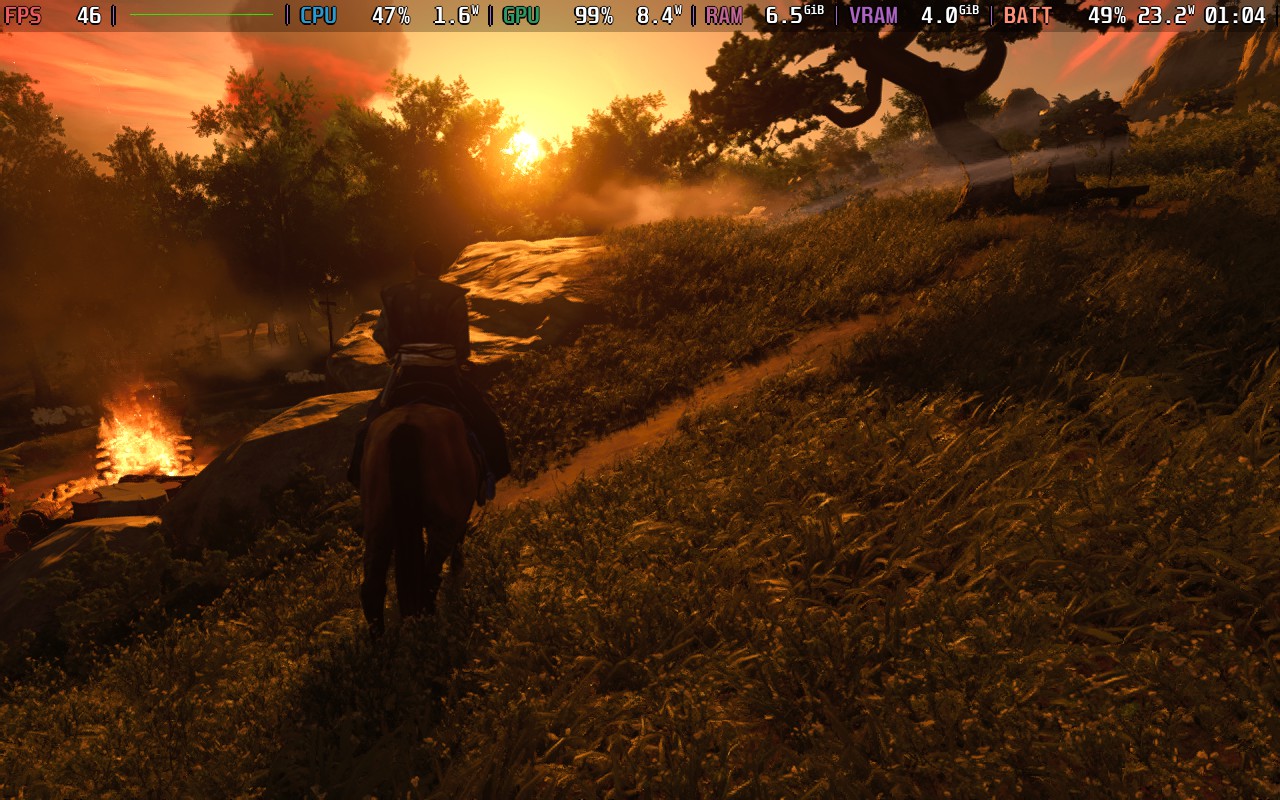
Ghost of Tsushima is a visually stunning experience that excels in combat and art direction, but falls short in areas like repetition, a cliche narratives, and underwhelming sound design. It stands as a contradictory “mixed bag” game, frustrating at times, yet undeniably impressive in what it achieves. Despite its flaws, it successfully delivers on the long-awaited samurai fantasy many players have been craving for years.
Thanks to its origins as a PS4 title and its excellent optimization, the game runs exceptionally well on the Steam Deck. It stands out as a rare AAA experience that not only performs great on the platform but also feels tailor-made for it, making it an easy recommendation for Steam Deck users.
このレビューはPC版に基づいています。
このレビューをお楽しみいただけたなら、SteamDeckHQ の他のコンテンツもぜひご覧ください!あなたのゲーム体験に役立つゲームレビューやニュースを幅広く取り揃えています。ニュース、ヒントやチュートリアル、ゲーム設定やレビューをお探しの方も、最新のトレンドを知りたい方も、ぜひご利用ください。
Legacy of Kain: Defiance Remastered was provided by Crystal Dynamics for review. Thank you!
The Legacy of Kain franchise has had a boon as of late. With Soul Reaver 1 & 2 both receiving a remaster, a new prequel game in the form of Ascendance just being released, and the Legacy of Kain: Defiance Remastered launching last month. Defiance wraps up the Legacy of Kain series by being the last game chronologically.
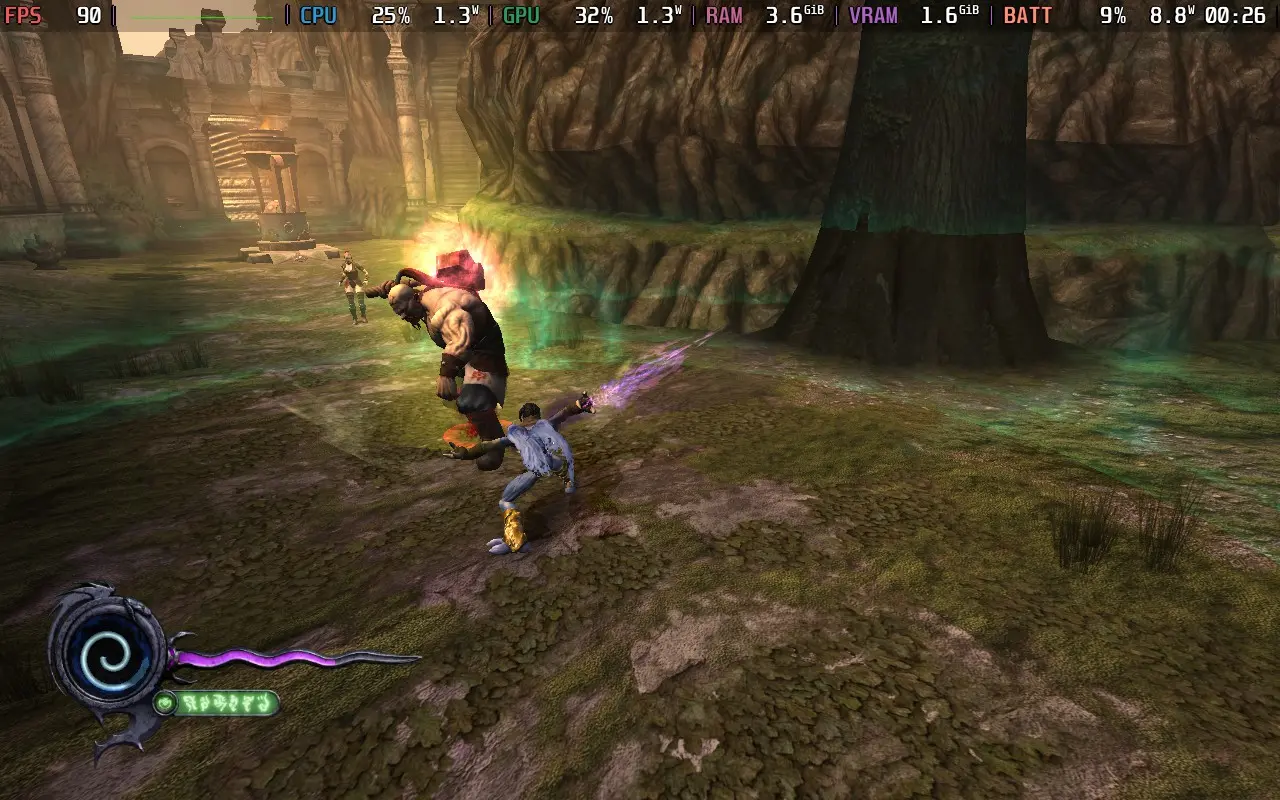
The story in the Legacy of Kain series gradually ramps up, with Defiance being the culmination of all the key characters playing their final moves, and this is a highlight of Legacy of Kain: Defiance Remastered for me. The voice acting is again on point, especially for the time. The stakes are high, and it's great to see these characters interact with one another and wrap up their fates. If you've been following the storyline in previous games, then Defiance is definitely worth a purchase to enjoy the finale.
As regards gameplay, the combat feels quite fluid and smooth. The TK abilities feel great to use and allow you to throw your enemies around the room (such as throwing them onto torches to ignite them, or throwing them into other enemies), or drag them towards you and tie them up in a combo move. It doesn't feel as dated as you might imagine, and when facing multiple enemies at the same time, there are plenty of opportunities to do some satisfying combat maneuvers, such as throwing enemies into each other.
You will get to switch between Kain and Raziel as your main character as you progress through the game, with Kain having a more heavy and hard-hitting approach, whereas Raziel is more agile and dextrous. The characters don't feel too different, but it does help to switch up the gameplay a little in level design, which can get repetitive due to some backtracking. Raziel's gameplay tends to focus on simple puzzles and platforming, whereas Kain's chapters emphasize combat.
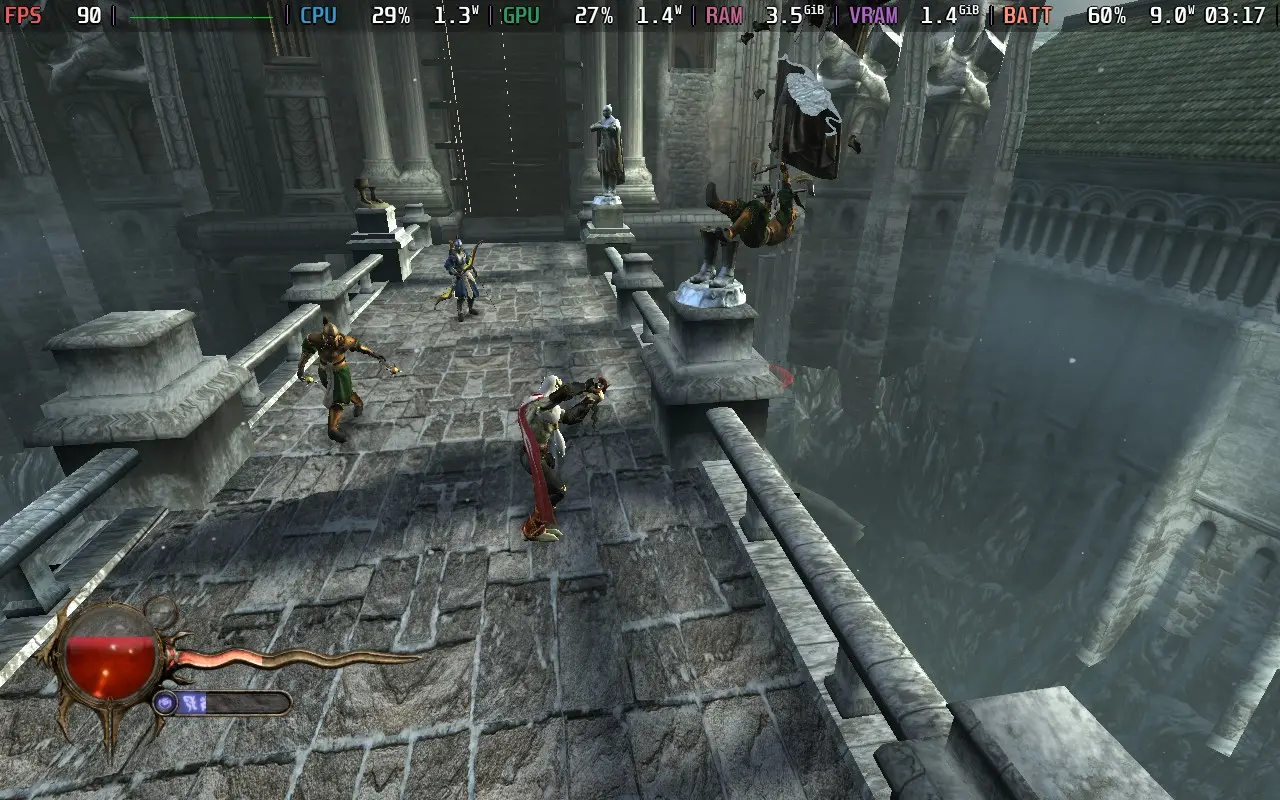
The visual improvements in the remaster are largely texture-based, with textures being run through an AI upscaler and then placed back into the game. In the AI disclosure on Steam, the developers state that they personally reviewed the AI upscaling before integrating it into the game, and that seems to be the case. Even still, there are times when it can be difficult to tell which is the remaster and which is the classic version.
A change that is far more noticeable, however, is the Remastered Camera option. This makes Legacy of Kain: Defiance Remastered a true third-person action game, with the camera following your character rather than using the classic fixed-camera perspectives. I would argue that this improvement is more important than the visual changes made to the game, as it markedly improves the gameplay and feel of the game.
With all that being said, it then begs the question: Is this remaster worth the price tag? As I said, the main upgrade, in my opinion, is the new camera system. If that bothered you in the original, it does make quite a difference here and definitely helps make the game easier for modern audiences, but if you were looking for a big improvement in visuals or any fundamental changes to the game, you will likely be left disappointed.
Hardcore Legacy of Kain fans should consider this remaster; it is the "best" version of Defiance, after all. If you already own the original and the camera mechanics don't bother you, or there are other things besides the camera that bother you, I would find it difficult to recommend this remaster, given the minimal difference it will make to you.
For those seeking the nostalgia factor, the enhancements are largely toggleable. You can play with the original textures and the original camera system if you wish to enjoy a more retro experience, or mix and match the two so you can play with the original camera and enhanced textures, or vice versa. There is, of course, the small bonus of getting to play some unreleased content for series fans, too.
As you might imagine, given the modest visual improvements over the original, Legacy of Kain: Defiance Remastered runs very well on the Steam Deck. There's no reason not to play the game at 90 FPS on an OLED model and 60 FPS on an LCD, since any battery savings from lowering the framerate would be minimal. There are also no video settings available to adjust.
The controls work flawlessly, and the game fills the Steam Deck's 1280x800 display. Because of all this, Legacy of Kain: Defiance Remastered definitely deserves a "Best on Deck" rating, as the game gives you the best experience it can on your first boot.
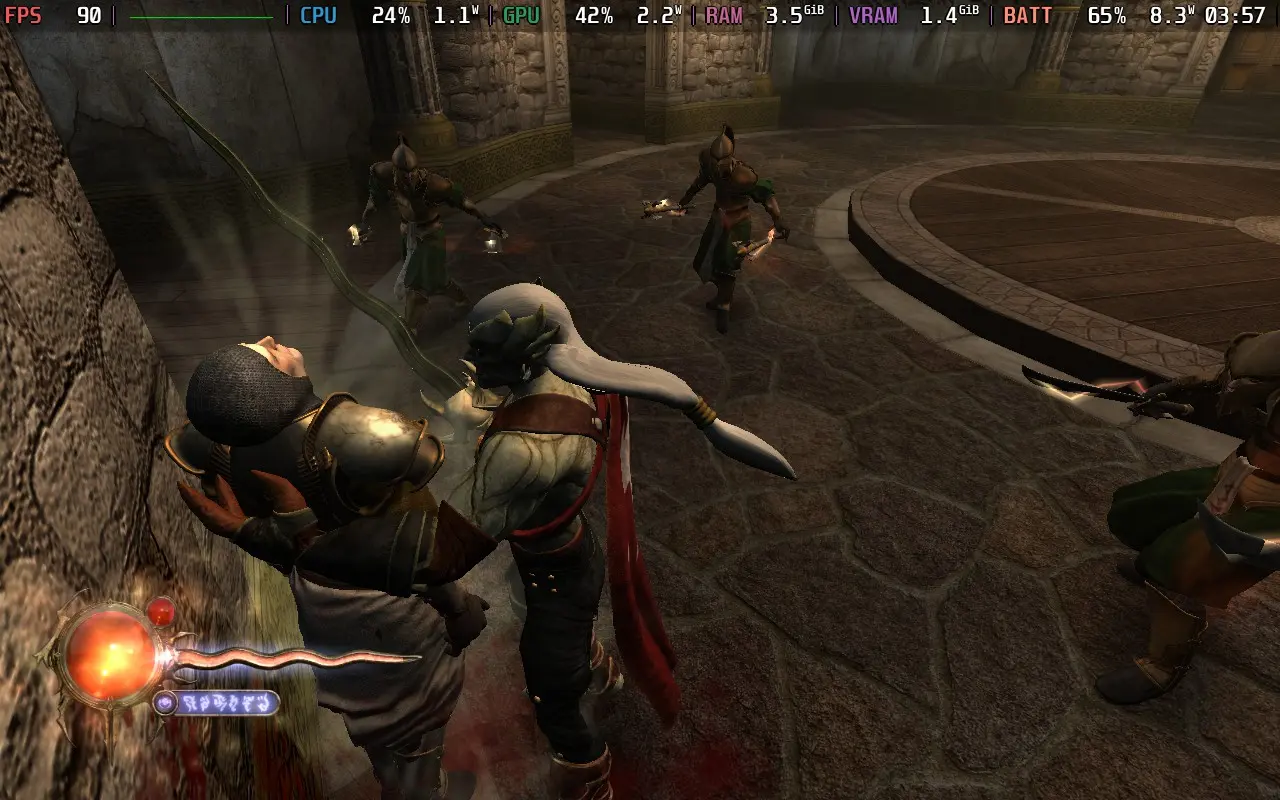
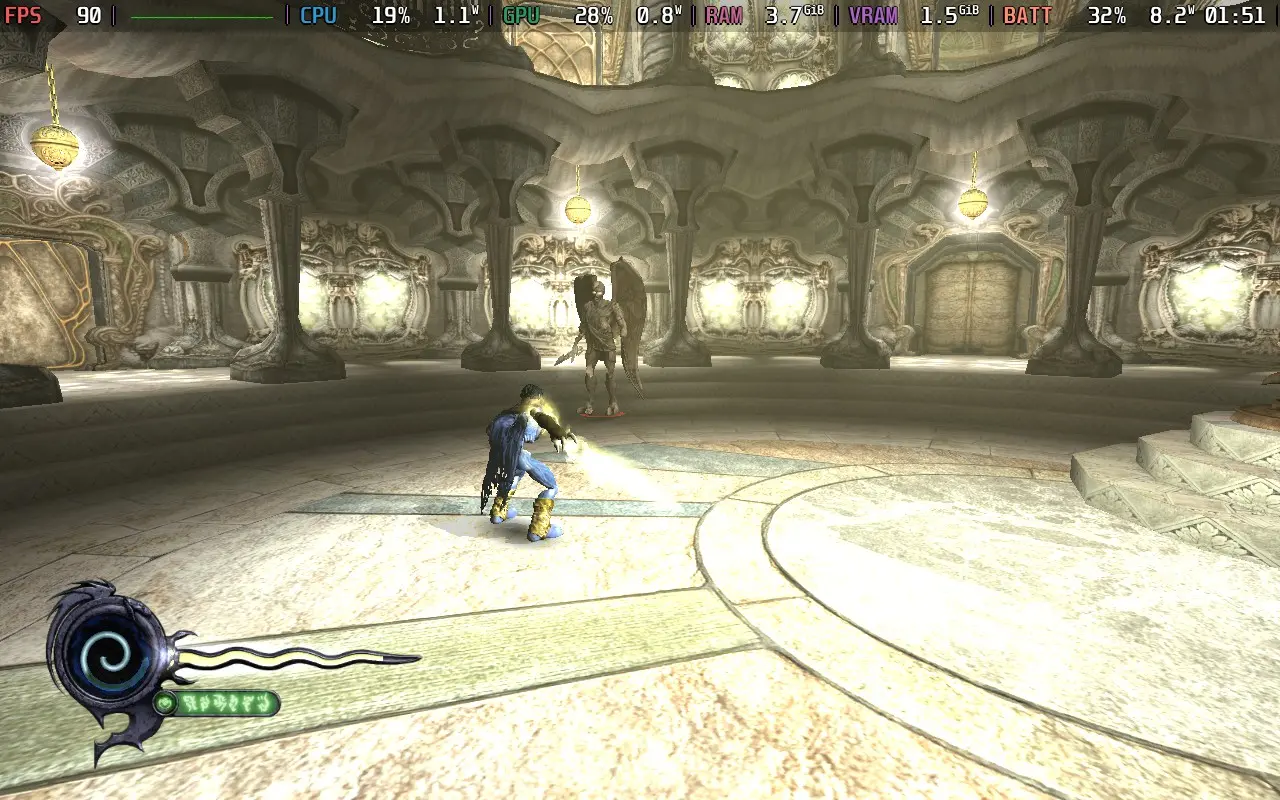
The power draw is around 8W-9W, so it doesn't stress the Steam Deck much at all. Expect a battery life of around 6 hours on a Steam Deck OLED and around 4 hours on a Steam Deck LCD. Temperatures were also low at around 50-55 °C.
You can apply a 7W TDP Limit if you want, but it has minimal impact on overall battery life compared to letting the Steam Deck manage it.
Legacy of Kain: Defiance Remastered doesn't have much in the way of accessibility, but it also doesn't need much. There are subtitles for the voiced dialogue, which is plentiful, and the game does have a lock-on/aim assist feature. It also has a hint system that guides you on how to proceed.
Legacy of Kain: Defiance Remastered offers slight visual enhancements, but the real upgrade is the new camera system and controls, which make the game much easier to play. Whether such a small change is worth the release of an entirely new game is up for debate, but series fans will probably want to check out the "best" version of Legacy of Kain: Defiance.
Legacy of Kain: Defiance Remastered works perfectly on the Steam Deck. There are no graphical options available, and the game will run at the maximum refresh rate of your model, be that 90 FPS or 60 FPS. Controls work perfectly, the 16:10 aspect ratio display is fully utilized, and battery life is lengthy.
このレビューはPC版に基づいています。
このレビューをお楽しみいただけたなら、SteamDeckHQ の他のコンテンツもぜひご覧ください!あなたのゲーム体験に役立つゲームレビューやニュースを幅広く取り揃えています。ニュース、ヒントやチュートリアル、ゲーム設定やレビューをお探しの方も、最新のトレンドを知りたい方も、ぜひご利用ください。
Mouse P.I. For Hire was provided by PlaySide for review. Thank you!
The time has finally arrived. I’ve been curious and following Mouse P.I. For Hire ever since the first trailer, which showcase it’s style that feels very close to old Mickey Mouse cartoons. Now, the game is here, and while I love the aesthetic and story, the combat just feels too generic to make me want to play for longer periods of time.
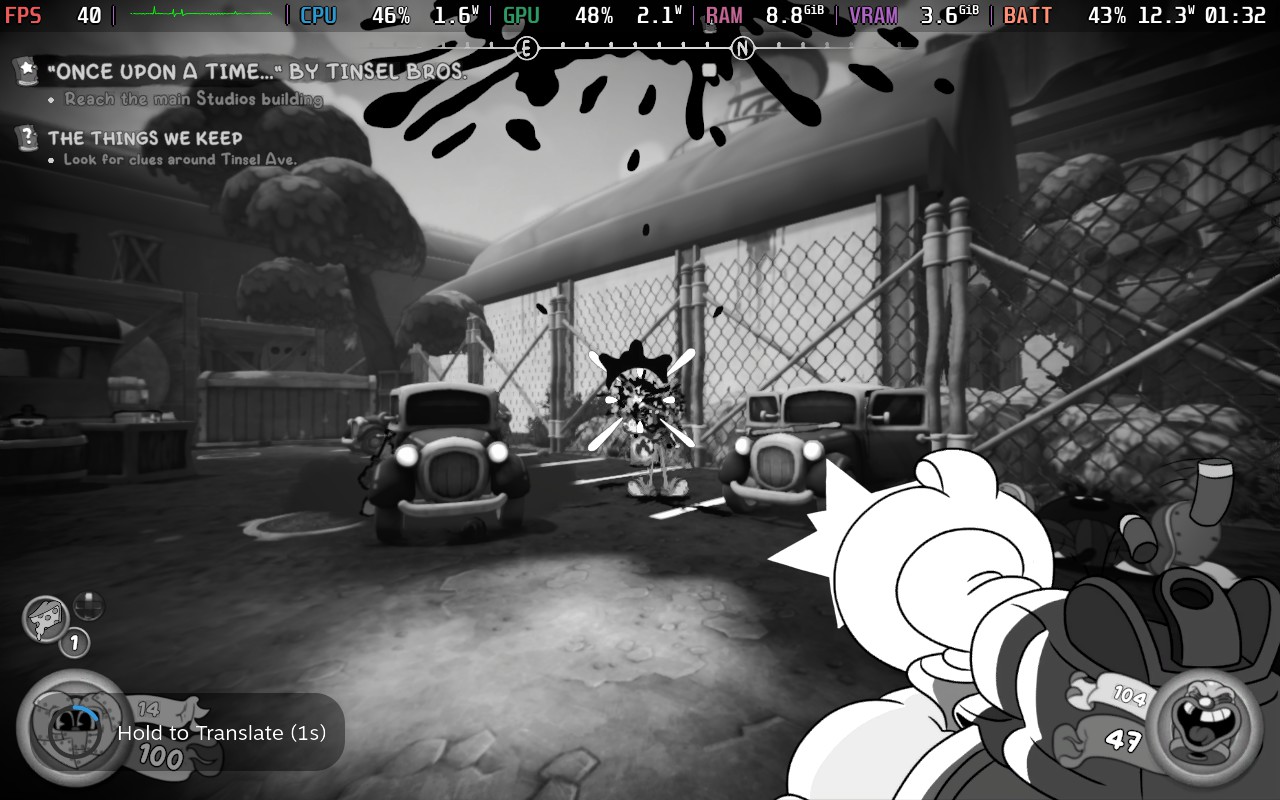
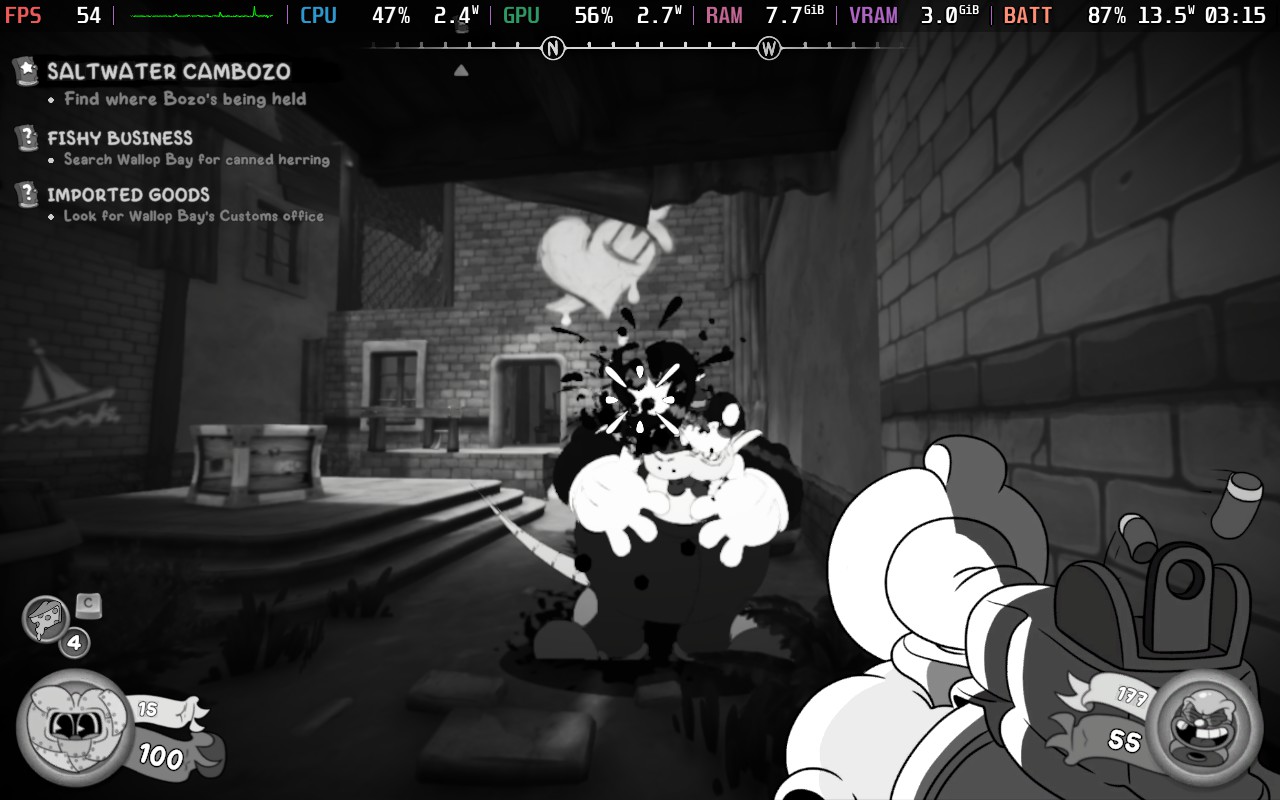
Now, the biggest attraction for Mouse P.I. is going to be the aesthetic, which I adore. There’s just so much personality and expression that is on display with the rubber hose animation the team uses. When it’s on screen, it easily captures attention while oozing charm. Whether it be death, animations, watching weapons reload or be upgraded, or finding secret collectibles (one of my favorites), it’s just a joy to watch.
It actually made me wish that more of the environments had the same animation style. While the bulk of the levels all fit in with the art style and still capture the 1930’s “Steamboat Willie” feel, it can also feel a little static. The game shines with expressive animations, so I was hoping to see more of it. So, I wouldn’t say it’s off-putting. It still fits the theme, and there’s a lot of variety with the different locations we go to, so it didn’t bother me as much.
Thankfully, the game has a fantastic cast help the characters feel more alive. Whether it be Jack Pepper’s one-liners from Troy Baker or hearing Tammy Tumbler talk about tinkering from Camryn Grimes, the cast did not disappoint. There will be a lot of times where we hear Jack speak, whether it be interrogating individuals or delivering relevant punch lines at just the right time, so I’m glad we have such a great voice behind it to make listening not harm the experience.
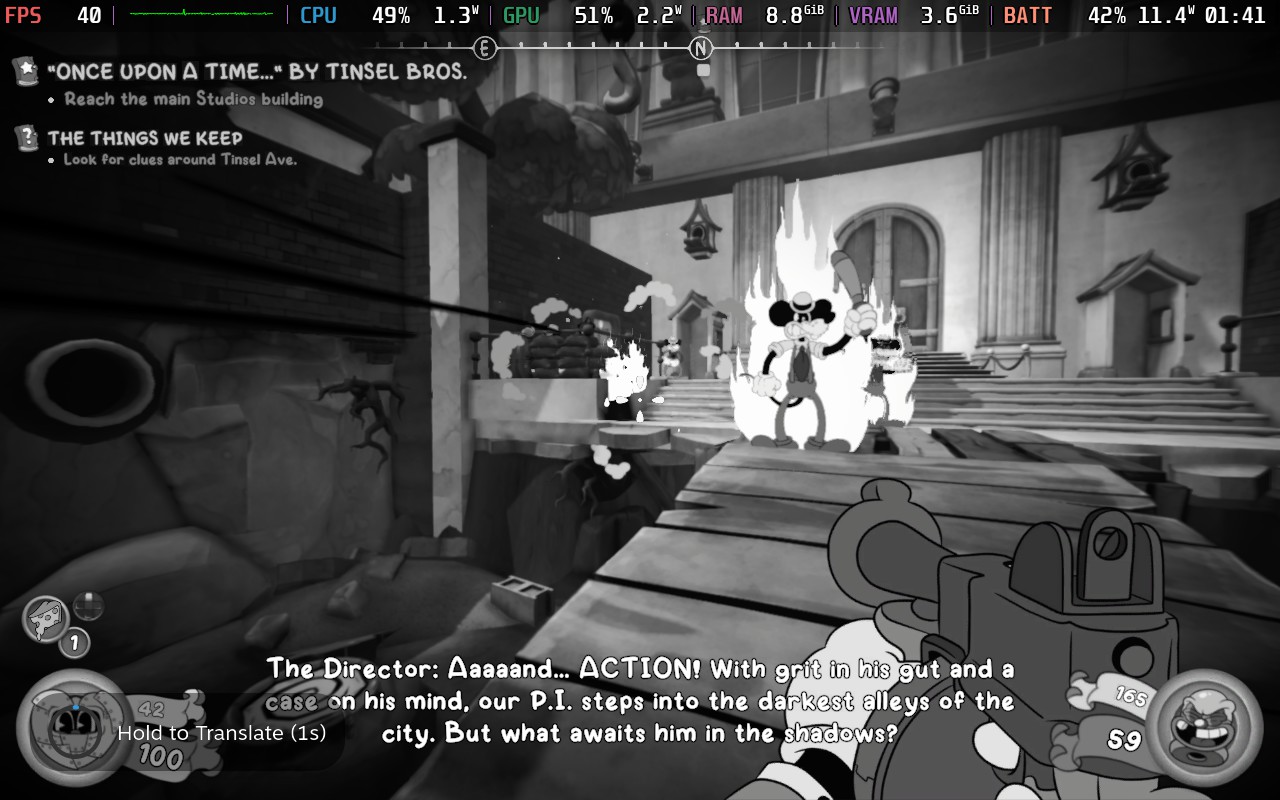
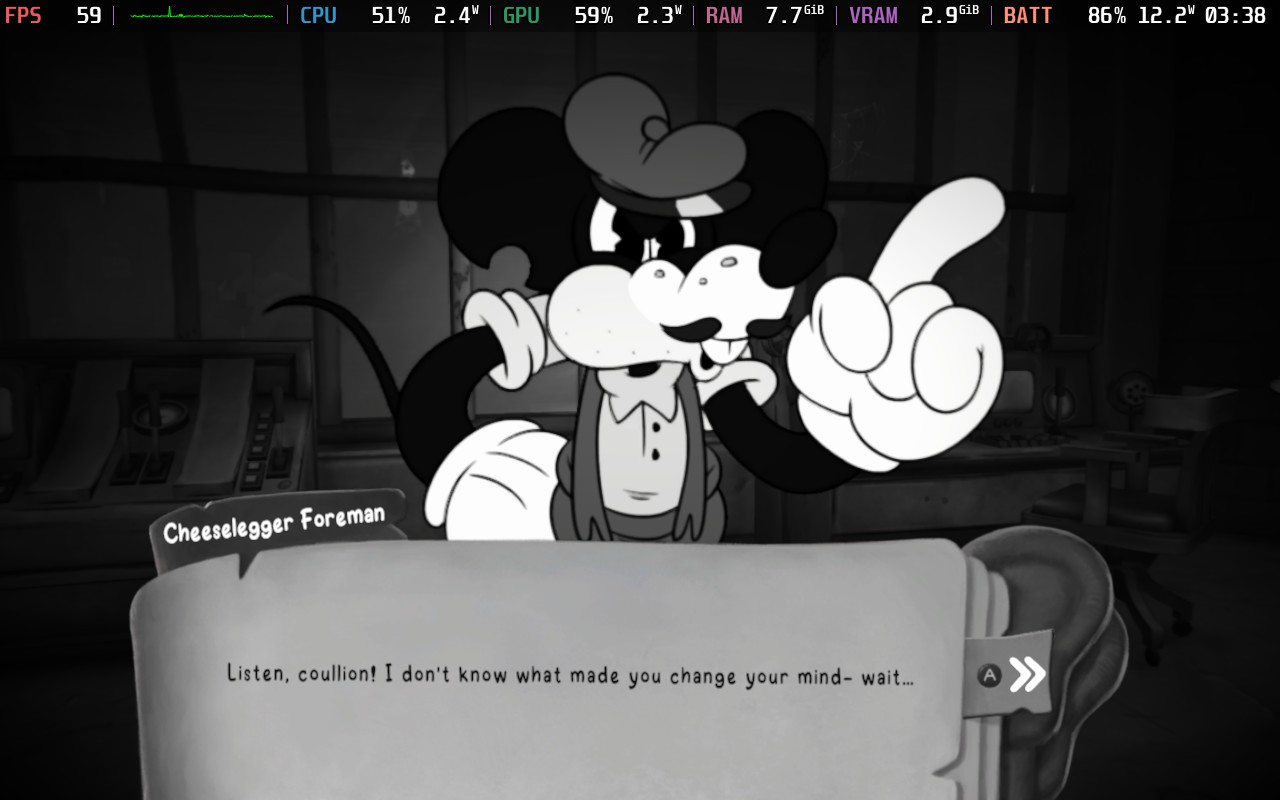
The game revolves around this aesthetic, and its story follows suit. It takes place in the 1930s in a noir-esque world. We play as Jack Pepper, a private investigator who is taking on some big cases. However, what starts as a case to find a missing person will evolve as the plot thickens and it goes deeper and deeper. I won’t reveal too much, but I was brought in further as more cases came in, and I started to see the links between them. I loved putting everything on our crime board to start seeing the links between them as it grows into a wider net that is all interconnected. It helps that Jack Pepper is a great protagonist who embodies the culture that Fumi Games is trying to capture here, but it’s an enjoyable story nonetheless.
While we will primarily follow the main story, there are some small side cases that we can take on. Most of these will just be finding things and reporting back to the people who asked, but it’s a nice way to get some extra currency.
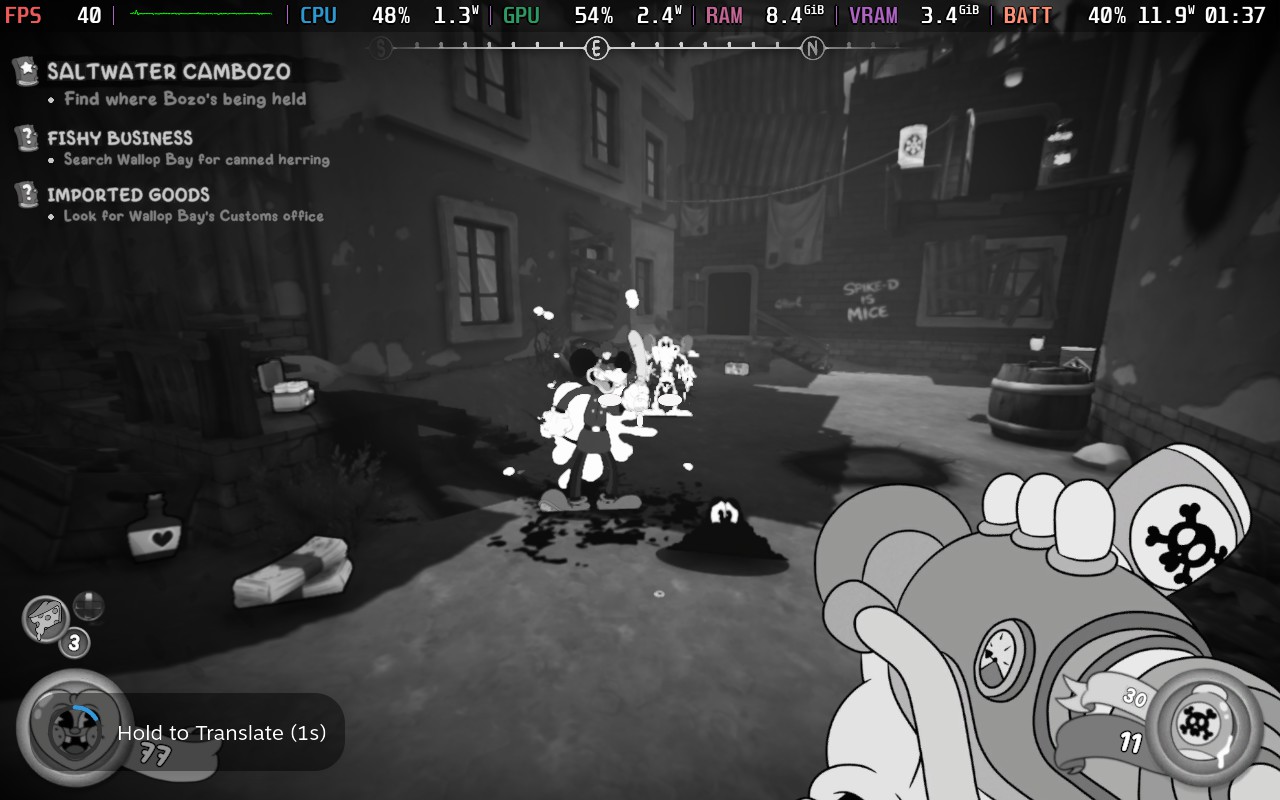
Mouse P.I. is a shooter at its core, bringing us to a multitude of locations to investigate cases, and all of them will quickly turn into a shootout. We have a decent assortment of guns to use, with some of the basics we’ve come to know and love, like a pistol and shotgun, and some unique guns, like the acid shooter. All of them have their place, and I found myself swapping between them consistently through fights.
The shooting itself is solid, though I wouldn’t consider it groundbreaking. It’s fun, and there’s a lot of movement required to make sure we survive. The guns themselves are decent to use as well, and I found myself loving a couple of them and developing a strategy to use them. And the level design encourages moving around a lot, which keeps fights more engaging.
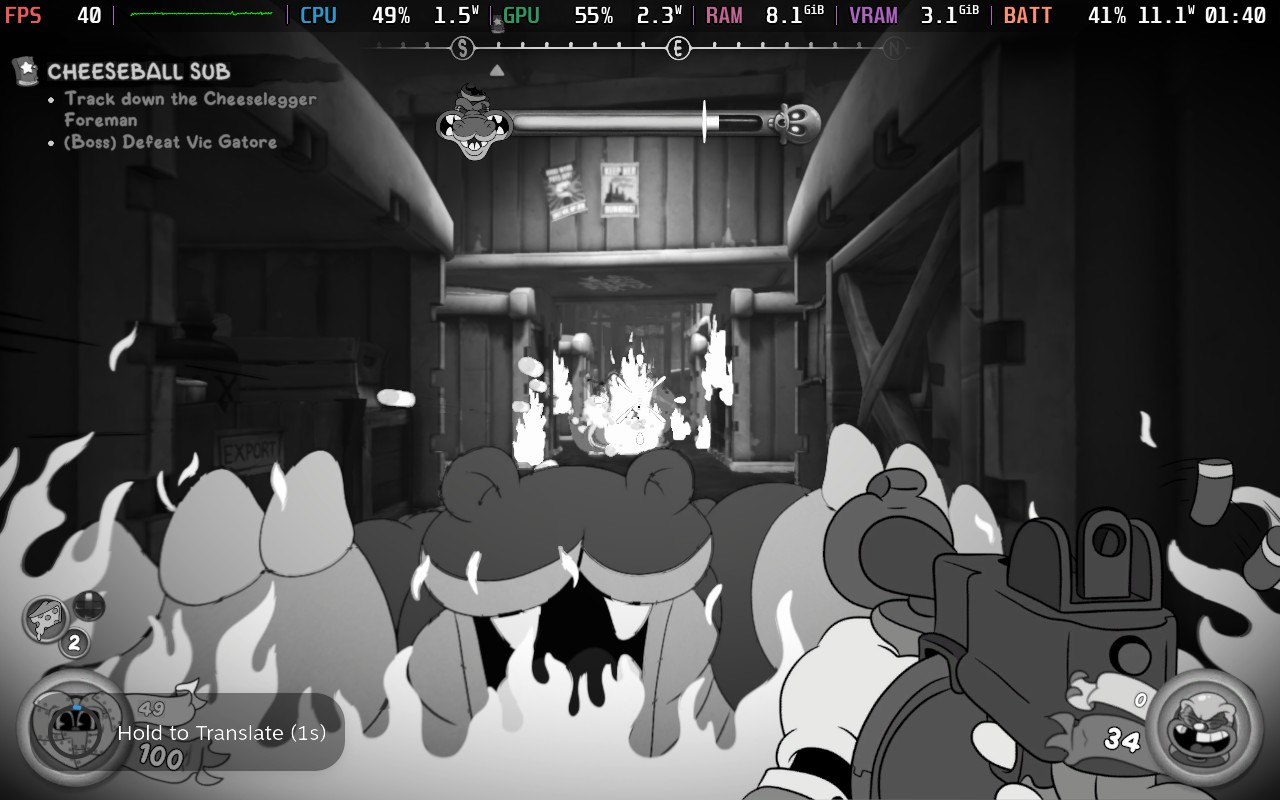
Still, I couldn’t help but feel the combat was a little too generic. It does the job, and it can be fun, but it never kept me hooked. The enemies can be a little too bullet spongy, swapping weapons wasn’t as fast as I like, and some of the animations could get in the way of the flow. Specifically, I didn’t like having to watch Jack drink a bottle every time we needed to heal. It was just a little too long, and it made me miss how health pick-ups are done in games like DOOM, where we just walk over them, and they immediately heal us. Take away the gorgeous aesthetics, and it feels like a cookie-cutter shooter. Again, it’s not bad, but it just doesn’t do anything special to keep me coming back for more, and I feel like I could play nonstop.
There is a simple progression system to make our weapons more powerful, and I actually like it. Every weapon has three tears, and you use schematics to upgrade them. The first upgrade unlocks an alternate fire, while the others will usually increase damage and the clip. It does show a noticeable difference as well, with the pistol going from an average of four shots to kill to 2-3 shots after 2 upgrades. Some of the alternate fires can really help, too, like the shotgun charging up to unload two bullets at a time.
However, I found it very hard to find enough schematics to upgrade my guns as often as I wanted to. Even when I was looking for secrets, there were a few levels where I found only one or two schematics. The second and third upgrades of each gun need three and five schematics, respectively, so it took some time to upgrade. It’s very possible I missed some, but I was looking around, so I would consider them easy to miss.
There are some little detours we can make, like playing the baseball card game and collecting tokens, but we will mainly be going from level to level, investigating cases, and getting into shootouts.
Mouse P.I. For Hire defaults to the Medium quality settings and 40 FPS, which actually worked quite well for it. The game looks great and feels smoother than it would at 30 FPS, striking a nice balance between the two. After testing and pushing to get the game to 60 FPS, I would say this is arguably the best way to play it. There are some unavoidable drops, even on the lowest settings, and these drops only affect framerates higher than 40. So, keeping it locked to 40 FPS on the gate almost every single framerate drop.
I also tried bringing up the quality settings to see if we can still play it at 40 FPS. The answer is yes, but it does come with a little bit of a higher battery drain, more drops when turning around really quickly, and the benefit of higher quality settings is minimal. Just going from the default Medium to High only really changed some slight shadows further away. Otherwise, the image was almost identical. Even comparing it to Ultra, the image just didn’t look very different. So, the default settings are actually the best right now.
Now, it’s going to be possible, and relatively easy, to get the game running at 60 FPS. We don’t have to change much, but there are gonna be a few sacrifices. It may seem as simple as moving the in-game framerate limit up to 60, but there are gonna be drops when spinning around quickly. This will be a nightmare in fights, so there are a few changes I recommend making if you want to try playing this game at 60 FPS.
After changing the framerate limit, I would set the rendering scale to 0.9 and move shadows down to low. This will negate almost all of the drops when moving around quickly, keeping fights at 60 FPS and feeling smooth as butter.
Honestly, this doesn’t change the visuals too much, but there are some drops that are completely unavoidable. Even with the lowest possible settings and the rendering scale down to 0.5, I would still get drops into the 40 FPS range when looking out in certain angles. If these were angles that I encountered when running around, it wouldn’t be a big deal, but these areas also happened to appear during battles. I would say 90% of the game can be played this way at 60 FPS, but there will still be some drops that can harm the flow during combat.
And just because I’m sure it will come up, you can use lossless scaling to make the game feel smoother, and it doesn’t have much input lag. However, it will be affected by the same exact issues that trying to play the game at 60 FPS has, so it isn’t really helpful. I would say playing at 60 FPS with the setting changes is a better experience than 90 FPS with lossless scaling frame generation, especially since visual changes aren’t that obvious.
Mouse P.I. For Hire is a solid shooter with a beautiful aesthetic and interesting story, but the combat can feel a little too generic. The expressive rubber hose animation works, wonders, and the great cast help bring the characters to life in this mystery thriller, but I found it difficult to stay interested for longer periods of time because it didn’t have that spark that other big shooters have. It’s still fun, and I had a good time, but it just didn’t do enough to keep me locked in for longer periods of time.
And despite some of the sacrifices, like having to play the game at 40 FPS, it is enjoyable on the Steam Deck. It can also be played at 60 FPS with a few changes, but if you want the most stable experience, I would stick to the default for this one.
このレビューはPC版に基づいています。
このレビューをお楽しみいただけたなら、SteamDeckHQ の他のコンテンツもぜひご覧ください!あなたのゲーム体験に役立つゲームレビューやニュースを幅広く取り揃えています。ニュース、ヒントやチュートリアル、ゲーム設定やレビューをお探しの方も、最新のトレンドを知りたい方も、ぜひご利用ください。
PRAGMATA was provided by Capcom for review. Thank you!
While I understand it, I feel like most big studios tend to play it safe with their releases. We see a lot of similar styles of games with similar gameplay mechanics that are normal for their genre. It’s not necessarily bad, because these are tried and true mechanics at work and make the games fun. However, I love seeing the studios try something new, and that’s exactly what Capcom has done with PRAGMATA. The structure and style are not abnormal, but the gameplay takes a different turn than what I have seen before. And ultimately, Capcom has created a perfect blend of puzzle and action that keeps the game engaging, and this might be my favorite game. I’ve played so far this year.
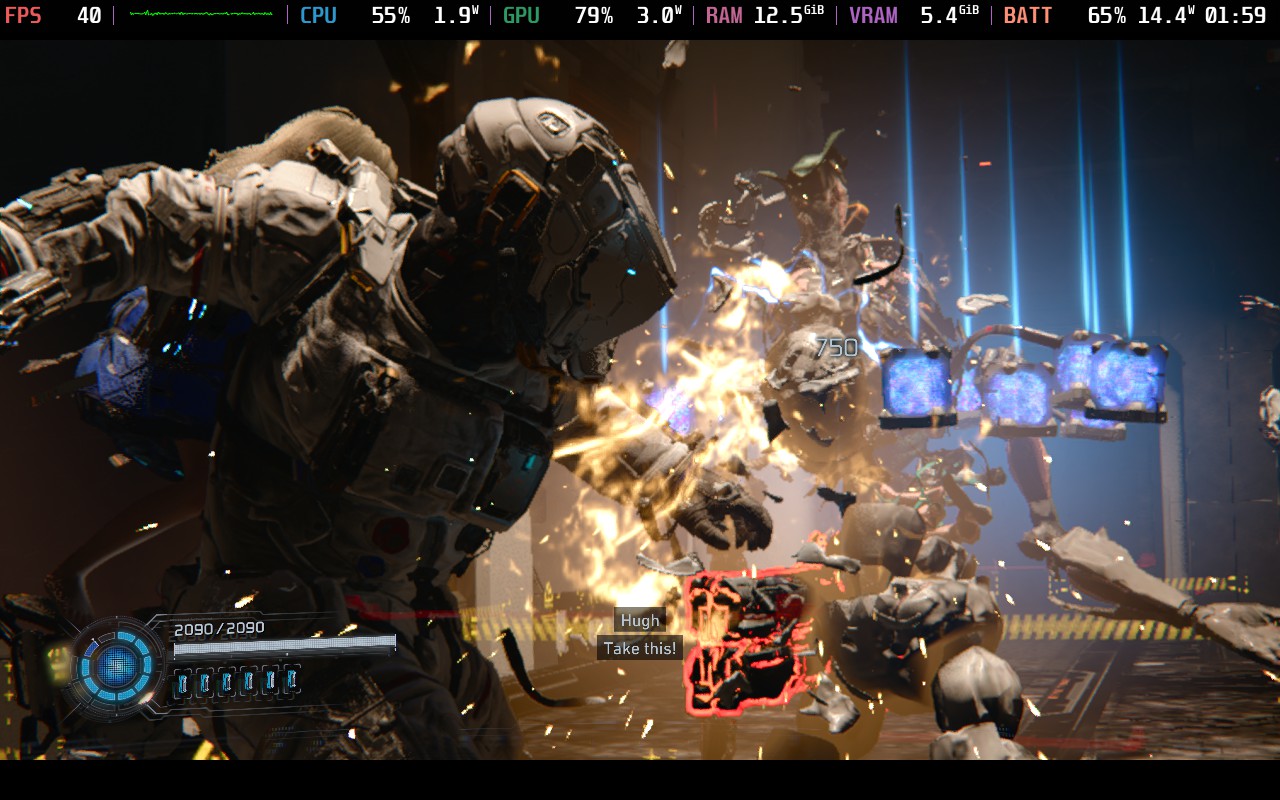
While PRAGMATA starts off in a predictable way, it diverges into a path that I did not expect as we continue playing. We enter the moon base as Hugh, who is part of a team to figure out what’s wrong with this corporate-made base. However, things quickly deteriorate as the entirety of our crew is killed, and Hugh is the only survivor. Ultimately, he will find Diana, a robot called a PRAGMATA, and they will work together to stop the rogue AI and get home.
I really thought this was going to be a similar-ish story to a lot of other games that do this, focusing on a crazy AI that is hell-bent on destroying humanity. But there is a lot more to it. I don’t want to spoil anything, but it becomes a surprising, emotional tale, where the dynamic between Hugh and Diana is what I came to fall in love with. The way they interact with each other, and the conversations that they have, are both enjoyable and hilarious, with Hugh warming up as a guardian and Diana fully embracing her childlike behavior. There are some legitimately hilarious conversations they have, but no matter the topic, it all feels fluid. None of their interactions or conversations felt forced, and they all felt like real conversations a parent and child would have.
Even though the story is a little bit on the shorter side, it had a good amount of surprises and emotion to it. I actually cried at the ending, with the development of the duo protagonists hitting hard. I also found the documents and reports that we could find throughout the levels actually very useful and provided a lot of details to parts of the story that may not be covered by skipping them.
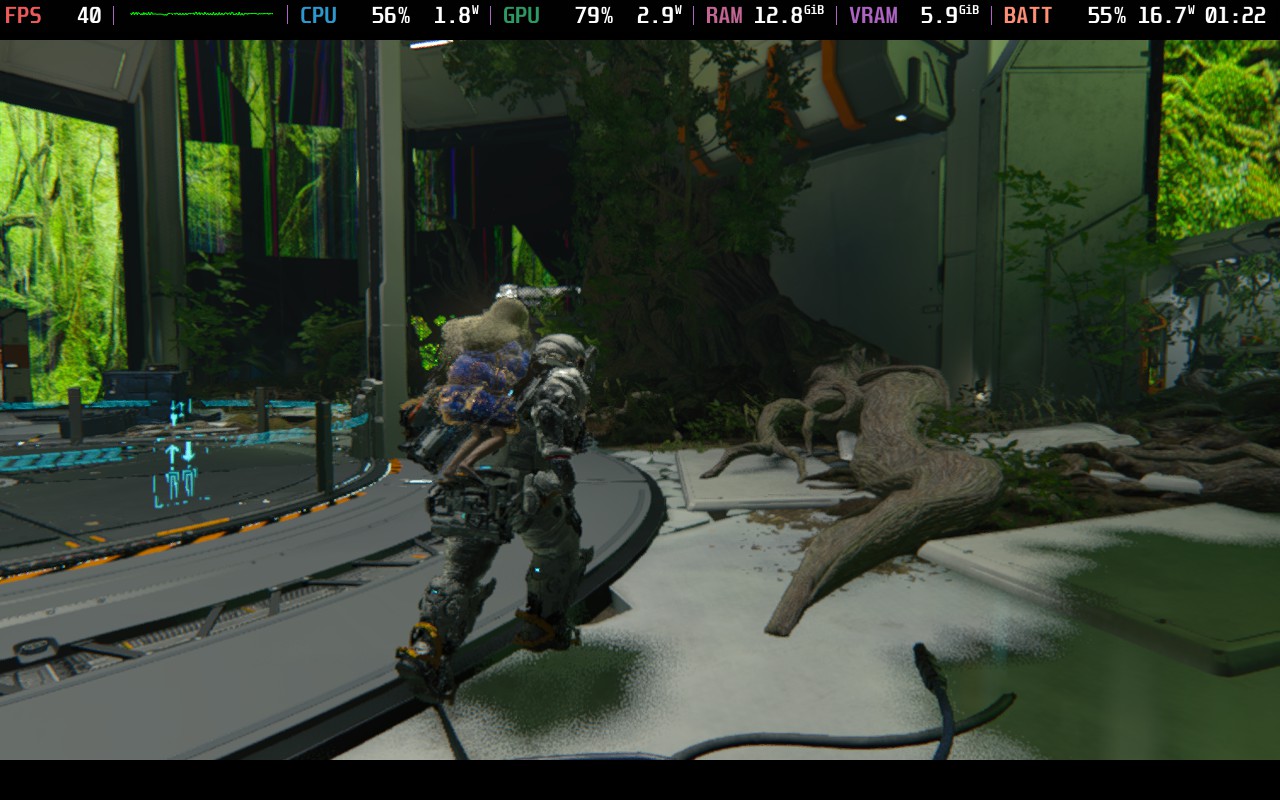
I’ll admit, when I first saw PRAGMATA’s gameplay, I was a little worried. However, playing it at Summer Game Fest last year alleviated most of my worries. And with the full game, I got to see the combat with all the bells and whistles, and I fell in love with it.
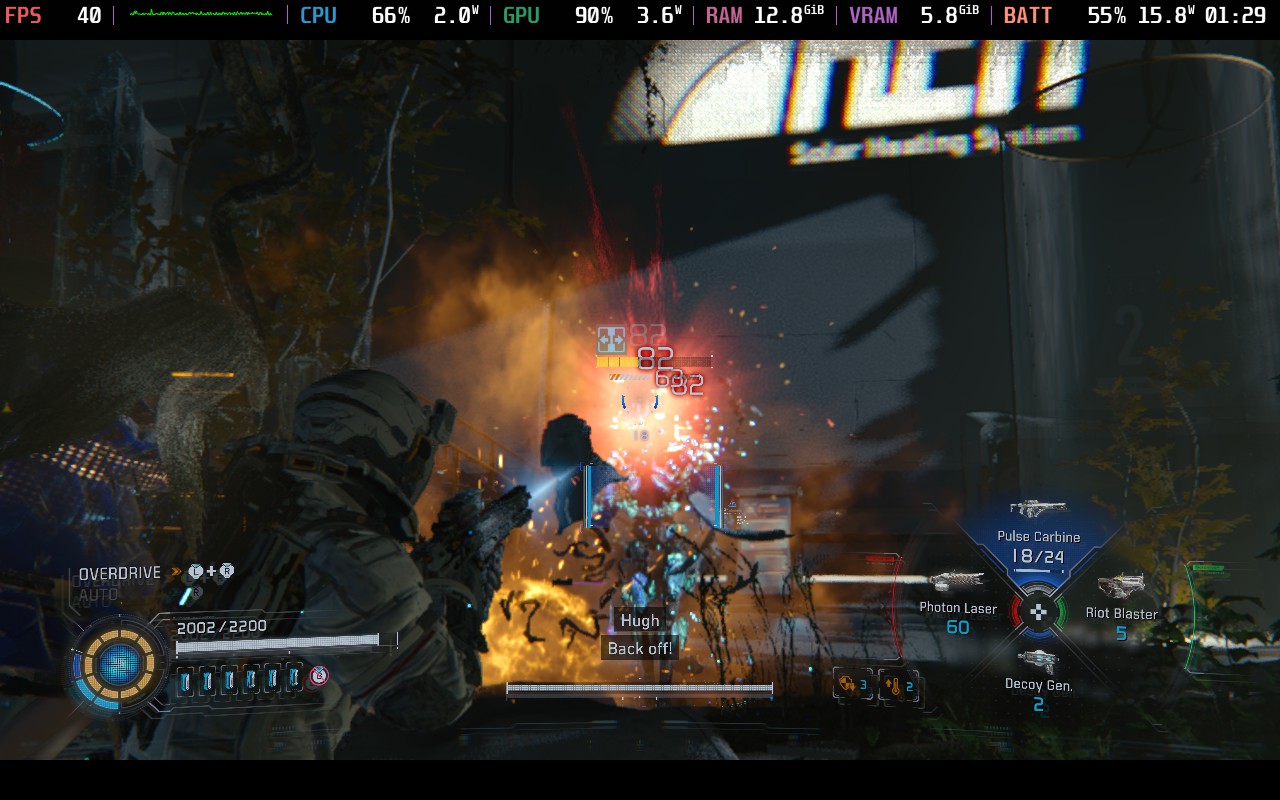
The expertly combined real-time hacking puzzles and fast-paced action just feel better, and better the more I play with it. Generally, the combat loop will consist of hacking to open up the robot’s weak points, which we will then use our assortment of guns to shoot at it. If we don’t do this, our guns will barely do any damage, so it’s imperative to continually pay attention and hack to open them up. The swapping back and forth between hacking and shooting is wonderfully engaging, and it never got old the entire game.
Part of what makes it work so well is the movement when hacking. You don’t have to stand still to complete these puzzles; you can move around, dodge, and even use thrusters to fly in the air while you hack. They kept me on my toes and made each fight feel more dynamic. And even if we lose sight of our enemy, as long as we don’t get hit, our previous progress through the hacking puzzle remains. Successfully completing hacks also feeds into our Overdrive gauge, which is a giant attack that will hack every enemy around automatically and stun them, making them open to our shots.
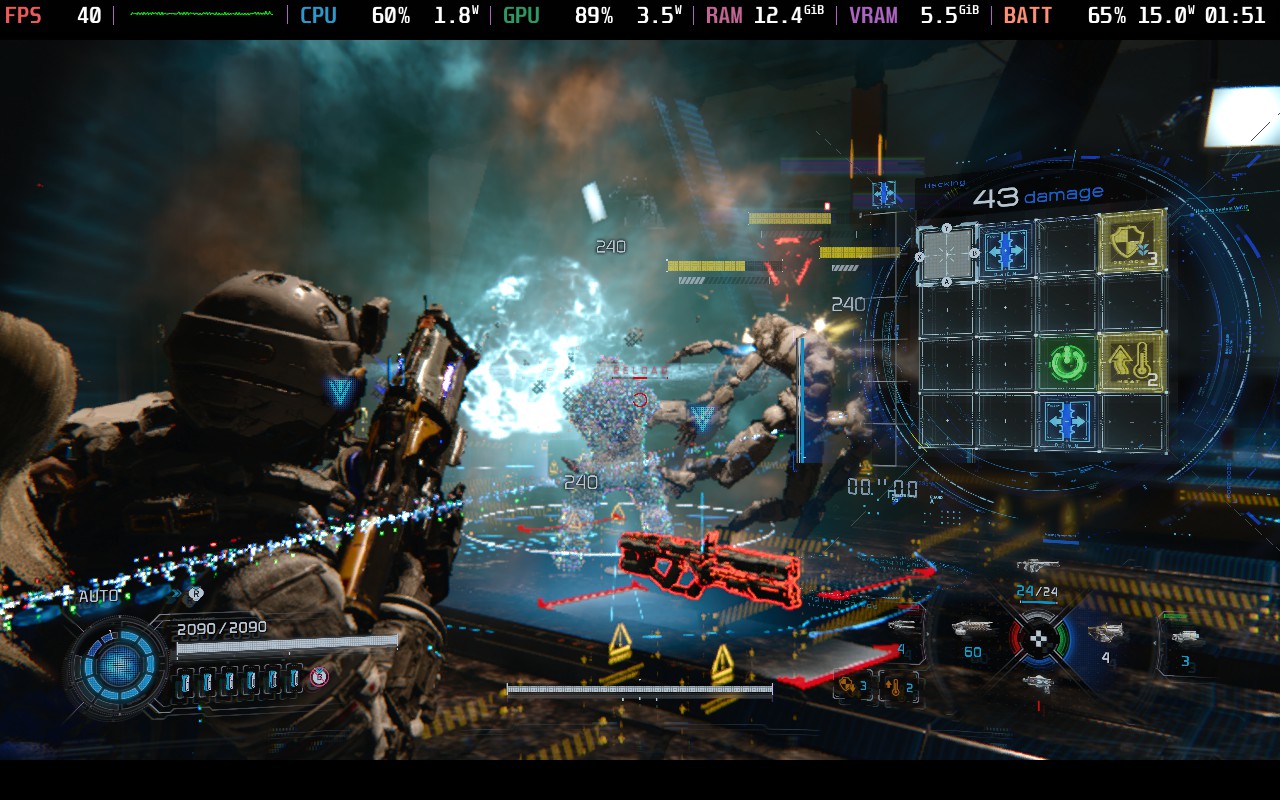
On top of that, we can find hacking nodes that will appear on our puzzle. We have a limited number of them, similar to how temporary weapons work, and we can choose whether or not to use them when completing the hack. If we do, they will usually inflict some sort of debuff, like decreasing their defense or stunning them temporarily, or give us buffs, like healing some of our health. These will be dropped on the ground, and we can pick up and choose which ones to equip at will.
And then we have our arsenal. This was another point where I worried a bit, since we really only have one permanent gun, but I actually really liked the way. These temporary guns were implemented. Other than our main gun, we will be able to pick up three other types of guns to have in our loadout: one for dealing serious damage, one for tactical advantages, and one for defensive capabilities. Each one of these guns has limited ammo, and we will need to find new guns to replace them. Thankfully, there are so many of them to pick up, and with each one feeling balanced, I never felt overpowered or lacking in power.
If I had one criticism for PRAGMATA's combat, it’s that I sometimes found the slow recharge of ammo in my main gun a little too slow. With it being a permanent weapon, I relied on it a lot, but it has a slow recharge, which gets in the way. I understand that it’s there to encourage switching weapons and consistently cycling through the temporary guns, but there would be times I wanted to save them, and that means running around or dodging to recharge my ammo. It’s nice that we don’t have to try managing ammo for our main weapon, but the recharge is a little bit slower than I’d like.
But overall, the system feels fantastic. The dynamic swapping between hacking and shooting, being able to move freely, and the addition of hacking notes and temporary guns to give us an edge are just great. It encourages continually watching around and getting out of the usual comfort zone of what we may be used to or prefer. I look forward to every fight I get to participate in, and the nice variety of enemies just made an overall exciting experience feel even better.
Then there’s the progression, which is simple and to the point. There are only three components that we can upgrade for survival ability: suit, integrity, our permanent weapon, and hacking power. These use their own dedicated currency, which we will pick up, and it does feel impactful. Upgrade the suit integrity gives us more health and defense, upgrading. Our main weapon increases damage, ammo capacity, and hacking power, which increases how much damage it does and how long the enemy will stay vulnerable.
However, we can also upgrade our temporary weapons, hacking nodes, and even get new/upgrade abilities. By using the much more common blue currency, Lunafilament, we can upgrade our arsenal and expand our move set further, which can help a lot. Some of the abilities we can get are essential, like being able to use our thruster to get back up if we are knocked down and being able to scan the environment to see weak points on robots.
By upgrading these, we also unlocked them to add to our loadout. In between each of the levels, we will heal up and relax at the Shelter. Not only is this where we upgrade ourselves, but we will also be able to take on training missions for extra upgrade materials, unlock extras and cosmetics via bingo cards, and equip our loadout before heading to the next map. This is also where we will equip mods we find, which can further augment our capabilities. It could be something as simple as extra damage when fighting enemies closer up, or increasing how much of the Overdrive gauge we gain when successfully completing hacks. There are tons of these to find, and we can upgrade how many we have equipped at any given time to further fine-tune our playstyle.
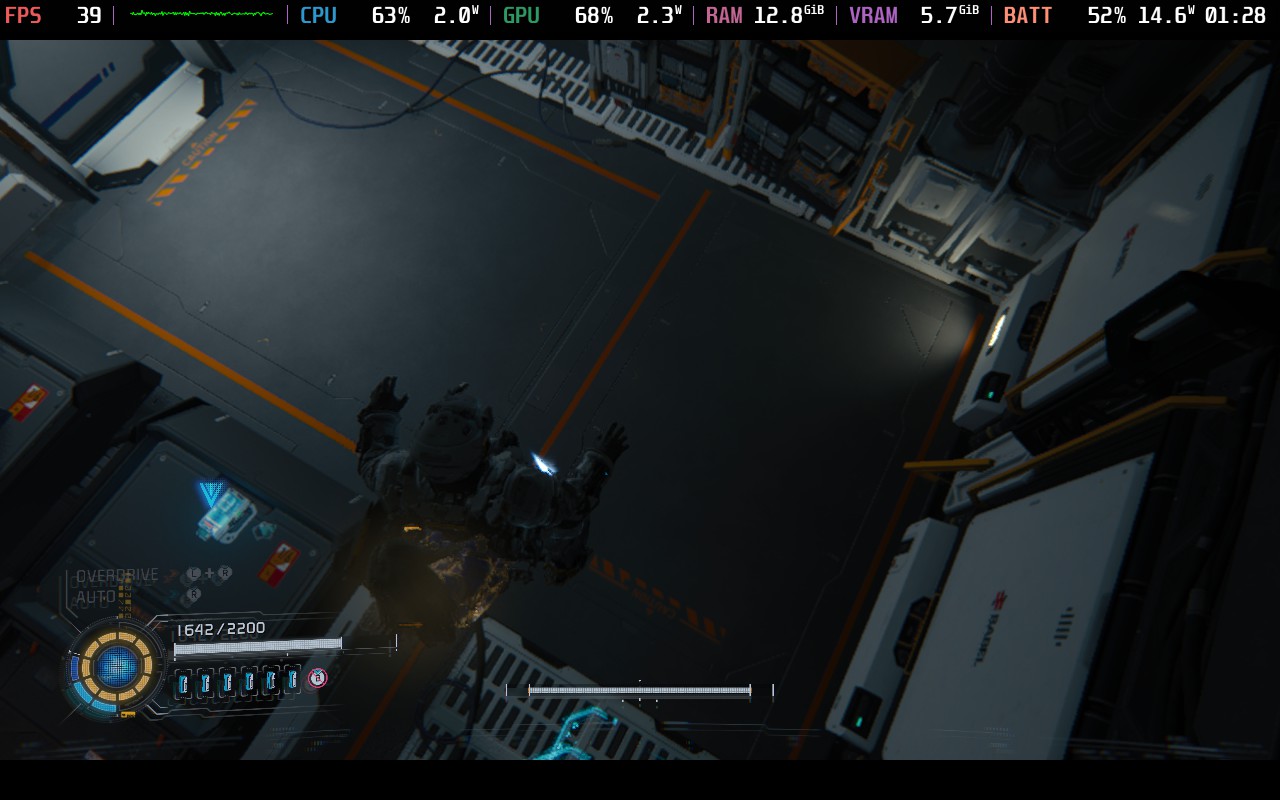
I also want to praise the structure of the game itself. I like that we have individual levels that are a decent size, rather than one giant open-world map. Each level feels unique and has a great design, and I like that we can go back to past levels at will. In the first few levels, we went from a neon-filled recreation of New York to a terrarium with overgrown greenery to walking on the moon’s surface, and it’s just so cool seeing the differences. All the levels also have an assortment of secrets and goodies to find. The amount of each of these is listed in the menu, which is a nice way to keep track of making sure we’ve collected everything, and I felt that every single item to pick up has a worthwhile purpose. I found myself going back and getting these items not just because I wanted to, but because I felt they had real value that made taking the time to go back and find them worth it.
PRAGMATA’s default settings basically bring it to the lowest possible, with the only setting, not at the lowest, being the upscaling quality. However, because this is the RE Engine, the game still looks fantastic. There are a few noticeable issues here and there, like shadow quality in close-up cutscenes, but it does look good when actually running around and fighting. But there are some ways to improve the experience, and it’ll make it much more enjoyable to play.
I also want to quickly mention that the default Proton layer causes a D3D error, so we will have to force Proton Experimental to get the game to run without issues. Proton GE should work as well, but Experimental works all the same. There are also going to be some unavoidable drops here and there, no matter the settings, but it doesn't detract from the gameplay 99% of the time.
At these lowest settings, the game still looks good, but the upscaler is the big problem. The game defaults to FSR 1, which makes the game look extremely shimmery. Even with the upscaling quality on balanced, it still doesn’t look great. This completely changes by making the upscale FSR 3 instead. 95% of that shimmering is gone, and we get a much clearer-looking image.
The one downside is framerate. Because of FSR 3, the game will drain a little bit more power, which brings the framerate down. So, I recommend locking the game to 40 FPS. Granted, even with FSR 1 upscaling and the lowest possible settings, we won’t be getting over 45 FPS throughout the whole game. There are spots where we can hit 60 and above, but as soon as we get to open areas, it will dip. And this happens enough that we can’t just shrug it off.
Because of that, I preferred a clear-looking image with a stable 40 FPS, instead of a shimmery image at 45. I would also say we can keep the upscaling quality at balanced, since I didn’t see huge improvements changing it up or down. I also tried turning upscaling off completely, which makes the game look extremely sharp, even with anti-aliasing on. So, FSR 3 was my favorite to use.
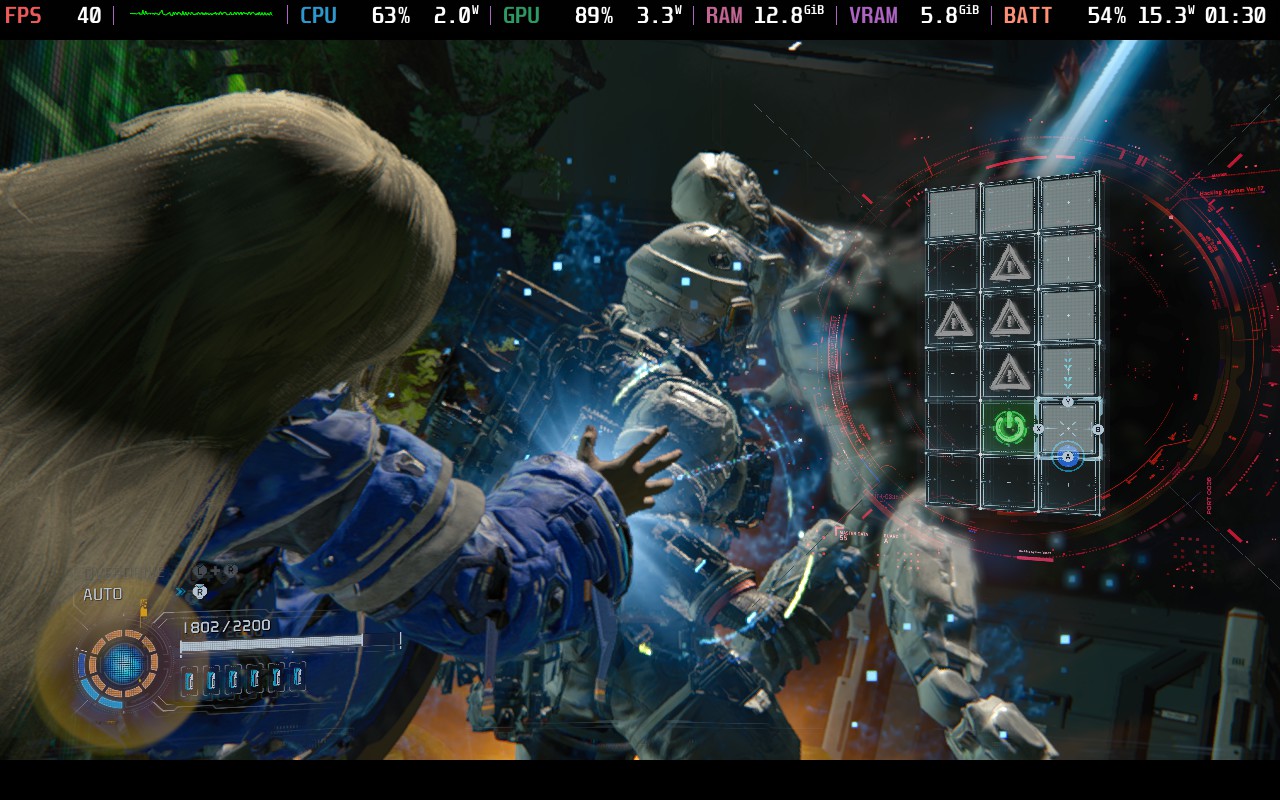
Because of these more open areas, the battery drain will fluctuate, so I recommend not turning on any TDP limit. Most of the game will stick between 14W - 18W, but to account for those open areas, I recommend no limit.
Now, if you want to play the game with higher visual quality, it’s possible, but it comes at a cost. There were some essentials that I wanted to make sure looked better, including making sure hair quality went up, shadows looked more like their objects, Volumetric Lighting was turned on, and effects looked a bit better. Coupled with the upscaling brought up to Quality, the game shows some big differences in quality.
However, we will need to set a 30 FPS limit here. The open areas are not able to handle the extra load at a higher framerate, and it will drain high as well. But the game looks great, and once you get used to 30 FPS, it’s a good way to play.
Personally, I preferred having the higher framerate in combat, but it wasn’t bad after I got used to the lower FPS. But with similar battery life, and with the visuals still looking great with the higher framerate, I decided to keep my recommended settings with the higher framerate.
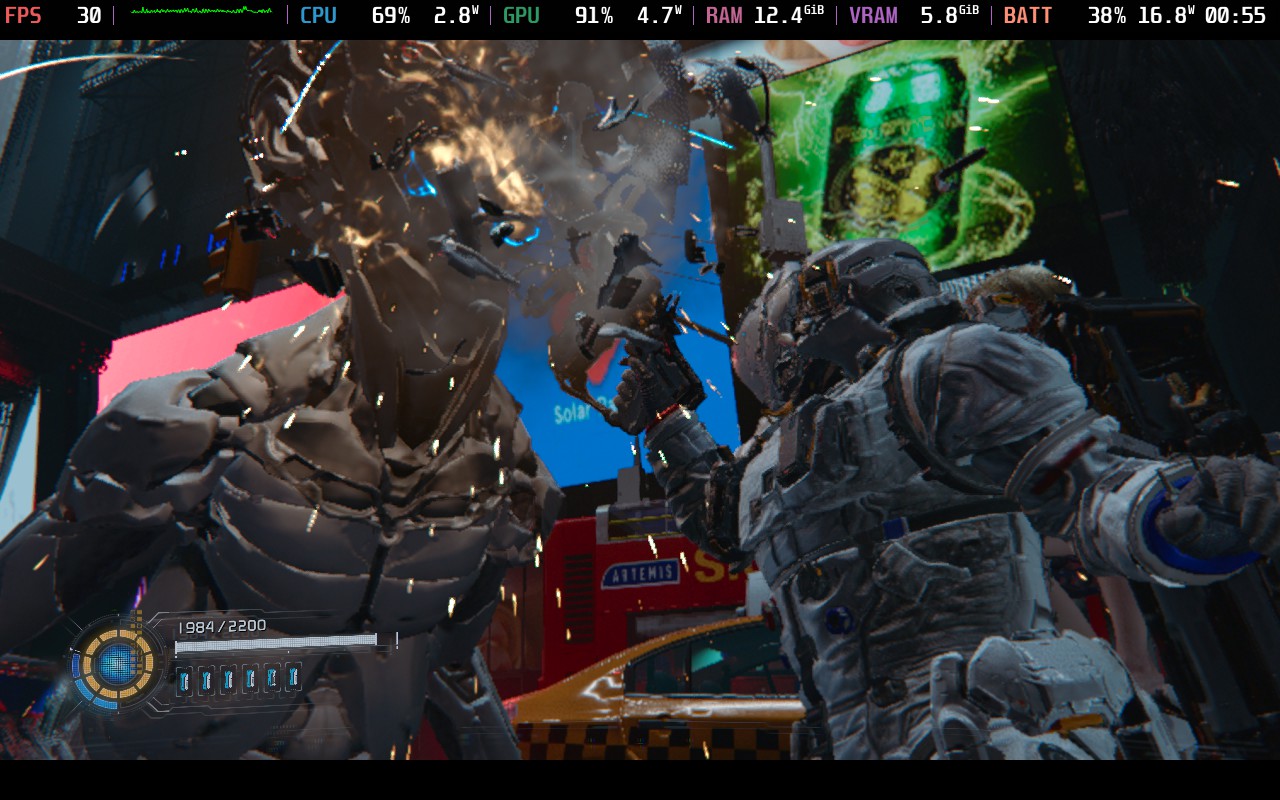
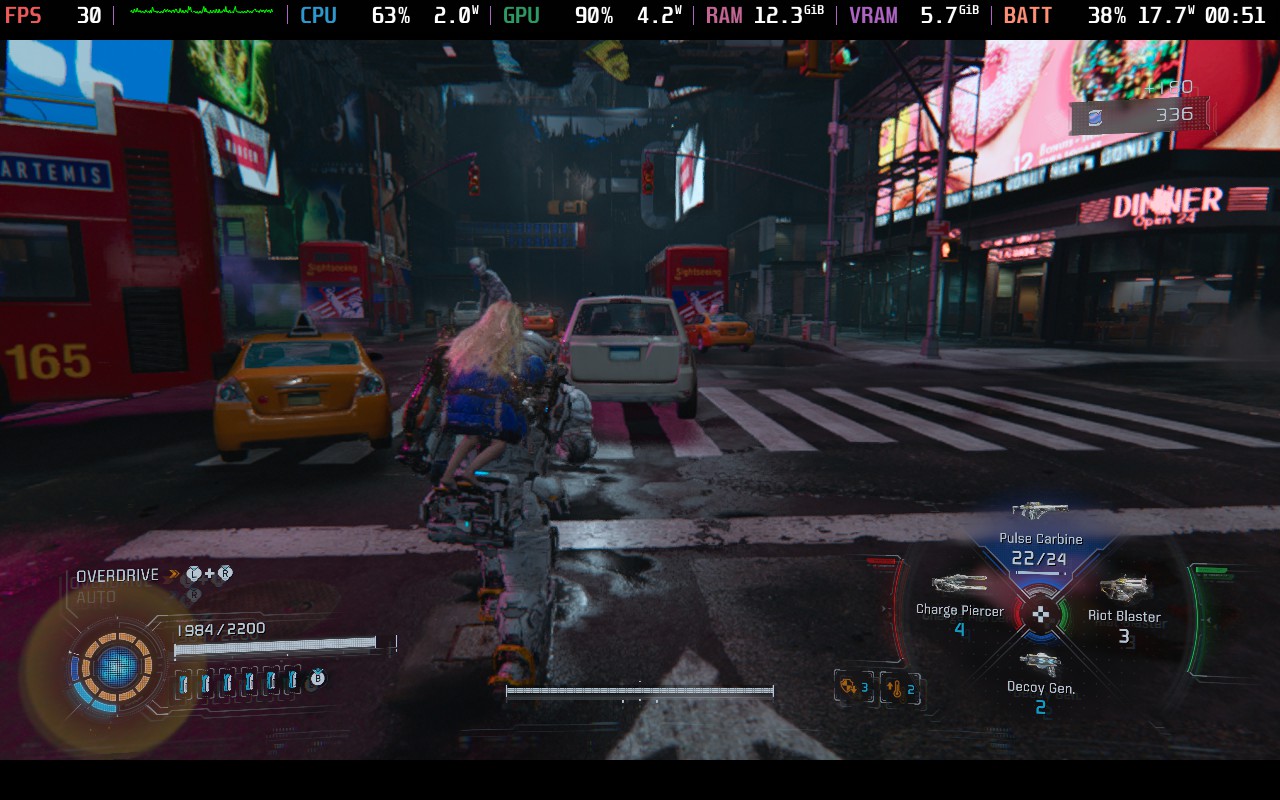
One issue I did notice is that whenever we talk to Cabin, visuals can jitter in conversations. Capping the frame rate fixes this entirely, but if you play uncapped, you’ll most likely notice this problem. Otherwise, the game is great to play on the Deck.
I don't give out perfect scores lightly, and I mulled over this for some time, but there was almost no part of PRAGMATA I disliked. The story had emotional weight and surprised me with its twists, and the combination of puzzle and action in real-time made fights engaging, and the temporary weapons continually made combat feel dynamic. The simple progression was enjoyable, and I felt that every single collectible I could find held meaning that made me more powerful. This is a must-have game. I even went back in to 100% it, which is not something I tend to do, and it's a testament to how much I enjoyed playing.
And even though there are some compromises, the game is wonderful on the Steam Deck. I had such a blast playing through on the go, even if I couldn’t hit 60 FPS. Thankfully, the RE Engine pulls its weight and keeps the game looking fantastic and optimized.
このレビューはPC版に基づいています。
このレビューをお楽しみいただけたなら、SteamDeckHQ の他のコンテンツもぜひご覧ください!あなたのゲーム体験に役立つゲームレビューやニュースを幅広く取り揃えています。ニュース、ヒントやチュートリアル、ゲーム設定やレビューをお探しの方も、最新のトレンドを知りたい方も、ぜひご利用ください。
When I first played Death Stranding when it came to PC back in 2020, I really liked Kojima’s bold and unconventional approach to the gaming industry. But even though the story was great and engaging, the gameplay felt too experimental. Now, one year after the initial release of Death Stranding 2, PC players can finally embark with Sam on a new journey filled with even more struggles, more content, and that signature Kojima-esque insanity, improving upon the experimental nature of the first game.
From the moment the game begins, you're thrown into one of gaming's most expansive atmospheres. A massive, mountainous landscape with almost photorealistic graphics, a goosebump-inducing soundtrack, and a strong sense of freedom. The game lets you know that you are about to embark on a journey that is going to be very special and truly one of a kind from minute one. No game has made me feel this excited and blown away right as we get past the main menu.
The story is set shortly after the first game. Sam has connected all of the UCA, saved the world from extinction, and moved on from his past life, now living a simple, quiet life with his former companion, now daughter, Lou, in a shelter near the Mexican border. But as you might expect, not everything goes according to plan, and he is forced back into his old porter life, this time in Mexico and Australia.
While the game’s narrative retains the predecessor’s mysterious, deep tone, it feels more grounded and clearer, thanks to more action-packed cinematics and a less confusing plot. This is a huge improvement, as almost half of the world’s lore in the first game was delivered through holographic, often dull dialogue. Now, you have clearer goals and more engaging conversations. The sense of loneliness that defined the first game is largely gone as well. This time, you have a crew and masterfully written new characters to accompany you.
Kojima’s infamous, unfiltered, awkward yet fun style also remains, but it feels less out of place and more organic this time. These “what the hell is this?” Kojima moments don’t disrupt the overall serious tone of the narrative; instead, they add a unique signature from the master himself.
The only criticism I have is that the overall story structure feels a bit too similar to the first game. Nevertheless, it’s still one of the most engaging scripts I’ve ever experienced in a video game.
I’m just going to say it without any exaggeration: the graphics in Death Stranding 2 are the best I’ve seen so far. Nothing else comes close. The attention to detail, lighting, and facial features is unmatched in the industry. It feels like mind-blowing witchcraft.
We already knew Decima was a powerful, optimized engine, but seeing this level of almost-photorealistic visuals feels genuinely surreal. Thanks to the game’s new day and night cycle, you can fully experience the beautiful sunny environments, gorgeous sunsets, and the insane blue neon chiral lights at night in every scene. The art direction and design team also deserve praise for turning post-apocalyptic Australia into a vast, incredible playground for us to explore every inch of. The motion-capture performances from well-known actors further enhance immersion, making this the most visually stunning game out there.
Much like its predecessor, the soundtrack and sound effects are also incredibly well done. The BT horror area audio design, in particular, has improved so much that it single-handedly turns these sections into a full-on horror experience. It's flawless.

The most radical and pleasantly surprising change in terms of gameplay is the main story design. In the first game, much of the experience embraced the walking-simulator and cargo-delivery style, while action, stealth, and horror mechanics felt like they were sprinkled in just to keep players from getting bored. In Death Stranding 2, it’s the complete opposite. Almost every main order turns into an encounter-driven sequence, while the traditional “delivery style gameplay loop” is mostly optional.
I’m actually one of the few people who enjoyed the delivery struggles, careful planning, and overall porter-style gameplay, but even I prefer the action-packed approach this time. The main reason for that is the new variety of enemies, which was nearly non-existent in the first game.
Instead of the classic “human enemy,” “a BT,” and “a large boss BT,” we now have a whole arsenal of different enemy types. There are countless BT animals, new BT variants such as Watchers that can see you, and dozens of different mech enemies and bosses. It all feels incredibly rich. And each type of enemy requires its own specific approach, tactics, and weapons, so the original “pre-planning” magic is never lost. If anything, it’s amplified in a different way.
There are countless new weapons, fun and useful tools, transports, customization options, and a massive new talent system that are unmatched in the industry. The new day-and-night cycle adds another layer, with different wildlife and stealth possibilities, along with new natural hazards and much more. The gameplay feels truly alive and fun. The game also offers more dialogue options and lots of fun Kojima-esque mini-games. It feels impossible not to get hooked thanks to the incredible amount of improvements and unique content.
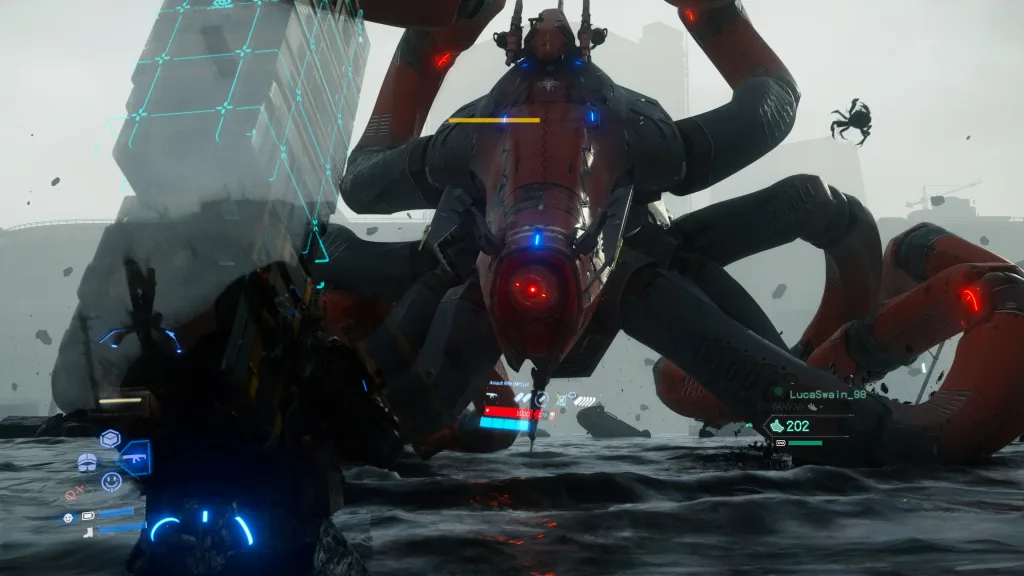
One more thing I need to highlight is the boss fights, because they are genuinely exceptional. After the bullet sponge, amateurish encounters of the first game, DS2 takes a sharp U-turn and delivers some of the best-designed boss fights I’ve seen in years. Each one feels closer to an MMO raid boss, with unique mechanics, strategies, and even puzzle-like elements you need to figure out. They all feature clearly readable attack patterns and hidden weaknesses, rewarding observation and adaptation over brute force.
Especially on the new “To the Wilder…” difficulty, you’re pushed to refine your muscle memory and come prepared. Instead of relying on bloated health pools, bosses hit incredibly hard, often taking you down in just two hits. But because every attack is avoidable with proper positioning, timing, and tactics, the challenge feels fair rather than frustrating, making each victory satisfying.
However, the PC version came with some new features that the original release never saw. The best part exclusive to the PC version is the new “To the Wilder…” difficulty option. Unlike other difficulty settings, once you choose it, you can’t change it. Honestly, it feels like the best way to experience the game.
The spike in difficulty mostly affects the more realistic, simulation-focused aspects. Combat and stealth are largely unchanged. This means you’ll lose your balance more easily, your stamina and battery drain much faster, and natural hazards affect you more severely. If you don’t like auto-piloting through even the walking simulator sections and prefer to stay engaged, I highly recommend giving it a try. You won’t regret it.
The online section of the game largely remains unchanged, with the only new addition being the Aid Request system. If you want something to be built or need specific materials, you can place a request sign anywhere on the map, and other players can help you. Other than that, seeing and using other players’ useful structures still feels awesome. Linking your zip lines with those of other players especially amplifies the sense of “connection” to a whole new level. It was an awesome feature, and it still is.
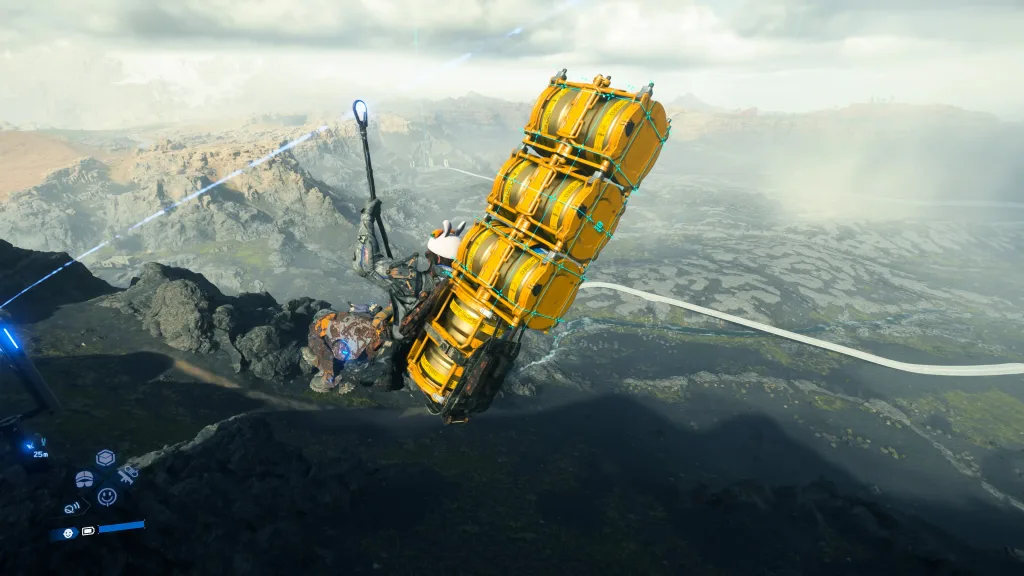
When I first opened the graphics settings for Death Stranding 2, I saw a “Portable” preset and got really excited. But once I applied it and jumped into the game, I was met with a massive disappointment. Even with upscaling set to Ultra Performance, the game struggles to reach 30 FPS outside of cinematics, mostly hovering around 13–22 FPS with heavy compromises. And that’s not even the worst part. I encountered a whopping 40-second freeze, along with a separate crash.
Similar to the first game, it heavily bottlenecks the CPU, and sadly, the Deck just can’t handle it.
Still, the presence of a Portable preset gives me some hope for the future. But even with a stable 30 FPS, I wouldn’t recommend playing this on the Deck. The Portable preset looks terrible, and this is a game that needs to be experienced in full immersion. I’m all for minor visual compromises, but when everything looks like it’s from the PS2 era, that’s simply unacceptable.
I usually hate Frame Generation and never recommend it since it usually creates more issues while fixing FPS. I must admit that turning on XeSS FG makes the game ''somewhat'' playable if you are just building structures, doing side orders, or farming materials. Combat feels awful thanks to the input delay, so stay away from enemy territories.
There are some unofficial workarounds to improve the frames and gameplay, like the Eclipse mod. I tried them all, but they became barely playable, and still not worth the effort and risk. They never perform the miracles we need for fully stable gameplay.
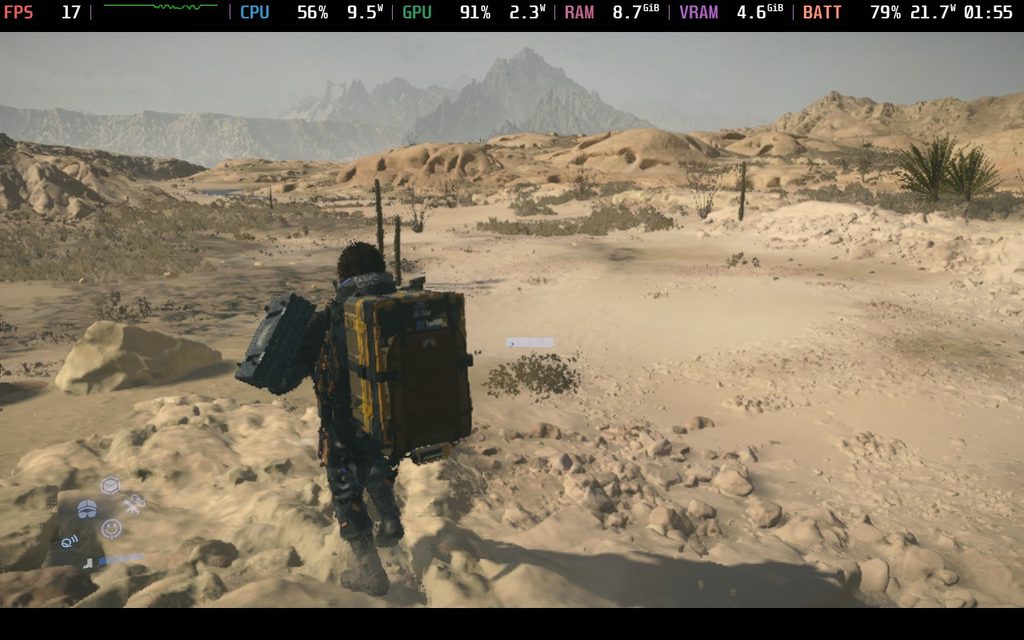
Death Stranding 2 is everything I could have asked for in a sequel and more. Its incredible improvements, combined with insane visual quality and immersion, make it an outstanding experience from start to finish. Even if you were put off by the first game’s gameplay loop, the sequel’s more action-packed approach and more natural, engaging narrative make it feel fresh.
If the “delivery man” aspect of the first game put you off, and you really hated the idea of all the delivering and “walking simulator” elements, that core concept and gameplay loop are still very much here. However, there's a lot more action this time around, and the experience is far more accessible than before, but it still remains a very unique game that simply won’t be for everyone.
Steam Deck users should wait for a couple of patches to see if things improve. It can still be used for simple side orders while you’re away, like I do, but playing the main story with this level of visual flaws and performance issues is something I can’t recommend.
このレビューはPC版に基づいています。
このレビューをお楽しみいただけたなら、SteamDeckHQ の他のコンテンツもぜひご覧ください!あなたのゲーム体験に役立つゲームレビューやニュースを幅広く取り揃えています。ニュース、ヒントやチュートリアル、ゲーム設定やレビューをお探しの方も、最新のトレンドを知りたい方も、ぜひご利用ください。
Crimson Desert was provided by Pearl Abyss for review. Thank you!
Ever since its announcement, I have been getting more and more excited for Crimson Desert. It looked like a gigantic game, brimming with so much content on a huge map that looked so visually pleasing. It was clearly ambitious, with developer Pearl Abyss making a larger-than-life single-player action RPG. Honestly, I was even a little worried the hype would not be worth it. Yet here I am, with over 70 hours in the game, and I fell in love with the world of Pywel, despite some execution mishaps. Crimson Desert lives up to its expectations in more ways than one, even if what makes it incredible also harms the experience.
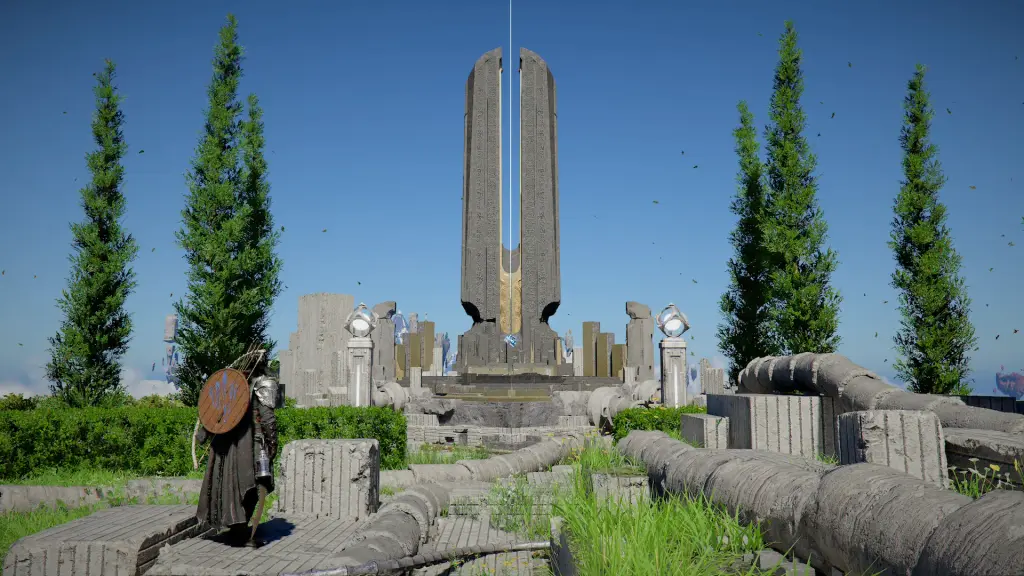
Visually, Crimson Desert is stunning. Through the forestry landscapes, snow-covered mountains, red-hued deserts, and futuristic islands, the world consistently looks incredible. I was blown away by how many times I had to stand still and just take in the sights, watching as the purple and white flowers blew back and forth with the wind on a mountain with a gorgeous backdrop of the town beneath me. I couldn’t count how many moments I was riding my horse and just had to take pictures to remember the beauty of the setting, and I can count the number of games on one hand where I had this compulsion. This is a world worth exploring, even if it’s only to see what the other side of the continent looks like.
And boy is Pywel massive. I spent the first 30 hours or so going around the giant town and its surrounding areas, completing side quests, and moving along the story across 5 chapters. It is a significantly large area covered, and I was sure it would primarily take place in this area. However, I could not have been more wrong. In those first 30 hours, I had only explored around 25% of the map, with gigantic regions that I still haven’t gone to. I was actually blown away when I was looking at the map and seeing how much area I had covered, which was only compounded when I saw the landscape from above in the abyss. That sense of wonder never disappeared, and I was so motivated to keep on exploring.
However, traversing the world, especially in the early game, was not enjoyable. Having to figure out how to find fast travel points and the scarcity of them early on meant running around or riding my horse. With so many places to go back and forth, and fast travel points not feeling close enough to where I needed to go, it started to feel like a chore to do side quests all in the same area. I didn’t mind exploring new areas, but I very much disliked backtracking in areas I already knew. This gets significantly better later on as we unlock more points and get new ways to go around the world, like the dragon, but early on, it wasn’t great.
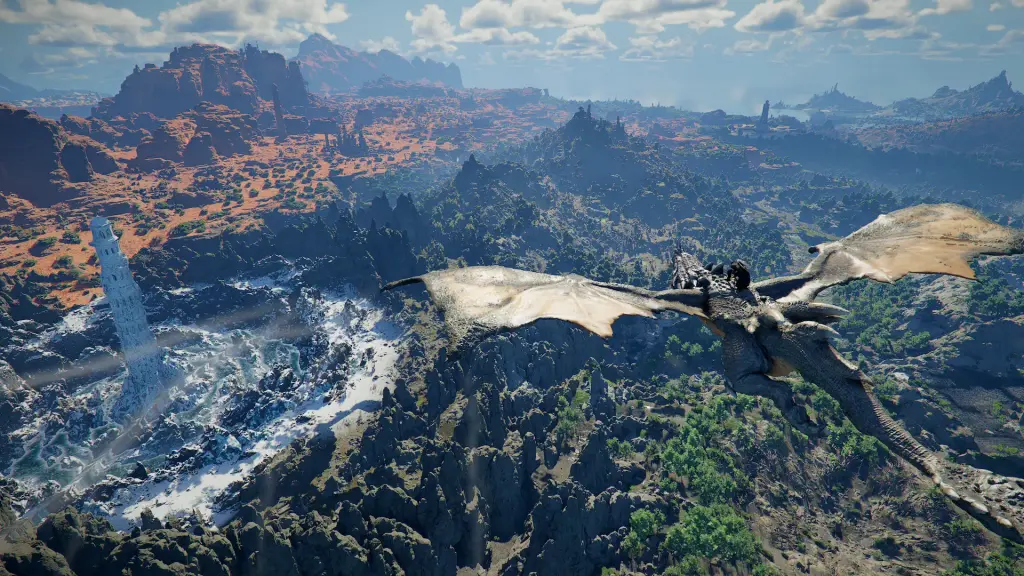
Now the world is littered with secrets to find, and I would find myself hunting them whenever I could. They can be somewhat well hidden, though if we use the lantern, we can see a glimmering light where those secrets are. In these secrets could be entrances to puzzles, Sealed Abyss Artifacts, or those aforementioned fast travel points. Completing puzzles also turns into fast travel points, which does make it a little bit better, but it’s not something that will help a lot early on. Still, the rewards outweigh the issues heavily.
I was also pleasantly surprised by the story. It wasn’t anything new, but it was still entertaining with so much lore packed in through side quests. We follow Kliff, who, with his fellow Greymanes, is attacked by another group, the Black Bears. They are slaughtered and kicked out of their country, Pailune. However, we survive, and decide to start rebuilding the Greymanes in Hernand. But that’s not all. We are also selected by the Abyss to help balance the world, giving us interesting magical powers.
This is essentially what set us off on our journey. We face riddling defeat, get magical powers, and decide to rebuild and come back stronger to save Pailune. However, there are some twists and turns that I didn’t expect, and the game became significantly longer and larger than I had previously thought.
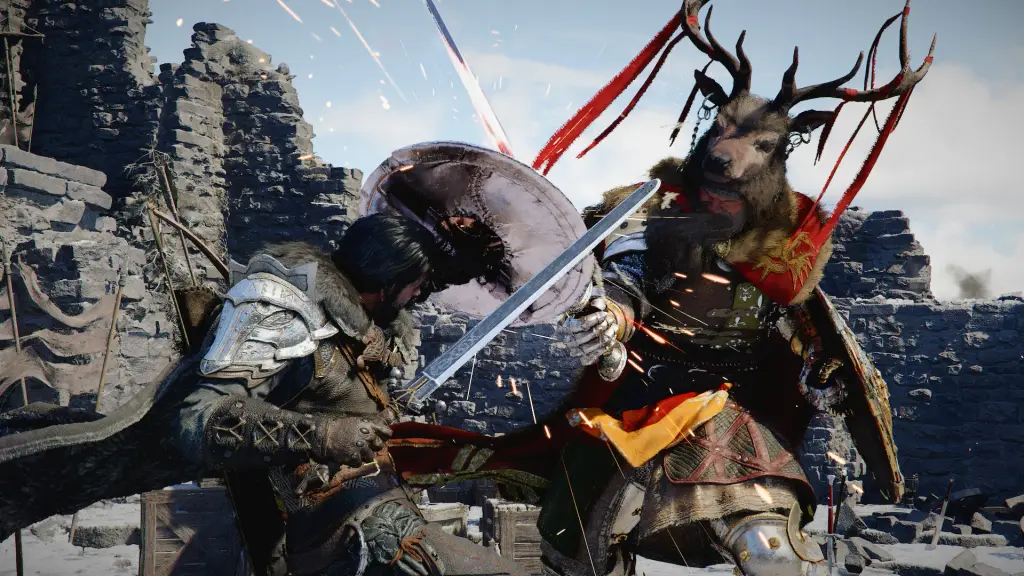
There’s also a wealth of side quests and extra content to give us much more insight into the characters and lore of the world, including multiple playable characters who all have their own story elements. Even at the 70-hour mark, there was still so much to unlock, so much to do, and it felt like I always had something to learn about. As far as the story goes, I was pleasantly surprised the longer I played.
Now let’s talk about the gameplay, which is arguably going to be the biggest part of this review. Crimson Desert has an overwhelming amount of content that exudes across all facets of the game. In the opening hours, it can feel pretty overwhelming, but once things settle in and open up a little bit more, more mechanics start to come to light and are understood, and it all just clicks. This is one of the big reasons it succeeds; it never gets to the point of significant overload and can still be very manageable.
One of the biggest draws to the game for me was the combat. Seeing it in action, just looked insane, with unique abilities, flashy effects, and ridiculous attacks like clotheslining and dropkicks. All of these attacks are indeed in the game and quite easy to use with practice. For the most part, combat is exhilarating. When everything works, fighting groups of 20 enemies with the diverse moveset we have, which includes our ranged attack in magical strikes, it’s the best. And it’s a system that gets significantly better further in the game once Abyss Cores (Abyss Gears) come into play.
However, it will take some time to get used to it, and while there are a lot of options for us to use, I would ultimately not use some of them or completely forget how to activate others. Most of the attacks we have are linked to one of many combinations of six different buttons, and it was sometimes very hard to remember exactly which does which. Even though it was one of the initial moves, I learned that I almost never found myself using Blinding Light, and I consistently forgot about shield bashing, grappling, the flying kick, and spinning slash. I love having options, and when I remember which attack to use, it’s awesome. But there are so many different combinations that do so many different things that I found myself getting lost and sticking to the basic attacks I memorized.
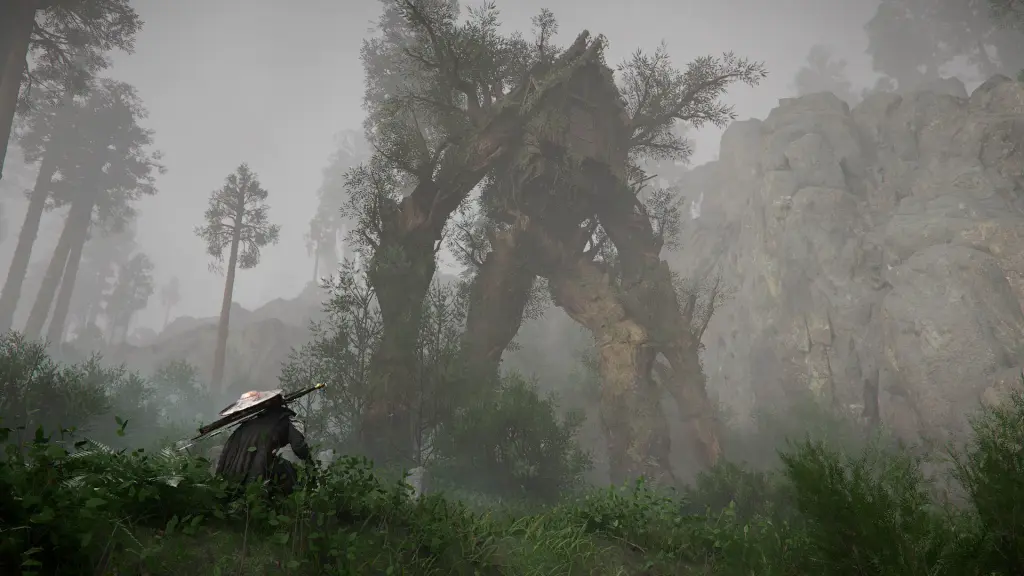
The controls and targeting can also feel really wonky. Even if I automatically lock onto an enemy, my attack will sometimes go in the wrong direction, or the game will automatically lock onto an enemy I’m not actively attacking. I also had trouble trying to aim my meteor kick, which is a giant kick that comes from above and can hurt a bunch of enemies around. Without any modifications, this kick needs to land a direct hit on the enemy, and I cannot count the number of times I have locked an enemy in the targeting ring and still completely missed.
Yet, despite all of this, I looked forward to every battle. There’s just something so enticing about the scale, the effects, and the abilities we have that just keep combat so entertaining. Remembering older attacks and finally utilizing them was exciting, but I would say the big reason to keep coming back to it is those Abyss Cores (Abyss Gears). Bosses could be a hit or miss, with some feeling a little too difficult, but with some grit and strategy, they were able to be destroyed.
Different parts of your gear have different sockets, and in the sockets, you can put in Abyss Cores (Gears). These can completely augment your abilities and stats, which can range from better attack, movement, speed, or even making it so orbs of lightning come out of your sword. The effects of these can range wildly, and make some of your attacks insane. On top of that, you can synthesize and craft more powerful cores, so you can keep getting stronger and stronger. This, on top of getting resources to refine weapons and armor, to make them more powerful, will be the crux of how we progressively become stronger. It’s an extremely compelling system, and I cannot overstate enough just how great playing around and combining Abyss Cores (Gears) is. It’s tough to get into it until later on in the game, but the wait is worth it, especially once we start playing with elemental powers.
It’s a genius system, complemented by Crimson Desert’s great skill tree. I was a little worried when I heard that this giant action RPG wouldn’t have leveling or any exp system, but my worries were unwarranted. Instead of the usual leveling, we have a skill tree reliant on Abyss Artifacts. The skill tree itself can give us a boost to three of our stats and unlock a wide range of new attacks. The tree, containing mostly new ways to beat down enemies, made it feel more rewarding to actually complete it. I would tend to get a little fatigued if the skills I want are locked and I have to go through multiple nodes that I don’t care about. However, that’s not the case here, and it’s great.
There are multiple ways to get these artifacts we will need, but the majority of them will come from random drops from killing enemies, side quest rewards, and completing different puzzles or challenges. All of the puzzles felt appropriately difficult, and they require some out-of-the-box thinking and logic. As for the challenges, which are found from Sealed Abyss Artifacts, they vary between different activities in the world, side quests, and special challenges with the weapons. With hundreds of these to do, it feels like a never-ending way to get the artifacts necessary to make us more powerful.
Which will be needed, because all of the characters we can play as have individual skill trees to go with their unique movesets and weapons. They do share the three stat upgrades, but there are going to be individual skills to unlock independently. With how many artifacts we can get, as well as random drops from time to time, it never felt daunting to complete them. If anything, I was more motivated to grind, knowing I was going for artifacts versus experience points.
Crimson Desert sometimes feels like a life-simulator RPG outside of combat with how much they throw at you. There is so much to do outside of combat, and they all feel beneficial. Not including side quests, there’s a full camp management system where we can send our crew to complete missions to get camp resources to take on bigger missions to give us more resources for personal use and even unlock new mounts. We will also be able to partake in tons of different little activities, like mini games for arm wrestling, fishing, mining, and logging for resources to upgrade our weapons. And of course, we have the puzzles, which can be scattered throughout the world and above.
On some level, the game gave me the impression that it was trying to do so much, but not mastering any of it. However, I never felt like I needed to do any of these. All of this stuff is optional, as we can find a lot of these resources off the bodies of bandits we kill, we can trade in unwanted weapons to get resources for our camp, and traveling gets much easier later on. Nothing felt forced, but everything felt worthwhile. And it helps that we unlock new abilities later on that can make some of this much easier. I also think it’s one of the coolest things that we can learn new recipes and information by scanning and reading books. It’s small, but I enjoyed picking up recipes and making sure I scanned them so I could cook them later on.
In the beginning, it was very overwhelming. It felt like there was so much I could do, and every part of me wanted to grind and explore. However, with how the game is structured, it’s best to follow along the main story for a while. There is an update for the game that fast-tracked some of this, including getting Abyss Cores (Gears) and a tutorial earlier, but there is so much that opens up the more you play that spending extra time early on to unlock more of the world will be more rewarding later on.
There will also be a Day 1 patch that drops as soon as the game launches, which does smooth out progression and fixes some key bugs. It doesn't change my thoughts on the game, but it is a welcome update.
There’s been a lot of speculation as to how Crimson Desert would run on the Steam Deck, but unfortunately, it’s an experience I can’t recommend. The reason this was posted so late is that the game did not work on the deck until a day before the embargo was lifted. Because of that, there was not enough time to test all the areas and fights that I wanted to, as well as the different settings we could try. Now, I’ve had that time, and there’s no way I can recommend playing this on the Steam Deck.
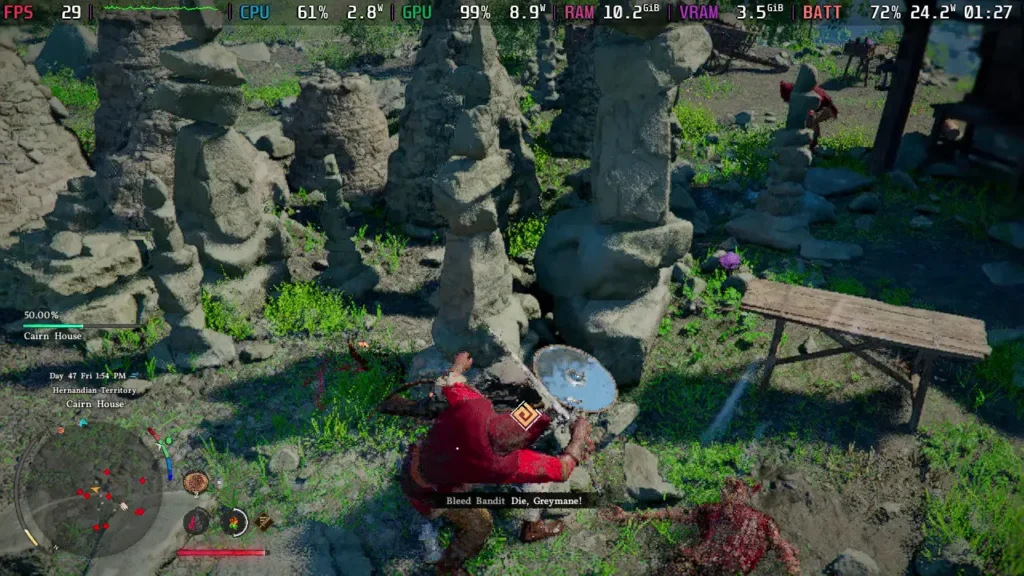
Before lunch, there were a couple of ways we could get the game running on the deck, but now it seems Valve pushed a fix to the Proton Hotfix branch, which is now the default. And it does work, so that is what I used primarily for testing.
For whatever reason, the game will boot up at the highest quality setting, possibly in an extremely high resolution. For me, the game was set to cinematic quality at 4K resolution. You will need a little bit of patience to get through the settings, as it sometimes takes a little too long to apply the new settings. I even had to restart the game once just so I could get to the settings, since it was taking so long just to apply the brightness filters.
After all is said and done, it doesn’t even matter how low the settings go; it will not hold a stable 30 FPS. Running across open fields, solving independent puzzles around the world and in the Abyss, and fighting small groups of enemies should hold strong at 30 FPS on the lowest possible settings with FSR 3 upscaling at Performance. There may be some minor drops here and there, but they’re relatively unnoticeable. We can also bring down the upscaling to Ultra Performance to keep it at a smooth 30, but the game becomes a washed-out, pixelated mess. Because of this, I do not recommend going lower than Performance.
Now, as soon as we get to larger cities, bigger fights with 20 or more people, and going around the world in a faster way than running, the framerate will drop. In these moments, I could see it get to as low as 17 FPS, which is horrible for combat, but just not enjoyable as a whole. Bosses and mini-bosses could bring it down even further because of all the visual effects that they have, making fighting them relatively impossible.
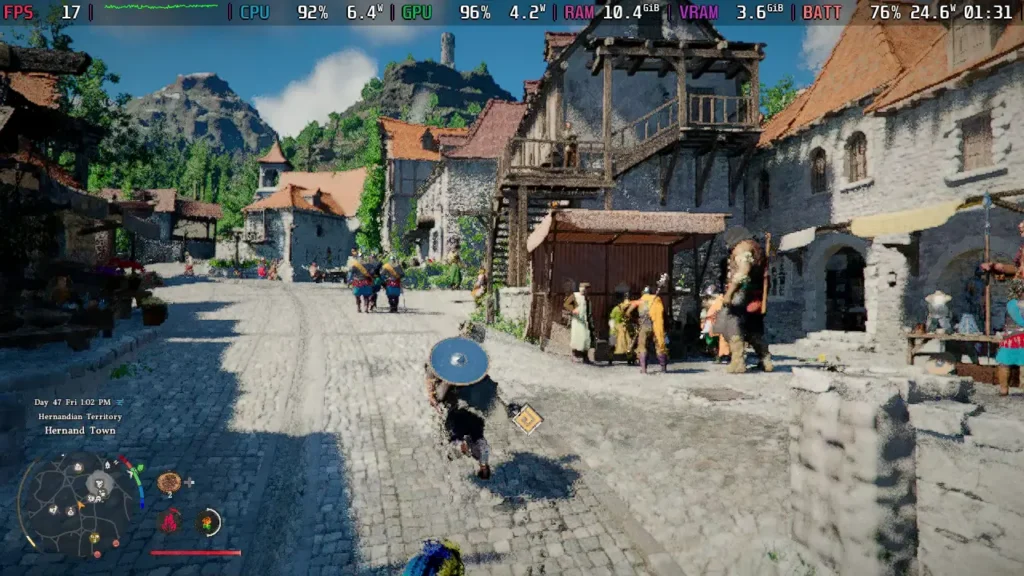
And for those who want to try frame generation or lossless scaling, please don’t. In most scenarios, the game will feel smoother with lossless scaling. However, it will not keep a solid framerate, stutters will appear in the areas where the framerate drops, and the input lag is atrocious. Even at just 2X for lossless, I was getting major lag to the point where I couldn’t dodge at the right time or execute attacks that I wanted to. This kind of lag is a death sentence for any major fights against harder enemies or bosses, and will immediately ruin the experience. It is not worth it.
So, when all is said and done, Crimson Desert is not a game I would play on the Steam Deck. There are too many compromises that make it nearly impossible to enjoy fully. Is it decent for exploration, puzzle solving, and secret finding to complement a more powerful rig that the game is mainly being played from? Yes, it is. I actually did this a few times, where I just focused on exploring the world on the Deck when I took a break from sitting down at my desktop. However, there’s no way I could see playing this through completely on the Deck. If you have a more powerful PC or a console like the PS5, it will be a better experience there. The game is also available on GeForce NOW to stream, so that is also an option.
After reading my review, you might be wondering why Crimson Desert has such a high rating despite a good amount of grievances. There is one big reason, and it’s that despite these grievances, I found myself craving more. I would go in to play for one hour, and I would come out four hours later, satisfied. It didn’t matter how frustrated I would get; the joy of playing through the game overtook it immediately. The sheer amount of content is overwhelming, but it never overloaded me. There was always something to do, and even if it was a little difficult at times, it was always fun. Pearl Abyss found a way to weave everything together in one glorious, large, monstrous package that is a joy to experience.
I didn’t think it was possible for a game of this scale to exist yet, and I don’t recall the last time I ever played a game that wasn’t designed to be replayable that hooked me for such a long time. But here we are. The game lived up to its hype, and even though it isn’t perfect, Crimson Desert is one of the best RPGs I have ever played.
このレビューはPC版に基づいています。
このレビューをお楽しみいただけたなら、SteamDeckHQ の他のコンテンツもぜひご覧ください!あなたのゲーム体験に役立つゲームレビューやニュースを幅広く取り揃えています。ニュース、ヒントやチュートリアル、ゲーム設定やレビューをお探しの方も、最新のトレンドを知りたい方も、ぜひご利用ください。