まだの方は、X(Twitter)、Mastodon、Blueskyでフォローし、新しい記事が投稿されたらお知らせください。また、Redditに参加したり、YouTubeに登録して、私たちのコンテンツをチェックしたり、素晴らしいコミュニティと交流してください。応援ありがとうございました!
Resident Evil Village on Switch 2 was provided by Capcom. Thank you!
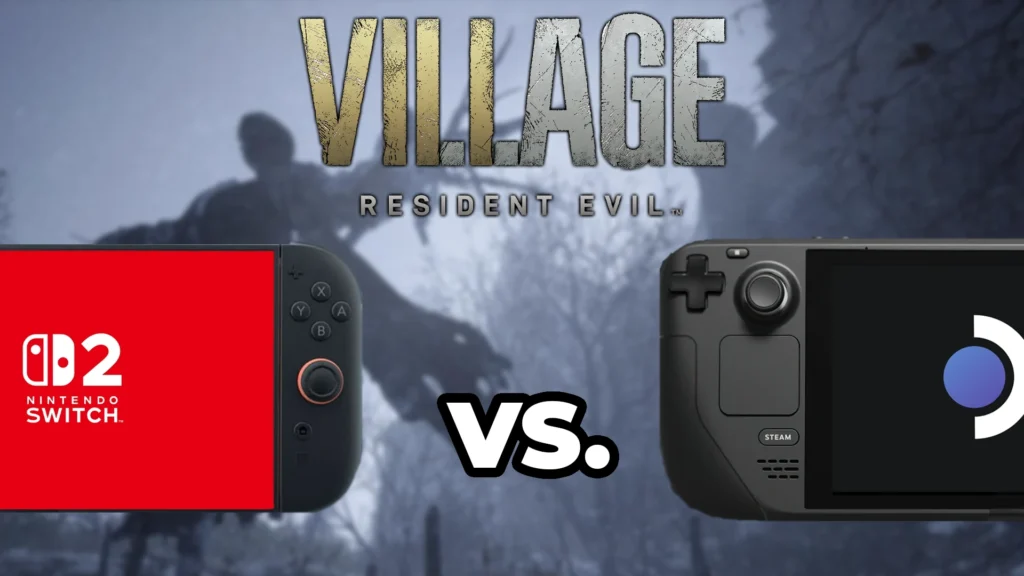
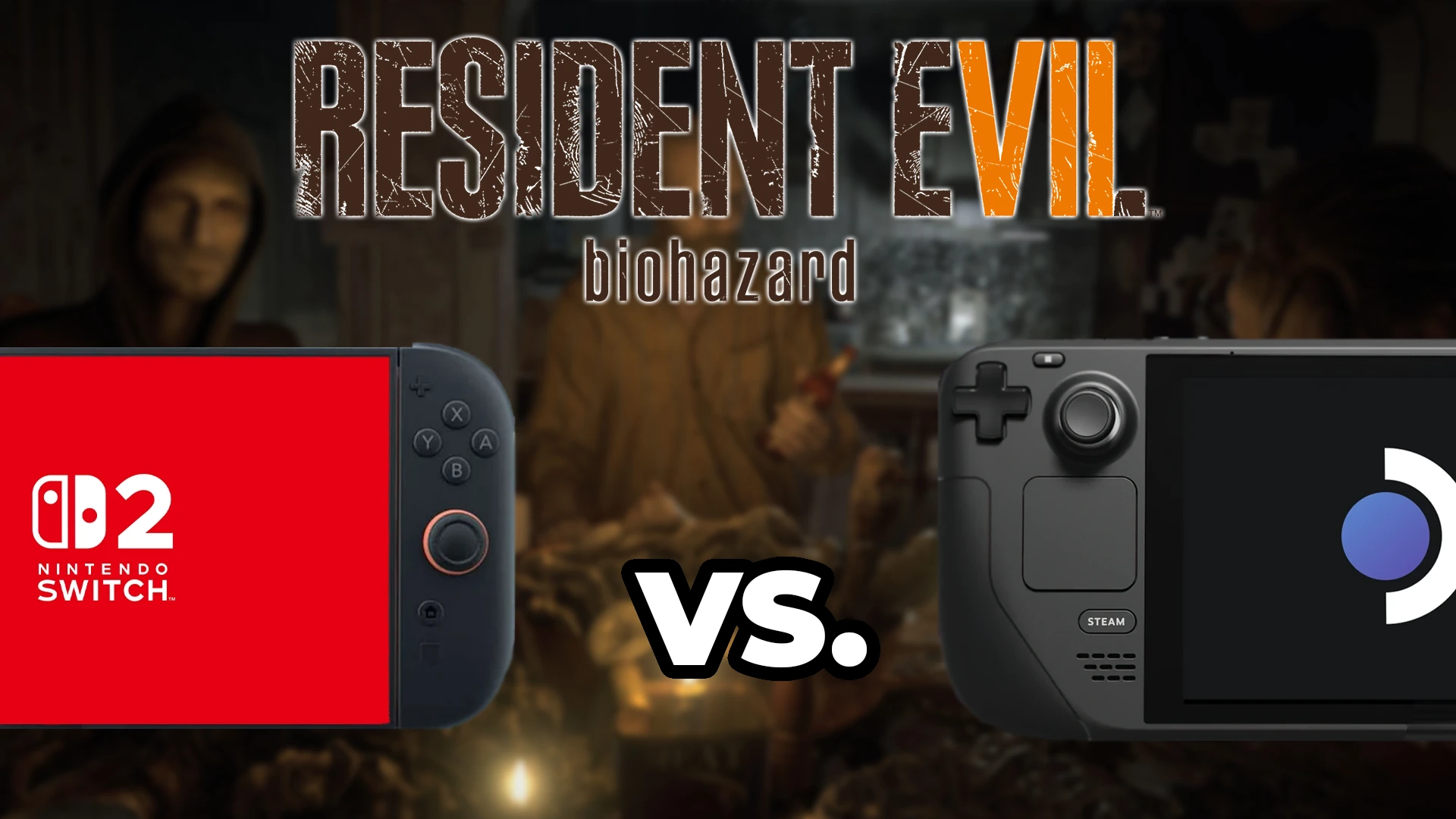
Resident Evil Requiem is nearly here, and with its release on the Nintendo Switch 2, Capcom is bringing the previous two mainline games as well. Both Resident Evil 7 and 8 are coming to Switch 2, dropping on the same day Requiem is (February 27th), and I couldn't be more excited. Capcom sent us over Resident Evil 7 and 8 on the Switch 2 to check out for ourselves, so I decided to do some comparisons between the Steam Deck and Switch 2 to see which version is going to have the best handheld experience.
So, let's check out Resident Evil Village and see where you will get the best experience:
Price Comparison
Starting off with the price, Resident Evil Village Gold Edition will cost $49.99 on the Nintendo eShop if buying it separately, while it is currently on sale on Steam for $14.99. While the sale only lasts until February 26th, the game does regularly go on sale, so finding it for this price isn't uncommon.
Buying Village individually will be cheaper on PC/Steam, but if you plan on buying Resident Evil 7, Village, and Requiem all on the Switch 2, the Generation pack for $89.99 will be the best deal, no matter what. However, this pack will disappear on March 31st, so you have 1 month to take advantage of this better deal.
Switch 2 Handheld Vs. Steam Deck
I expected Resident Evil Village to be a bit harder to run when compared to 7, but it was a lot more noticeable than I expected. While Village on the Switch 2 starts off stronger, as soon as we actually get to the village, the framerate will drop dramatically. It's a night and day difference, going from an ok 60 FPS to fluctuations that feel below 45 FPS. There's no framerate lock either, so it will sometimes feel like 60, while other times it will go much further down. In enclosed spaces and in buildings, the framerate should be ok, but going outside is a mixed bag that just feels jarring.
On the Steam Deck, framerate is much closer to 60. It doesn't completely hit it with the default settings for the Deck, but it's definitely much closer than the Switch 2 in handheld mode. We also have the option to cap the framerate, which I would recommend at 45 FPS, and it overall feels smoother than the Switch 2's handheld gameplay.
As for the visual quality, this one may come down to personal preference. The Steam Deck and Switch 2 have generally similar quality levels, with some big differences that are apparent as soon as you see them side by side.
Despite the Switch 2 running at a higher resolution (1080p), the image quality looks blurry. This does help shadows a bit, but it makes the entire game look like it's running at a lower resolution. When looking at the Steam Deck, we do have a much sharper image, which I would say makes the game look better overall. There are some rough edges and some shadows look too sharp, but when looking at the game on the smaller handheld screen, it's not noticeable much.
I also noticed this glistening effect when walking around on the Switch 2, which is usually indicative of upscaling. While some games can hide this fairly well, Village doesn't. So, when walking around, there are some edges that will glisten and look pixelated, then will smooth out as soon as you stop moving. This effect is not happening on the Deck, or at least not to a noticeable extent.
Battery Life (Handheld) and Loading Time Comparisons
If you are trying to play on the default settings on the Steam Deck, then battery life will be around the same. However, as we will note later, there are changes that can be made to the settings to increase battery life on the Deck. But for right now, since we are going by out-of-the-box settings, it will be around 2.5 hours on each device.
As for loading times, the Switch 2 comes out on top once again. The Switch 2 takes about 5.5 seconds to get to the skippable splash screens once you hit play, while the Steam Deck takes about 18 seconds. Loading into a save game takes 10 seconds on the Switch 2, and takes about 11 seconds on the Deck. And as for saving a game, it takes 2 seconds on the Steam Deck, while being instantaneous on the Switch 2.
So, for battery life, it's a tie, while the Switch 2 takes the cake for loading and saving time.
Switch 2 Docked Enhancements
When it comes to playing docked, it solves some of the image quality issues. It doesn't look sharper, but it does look like it's rendering at 1440p, and the details pop out more. The glistening effect when walking around is also either gone or unnoticeable, which is very nice. Quality details are about the same, but the bump in resolution and removal of the glistening fixed the two more prominent issues I found when playing handheld.
However, it doesn't solve the framerate drops when in the village. Even when docked, I still had drops below 60 FPS, and while it may be slightly better, it's still extremely noticeable and obnoxious. I was actually quite surprised by this. The Switch 2 docked is more powerful than the Deck, and the Deck can push to almost 60 FPS on default settings. Maybe it's due to pushing to 1440p resolution, but this feels like an optimization issue that could have been solved.
Further Steam Deck Improvements
As for further Steam Deck improvements, there are changes to the settings that we can make to change how we play. We could just cut the framerate down to 30 and turn the settings up, or just keep at the default to extend battery life. But, we can also turn on FSR 1.0 upscaling to Quality and start getting 60 FPS throughout the village. Is it a worse image? Yes. But it comes with a full 60 FPS throughout the game.
The beauty of the Deck is that it's a PC, which means we can access settings and change them to fit our desires for the game. Running well out of the box is nice, but having the options to modify how we play the game is always a treat.
So Which Handheld Should You Play On?
Despite the Switch 2 having a higher resolution, the edge overall goes to the Steam Deck here. The sharper quality looks better on the handheld screen, and with a more stable framerate and no glistening effect, it's just more enjoyable to play on the Deck. The Switch 2 docked improvements do help in some areas, but the fact that it still suffers from framerate drops is odd and disappointing. The Switch 2 does have shorter loading and save time, but with the changes we can make on the Deck, it's hard to look at this and say the Switch 2 is better.
So, my choice would be the Steam Deck here. It feels like the Switch 2 was underutilized or just not optimized enough to take advantage of the extra power it has. The resolution bump is very nice, but I can't get over the massive framerate drops when in the village. I would ultimately say that Resident Evil Village will be a better experience on the Steam Deck.
Resident Evil Village Gold Edition is on sale for the Steam Deck for $14.99, while over on the Switch 2 eShop, you can get it for $49.99.
この記事を楽しんでいただけたなら、SteamDeckHQ の他のコンテンツもチェックしてみてください!あなたのゲーム体験に役立つゲームレビューやニュースを幅広く取り揃えています。ニュース、ヒントやチュートリアル、ゲーム設定やレビュー、最新のトレンド情報など、あらゆる情報をお届けします。 カバーしています!

最近のニュース
カテゴリー
Accessories
Anbernic
Android
ASUS ROG Ally
ROG Xbox Ally
Classics on Deck
Community
Cryobyte33
Deals
Deck Mods
Emulation
Events
Featured Post
Game News
Game News
General Game News
HandheldHQ
Hardware
Lenovo
Linux
MagicX
Nintendo
ONE-NETBOOK
Opinion
Other Reviews
Accessory Reviews
Handheld Reviews
PlayStation
Proton
Retro Handhelds
Anbernic
AYANEO
AYN
GPD
MagicX
MANGMI
Retroid
TrimUI
SDHQ
Steam
Steam Machine
SteamOS
The Unsupported Report
Uncategorized
Uncategorized
最近のヒント&GUIDES
新着レビュー