



Moros Protocol was provided by Super Rare Originals for review. Thank you!
The Roguelite FPS genre has really been kicking off as of late, and Moros Protocol is here to give us a "boomer shooter" twist to the format, with fast-paced combat, 2-player co-op gameplay, and some retro-esque visuals.
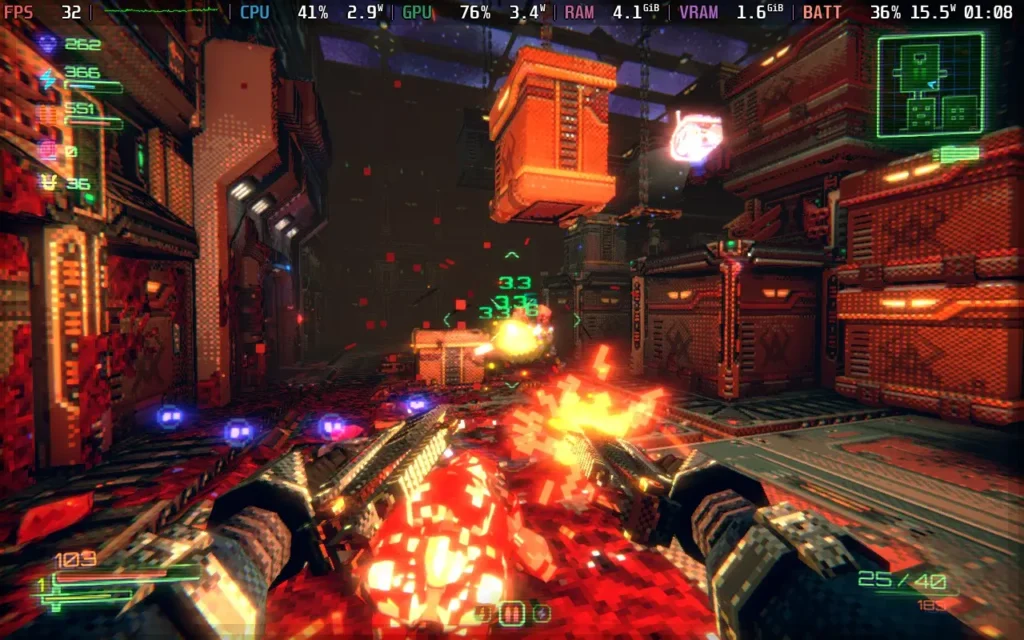
Moros Protocol pretty much throws you in at the deep end, in the body of a soldier stranded on a warship that has succumbed to horrendous creatures, with no knowledge of who you are or how you got there. The one thing up your sleeve is that if you die, you are revived in a new body, with your memories intact. Now you have to progress through the ship's various decks and find your way out of this nightmare scenario.
The game manages to vary each run by giving each level you play through a random effect, such as featuring more weapon pickups, playing during a blackout to make it harder to see, or increasing the strength of enemies for that floor, the latter 2 of which grant you additional rewards. The differences are fairly minor, but I can't say I found the game repetitive.
Moros Protocol also has a nice balance regarding weapons, from melee swords, basic pistols, pistol shotguns, and dual-wielding weapons. Ranged weapons are usually the most effective, but ammo isn't abundant in the game, so if you rely solely on your ranged weapons, you'll likely encounter ammo woes at some point. So it's best to use your melee weapon where possible. Ranged weapons are divided into physical and energy ammo, which creates a good balance where you don't just pick one weapon and stick with it; you have to change between your two ammo types and melee weapon if you want to succeed.

The action is fast-paced, and you'll mostly find yourself sprinting around tight rooms, avoiding enemy attacks, and slicing or shooting your way through enemies. The movement is nice and smooth, and with the guns and even the melee weapons feeling satisfying to use, with plenty of visual effects/feedback from enemy deaths, it all comes together to create some nice gameplay.
However, I felt the balance was slightly lost regarding the game's progression. Either I'm a bad player, or the game doesn't give you much of the currency you use to upgrade your character between runs. In some situations, even after clearing a few sectors, I still didn't have enough points to unlock any upgrades, thanks to some being more expensive than others. The upgrades are often pretty tiny in their scope, such as offering 2 additional HP, which is not much, when a single hit from a basic enemy deals several times that amount.
For the first couple of hours of playing, I felt that I had barely improved my stats and was only doing better because of experience and game knowledge. It takes a while before your upgrades become meaningful, and the difficulty spike for bosses is quite brutal, holding you back from progressing quickly.

You can't pause Moros Protocol, annoyingly, even in a single-player run. If you do need to take a break, though, progress is saved up until the current "Sector" that you're on, which roughly equates to an autosave every 5-10 minutes, depending on how fast you progress, so you can close out of the game mid-run and resume it later.
Visually, the game adopts a pixelated aesthetic, which I really like. It still combines some modern rendering techniques and is a great blend of feeling like an early '90s game but with the smoothness and refinement we would expect from a well-made modern title. Like the visuals, the sound enhances the fast-paced action with high BPM (though quiet) music and visceral sounds when enemies explode.
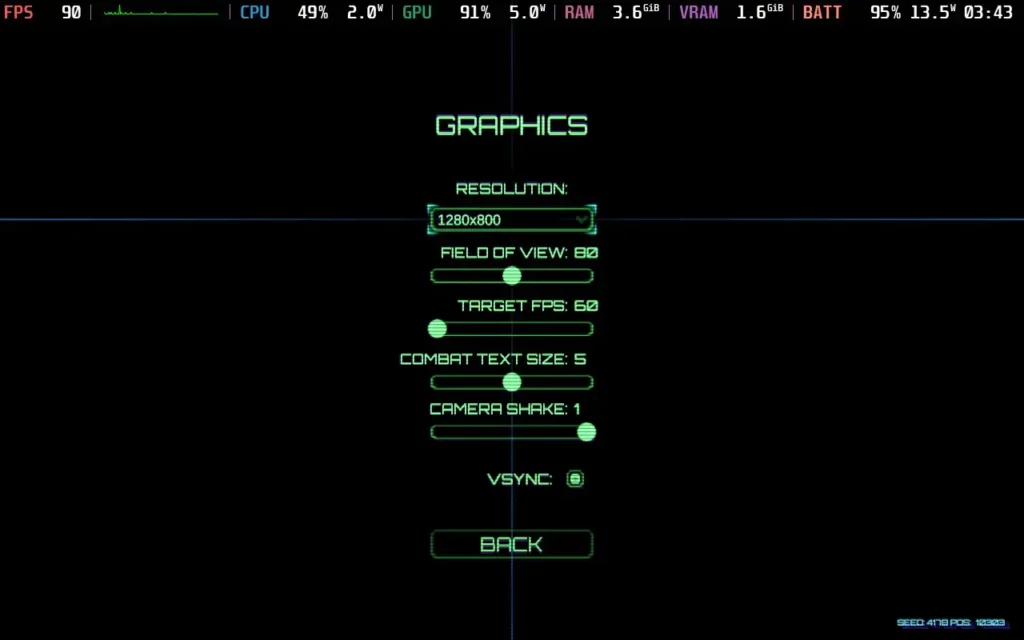
Moros Protocol does have good controller support, and it also supports the Steam Deck's 1280x800 resolution, meaning there are no black borders around the display. One thing I will say is that the game doesn't feature aim assist on the controller, which can make aiming a ranged weapon quite difficult, given its fast-paced nature.
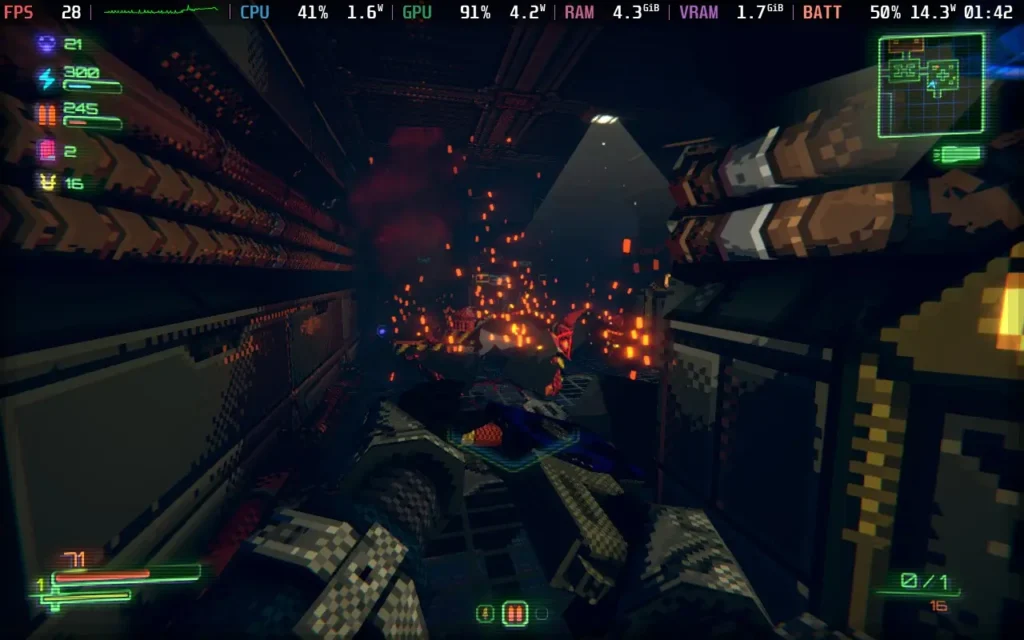
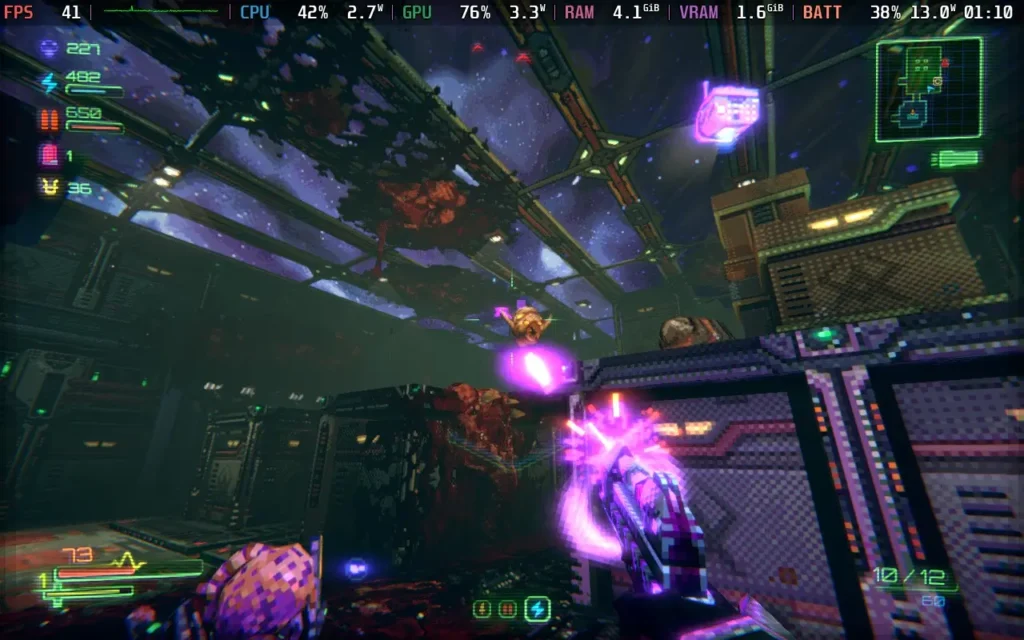
On the downside, Moros Protocol has no graphical settings, requiring you to stick close to 60 FPS, or else the game moves in slow motion, and the Steam Deck struggles to maintain 60 FPS. We frequently see dips into the 40s in larger rooms, and you can expect to be running below 60 more often than not. It doesn't make the game unplayable, but it does hamper the fast-paced feel it is sometimes going for.
The power draw hovers around the 13W-17W mark, so we get an average battery life of around 3.5 hours on a Steam Deck OLED and 2.5 hours on a Steam Deck LCD. Temperatures were around 60-70 °C.

Moros Protocol allows you to disable screen shaking and rebind controls. All dialogue is text-based, and the text is a good size for reading on the Steam Deck.
Moros Protocol has a lot going for it: the movement feels good, the gunplay feels good, and it has co-op play. Sadly, the biggest downside for me was the grind; it takes a while even to feel like you're progressing anywhere, and the sense of getting stronger is one of the biggest pulls for a roguelite game, at least for me.
Performance on the Steam Deck is disappointing. I would still call it playable, but it's a shame that the game literally slows down when the frame rate drops, which is quite often. Hopefully, we can see some optimizations post-launch or at least some graphical settings to adjust to improve things, as a game of this style should be able to maintain 60 FPS on the Deck.
Our review is based on the PC version of this game.
If you enjoyed this review, be sure to check out the rest of the content on SteamDeckHQ! We have a wide variety of game reviews and news that are sure to help your gaming experience. Whether you're looking for news, tips and tutorials, game settings and reviews, or just want to stay up-to-date on the latest trends, we've got your back.
Moros Protocol has excellent gunplay and movement, coupled with online co-op; it's a great recipe. Sadly, some poor optimization makes the Steam Deck experience less than stellar.