




GODBREAKERS was provided by Thunderful Publishing for review. Thank you!
There’s a particularly fine line between comfort and predictability in gaming, and GODBREAKERS walks it confidently. This four-player co-op hack-and-slash roguelite from developer To The Sky might not reinvent anything or particularly excel in anything either, but what it lacks in originality in premise, it makes up for in execution and sheer fun. With fast, flashy combat, a clever power-absorption mechanic, and a colorful, chaotic world that feels ideally suited for short bursts on the Steam Deck, it’s hard to put down once you get going, even if it never leaves a lasting impression.

GODBREAKERS drops you into a series of surreal, yet aesthetically clean, biomes, crawling with bizarre enemies, mini-bosses, and hulking gods waiting to be taken down a peg or two. The hook lies in its Godbreak system, whereby weakened enemies can be absorbed, adding their unique ability to your arsenal on a single-use basis. It’s a mechanic that rewards aggressive play and experimentation, keeping combat dynamic and unpredictable.
Between runs, you’ll unlock various new “Archetypes” (classes) and Tangles (modifiers) that alter the challenge in interesting ways. Structurally, it’s a familiar roguelite setup: dive in, fight your way through, get stronger, die, and do it all again, but the game’s rhythm and responsiveness make the repetition feel rewarding rather than exhausting. The key to the enjoyment is the combat and the variety in which each unique Archetype controls. They’re all fast, flashy, and consistently rewarding, with a satisfying balance between precision and chaos amongst the various classes available, having been masterfully constructed by the developers.

And whilst BuildCraft is as essential in GODBREAKERS as it is amongst its roguelike peers, it’s almost bordering on less crucial considering the fundamental abilities, attacks, and absorbed attacks being so capable a base already. A mixture of light, heavy, and cooldown-locked special attacks makes up your arsenal, and dropped equipment, one available for each body part (head, chest, arms, legs, feet), make up the core options for “additional” effects. Do you want enemies with status debuffs to explode once they’re killed? There’s an item for that. Do you want a chance for a random Godbreak to be added to your armory? You’ve got it. I’ve found, more so than its contemporaries, that some of the effects feel more… dare I say it, fun?
This beautiful chaos only increases fourfold when you take co-op play, a rarity in the roguelike genre, into consideration. Teaming up with friends adds tactical variety to runs: coordinating power combinations, covering different roles, and laughing through the inevitable chaos. It’s the kind of game that thrives on shared energy and spontaneity, making it a strong choice for online or couch co-op sessions, particularly those that last much longer than you initially expect.
For all its strengths, Godbreakers doesn’t really break new ground. Its structure, loop, and presentation feel familiar; it borrows from genre heavyweights like Hades, Risk of Rain 2, and Dead Cells, but never reaches the same heights. The Godbreak mechanic is clever, but doesn’t fundamentally change how you approach each run. The game also struggles with pacing in places, with some enemies and bosses feeling too spongy, dragging out fights without adding much strategy. At the same time, certain power combinations can make runs feel trivial or frustratingly unbalanced, despite the earlier comment that the fundamentals are more than capable. It’s clear the aim was depth, but the execution occasionally falters.
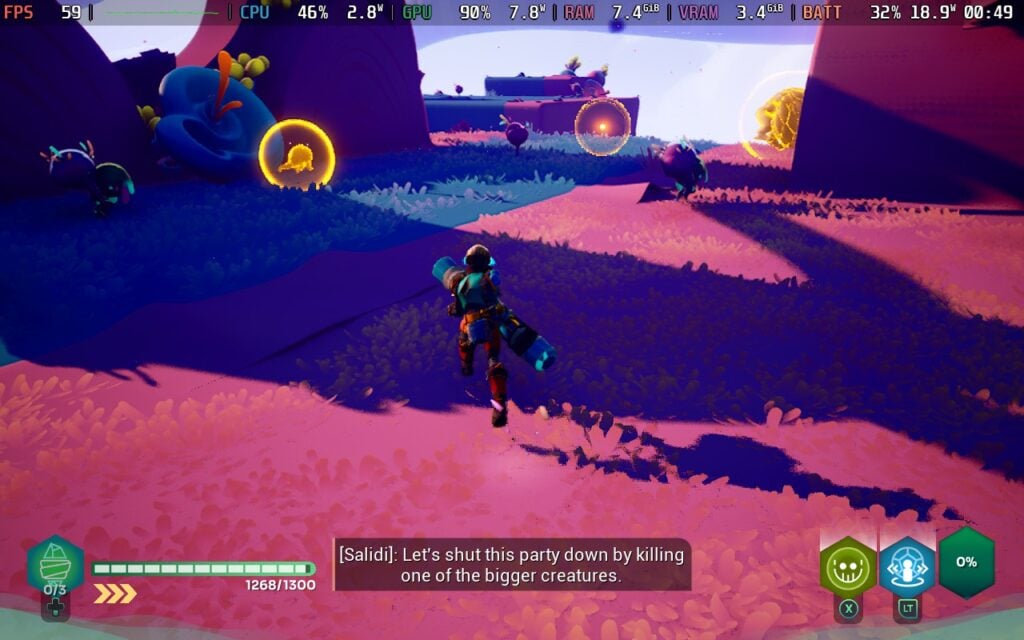
Visually, Godbreakers is striking but not groundbreaking. Each biome is drenched in vibrant color, giving the game an energetic, almost comic-book flair. Character and enemy designs lean into exaggerated silhouettes and effects-heavy attacks, which pop nicely on the Deck’s OLED display. While the environments don’t always vary drastically, there’s enough style and flair in the animations to keep the action feeling alive.

On the Steam Deck, Godbreakers performs admirably. It’s officially verified, and it shows — you can expect smooth gameplay at near 60fps on the out-of-the-box settings, but by making one small change, specifically knocking Global Illumination down one setting to Medium, you can guarantee a locked 60fps. The change is barely noticeable, graphically, too, making it an easy choice/sacrifice for stability’s sake.
In the settings, you can change the language, toggle target lock, change camera field of view and shake intensity, some HUD elements like the floating combat and received damage numbers, toggle vibrations, rebind keys, and change audio settings.
The game does support 16:10 resolutions, cloud saves, and controller support. There are no HDR settings.
Godbreakers might not be revolutionary, but it’s undeniably entertaining. Its particular brand of colorful chaos, satisfying combat, and clever co-op make it one of those games you’re more than happy to boot up for a quick session, only to end up losing hours to. It doesn’t do anything new, and it probably won’t stand out in the increasingly crowded roguelite landscape, but it nails the most important part — it’s incredibly fun to play.
On the Steam Deck, it shines even more thanks to excellent performance and an experience that feels built for handheld bursts of action. If you’re looking for something fresh or genre-defining, Godbreakers won’t deliver that. But if you all want to jump in, smash things, steal powers, and have a blast doing it, this game delivers.
Our review is based on the PC version of this game.
If you enjoyed this review, be sure to check out the rest of the content on SteamDeckHQ! We have a wide variety of game reviews and news that are sure to help your gaming experience. Whether you're looking for news, tips and tutorials, game settings and reviews, or just want to stay up-to-date on the latest trends, we've got your back.
Godbreakers might not be revolutionary, but it’s undeniably entertaining. Its particular brand of colourful chaos, satisfying combat, and clever co-op make it one of those games you’re more than happy to boot up for a quick session, only to end up losing hours to. It doesn’t do anything new, and it probably won’t stand out in the increasingly crowded roguelite landscape, but it nails the most important part — it’s incredibly fun to play.