




A copy was provided by Koei Tecmo for review. Thank you!
I have been playing JRPGs for a very long time, and have come to regard them as my favorite genre of games. What started off with Kingdom Hearts has spiraled into playing tons of games in the genre like Final Fantasy, Dragon Quest, and my two favorite series in the genre, Tales of and Trails. However, one of the series that I don’t talk about much, but I play a lot, is the Atelier games. The series falls more into JRPG tropes than the others I mentioned, but it’s still good fun. I remember playing the previous mainline release, Atelier Yumia, and I liked the direction the series was heading.

Yet, in a move I didn’t see coming, the newest mainline game, Atelier Resleriana: The Red Alchemist and The White Guardian, actually takes a couple of steps backward. I was surprised initially, as it seemed like the series was moving to the past instead of expanding and fine-tuning the new ideas introduced in Yumia. I went into the game a little worried, but I came out of the experience impressed. I wouldn’t have guessed it before, but the steps backwards actually helped make this one of my favorite games in the entire series.
I have had Atelier Resleriana for quite some time now, and instead of rushing through to make sure my review was out before release, I decided to take more time with it. I had fallen in love with the game, and I wanted to take my time to make sure I saw everything that had to be seen and enjoy the story. I’m glad I did because it just made me enjoy the experience much more than I would have.
The story is overall on a much smaller scale than a lot of other JRPG games, but that made me appreciate it more. We play as Rias and Slade, who end up on an adventure to restore the town of Hallfein and discover the secrets behind this mysterious Atelier found in a cave. However, this will lead them across the world and into different dimensions, all while getting to the bottom of the Geist Cores and what actually happened to the town years ago, and what this red mist could be.

It's a smaller story that mostly revolves around this town, and it's wonderful to have a more focused story instead of something more dramatic that involves the entire world. It actually makes the emotional connection that Rias and Slade have with the town feel heavier. Rias's connection in particular hits hard as she goes from a mischievous figure that wants to be included to a staple figurehead that uses her alchemy gifts to make others happy and help the town. With her essentially becoming an alchemist, she will make items and raise money needed to bring the town back to its former glory.
Atelier Resleriana also features a ton of characters from previous entries in the franchise, like Ryza, Sophie, Totori, Ayesha, Elie, and many more. It kind of feels like a Trails game in some ways, with so many characters from the past games appearing in both major and minor roles. There are some special interactions and side stories with these characters as well, and it's a nice touch to interact with them more. With the great-looking world and interesting settings, and some solid voice acting, I was totally into it. As much as I enjoy English voice acting, the Japanese voices fit extremely well and just feel right.
Compared to the previous mainline game, this one does make the mechanics simpler and straightforward, yet still has the innate complexity that I’ve come to expect. Synthesizing, the core component of every Atelier game, became a more accessible component to enjoy. With each ingredient we pick up being put into a category, we will take three or four of them to create the initial item. Once that’s done, we have the option of adding three more ingredients to further enhance stats, add new traits, or increase the quantity that we get.

On the surface, it’s pretty simple. All we have to do is choose the best ingredients in their respective category and match up colors to make our item as powerful as possible. Each ingredient also has a trait, which can be added to the item, so finding and matching the best ingredients with the best traits is going to be what we do for a while. It’s still enjoyable, and I love watching my items get more powerful, but this didn’t start satisfying me until we got to recipe morphing and color changing.
By using specific ingredients, we can morph the item we are making to create a more powerful version of it. This will also carry over all of the upgrades we have put in with the initial item. So, it becomes more beneficial to start from the beginning of the recipe instead of using a shortcut to just get the upgraded item desired. We will also unlock the ability to change the color of each ingredient, and even change the category of ingredient for a specific slot. This will be necessary to create the most powerful items, and is a great way to help maximize the quality of the item you want to synthesize.
Even still, despite the new mechanics, it never feels overwhelming. It adds just the right amount of options to keep the mechanic engaging, even in the late game, and I never had a hard time understanding. Atelier Resleriana strikes a balance that I didn’t expect it to have, and I couldn’t be happier.

Over time, we will unlock new mechanics to enhance items further, depending on the characters and fairies you have, but my favorite is item duplication. It’s kind of a chore to have to create advanced components needed for late-game items, but if you have enough money, you can duplicate items you’ve already synthesized. So, as long as you have the money, you can duplicate that extremely powerful crafting component, so you don’t have to make a new one every time when trying to get the perfect end product.
There are multiple ways to get the ingredients we need for synthesis. We can go around and gather from a multitude of spots around each map, but we can also get them through the turn-based combat. Most Atelier games feature some sort of combat and RPG leveling system, and just like the synthesizing, Resleriana simplifies these as well. You fight monsters with your party, using basic attacks, skills, and items. When you beat them, you get experience, money, and skill points. Experience levels up your team, increasing their stats and making them more powerful, while skill points are used specifically to unlock nodes on each person’s skill tree.
I do like most of the mechanics to take advantage of in combat. Enemies have elemental weaknesses that we can take advantage of, which can help bring down their respective stun bars to stop them from attacking and deal extra damage. There's also a separate Unite meter that, as it rises, allies who previously took their turn can come in with a follow-up attack, and if it hits the max, we can start using more powerful abilities to deal tons of damage.

While I like the follow-up attacks, I am not the biggest fan of the Unite meter. I almost never get it to hit max to take advantage of those more powerful attacks. Even with bosses, I either get the Unite meter up to max after most of my allies are dead, or just either fully die or defeat the boss before it happens. There are Multi-Actions we can utilize, like someone coming in to use an item or use three different skills at a time, but that has its own meter that needs to recharge. I would have liked to use these attacks more, but I ultimately was never really able to.
However, I like how much we have to pay attention to the timeline of attacks. With the game having turn-based combat, there is an order in which each person and enemy attacks. While we can modify the term order with skills to push enemy attacks back, we will have to pay even more attention because specific turns can have different positive and negative buffs. This can range from gaining health or more attack, to getting injured via frostbite or defense going down. So it's no longer just about pushing enemy attacks back; we also have to weigh in on whether there will be any positive or negative effects for it.
While we do get some money from fighting enemies, the main way we will get money is by selling our items at the shop. After choosing nine different items, which can be put on the shelves to give bonus money, we will open the store and sell them. It is a neat idea that I wish were expanded a little more. It feels very basic and more of a chore to do instead of something to enjoy. I appreciate that there's an option to automatically place items to sell, and we can somewhat customize the look of the shop for extra bonuses, but ultimately, it wasn't something I looked forward to.

Apart from that, we can take on side quests to get more skill points, ingredients, and money, and that can be used to invest in the town to give us some passive buffs and increase the town level. We can also go to Dimensional Paths, which feels like a very light roguelite mode. We will find Fairies that can give us some bonuses, and these fairies can be hired to work at the shop. The Dimensional Paths are a nice addition that I actually like, finding myself going back in and getting the best ingredients, finding new fairies, and fighting powerful monsters.
Atelier Resleriana: The Red Alchemist & the White Guardian is a joy to play on the Steam Deck. I was actually a bit surprised, since I only discovered I was playing at the highest possible settings when I had gotten to the end of the game. It's pretty amazing how well it runs, and I would consider this an easy Best on Deck game.
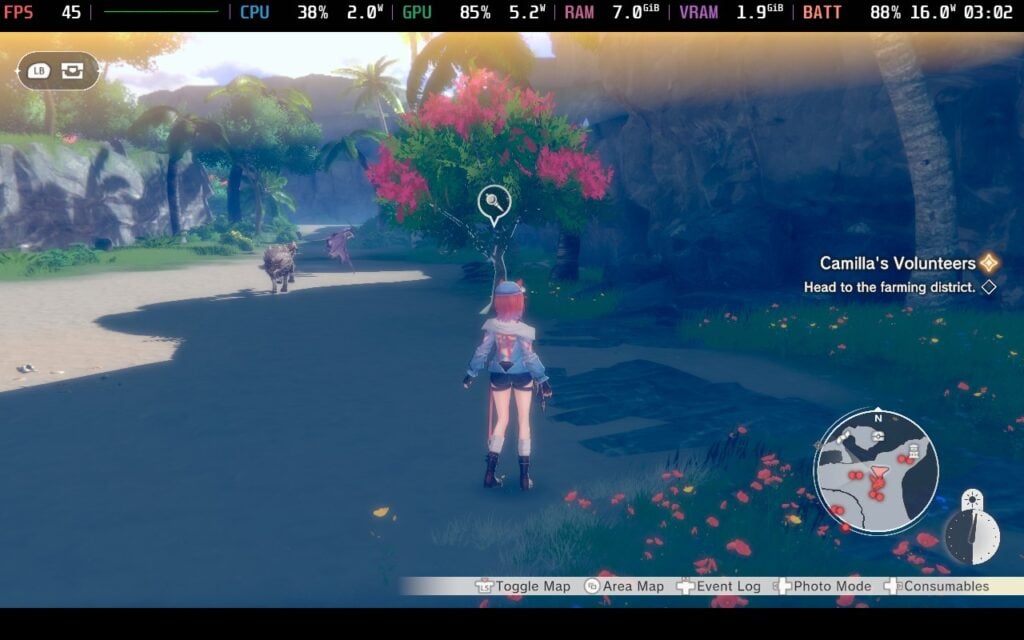
Personally, I preferred playing the game at the highest settings, only changing the resolution back down to 1280x720, and I set the framerate/refresh rate to 45 FPS / 90Hz. This kept the game looking fantastic, feeling smooth, and battery drain below 14W on average. You can play at 60 FPS for the most part, but going to 45 adds an extra hour or so of battery life and still feels wonderfully smooth, so I would consider it more of a pro than a con.
There are a couple of spots where it seems some bottleneck pushes the framerate down. The most consistent was in Cape Petal, but 95% of the areas will run like a charm. If you want the most stable experience, with a low battery drain, we can set the framerate down to 30 FPS, but it will only add about 45 minutes to the battery life, and I would still just say going to 45 is better overall.
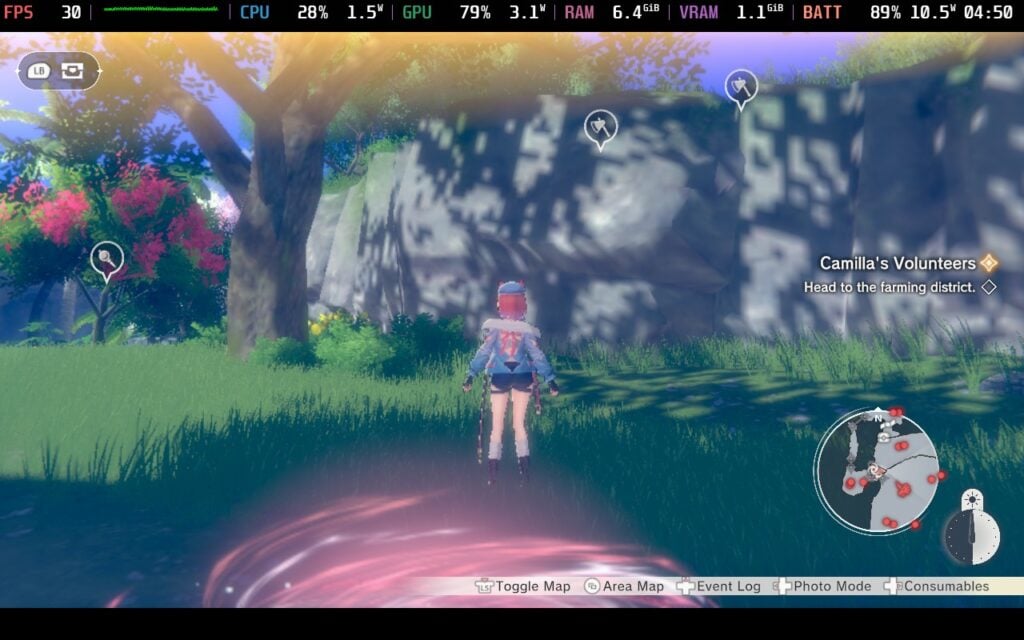
Interestingly, trying to play at 60 FPS just isn't as viable as I would like. Even at the lowest settings, there are more areas that can hit bottlenecks and bring the framerate down. I found this odd, since the game is running at 45 FPS on the highest setting, but it still has those issues. So, in the end, I still recommend just playing at the highest settings at 45 FPS.
While there is no accessibility tab, we can invert the camera controls and change sensitivity, change the difficulty, toggle autosave, change the minimap rotation, modify keybindings, increase text size, and increase or decrease audio settings. We can also change the color filter settings to account for Deuteranopia, Protanopia, and Tritanopia color blindness.
The game doesn't support 16:10 resolutions, but it does have cloud saves and controller support. There are no HDR settings.
Atelier Resleriana: The Red Alchemist & the White Guardian is a fantastic next entry in the series. The game moves forward by taking a few steps backward, which works well in its favor. The more accessible and easy-to-understand synthesis and combat is fantastic, while the smaller-scale story actually makes it more emotionally endearing with tons of guest characters. Even with some minor nuisances, this is a fantastic entry in the series that is well worth playing.
The game is also a joy to play on the Steam Deck. We can play it at 45 FPS on the highest settings, and even though there are a couple of areas that are bottlenecked, a majority of the game will run with ease, and it's amazing to see.
Our review is based on the PC version of this game.
If you enjoyed this review, be sure to check out the rest of the content on SteamDeckHQ! We have a wide variety of game reviews and news that are sure to help your gaming experience. Whether you're looking for news, tips and tutorials, game settings and reviews, or just want to stay up-to-date on the latest trends, we've got your back.
Atelier Resleriana: The Red Alchemist & the White Guardian takes a couple steps backwards to move forwards successfully, and it's a fantastic experience both in content and on Steam Deck.