Two Point Museum was provided by SEGA for review. Thank you!
Two Point Museum joins other Two Point games, such as Two Point Hospital and Two Point Campus, in the strategy management genre. As the name would suggest, in this one, you're taking charge of Museums, aiming to provide your visitors with the ultimate curated experience. That inherently comes with a problem, though, as museums are stereotypically dull. So, how do you make a game about running a museum have some excitement? Two Point Museum tries to answer that question.
Two Point Museum follows in the footsteps of its predecessors like Two Point Hospital, whose objective is to build up a successful museum by presenting exhibits and designing your museum efficiently. During the campaign, you'll be running several museums, and the game will ask you to jump between them at various points to advance them further and obtain higher star ratings.
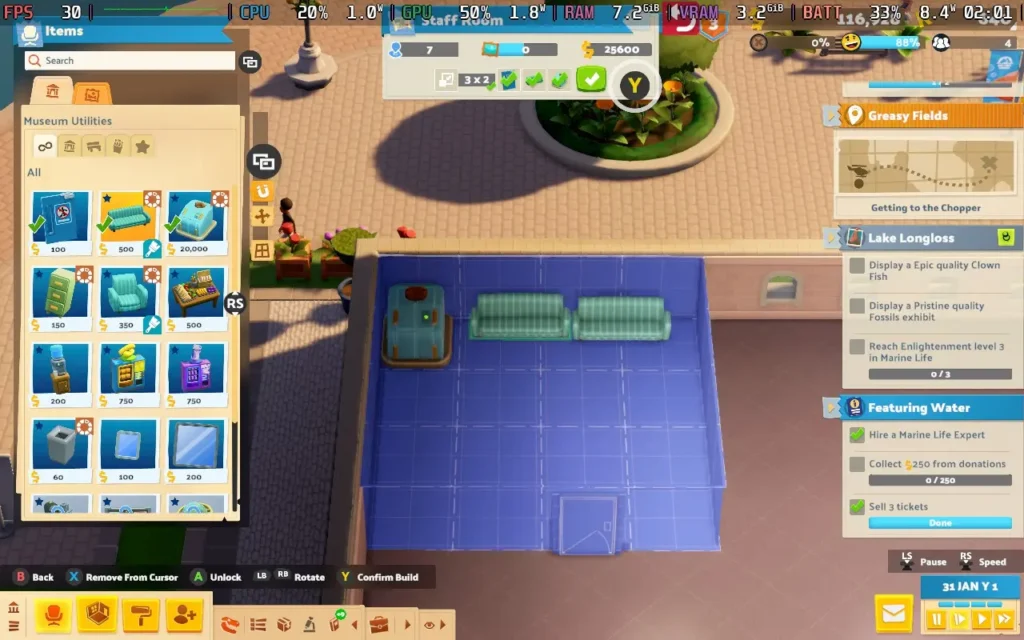
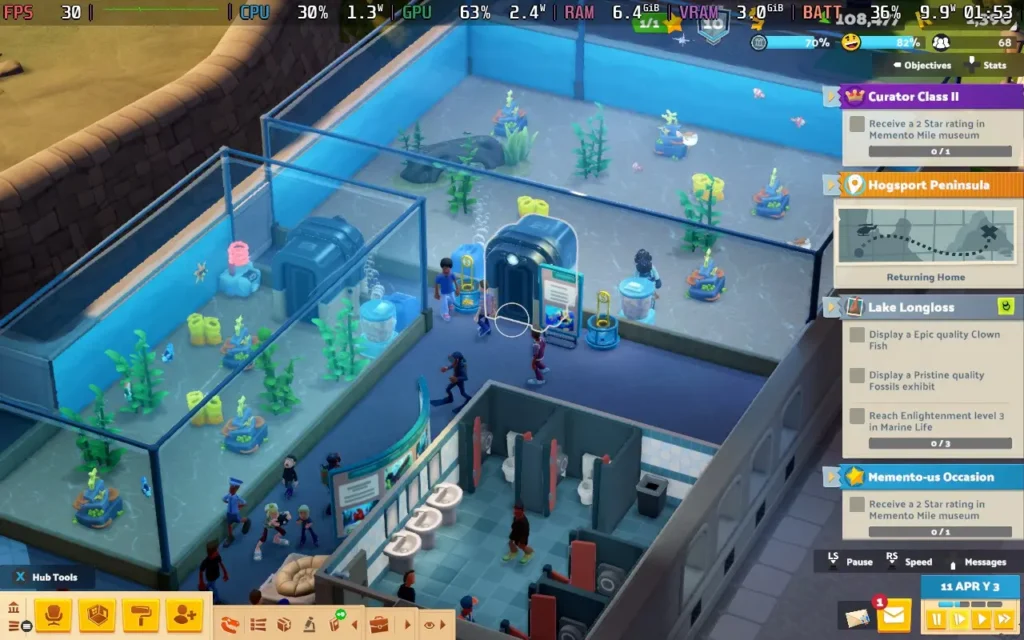
Just like Two Point Hospital (and Theme Hospital before it), Two Point Museum brings back the "room" system, but it's a bit different here. "Rooms" aren't the focus anymore. You're running a museum, so you focus on organizing spaces that flow naturally and provide enough space for some rather huge exhibits. The room system here is pretty much reserved for souvenir shops, private staff areas, and toilets.
This change does, however, work in this game's favor. You aren't always organizing your available space into squares or rectangles anymore, so you can be much more creative when presenting your exhibits. You could even remove most walls and have a large open exhibition center if that's your style, or simply use some basic rope partitions to guide your visitors.
The strategy element of the game comes from placing "Info Boards" and other decorations that can create "Buzz" around your exhibits, effectively leveling them up and making them more appealing to visitors. This means that you'll have to plan where your exhibits are placed and where you can place info boards to get the most effective placements. It's not the end of the world if you aren't "optimal", as the Info Boards and decorations are cheap, but it's cool that the mechanic is there to promote some form of organized building.
Perhaps the most intriguing part of Two Point Museum is the expedition system. New exhibits to display don't just show up at your doorstep. Instead, you'll need to hire experts in various fields, as well as other staff, to go out in search of the next big thing to show off in your museum. Random events can happen during expeditions that can affect the outcome, and you can use items to enhance the outcome or protect your crew from any unexpected surprises.
At the end of the expedition, your crew will return with a crate containing an exhibit. It could be an extra part of an existing exhibit, such as another part of a skeleton, or a smaller, stand-alone exhibit. Either way, the game enters a "lootbox-esque" opening cutscene when you reveal what's in the crate, which aims to build some excitement, and it does a decent job of doing it, although it can sometimes be hard to muster up excitement about finding a tail.
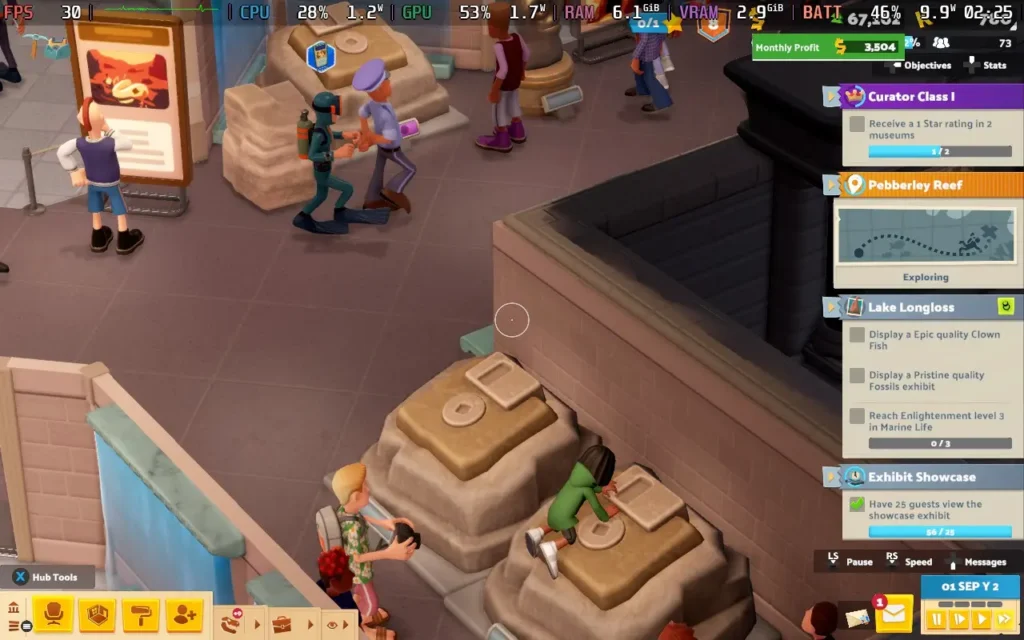
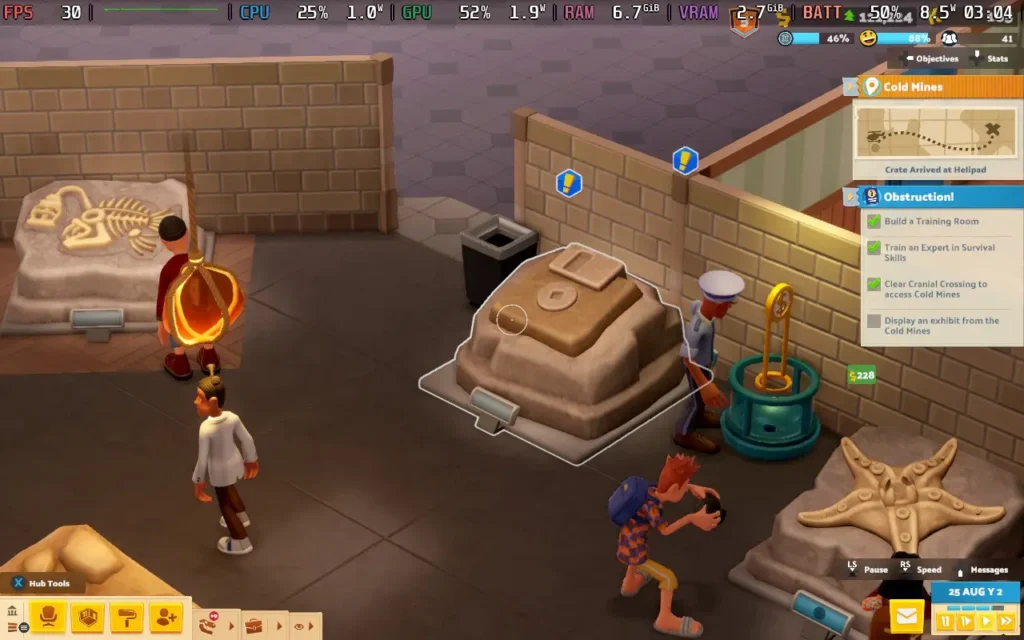
The game has a decent number of exhibits, and it can be interesting to see what you get each time. You can send your experts off to different areas, which will yield different results. Some will give you prehistoric exhibits, others botanical and marine life. Unfortunately, many of the exhibits are "joke" exhibits, such as the "Disk Fossil," which is just a floppy disk embedded in some dirt. Clownfish have actual red clown noses on them, and Starfish wear sunglasses.
While I get that the Two Point games lean into being humorous, the whole thing just feels like they're trying too hard, and it feels out of place in a museum environment to have all these comical but silly designs mixed in with real ones.
Unfortunately, the "humor" of the game let me down. While games like Theme Hospital kicked it all off by having tannoy announcers make humorous quips about situations in the hospital, Two Point Museum attempts to carry this forward into the museum environment, and it just falls a bit flat.
The announcer and radio DJ make fairly constant jokes that quickly get repetitive and just aren't very funny anyway. They might appeal to some, but I found myself disabling the voices in the game pretty quickly. Thankfully, the voice volume is separate from all other volume sliders in the game, so you can disable them without affecting the rest of the game.
The game also seems to be incredibly easy. There are no difficulty options, and I never encountered a point where I was actually losing money. I found myself pretty much not paying attention to the money I had while I built my museums, as cost never really became an issue for me.
I also ran into a couple of bugs while I was playing. For example, at one point, another staff member came to take over a ticket stand, and the staff member they took over from got trapped in the ticket stand and couldn't leave because the other staff member was in the way. This led to them being unable to fulfill their needs and threatening to resign. It could be resolved by simply picking up and moving the staff member manually, but I shouldn't have needed to do that.
Two Point Museum is an interesting concept. It's a brave move to take something stereotypically dull and make a game out of it. Do I find it as interesting as a hospital simulator? No, I don't. But the museum angle does open up some new gameplay mechanics, and for those who have been yearning for a museum simulator, you finally have one.
Two Point Museum - Steam Deck Performance
Two Point Museum works really well on the Steam Deck, with full controller support and support for 1280x800 resolution, removing any black borders. It's also pretty easy-going with requirements, with the CPU being the main issue rather than the GPU here.
As we have some flexibility in the settings for this one, I'm offering two presets: one focused on battery life and the other on visual fidelity.
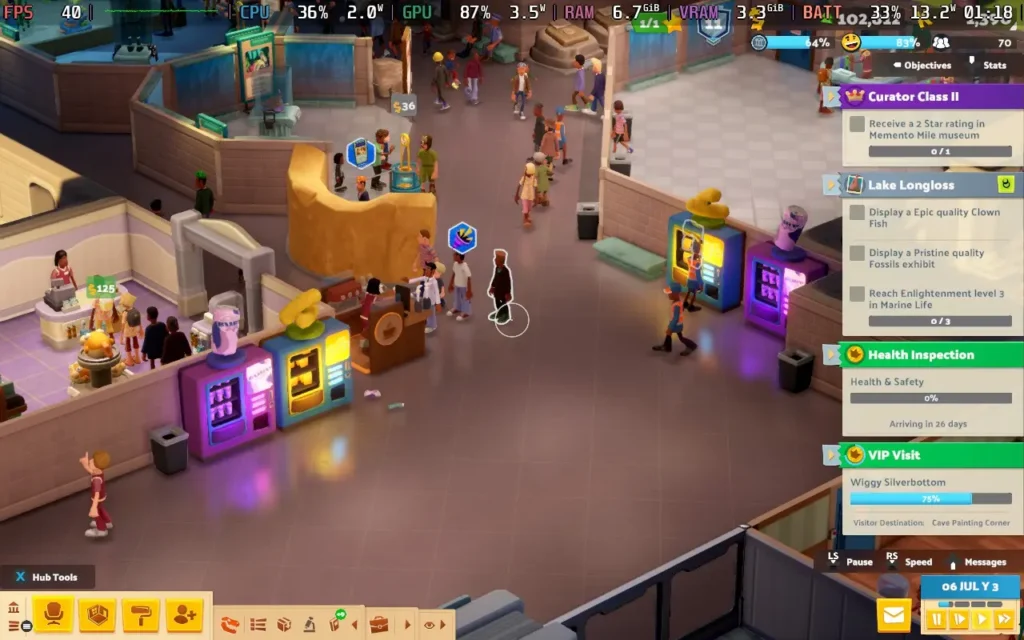
Prioritize Quality Settings - 40 FPS
If you want your floors to look extra shiny and your displays to be gleaming, then you might want to take a look at these settings. They're more demanding on battery life, but do give you a nicer presentation.
In SteamOS, you'll want to set a 40 FPS Frame Limit and set your TDP Limit to 10W.
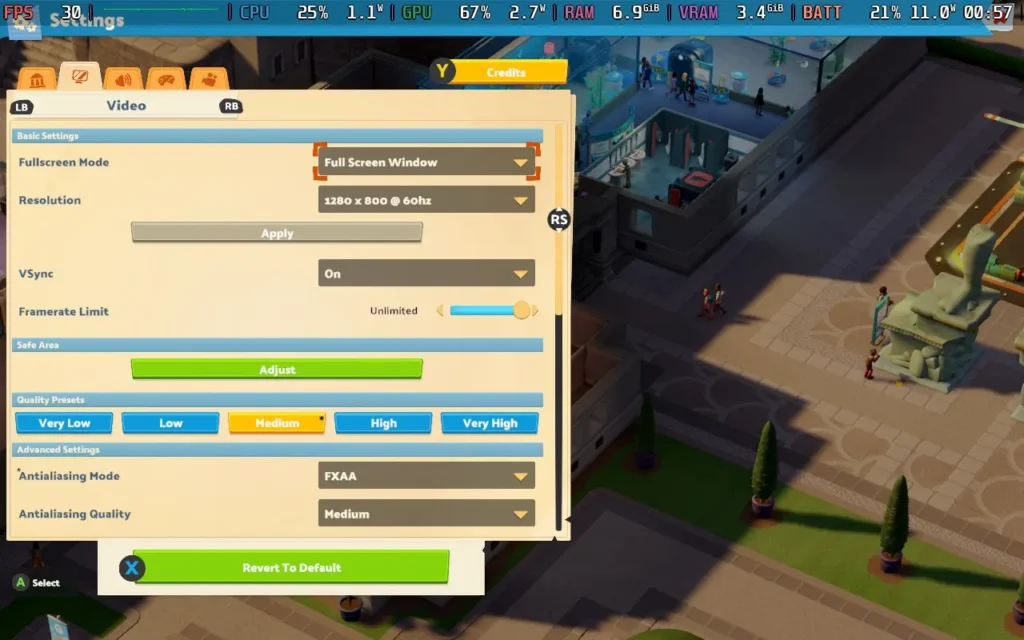
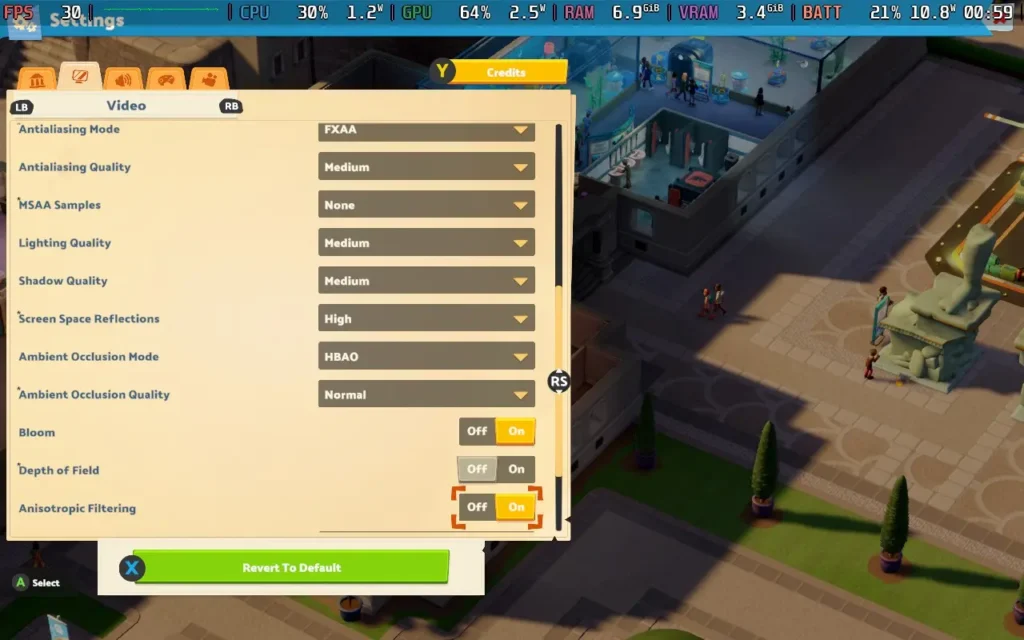
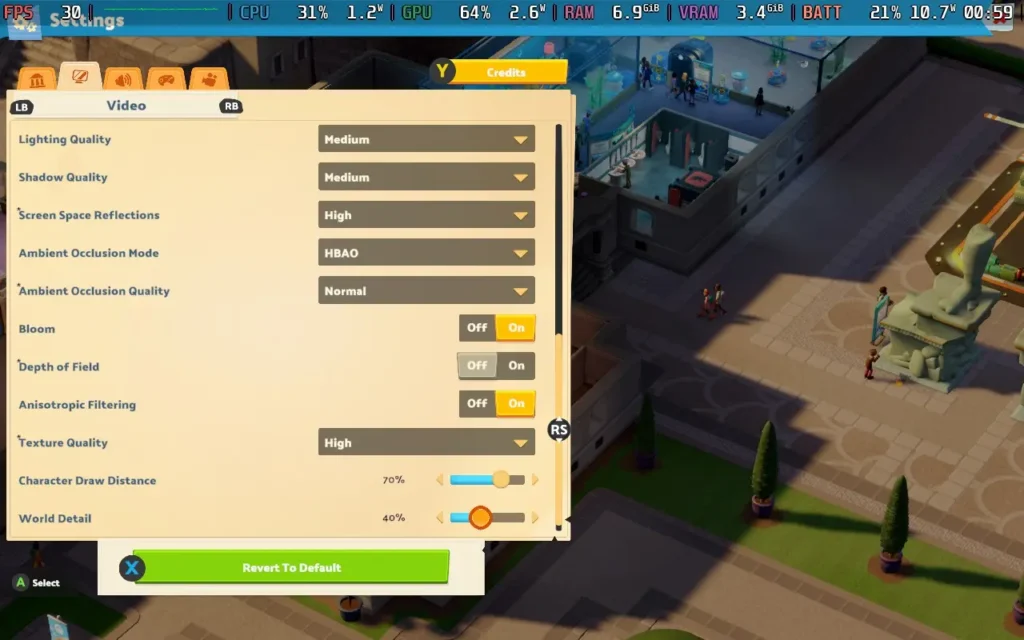
For graphical settings, you can see the side panel or click the images below, but we are sticking pretty close to the Medium preset here.
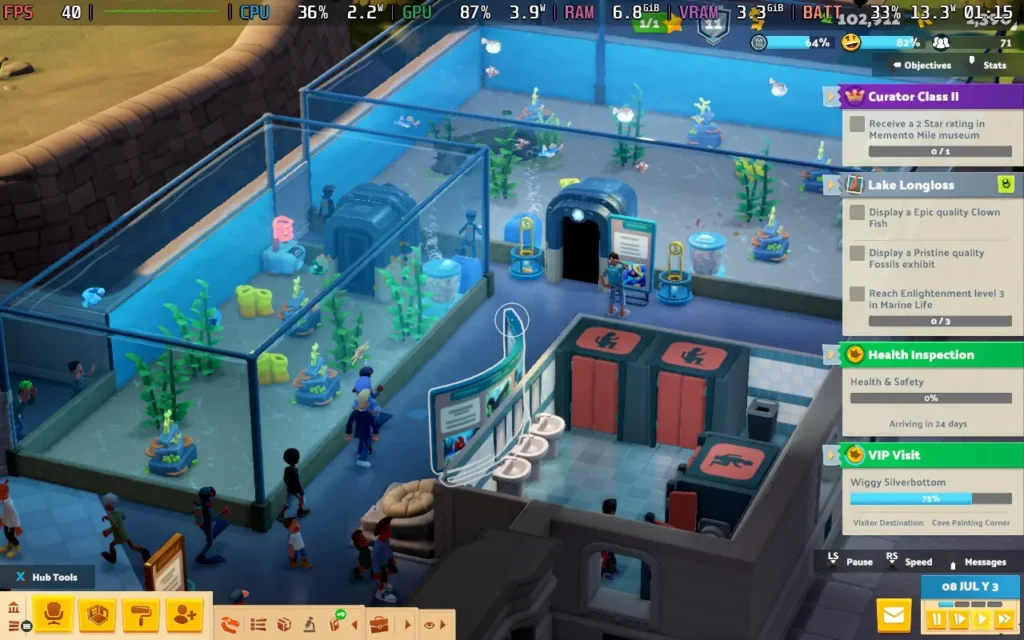
We can hold a steady 40 FPS with these settings and we get some pretty nice visuals to boot. We do have the occasional stutter, but it's not anything that's particularly noticeable or affects the gameplay.
Power draw with these settings goes up a notch, so expect around 12W-15W drain on the battery. Temperatures were again around 60C-65C. You can expect about 3.5 hours of battery life from a Steam Deck OLED and around 2-2.5 hours from a Steam Deck LCD.
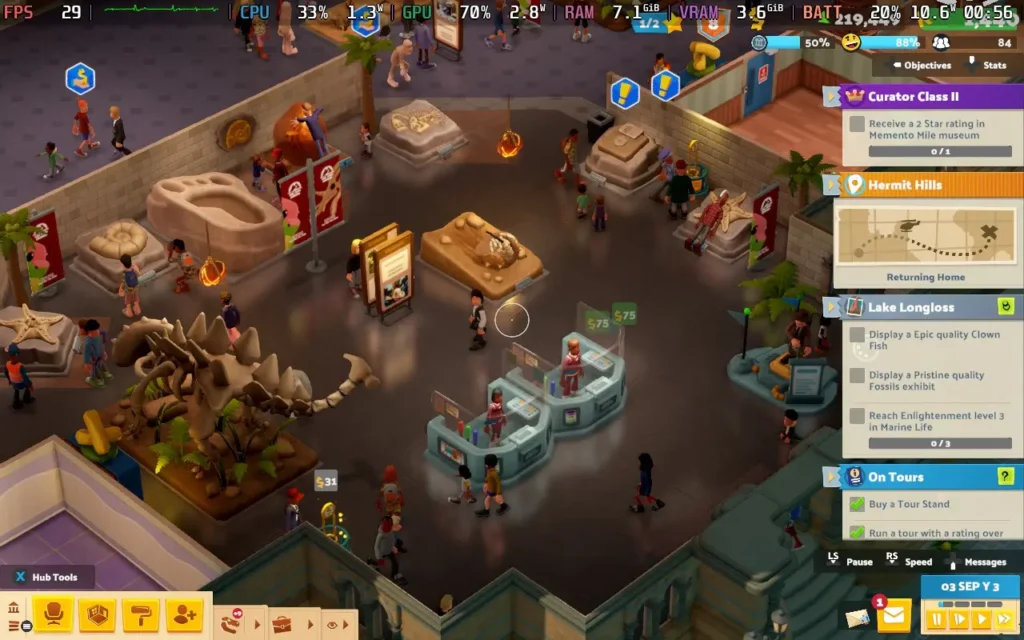
Battery Life Build - 30 FPS
To maximize your battery life, you'll want to set a 30 FPS Frame Limit in SteamOS, along with a 7W TDP Limit.
For graphical settings, we keep the same as those in the settings above, with the exception of setting Screen Space Reflections to "Off."
At these settings, the game pretty much held 30 FPS. There could be occasional frame drops when something new loaded and a few stutters here and there, but general gameplay was stable.
The power draw for this one was around 10W-11W, with temperatures of about 60-65C. Expect around 4.5 hours of battery life from a Steam Deck OLED and 3 hours from a Steam Deck LCD.
アクセシビリティ:
Two Point Museum has some accessibility options. Importantly for Steam Deck, it has a UI Scale option, which you should set to large, making some difficult-to-read text slightly more legible. You can also disable camera shaking and certain flashing light effects in the game.
Subtitles can be enabled for certain flavor text, like the tannoy announcer.
結論
Two Point Museum is brave in that it takes aim at an industry that is usually not regarded as all that interesting and tries to make a fun game out of it. Unfortunately, this was attempted by injecting a lot of "humor," which just didn't pay off for me. I'd have much preferred a more authentic museum experience with real fish and exhibits rather than being hit with a joke-a-minute, which rarely pays off. If you can tolerate the comedy, the gameplay works well and there's still an enjoyable experience to be found here.
That being said, Two Point Museum does run great on the Steam Deck, so if you have had your eye on this one and a bit of silliness doesn't put you off, you shouldn't hesitate to get it to play on your handheld.
Two Point Museum does a decent job of making running a museum interesting, despite the tedious gags. It also runs well on the Steam Deck with some play in the settings to tune them how you like to play.
Let us know what level of playability you consider Two Point Museum to be. Help our community determine the viability of playing this game on Steam Deck!