




Possessor(s) was provided by Devolver Digital for review. Thank you!
Heart Machine has always had a knack for creating worlds that feel at once ethereal and suffocating, vibrant yet hopelessly fractured. From Hyper Light Drifter’s cryptic melancholy to Solar Ash’s vast, dreamlike traversal, the studio has carved out a distinct aesthetic identity, one built on atmosphere, mystery, and momentum. Possessor(s) continue that lineage, but channels it into something sharper and more confrontational: a grim, kinetic metroidvania where each movement is as much an act of warranted violence as exploration.
Set in a quarantined city swallowed by decay, Possessor(s) follows Luca and her otherworldly counterpart Rhem, two halves of a single being, bound by parasitic connection and shared guilt. The narrative unfolds through implication more than exposition; you don’t so much follow the story as feel it creeping into your periphery. Environmental details, scattered dialogue, and the city’s bizarre denizens all hint at something deeply wrong just beneath the surface.
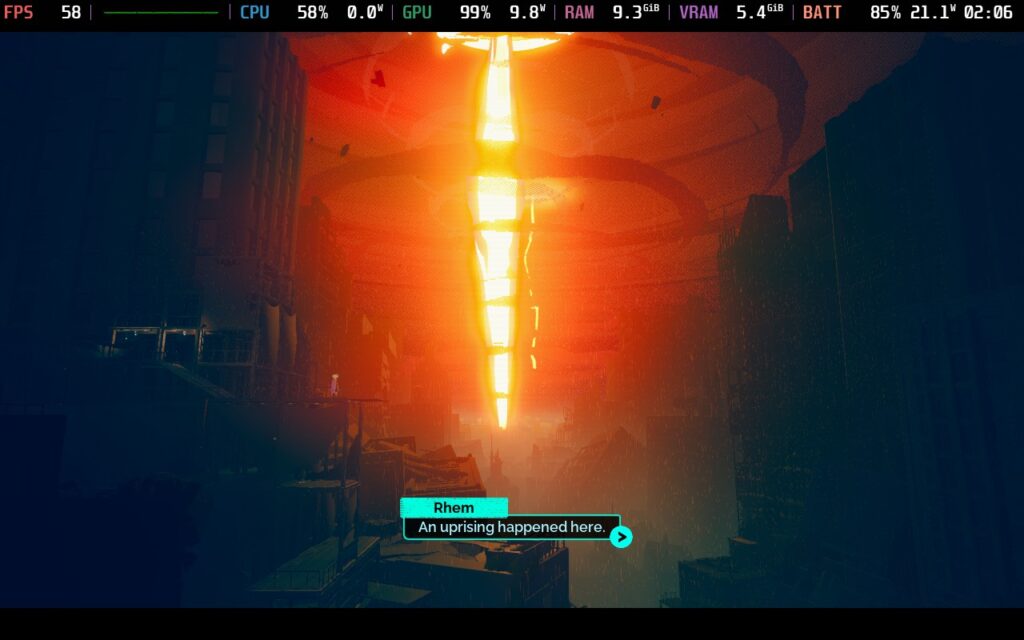
It’s a tone that Heart Machine excels at, desolate yet oddly intimate, but players, including myself, looking for clarity may find themselves wanting. The writing is effective when it leans into emotional unease, though its tendency toward the abstract occasionally risks detachment. Still, when everything coalesces, a quiet exchange in a flooded corridor, or a flicker of remorse in Rhem’s dialogue, Possessor(s) can be haunting.
At its best, Possessor(s) is an exhilarating dance of aggression and precision. The combat blends directional inputs reminiscent of platform fighters with the deliberate weight of a soulslike, rewarding timing and spatial awareness. You’re constantly pushed to read your opponent’s rhythm, to parry and punish, to launch them skyward before smashing them down with a charged strike. Weapons, if you can call them that, have an improvised, street-level brutality: repurposed instruments, tools, and gadgets, such as Kitchen Knives, Computer Mice, and so forth.
Each hit feels tactile, heavy, and deliberate, thanks to excellent animation and audio design, despite the absurdity/desperation in your weapons of choice. Chaining attacks into aerial combos is immensely satisfying, and the control scheme’s responsiveness (when the framerate behaves) makes even basic skirmishes feel tense and alive.
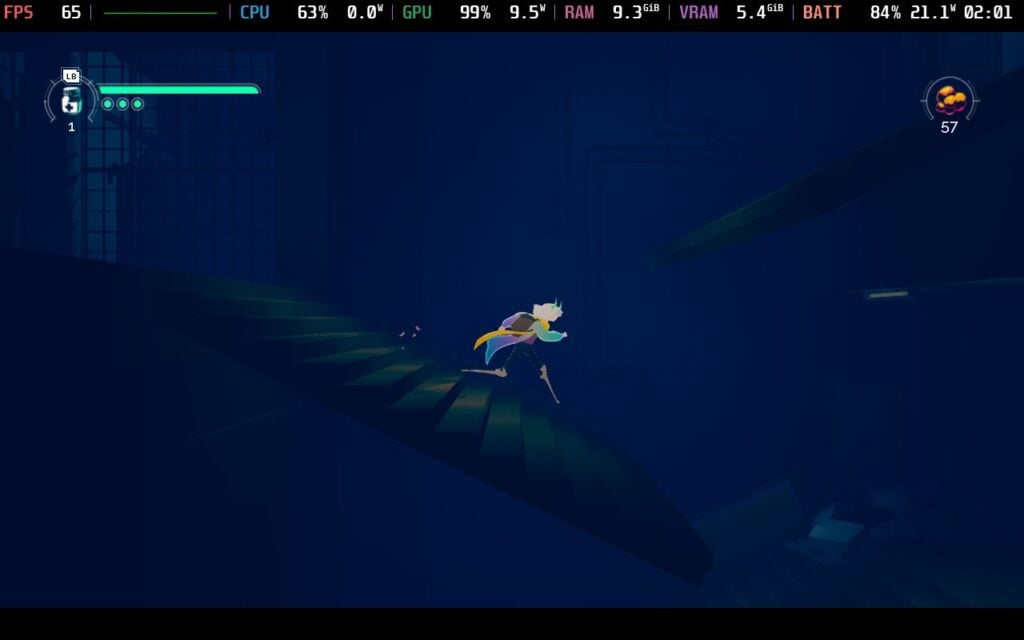
That said, not every part of the moveset feels equally polished. Grapple mechanics, in particular, can be inconsistent, like the whip sometimes latching when it shouldn’t or missing clear anchor points. Wall-jumps and vertical navigation occasionally lose their flow, creating moments of frustration that break the game’s otherwise fluid pacing. These are minor blemishes, but in a game so focused on momentum, they stand out nonetheless.
Heart Machine’s art direction remains as impeccable as ever. The ruined city is a masterclass in atmosphere; every neon flicker, every waterlogged alleyway tells a story. The layered parallax gives each screen an uncanny depth, and the studio’s distinct colour palette, luminous blues against washed-out decay, remains striking. The music and soundscape complement that aesthetic beautifully. Percussive synths rise beneath combat, while ambient hums and distant echoes make quiet exploration moments genuinely unsettling. There’s a confidence in how the game knows when to overwhelm and when to let silence breathe.
This is particularly impressive and crucial in a game where exploration is as methodical as it is rewarding, and is yet another show of mastery on Heart Machine’s flourishing journey of growth. The city folds in on itself with clever shortcuts and hidden chambers, occasionally offering optional encounters that test both your mechanical skill and your patience, as any good metroidvania should, and when the level design is dense and interconnected, balancing vertical traversal with combat arenas that feel purpose-built for acrobatic aggression, Possessor(s) finds it carefully carved out place in the myriad of other, more prominent titles breathing in the same genre space.

For a game that lives and dies on precision, performance is everything, and this is where Possessor(s) occasionally stumbles. When the game runs smoothly, its combat sings. Inputs feel immediate, movement is crisp, and the fluidity of chaining attacks makes for a genuine adrenaline rush. But when the framerate dips, even briefly, that delicate rhythm falters.
On Steam Deck, frame pacing inconsistencies can arise during particle-heavy scenes or large enemy clusters. These moments don’t ruin the experience, but they do undercut the game’s responsiveness, which is critical in a system built around timing and control. The difference between a clean 60fps and a fluctuating 45–55fps isn’t just aesthetic; it changes how the game feels. With that being said, an immediate change to the game’s settings to Low across the board gives the best, although still unfavourable, chance at hitting the high 40s/low 50s.

I have also encountered traversal-oriented bugs, particularly tied to the whip and wall interactions, that appear to stem from animation state issues rather than pure performance drops. Still, the perception of inconsistency can make combat feel uneven, especially when execution matters most.
Heart Machine’s track record suggests post-launch updates will smooth much of this out, but as it stands, Possessor(s)feels just shy of technically cohesive. The beauty of its world and the brilliance of its combat foundation remain intact, but the overall stability doesn’t always support the ambition.
The game offers a modest set of accessibility basics: sliders for both Screen Shake and Vibration, toggles for Motion Blur and Chromatic Aberration, and configurable button mappings.
Possessor(s) is a game of contradictions, punishing yet graceful, intimate yet alien, technical yet emotional. It’s one of the most visually arresting action games of the year and an imaginative evolution of Heart Machine’s design philosophy. When its systems align, it achieves something spectacular: a ballet of violence wrapped in existential dread. But that spectacle depends on stability. For a game built so squarely on feel, the occasional stutters and traversal inconsistencies stand out all the more. They don’t sink the game, but they do prevent it from hitting the seamless heights its design so clearly reaches for. Still, even with its technical blemishes, Possessor(s) is unmistakably Heart Machine, ambitious, stylish, and brimming with strange, painful humanity.
このレビューはPC版に基づいています。
このレビューをお楽しみいただけたなら、SteamDeckHQ の他のコンテンツもぜひご覧ください!あなたのゲーム体験に役立つゲームレビューやニュースを幅広く取り揃えています。ニュース、ヒントやチュートリアル、ゲーム設定やレビューをお探しの方も、最新のトレンドを知りたい方も、ぜひご利用ください。
Possessor(s) is a game of contradictions — punishing yet graceful, intimate yet alien, technical yet emotional. It’s one of the most visually arresting action games of the year and an imaginative evolution of Heart Machine’s design philosophy. When its systems align, it achieves something spectacular: a ballet of violence wrapped in existential dread. But that spectacle depends on stability. For a game built so squarely on feel, the occasional stutters and traversal inconsistencies stand out all the more. They don’t sink Possessor(s), but they do prevent it from hitting the seamless heights its design so clearly reaches for. Still, even with its technical blemishes, Possessor(s) is unmistakably Heart Machine — ambitious, stylish, and brimming with strange, painful humanity.