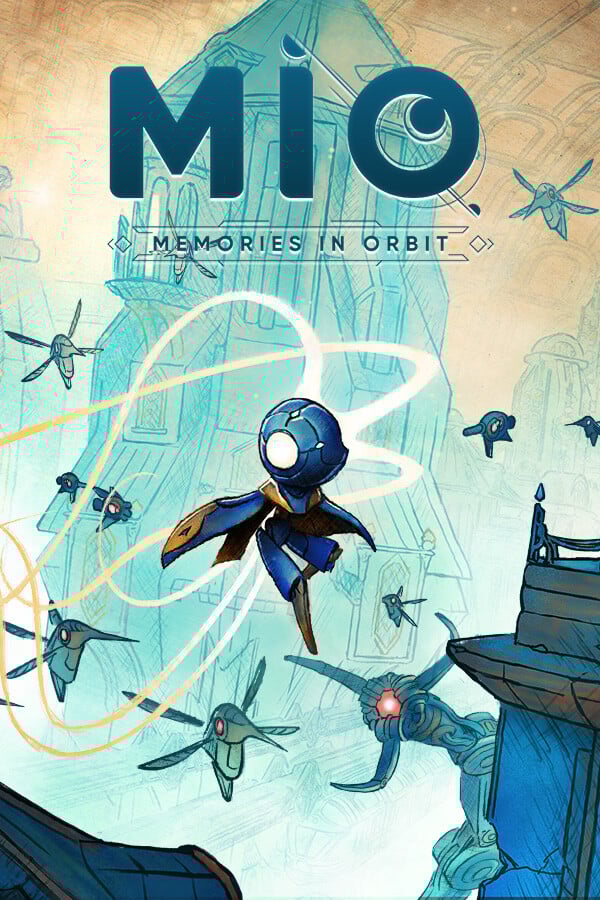
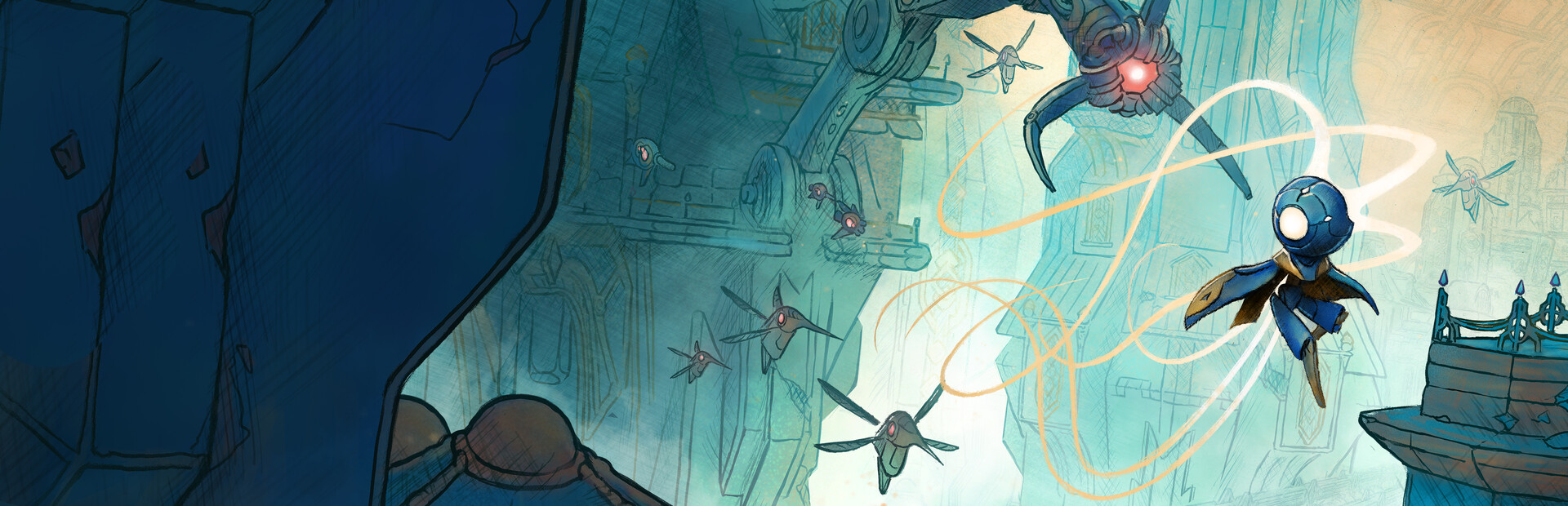


MIO was provided by Focus Entertainment for review. Thank you!
While I do have fun with metroidvanias, it’s very easy for me to lose interest in them. There are some frustrating mechanics that have become staples of the genre, but if they are implemented well, I end up enjoying it regardless of my usual feelings. Not many games can achieve this through the entirety of the game, usually having some pitfalls somewhere that take me out of the experience. However, despite some minor grievances, MIO: Memories in Orbit succeeded in captivating me from start to finish, and its pros heavily outweigh the cons.
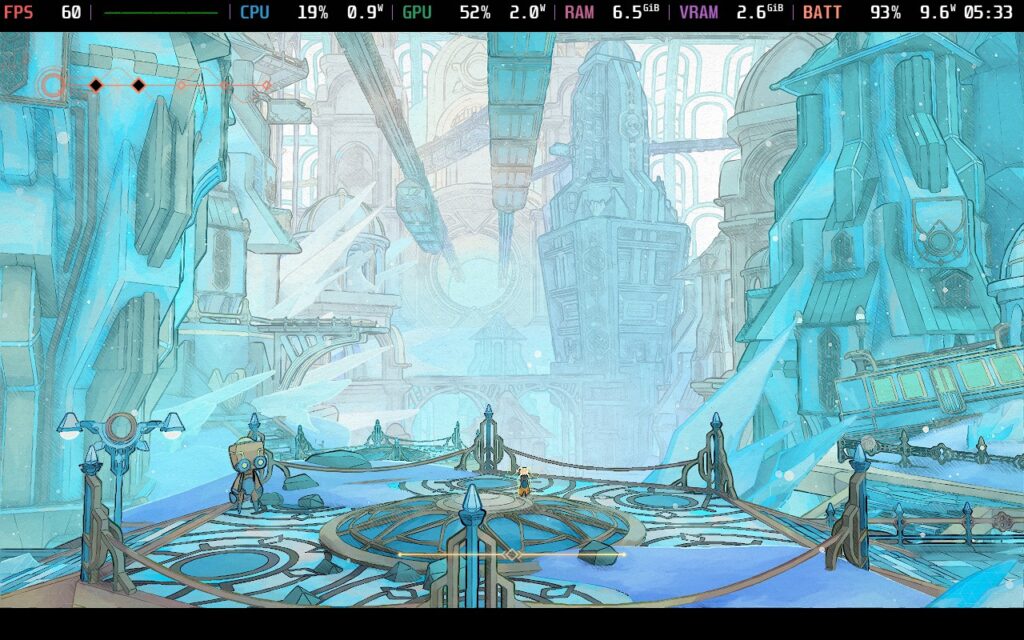
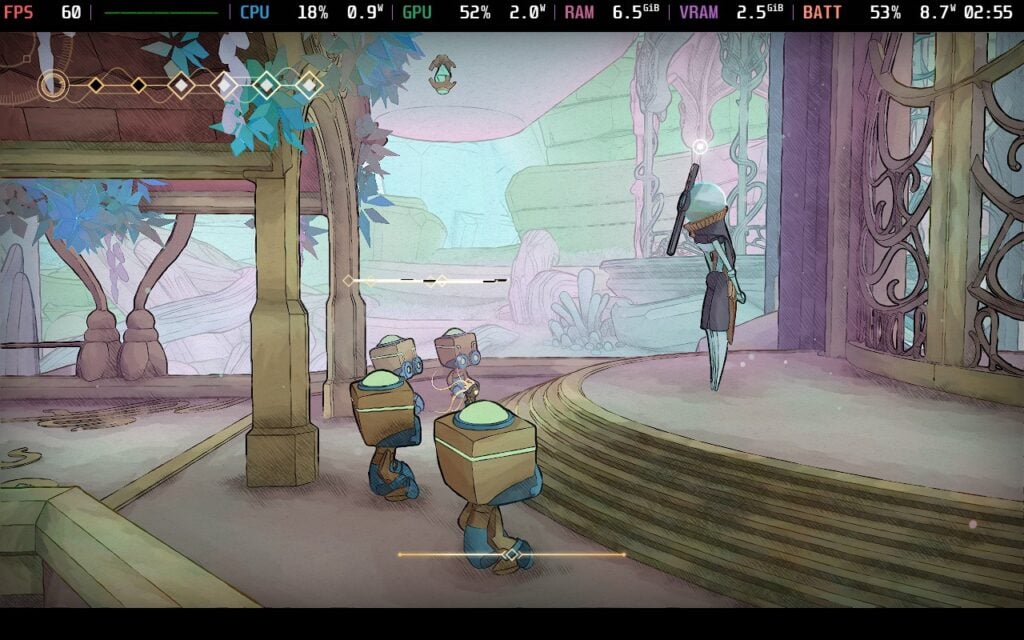
One of the first things that stood out to me about MIO when I initially saw and played it was the visuals. They have this enchanting, storybook-request look to them, making the unique environments in the sprawling metroidvania map pop. From the icy metropolis city to the vibrant, watercolor-like garden, each biome stands out from the others while still keeping the consistently gorgeous quality. It never failed to amaze, and it was encompassed by a great soundtrack that made the audio-visual experience feel wholly unique.
MIO is a true metroidvania, for better or worse, but it’s implemented very well with only a few issues that irked me. The general gameplay will have us traversing its large map, fighting enemies, discovering new abilities, using those abilities to reach places we didn’t have access to before, and taking down difficult bosses. If you play a lot of these types of games, it’s going to feel very familiar very fast.
There are also no indicators as to where anything is on the map. There are some small indicators showing pathways that you haven’t explored yet, but otherwise, there is no handholding. Personally, for these kinds of games, I like this approach. It can feel very rewarding to explore and find secrets and stumble across bosses and story elements, all because of my decision-making. It can’t get a little confusing, and it’s easy to take a lot of time to explore and figure out where you will try to go next, but in my eyes, that’s part of the fun.
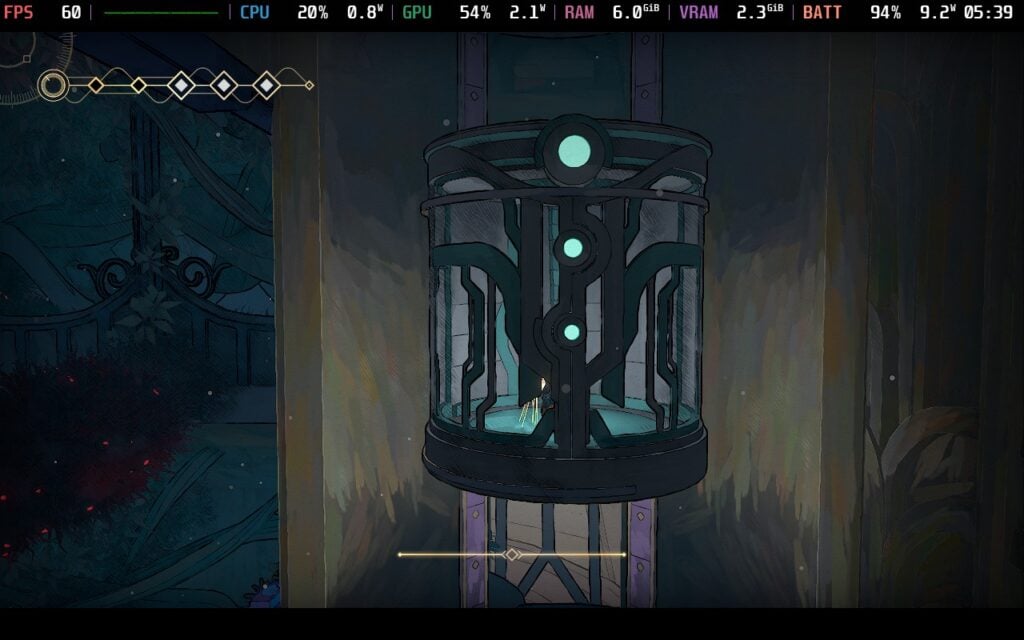
What isn’t part of the fun is the respawn and fast travel system. As with a lot of games that have combat, you are going to die as you come across difficult bosses and learning the mechanics. When you die, you’ll respond from the point you had saved last. However, there aren’t many of these, and they aren’t clearly marked on the map unless you’ve already discovered them. This means that it can be easy to miss, which could set you very far away if you die. This happened to me multiple times, especially in the early game, and backtracking was very frustrating. I sometimes respawned in a completely different biome than I just was, and that just sucked.
This ties in directly with the fast travel system. We can fast travel between the save points, but only if you found this weird squid-like creature to inhabit it. Some of these can be tough to find, which means fast traveling to another location to explore new pathways will take longer. That means even more backtracking, which was the bane of my existence while playing this.
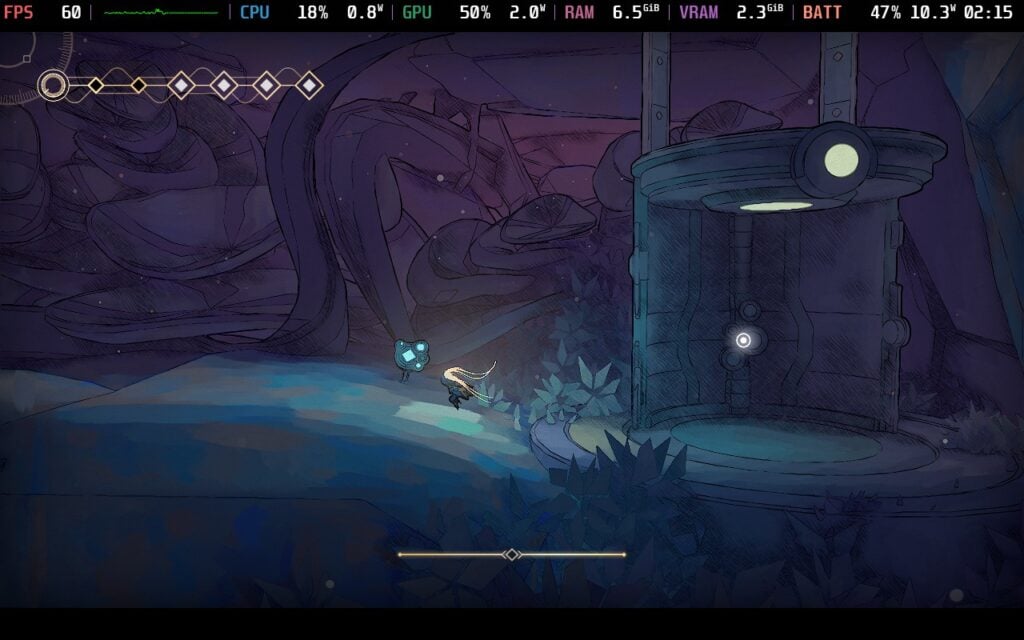
Thankfully, almost the entire rest of the game makes up for these frustrating elements. There is a lot of platforming across MIO’s sprawling map, and I loved it. It starts off a little slow for my tastes, but once we get the ability to recharge our stamina after hitting an enemy or a specific kind of bulbous flower, it starts to feel a lot better. Abilities like flinging ourselves around, gliding, climbing on walls, and recharging stamina will all help us get to secrets on our own, but the areas where you need to utilize all of these to get from one spot to another are a welcome challenge that I look forward to. It felt so natural to switch from ability to ability, making challenges that could feel frustrating ultimately feel enjoyable.
They also made going off the beaten path, going on your own, to explore very rewarding. Deciding to let intrusive thoughts win and climb up buildings could lead to finding more secrets. This happened multiple times, which made me start to explore every inch of the map that I possibly could and try to do things that I had no idea would work. That experimentation, coupled with getting no directions, fueled my curiosity and pushed me to keep allowing myself to explore where I wanted to.
Combat is simple, but that doesn’t make it less enjoyable. We have one basic attack combo, as well as an up attack and a down attack, though the down attack doesn’t do any damage, and we’ll just knock ourselves up into the air a little bit more. It may sound boring to use only one combo to take down complex bosses, but attacking is not the only thing we need to keep in mind. We will have to think on our toes, using our multitude of abilities, well-timed dodges, and more to slowly bring down the boss's health. With how great traversal feels, this makes combat feel just as good. I didn’t feel like anything felt unfair either. The dodge timing wasn’t too short, and the precision of the abilities made it so I was keenly aware of whatever action I took would do.
The progression is interesting as well, though I also wished for a little more. Since you play as a robot, you’ll find a module that you can install to give you new abilities. Each one could have a wide range of effects, which can give you more attack power on your final hit of the combo, allowing you to glide faster while consuming more stamina. And each one has a bandwidth cost associated with it. There’s a limit to the number of modules that we can install, directly tied to how much bandwidth we have. I felt that the limit of bandwidth didn’t increase as much as I would like it to.
With how many modules I was finding when hunting for secrets, it felt like I wasn’t able to utilize a lot of them without uninstalling modules I had grown accustomed to. It would ultimately make me sacrifice aspects of my play style to try out another, but both achieved a very similar outcome, which made me not want to switch out anything. I would install those other modules once my limit increased, but finding the necessary components to increase my limit was rare. However, with some modules actually being able to decrease bandwidth and give a negative effect, it does open up more possibilities for customization.
The only other way to increase that limit is by buying parts from the shop. Pretty early on, we will unlock the shop, which we can use to buy new modules, bandwidth limit increases, and parts to increase our health permanently. At first, the common currency that drops from enemies is all we will need to buy some of these, but soon, we will have to gather up Old Cores to get some of the better modules and other parts. Finding these courses takes a while and they are not as common, so there’s gonna be a lot of picking and choosing.
The story of MIO is an interesting one, though it took me a little bit of time for it to start clicking. You play as a little android named MIO who goes throughout a derelict spaceship overgrown with fauna and littered with destruction. Now, it’s up to you to figure out what happened, revive the lost memories of the ship, and do what you can to save it from destruction. It was intriguing to find out what happened on the ship, what its true objective was, what happened to the AI governing the ship, and who MIO really is. I was interested enough that I read all the documents I picked up, which isn’t something I do in most games.
It left me with an odd feeling, seeing all of these robots exhibiting human-esque characteristics and seeing the hope and despair that they have when it comes to salvaging the ship and its mission. It feels like there’s this dreaded overtone as we find the governing AI and see the state they are in. With some being more cheerful, while others being skittish and afraid. All it did was pique my curiosity further.
MIO: Memories in Orbit is a joy to play on the Steam Deck, but it does require one change to fully enjoy it on the go. Out of the box, it will default to the high-quality settings, and while most places will run at 60 FPS, there are some that will be bottlenecked and bring down the framerate to 40 FPS or lower. This does become an issue, since some of these areas include boss fights. Unless you are playing at 30 FPS locked, this is very jarring.
However, with one change, we can have a silky smooth 60 FPS with lower battery drain and great-looking visuals still. All you have to do is change the visuals from High to Medium. That’s it. This brings the entire game to a stable 60 FPS, lowers battery drain to under 12W at all times, and keeps it looking very nice. There are some minor visual differences, but they pale in comparison to the improvements in framerate and battery life.
While I do understand why the game is Verified, I do hope the developer changes the default settings on the Steam Deck to medium. This is a fantastic experience at 60 FPS, and I can’t see myself enjoying it below.
The game doesn’t support 16:10 resolutions, but it does have cloud saves and controller support. There are no HDR settings.
MIO: Memories in Orbit is a gorgeous, fluid, and intriguing metroidvania that succeeds on almost all fronts. The intriguing story hooked me in, while the fantastic traversal and platforming mixed well with the simplistic combat to create an engaging experience. The fast travel and respawns could be a little unforgiving, and I wish there were more parts to further upgrade MIO to continue experimenting, but it was still fun nonetheless.
And MIO is wonderful on the Steam Deck. Just changing the graphics quality to Medium gives us a perfect 60 FPS with lower battery drain, and it still looks great, especially on the OLED screen. So, I am pleased to say that not only is this a great metroidvania, but it’s a fantastic title to take on the go, and I highly recommend it.
このレビューはPC版に基づいています。
このレビューをお楽しみいただけたなら、SteamDeckHQ の他のコンテンツもぜひご覧ください!あなたのゲーム体験に役立つゲームレビューやニュースを幅広く取り揃えています。ニュース、ヒントやチュートリアル、ゲーム設定やレビューをお探しの方も、最新のトレンドを知りたい方も、ぜひご利用ください。
MIO: Memories in Orbit is a fantastic metroidvania, filled with beautiful sights, tight gameplay, and some solid Steam Deck performance after making one change.