



Hell Clock was provided by Mad Mushroom for review. Thank you!
When I previewed Hell Clock back in May, I was a big fan of the game’s unique setting and visual charm. The game was initially meant to launch in June but was pushed back to this month instead. That's fine with me, as games sometimes require time to cook.
And now I’m hungry.
I've thoroughly enjoyed myself with Hell Clock. I found it ironic to play a game called Hell Clock during another heatwave here in the UK. There are a ton of roguelike games on Steam, which can feel a bit insane, and while this is another one, there's still a lot to love, even with some parts holding it back from brilliance. Still, games in this genre need to stand out just enough, and it may be joining the list of games I keep returning to.
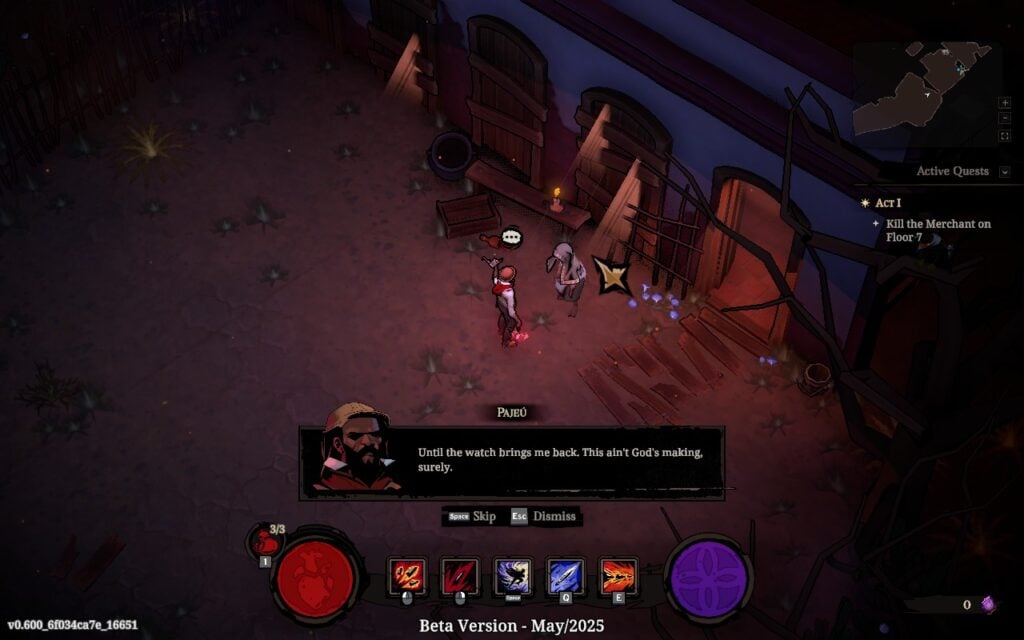
Hell Clock's unique Brazilian historical setting is its main draw for me. It's a rare treat to see a game set with Brazilian history in mind. The game is heavily based on the brutal Canudos war in 1896, which killed tens of thousands of people, and the devs help the game stand out by bringing the horror of that conflict into their game.
Players take on the role of Pajeú, a warrior fighting to rescue the soul of The Counselor, his fallen mentor, who is trapped in a nightmare world. It’s not often in a roguelike that we get to play something inspired by historical events, and weaving that with a demonic hellscape is a great way to symbolize the horrific nature of war.
While the lack of sexy deities giving me blessings like in Hades is disappointing, the voice acting performed in native Brazilian adds historical depth to the characters. Given the brutal historical context, hearing these broken individuals trying to survive hit me hard in what we call ‘the feels’, and elevates the story to make it feel much more memorable.

Hell Clock plays like the Diablo franchise in its gameplay loop, with some interesting changes. While many loot and weapon upgrades exist, you have limited access to the nightmare world. The Hell Clock is constantly ticking to your death, and while you can extend the clock, your death is inevitable. That is all too common with the rogue genre, and death makes you stronger as you try to rescue your ailing mentor.
The combat and movement are great, and I felt like Rambo blasting through the levels. The visual design isn’t spectacular, but the twisted concoctions of this nightmare world set the scene nicely, complemented by excellent sound design. You start with an unimpressive pistol, but gain access to better weapons and equipment as you progress through the maps.

I was concerned during the demo about the repetition of the dungeons, and the procedural generation of the level design makes the areas a little similar after a while. Procedural generation will always have this problem, no matter how much variance there is. While this is a little disappointing, I still enjoy the moment-to-moment gameplay. I can forgive level repetition as long as the core gameplay loop holds up, and that is the case here.
After you die, you return to the central hub, a safe area that serves as a base of operations and grows as you progress through the game. Quests such as reducing lost souls in the nightmare world return to this area, offering numerous benefits, including new weapons, items, and perks. Regarding content, Hell Clock has a lot of meat on the bones. The main story is stretched across 3 Acts alongside a generous dollop of side content, and it comes out of the gates swinging with difficulty modes, too.

Permadeath and relaxed mode are both in the game at launch. I did mess around with the former while playing, but the difficulty ramps up rather quickly, and with my specific lack of talent with these games, you can imagine how well I performed. I stuck to the standard mode for my time, but if the Hell Clock’s time mechanic is too stressful, Relaxed mode turns that off for you, which is a nice touch.
The performance was a mixed bag. I was happy to see complete controller support, and it feels great moving around the maps. I ran into some minor bugs, including when I dashed into a giant undead boss during a survival gauntlet and got stuck to it. That was pretty funny, although I could not damage him and eventually got turned into paste. I also had an issue with the mission log, which sometimes malfunctioned and indicated that Act 1 was still ongoing, even when I completed Act 3.

Hell Clock is a surprisingly intensive game. Even on low settings, it failed to hit 60 FPS on the Steam Deck. Optimization still needs some work, and I hope they add font scaling, as the text is currently too small to read.
Overall, there is much to like here, although the steep difficulty curve and performance quirks should be considered.
Hell Clock is fairly playable on the Steam Deck, with controller support being a lovely addition from the demo. However, it requires some compromises to reach its full potential, and the tiny font size detracts from the experience.

As previously mentioned, Hell Clock is surprisingly intensive. The visuals have some fantastic moments with great lighting and atmosphere, but the Steam Deck optimization is still not there for this game. That does not mean the game is a bad experience, but I had to lower the settings to the minimum to hit 60 FPS with an unlocked TDP and native resolution. Even then, it dips during the more intense action scenes, so we have to work to improve the experience.
The inconsistent 60FPS framerate was frustrating, but that did not make this a miserable experience. While the game often failed to maintain a steady 60 FPS, capping the frames to 50 went much smoother and more stable, so I decided to cap it there. I still saw a few drops during the more active scenes, but this was a better experience overall.
I tried adjusting the TDP limits to see if I could improve battery life, but an unlocked TDP provided the only smooth experience. Capping the refresh rate to 50Hz helps significantly, although the average battery draw remained around 12 watts. It occasionally spiked to 14 watts. For this reason, I will not include any Battery Saver options, as I found no optimal settings for them. You should expect at least 4 hours of battery life with a Steam Deck OLED.
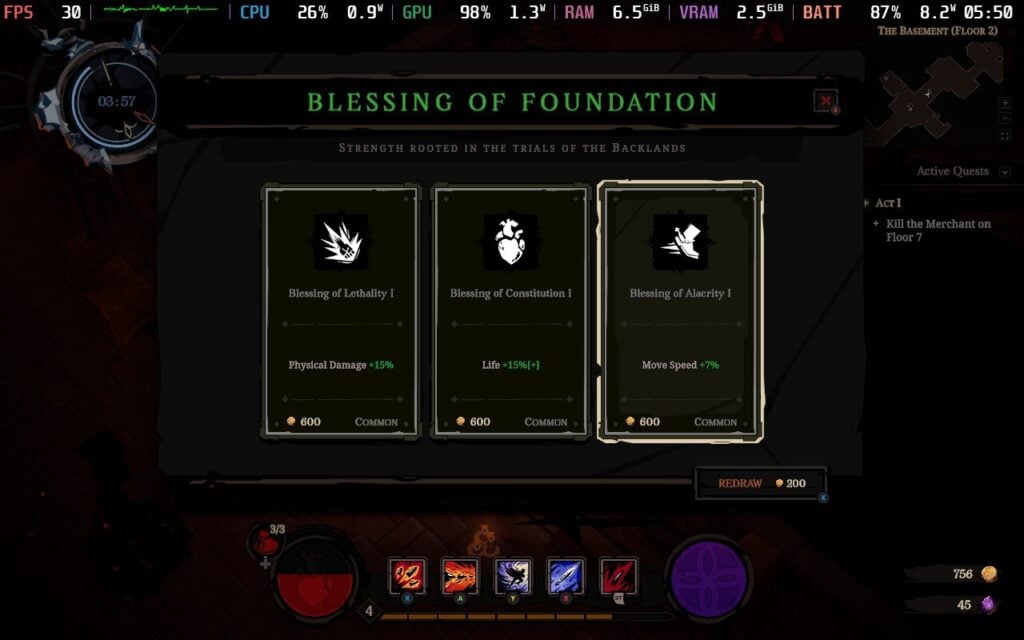
Hell Clock is available in many different languages; however, only English and Portuguese have full audio.

Hell Clock has a decent number of options. You can change the language, turn on screen shake, adjust the minimap opacity, reset tutorials, toggle the colorblind option, and adjust the colorblind strength. You can also change controller keybinds, but the base controls are sufficient.
When I played the preview, Hell Clock impressed me, and the full release does not disappoint. The setting and atmosphere are excellent, and we don’t have many games inspired by Brazilian lore. The production quality is very high, and I also enjoy the gameplay. Hell Clock is easily developer Rogue Snail's best game so far.
It isn’t a perfect experience with inconsistent Steam Deck performance and a lack of UI scaling. Still, Hell Clock is a refreshing addition to the roguelike genre with a damn good story to boot.
このレビューはPC版に基づいています。
このレビューをお楽しみいただけたなら、SteamDeckHQ の他のコンテンツもぜひご覧ください!あなたのゲーム体験に役立つゲームレビューやニュースを幅広く取り揃えています。ニュース、ヒントやチュートリアル、ゲーム設定やレビューをお探しの方も、最新のトレンドを知りたい方も、ぜひご利用ください。
Hell Clock is an inspiring and well written roguelike with some interesting mechanics, although its Steam Deck performance is a little flakey at the moment.