


Crimson Desert was provided by Pearl Abyss for review. Thank you!
Ever since its announcement, I have been getting more and more excited for Crimson Desert. It looked like a gigantic game, brimming with so much content on a huge map that looked so visually pleasing. It was clearly ambitious, with developer Pearl Abyss making a larger-than-life single-player action RPG. Honestly, I was even a little worried the hype would not be worth it. Yet here I am, with over 70 hours in the game, and I fell in love with the world of Pywel, despite some execution mishaps. Crimson Desert lives up to its expectations in more ways than one, even if what makes it incredible also harms the experience.
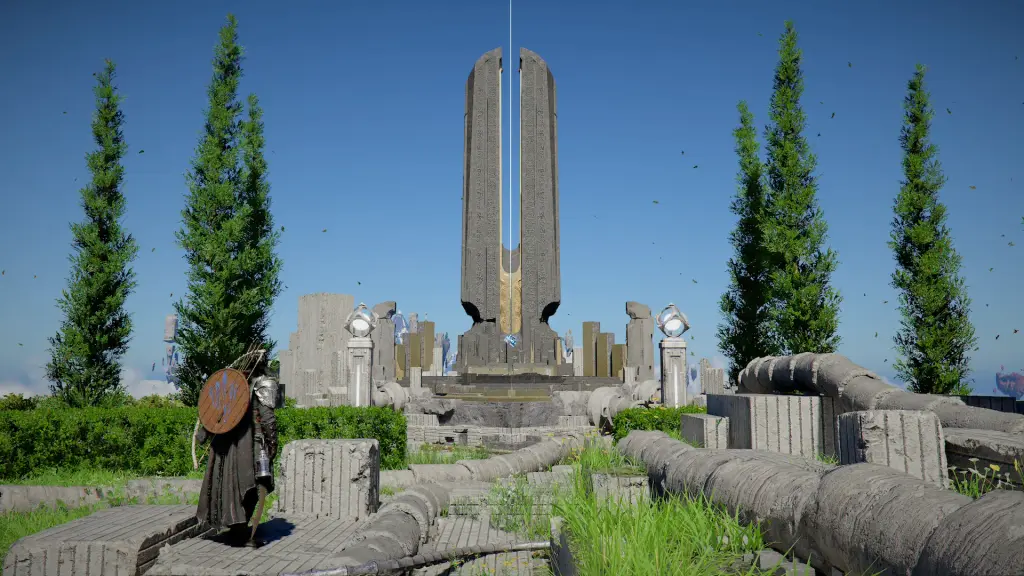
Visually, Crimson Desert is stunning. Through the forestry landscapes, snow-covered mountains, red-hued deserts, and futuristic islands, the world consistently looks incredible. I was blown away by how many times I had to stand still and just take in the sights, watching as the purple and white flowers blew back and forth with the wind on a mountain with a gorgeous backdrop of the town beneath me. I couldn’t count how many moments I was riding my horse and just had to take pictures to remember the beauty of the setting, and I can count the number of games on one hand where I had this compulsion. This is a world worth exploring, even if it’s only to see what the other side of the continent looks like.
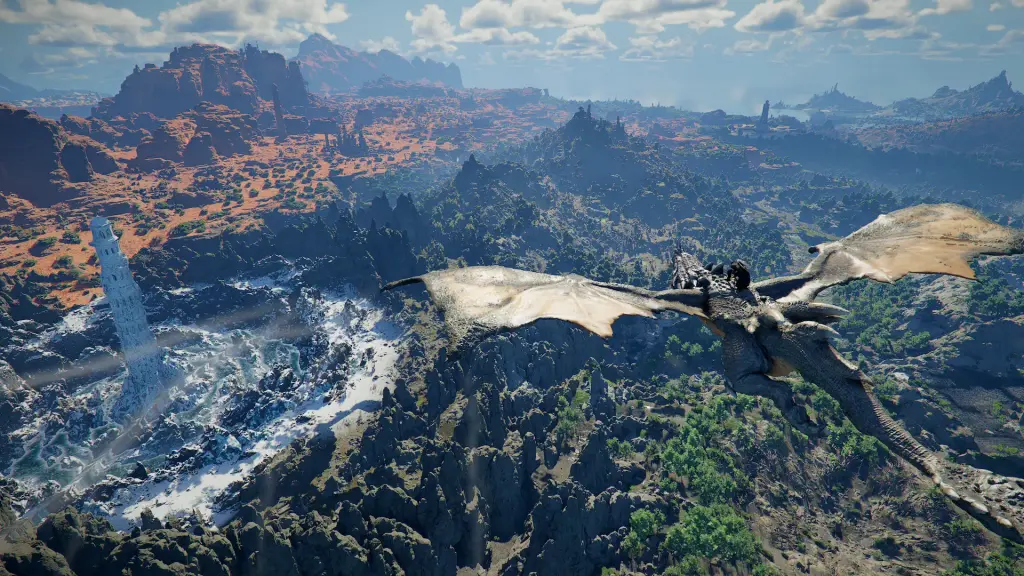
And boy is Pywel massive. I spent the first 30 hours or so going around the giant town and its surrounding areas, completing side quests, and moving along the story across 5 chapters. It is a significantly large area covered, and I was sure it would primarily take place in this area. However, I could not have been more wrong. In those first 30 hours, I had only explored around 25% of the map, with gigantic regions that I still haven’t gone to. I was actually blown away when I was looking at the map and seeing how much area I had covered, which was only compounded when I saw the landscape from above in the abyss. That sense of wonder never disappeared, and I was so motivated to keep on exploring.
However, traversing the world, especially in the early game, was not enjoyable. Having to figure out how to find fast travel points and the scarcity of them early on meant running around or riding my horse. With so many places to go back and forth, and fast travel points not feeling close enough to where I needed to go, it started to feel like a chore to do side quests all in the same area. I didn’t mind exploring new areas, but I very much disliked backtracking in areas I already knew. This gets significantly better later on as we unlock more points and get new ways to go around the world, like the dragon, but early on, it wasn’t great.
Now the world is littered with secrets to find, and I would find myself hunting them whenever I could. They can be somewhat well hidden, though if we use the lantern, we can see a glimmering light where those secrets are. In these secrets could be entrances to puzzles, Sealed Abyss Artifacts, or those aforementioned fast travel points. Completing puzzles also turns into fast travel points, which does make it a little bit better, but it’s not something that will help a lot early on. Still, the rewards outweigh the issues heavily.
I was also pleasantly surprised by the story. It wasn’t anything new, but it was still entertaining with so much lore packed in through side quests. We follow Kliff, who, with his fellow Greymanes, is attacked by another group, the Black Bears. They are slaughtered and kicked out of their country, Pailune. However, we survive, and decide to start rebuilding the Greymanes in Hernand. But that’s not all. We are also selected by the Abyss to help balance the world, giving us interesting magical powers.
This is essentially what set us off on our journey. We face riddling defeat, get magical powers, and decide to rebuild and come back stronger to save Pailune. However, there are some twists and turns that I didn’t expect, and the game became significantly longer and larger than I had previously thought.
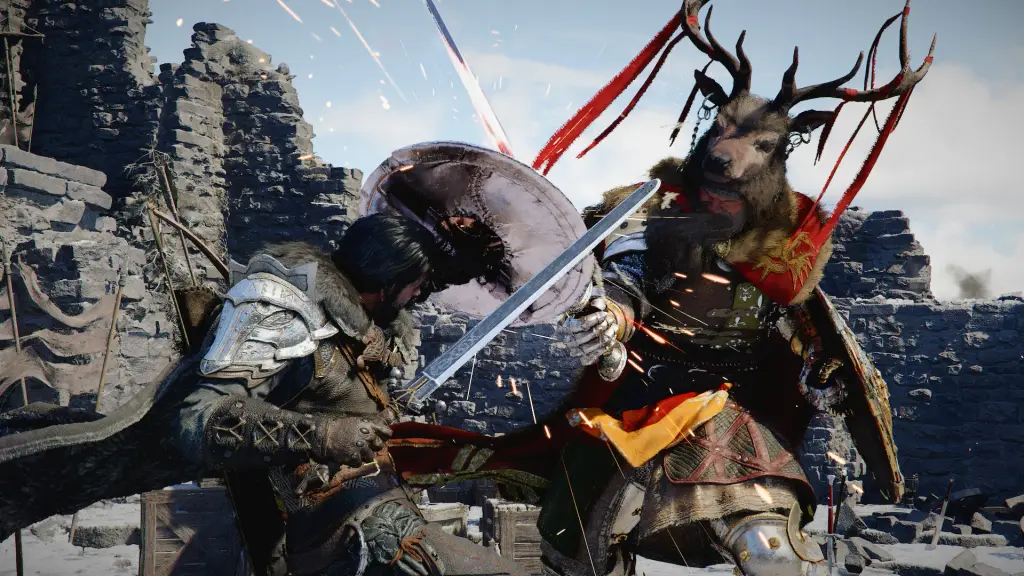
There’s also a wealth of side quests and extra content to give us much more insight into the characters and lore of the world, including multiple playable characters who all have their own story elements. Even at the 70-hour mark, there was still so much to unlock, so much to do, and it felt like I always had something to learn about. As far as the story goes, I was pleasantly surprised the longer I played.
Now let’s talk about the gameplay, which is arguably going to be the biggest part of this review. Crimson Desert has an overwhelming amount of content that exudes across all facets of the game. In the opening hours, it can feel pretty overwhelming, but once things settle in and open up a little bit more, more mechanics start to come to light and are understood, and it all just clicks. This is one of the big reasons it succeeds; it never gets to the point of significant overload and can still be very manageable.
One of the biggest draws to the game for me was the combat. Seeing it in action, just looked insane, with unique abilities, flashy effects, and ridiculous attacks like clotheslining and dropkicks. All of these attacks are indeed in the game and quite easy to use with practice. For the most part, combat is exhilarating. When everything works, fighting groups of 20 enemies with the diverse moveset we have, which includes our ranged attack in magical strikes, it’s the best. And it’s a system that gets significantly better further in the game once Abyss Cores (Abyss Gears) come into play.
However, it will take some time to get used to it, and while there are a lot of options for us to use, I would ultimately not use some of them or completely forget how to activate others. Most of the attacks we have are linked to one of many combinations of six different buttons, and it was sometimes very hard to remember exactly which does which. Even though it was one of the initial moves, I learned that I almost never found myself using Blinding Light, and I consistently forgot about shield bashing, grappling, the flying kick, and spinning slash. I love having options, and when I remember which attack to use, it’s awesome. But there are so many different combinations that do so many different things that I found myself getting lost and sticking to the basic attacks I memorized.
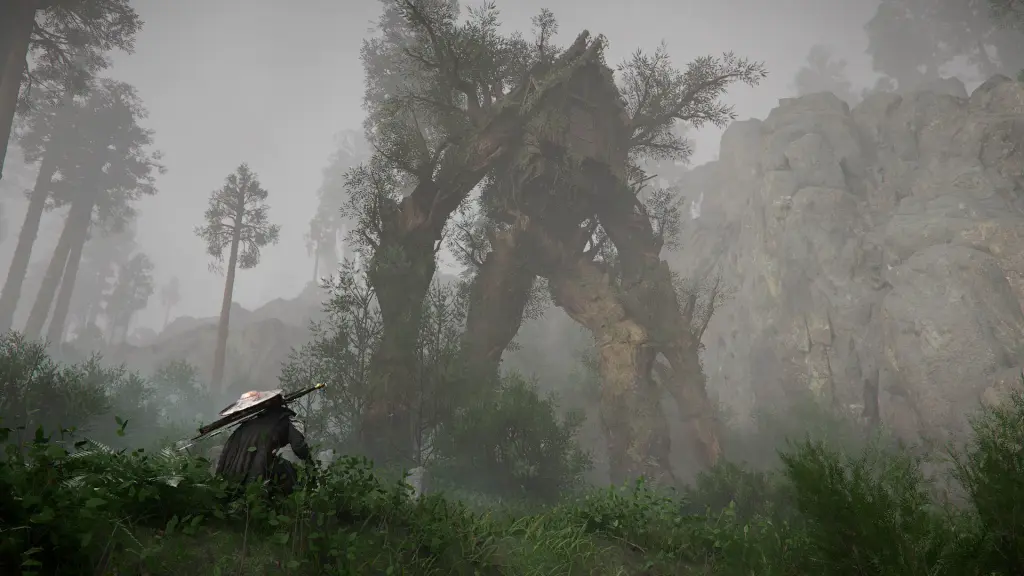
The controls and targeting can also feel really wonky. Even if I automatically lock onto an enemy, my attack will sometimes go in the wrong direction, or the game will automatically lock onto an enemy I’m not actively attacking. I also had trouble trying to aim my meteor kick, which is a giant kick that comes from above and can hurt a bunch of enemies around. Without any modifications, this kick needs to land a direct hit on the enemy, and I cannot count the number of times I have locked an enemy in the targeting ring and still completely missed.
Yet, despite all of this, I looked forward to every battle. There’s just something so enticing about the scale, the effects, and the abilities we have that just keep combat so entertaining. Remembering older attacks and finally utilizing them was exciting, but I would say the big reason to keep coming back to it is those Abyss Cores (Abyss Gears). Bosses could be a hit or miss, with some feeling a little too difficult, but with some grit and strategy, they were able to be destroyed.
Different parts of your gear have different sockets, and in the sockets, you can put in Abyss Cores (Gears). These can completely augment your abilities and stats, which can range from better attack, movement, speed, or even making it so orbs of lightning come out of your sword. The effects of these can range wildly, and make some of your attacks insane. On top of that, you can synthesize and craft more powerful cores, so you can keep getting stronger and stronger. This, on top of getting resources to refine weapons and armor, to make them more powerful, will be the crux of how we progressively become stronger. It’s an extremely compelling system, and I cannot overstate enough just how great playing around and combining Abyss Cores (Gears) is. It’s tough to get into it until later on in the game, but the wait is worth it, especially once we start playing with elemental powers.
It’s a genius system, complemented by Crimson Desert’s great skill tree. I was a little worried when I heard that this giant action RPG wouldn’t have leveling or any exp system, but my worries were unwarranted. Instead of the usual leveling, we have a skill tree reliant on Abyss Artifacts. The skill tree itself can give us a boost to three of our stats and unlock a wide range of new attacks. The tree, containing mostly new ways to beat down enemies, made it feel more rewarding to actually complete it. I would tend to get a little fatigued if the skills I want are locked and I have to go through multiple nodes that I don’t care about. However, that’s not the case here, and it’s great.
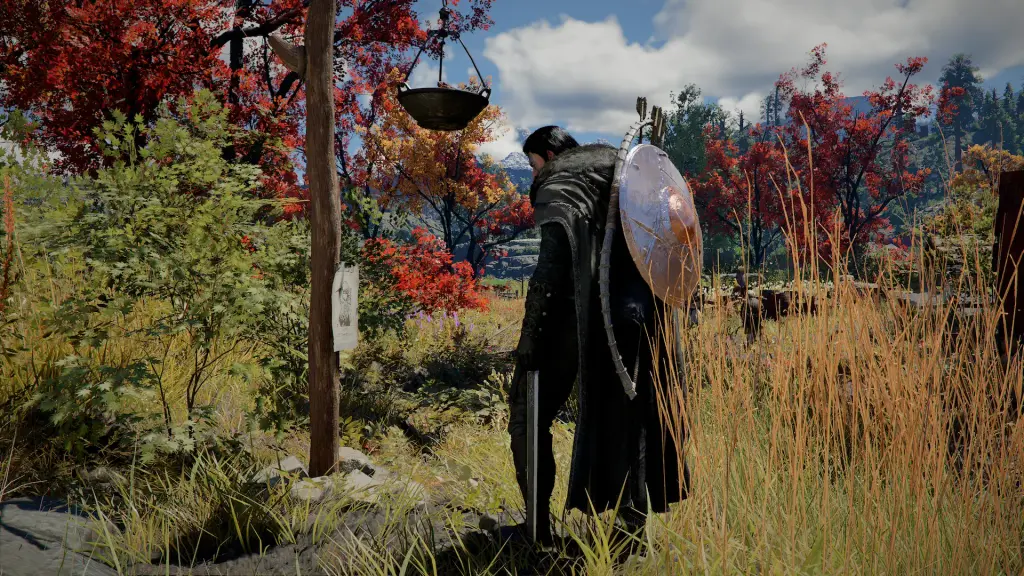
There are multiple ways to get these artifacts we will need, but the majority of them will come from random drops from killing enemies, side quest rewards, and completing different puzzles or challenges. All of the puzzles felt appropriately difficult, and they require some out-of-the-box thinking and logic. As for the challenges, which are found from Sealed Abyss Artifacts, they vary between different activities in the world, side quests, and special challenges with the weapons. With hundreds of these to do, it feels like a never-ending way to get the artifacts necessary to make us more powerful.
Which will be needed, because all of the characters we can play as have individual skill trees to go with their unique movesets and weapons. They do share the three stat upgrades, but there are going to be individual skills to unlock independently. With how many artifacts we can get, as well as random drops from time to time, it never felt daunting to complete them. If anything, I was more motivated to grind, knowing I was going for artifacts versus experience points.
Crimson Desert sometimes feels like a life-simulator RPG outside of combat with how much they throw at you. There is so much to do outside of combat, and they all feel beneficial. Not including side quests, there’s a full camp management system where we can send our crew to complete missions to get camp resources to take on bigger missions to give us more resources for personal use and even unlock new mounts. We will also be able to partake in tons of different little activities, like mini games for arm wrestling, fishing, mining, and logging for resources to upgrade our weapons. And of course, we have the puzzles, which can be scattered throughout the world and above.
On some level, the game gave me the impression that it was trying to do so much, but not mastering any of it. However, I never felt like I needed to do any of these. All of this stuff is optional, as we can find a lot of these resources off the bodies of bandits we kill, we can trade in unwanted weapons to get resources for our camp, and traveling gets much easier later on. Nothing felt forced, but everything felt worthwhile. And it helps that we unlock new abilities later on that can make some of this much easier. I also think it’s one of the coolest things that we can learn new recipes and information by scanning and reading books. It’s small, but I enjoyed picking up recipes and making sure I scanned them so I could cook them later on.
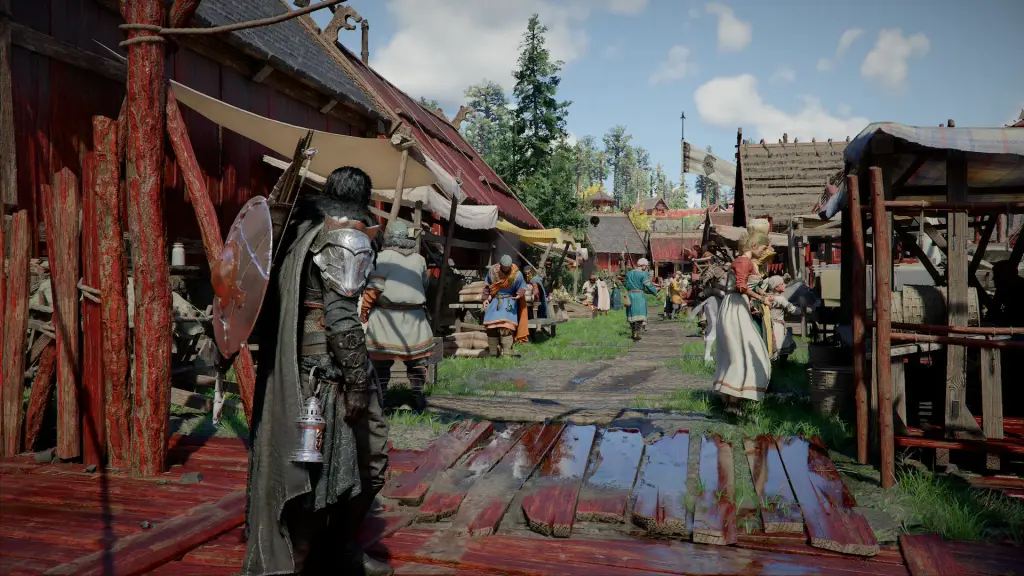
In the beginning, it was very overwhelming. It felt like there was so much I could do, and every part of me wanted to grind and explore. However, with how the game is structured, it’s best to follow along the main story for a while. There is an update for the game that fast-tracked some of this, including getting Abyss Cores (Gears) and a tutorial earlier, but there is so much that opens up the more you play that spending extra time early on to unlock more of the world will be more rewarding later on.
There will also be a Day 1 patch that drops as soon as the game launches, which does smooth out progression and fixes some key bugs. It doesn't change my thoughts on the game, but it is a welcome update.
There’s been a lot of speculation as to how Crimson Desert would run on the Steam Deck, but unfortunately, it’s an experience I can’t recommend. The reason this was posted so late is that the game did not work on the deck until a day before the embargo was lifted. Because of that, there was not enough time to test all the areas and fights that I wanted to, as well as the different settings we could try. Now, I’ve had that time, and there’s no way I can recommend playing this on the Steam Deck.
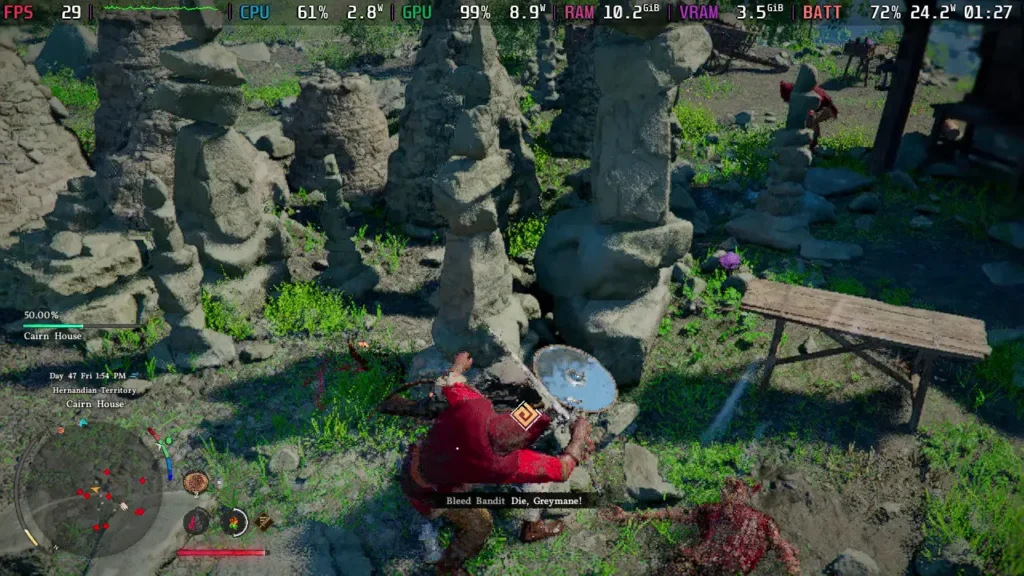
Before lunch, there were a couple of ways we could get the game running on the deck, but now it seems Valve pushed a fix to the Proton Hotfix branch, which is now the default. And it does work, so that is what I used primarily for testing.
For whatever reason, the game will boot up at the highest quality setting, possibly in an extremely high resolution. For me, the game was set to cinematic quality at 4K resolution. You will need a little bit of patience to get through the settings, as it sometimes takes a little too long to apply the new settings. I even had to restart the game once just so I could get to the settings, since it was taking so long just to apply the brightness filters.
After all is said and done, it doesn’t even matter how low the settings go; it will not hold a stable 30 FPS. Running across open fields, solving independent puzzles around the world and in the Abyss, and fighting small groups of enemies should hold strong at 30 FPS on the lowest possible settings with FSR 3 upscaling at Performance. There may be some minor drops here and there, but they’re relatively unnoticeable. We can also bring down the upscaling to Ultra Performance to keep it at a smooth 30, but the game becomes a washed-out, pixelated mess. Because of this, I do not recommend going lower than Performance.
Now, as soon as we get to larger cities, bigger fights with 20 or more people, and going around the world in a faster way than running, the framerate will drop. In these moments, I could see it get to as low as 17 FPS, which is horrible for combat, but just not enjoyable as a whole. Bosses and mini-bosses could bring it down even further because of all the visual effects that they have, making fighting them relatively impossible.
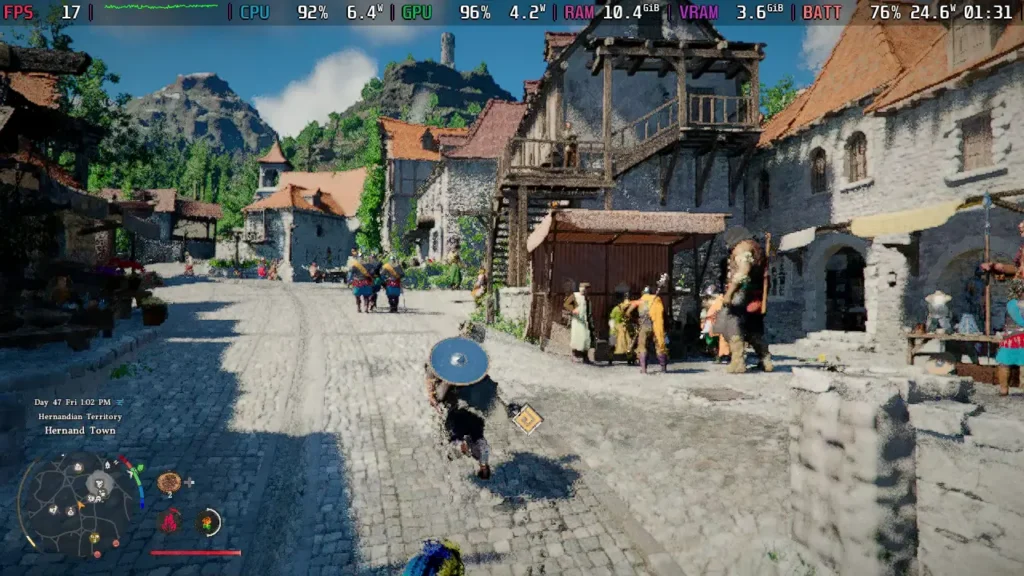
And for those who want to try frame generation or lossless scaling, please don’t. In most scenarios, the game will feel smoother with lossless scaling. However, it will not keep a solid framerate, stutters will appear in the areas where the framerate drops, and the input lag is atrocious. Even at just 2X for lossless, I was getting major lag to the point where I couldn’t dodge at the right time or execute attacks that I wanted to. This kind of lag is a death sentence for any major fights against harder enemies or bosses, and will immediately ruin the experience. It is not worth it.
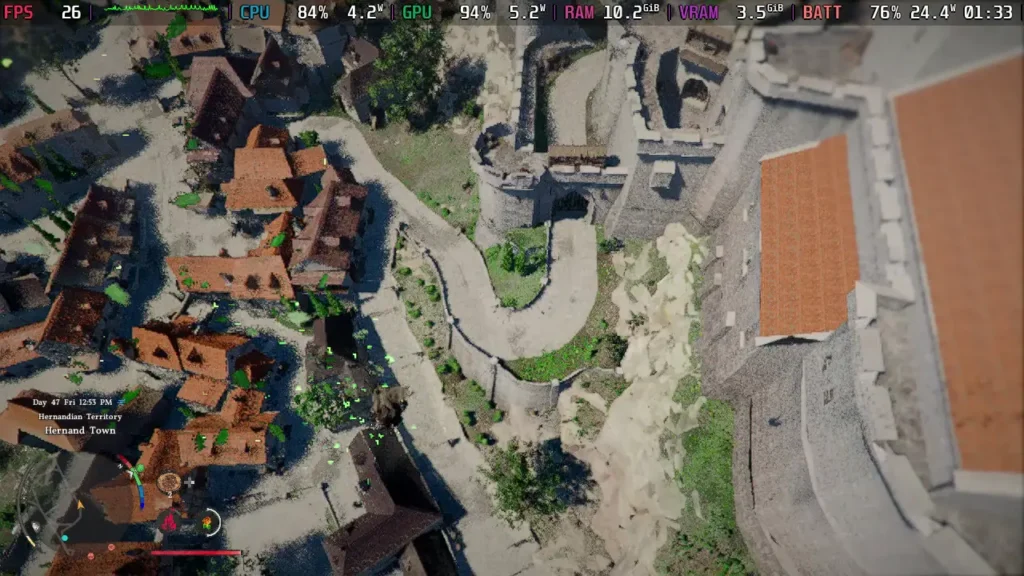
So, when all is said and done, Crimson Desert is not a game I would play on the Steam Deck. There are too many compromises that make it nearly impossible to enjoy fully. Is it decent for exploration, puzzle solving, and secret finding to complement a more powerful rig that the game is mainly being played from? Yes, it is. I actually did this a few times, where I just focused on exploring the world on the Deck when I took a break from sitting down at my desktop. However, there’s no way I could see playing this through completely on the Deck. If you have a more powerful PC or a console like the PS5, it will be a better experience there. The game is also available on GeForce NOW to stream, so that is also an option.
After reading my review, you might be wondering why Crimson Desert has such a high rating despite a good amount of grievances. There is one big reason, and it’s that despite these grievances, I found myself craving more. I would go in to play for one hour, and I would come out four hours later, satisfied. It didn’t matter how frustrated I would get; the joy of playing through the game overtook it immediately. The sheer amount of content is overwhelming, but it never overloaded me. There was always something to do, and even if it was a little difficult at times, it was always fun. Pearl Abyss found a way to weave everything together in one glorious, large, monstrous package that is a joy to experience.
I didn’t think it was possible for a game of this scale to exist yet, and I don’t recall the last time I ever played a game that wasn’t designed to be replayable that hooked me for such a long time. But here we are. The game lived up to its hype, and even though it isn’t perfect, Crimson Desert is one of the best RPGs I have ever played.
このレビューはPC版に基づいています。
このレビューをお楽しみいただけたなら、SteamDeckHQ の他のコンテンツもぜひご覧ください!あなたのゲーム体験に役立つゲームレビューやニュースを幅広く取り揃えています。ニュース、ヒントやチュートリアル、ゲーム設定やレビューをお探しの方も、最新のトレンドを知りたい方も、ぜひご利用ください。
Despite some nuisances here and there, Crimson Desert is one of the best RPGs I have ever played, with so much content, explosive combat, and an entertaining story.