Fogpiercer was provided by Hooded Horse for review. Thank You!
When I first heard of Fogpiercer, I couldn't help but wonder if it was related to the hit Snowpiercer franchise. Both are set in post-apocalyptic frozen wastelands, both heavily feature trains, and the similarities in the names are hard to miss, but no, they are not related, although I wouldn't be surprised if Fogpiercer was inspired by Snowpiercer.
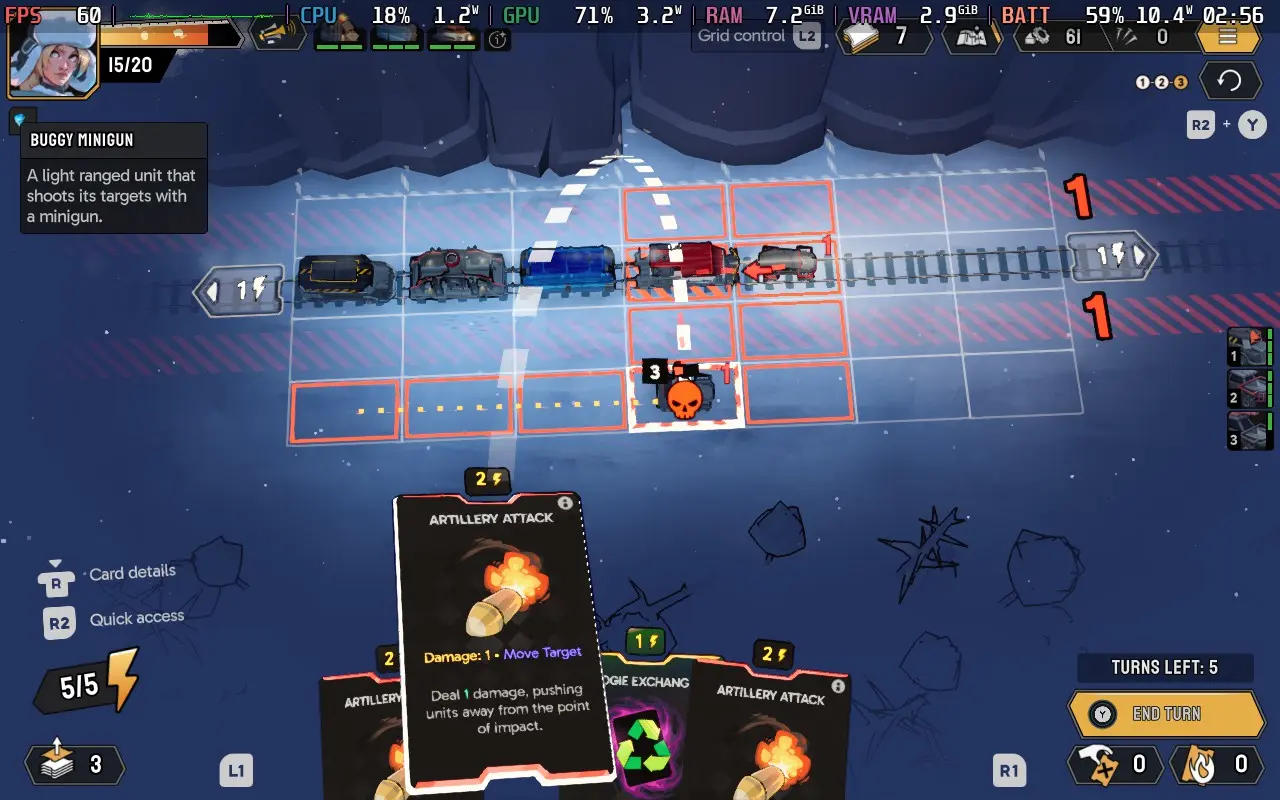
Fogpiercer doesn't offer much as far as a story goes, much in a similar vein to games it was inspired by, such as FTL. There's a (very) short preamble before you start, and then that's pretty much it. The gameplay is very much the driving force behind the game, and fortunately, I enjoyed the deck-building and strategic gameplay of Fogpiercer immensely.
If "Puzzle Strategy" were a genre, then Fogpiercer would definitely be in it. Rather than just drawing cards and using them to directly attack your foes, there's a big selection of strategies that you can employ that are often far more effective than direct attacks. Artillery, for example, can push enemy units away from the explosion, putting them in potentially even more dangerous positions, or knock them into other enemies, dealing damage to both.
When an enemy is defeated, it also falls backwards through the grid, damaging the next enemy behind. All of this means that when you play your cards, you're taking a lot more into account than the straight damage value, you're looking at chain reactions and combos, can you take out several enemies in just one play, or can you put enemies into a certain position with one card, so your next card can unleash a devastating attack, it's incredibly satisfying when you do. There are also defensive cards you can play to protect your train, which are invaluable if you're facing large numbers of enemies.
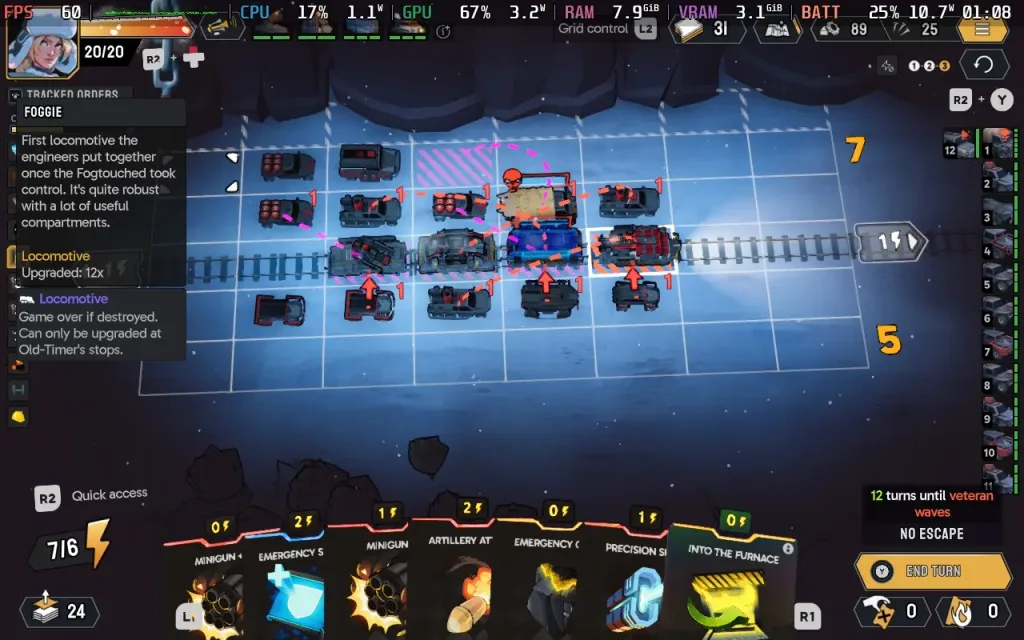
Another layer of strategy is created by the carriages of your train. The carriages determine what cards you can have in your deck. For example, there is a protection carriage that allows you to add Shield cards to your deck; there is also a minigun carriage, a tesla coil one, an artillery one, etc. And the placement of these carriages on your train also matters.
The shield carriage, for example, has some cards that only work for adjacent carriages, so I tended to favor putting it as my first carriage, so it could shield my actual locomotive easily regardless of what card I drew. Cards drawn for offensive carriages also have firing arcs, such as artillery not being able to shoot nearby grid spaces, meaning you do want to take into account the composition of your train, with the game allowing you to have up to 5 carriages in a run.
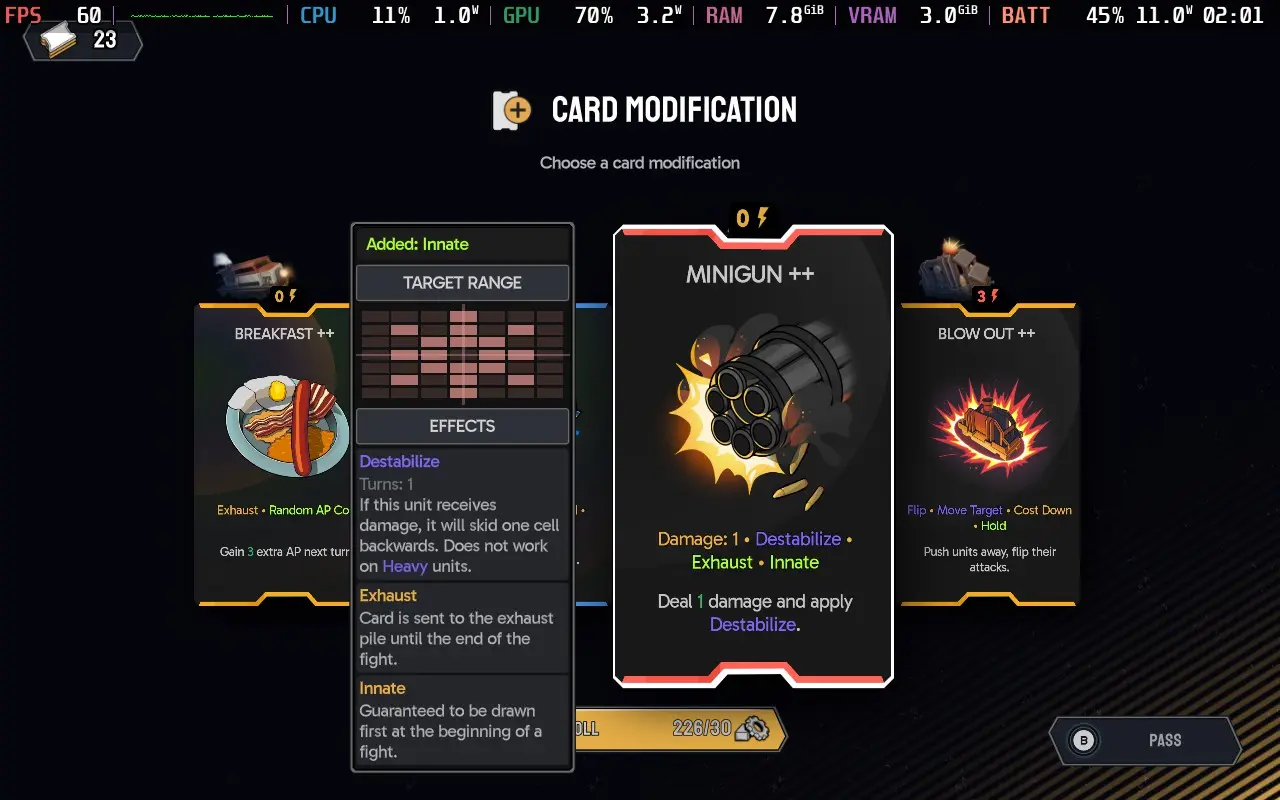
As is common for games in the genre, you'll work through a map of nodes, with each node being an "encounter", which can be a battle, a shop, or another area of interest where you can often upgrade or acquire new cards/loot. With your goal to eventually reach the end of the map and pierce the "fog". At which point, you'll face a major boss and your run will restart, with the goal of the game to beat all of the main bosses by choosing different paths on your journey.
The progression in Fogpiercer, however, I found to be a rather weak point. You'll unlock new characters/carriages/cards by either completing specific objectives or spending the game's permanent currency that lasts between runs. It takes a long time to unlock everything; arguably, you'll still have locked items when you've essentially completed the game, depending on how quickly you're able to reach the conclusion.
The unlocks also don't change the game by a huge amount. Sure, the extra cards you can buy add a bit of variety, but they don't really feel like they're a huge improvement over the starting cards; they just offer you more choices, which can sometimes be a bad thing, as more cards mean the cards you really want will appear in your hand less often. The carriages, however, are the big unlocks, and they have a large impact on how you play the game. There are only a few to unlock, though, and they all have quite high requirements, meaning you'll only unlock one every few runs.
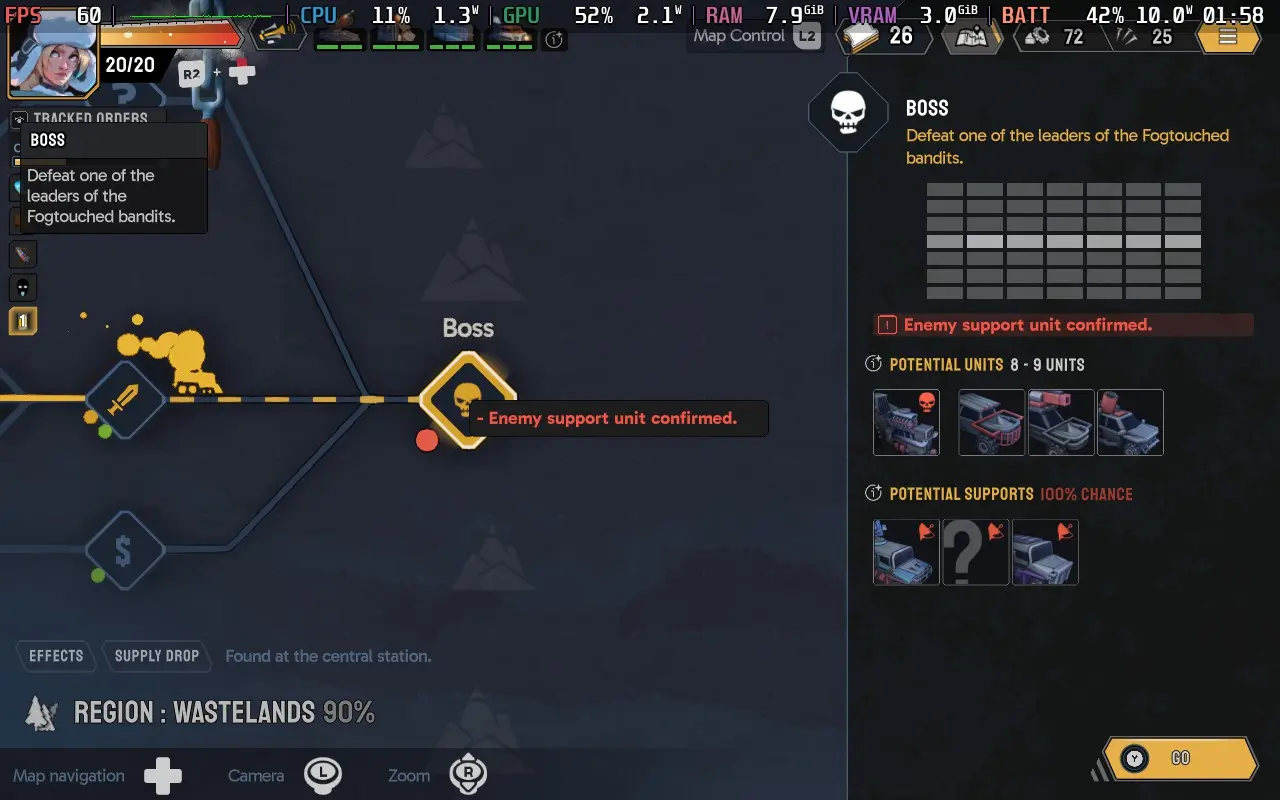
There are different environments you'll encounter in Fogpiercer, but really, there's only so much you can do with a post-apocalyptic snowy wasteland, and the environments don't really make the game feel any fresher. The main changes will come in the form of new enemy types appearing, bringing with them new attacks that you'll need to figure out how to defend against and counter. It helps keep the gameplay interesting; you'll just need to get used to similar visuals throughout.
On the plus side of the game's presentation, the music is great, and I'm a big fan of the slightly electronic feel to the soundtrack as your train blasts through the wasteland, taking out bandits along the way.
Fogpiercer runs great on the Steam Deck from the off. It supports 1280x800 as a resolution, has full controller support, and has a decent-sized UI with readable text.
As for performance, the game defaults to settings that work well on the Steam Deck. I would recommend just changing 2 things. For me, the frame limit was set to 144; I adjusted this to 60. I also changed the Render Scale from 70% to 100%; it has a minimal impact on GPU usage and helps clear up the edges of objects nicely. I opted out of employing any form of AA. TAA makes the game look way too blurry, and MSAA isn't worth the performance cost. The only thing we miss out on is Shadows, which look bad unless they're on the highest setting, which really hammers the Steam Deck's GPU.
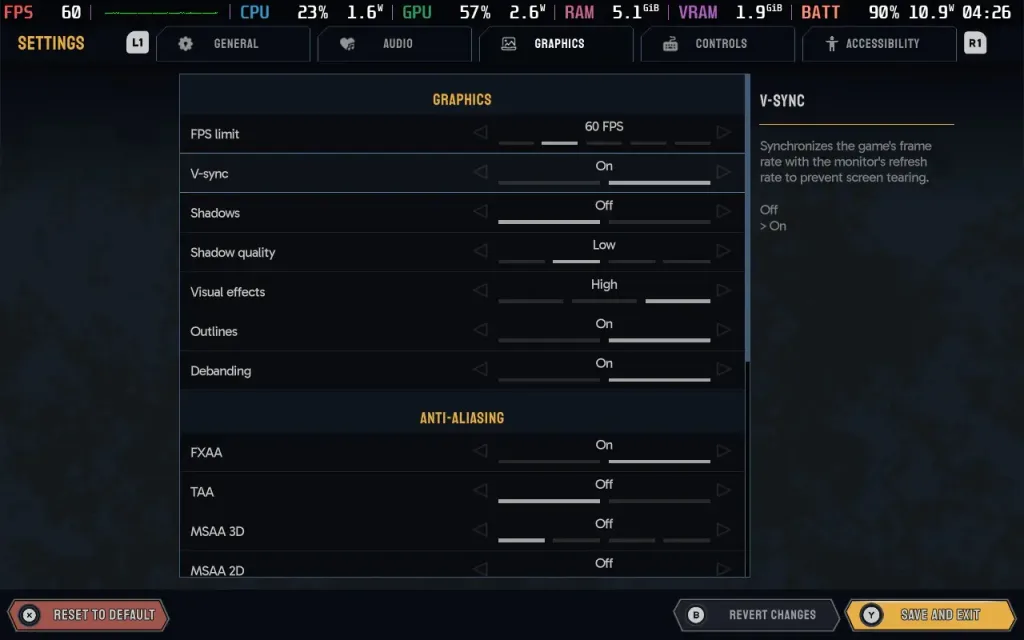
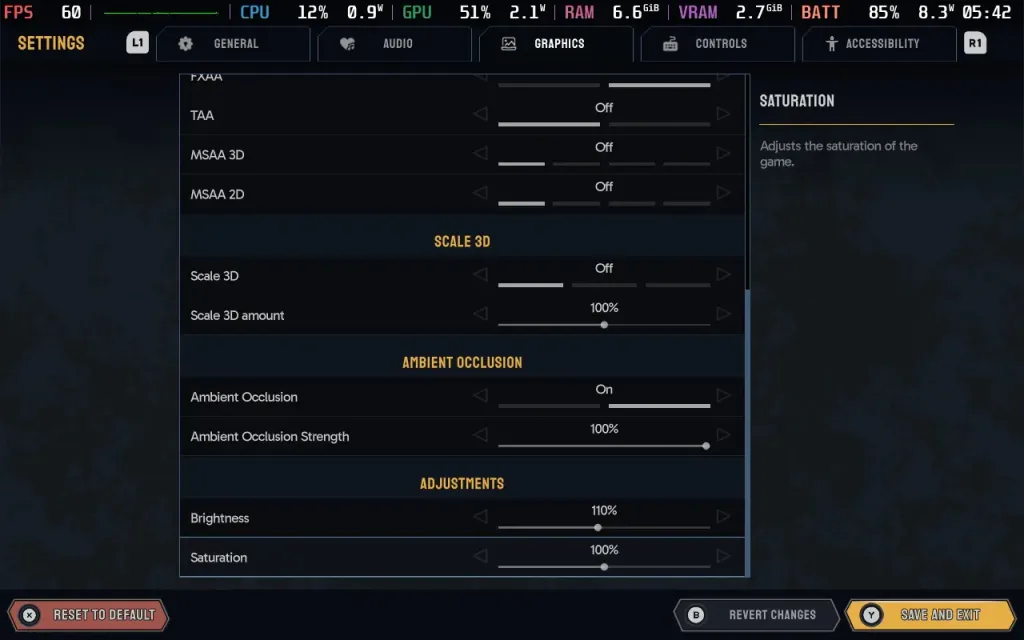
With these settings, expect a stable 60 FPS throughout. I didn't really notice any drops, except slight ones during transitional phases in the game, such as loading a scene.
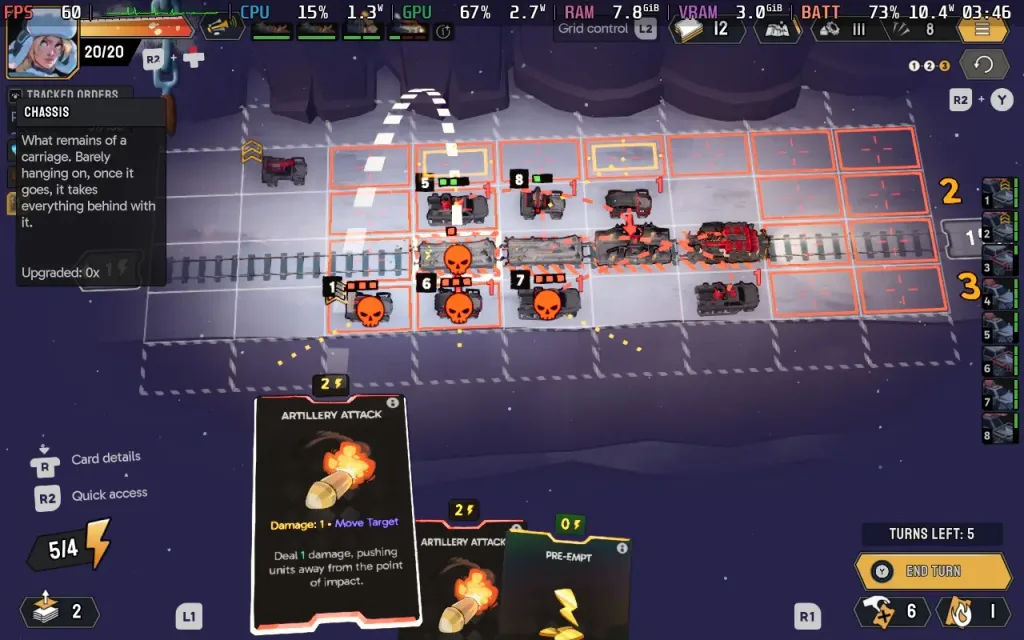
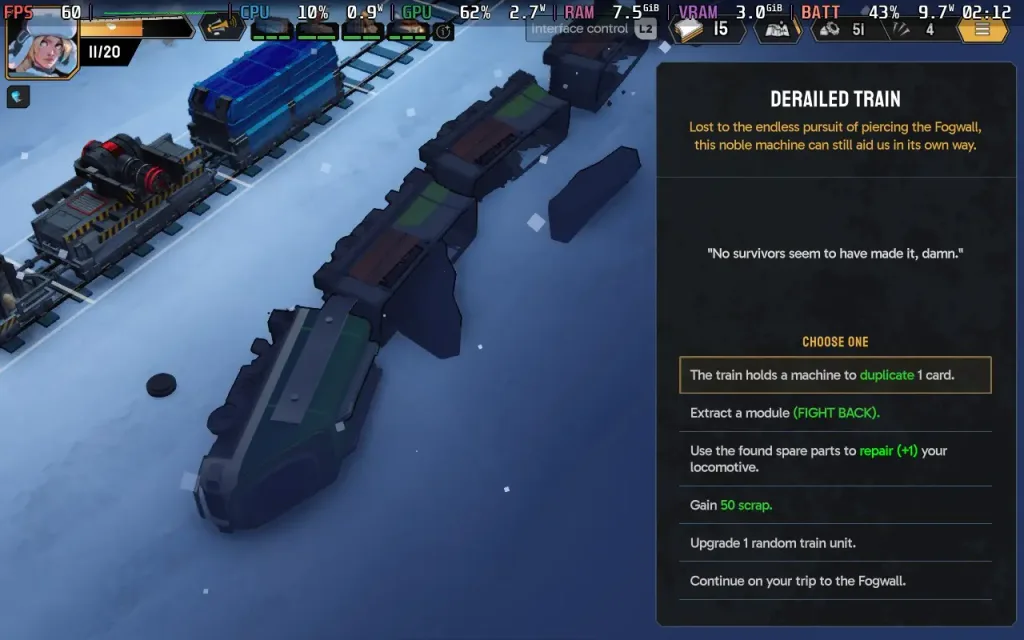
As for power draw, with the right settings, Fogpiercer is light on battery, drawing just 10-11W. This gives us a nice battery life of around 4.5 hours on a Steam Deck OLED and around 3.5 hours on a Steam Deck LCD. Temperatures were around 50C-55C.
Fogpiercer has plenty of accessibility options; all dialogue is subtitled, and you can adjust the intensity of camera shake, as well as camera movement, to help with motion sickness. You can even enable "God Mode" to make your train invincible, if you really want to.
There are also options to adjust the colors of certain UI elements to help distinguish them if you have a form of color blindness. Controls can be rebound.
Fogpiercer offers a unique take on the deck-building roguelite genre, with a focus on understanding how your cards can be used together against a challenging but fair array of enemies. Progression is limited, and the storyline is close to non-existent, but the gameplay is its saving grace.
Fogpiercer also runs great on the Steam Deck. You can up the render scale a little to improve the overall image quality, but off the bat, the controls, performance, and presentation of the game are good to go on the Steam Deck, earning it a Best on Deck rating.
Our review is based on the PC version of this game.
If you enjoyed this review, be sure to check out the rest of the content on SteamDeckHQ! We have a wide variety of game reviews and news that are sure to help your gaming experience. Whether you're looking for news, tips and tutorials, game settings and reviews, or just want to stay up-to-date on the latest trends, we've got your back.
33 Immortals was provided by Xbox and Thunder Lotus for review. Thank You!
33 Immortals presents us with an intriguing concept. Gathering 33 players together in a survival-like arena, battling against enemies and becoming stronger, before taking on increasing challenges and eventually facing the final boss in order to "ascend" to the next level.
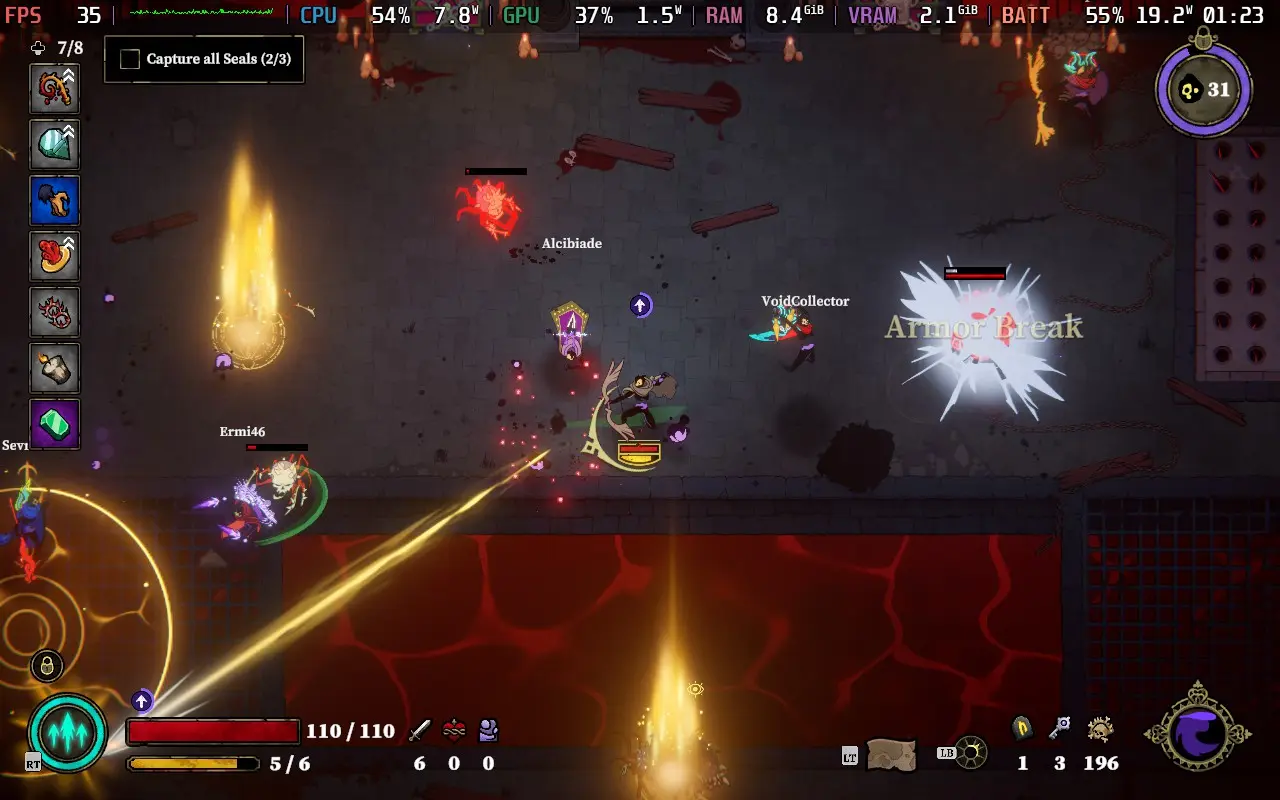
How does the concept translate into gameplay, though? While 33 Immortals may look on the surface like a typical Action RPG like Diablo or Path of Exile, I found the reality to be a little more disappointing. Likely due to the fact that the game is designed to be played in large groups of players, your individual strength is quite weak, and gaining power is one of the most exciting parts of games in this style, and 33 Immortals just didn't scratch that itch for me.
You could also compare 33 Immortals to games like Vampire Survivors, where you are facing off against endless enemies and periodically fighting bosses. But again, the appeal of these games comes from gaining exponential strength and feeling like a powerhouse, but 33 Immortals instead relies heavily on cooperating with your allies in order to succeed, which, to me, didn't give me as much of a thrill.
That said, the co-op aspect of the game worked well for me in the matches I played. When you first begin a match, you'll be thrown into a wide-open map with a large number of other players (up to 32), and people tend to split off into groups of 3-5 players as they take down weaker foes, acquire relics to increase their powers, and upgrade their stats. After a few minutes, smaller arenas will open, where small groups can enter and fight waves of enemies. There are many arenas around the map, and each must be beaten, so once you finish yours, you can help out other teams that aren't finished yet.
I must say that the weapons are also quite balanced, although I much prefer the ranged weapons like the bow and crossbow. The playerbase seems to use a fairly wide variety of weapons to good effect, meaning you can choose what playing style you want to go for without "nerfing" your character too much.
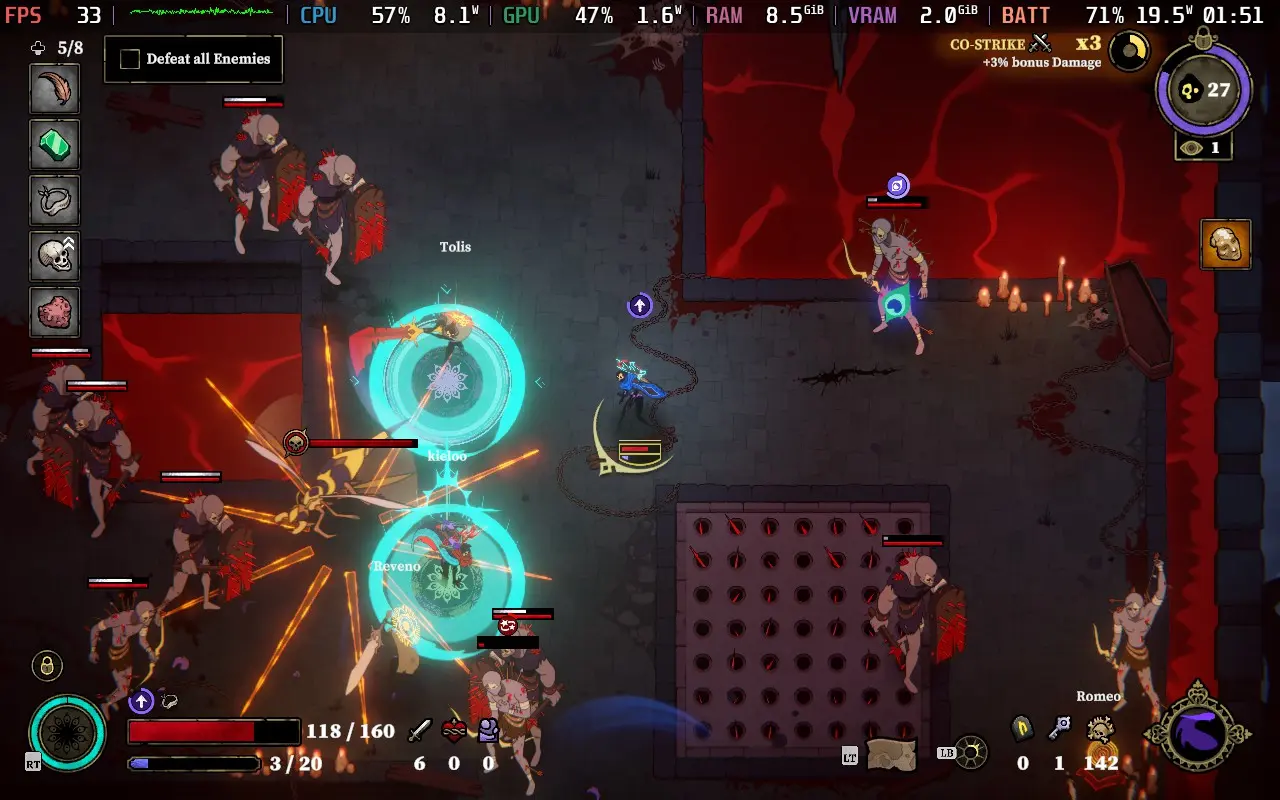
Once the arenas are finished, all surviving players team up to fight the big bad boss of the level. Sadly, this turned out to be pretty disappointing. The final bosses take time to beat, but the attacks of the bosses I encountered were easily avoidable, and I found the preceding arenas to be the more challenging part of the game. On my 2nd run, I succeeded and made it through the first level to ascend. There is a great feeling when it's you and 30 other players wailing on a boss together, but I also felt a little empty just repeating attacks over and over and then occasionally dodging when a very obvious attack was coming every few seconds.
Upon returning to the hub, you'll get the chance to hand in any "feats" you've completed, which reward you with upgrades such as leveling up and perk slots. This is 33 Immortals' progression system, and while you get a serotonin boost from handing in the feats, as I said before, you do still feel pretty weak. The main advantage I found was that each level up gives you some additional max health, which does help you tank a couple of extra hits. The perks are pretty modest in the advantages they give, but they can be upgraded to the point where they will slightly affect how you play the game.
After this, it's really rinse and repeat; there isn't too much change in the game as you progress. There are 3 different "levels" you can visit, with 33, 22, and 11 players entering them, respectively, and these levels don't vary up the game too much, with the aesthetics and core gameplay being pretty similar throughout. I definitely felt the repetition sink in after a few runs, since the maps stay the same each time. Having the environment be similar, but with procedurally generated maps, would likely have helped a lot here.
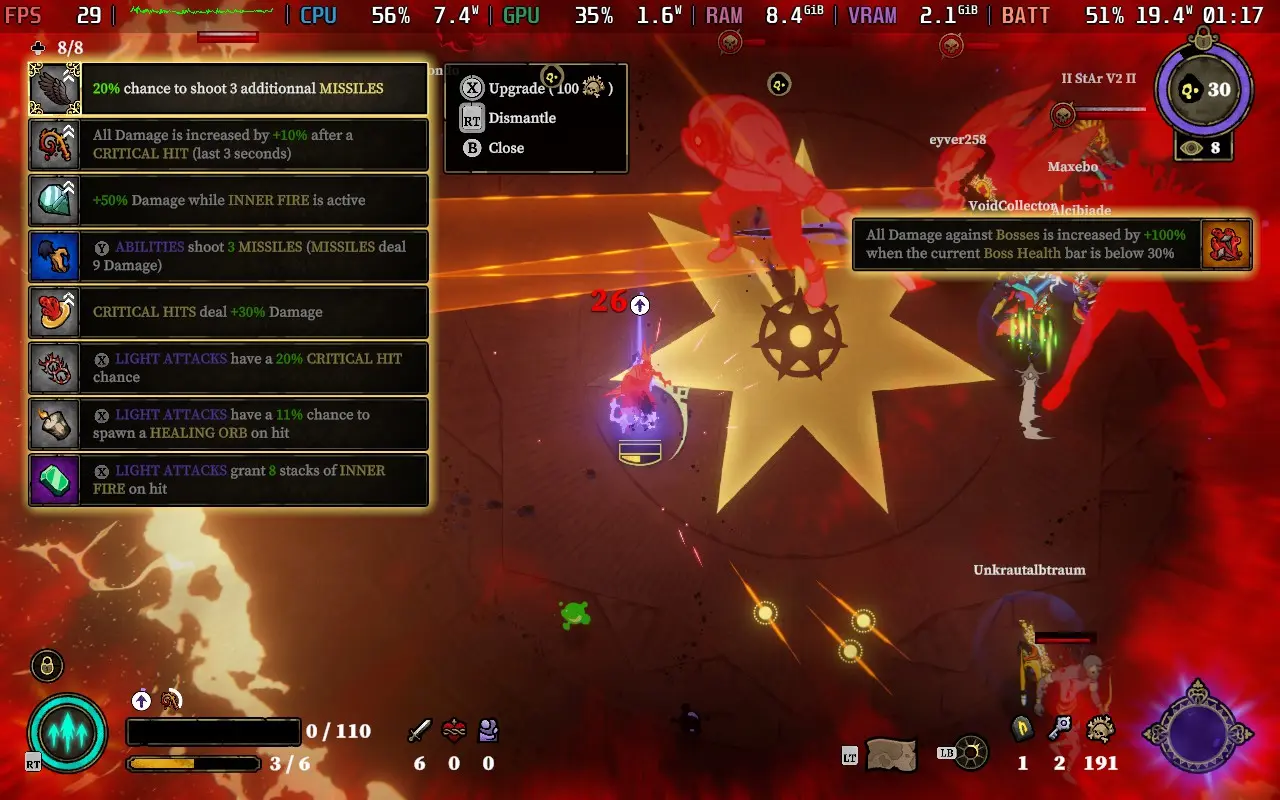
Don't get me wrong, there is fun to be had in 33 Immortals, and I think if I were playing in a party with friends that I knew (you can party with up to 4 players), I would have enjoyed my time with it more. But as a solo player, I felt rather disconnected from the other players I was fighting alongside, as there was little communication beyond trying to quickly fire off an emote mid-combat. That, coupled with feeling weak on my own and a rather slow progression, resulted in a middling, sometimes unsatisfying playing experience.
33 Immortals supports 1280x800 resolution and offers fantastic controller support, which is the recommended way to play, in my opinion.
The game doesn't offer many graphics settings, aside from the amount of VFX you want on screen. By default, this is set to the maximum, and there's no reason to change it, as 33 Immortals is bottlenecked by the Steam Deck's CPU, not its GPU.
I would recommend applying a 30 FPS frame rate cap in SteamOS when playing 33 Immortals. The game can often run in the 50s, but during intense combat with many enemies (and allies), expect the FPS to drop quite heavily, sometimes into the low 20s. Limiting the frame rate to 30 FPS provides a mostly stable experience in quieter combat scenarios, but do expect drops during the Arenas and Boss encounters when many players are together.
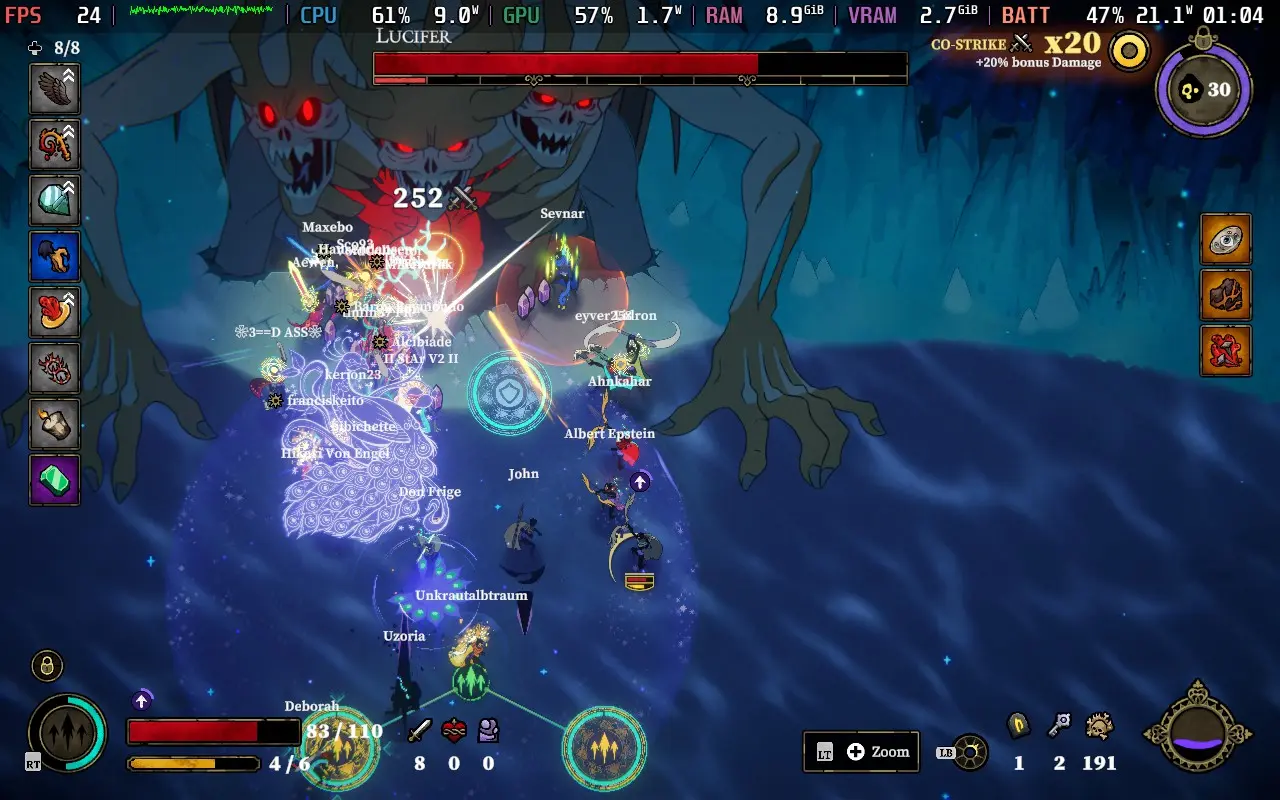
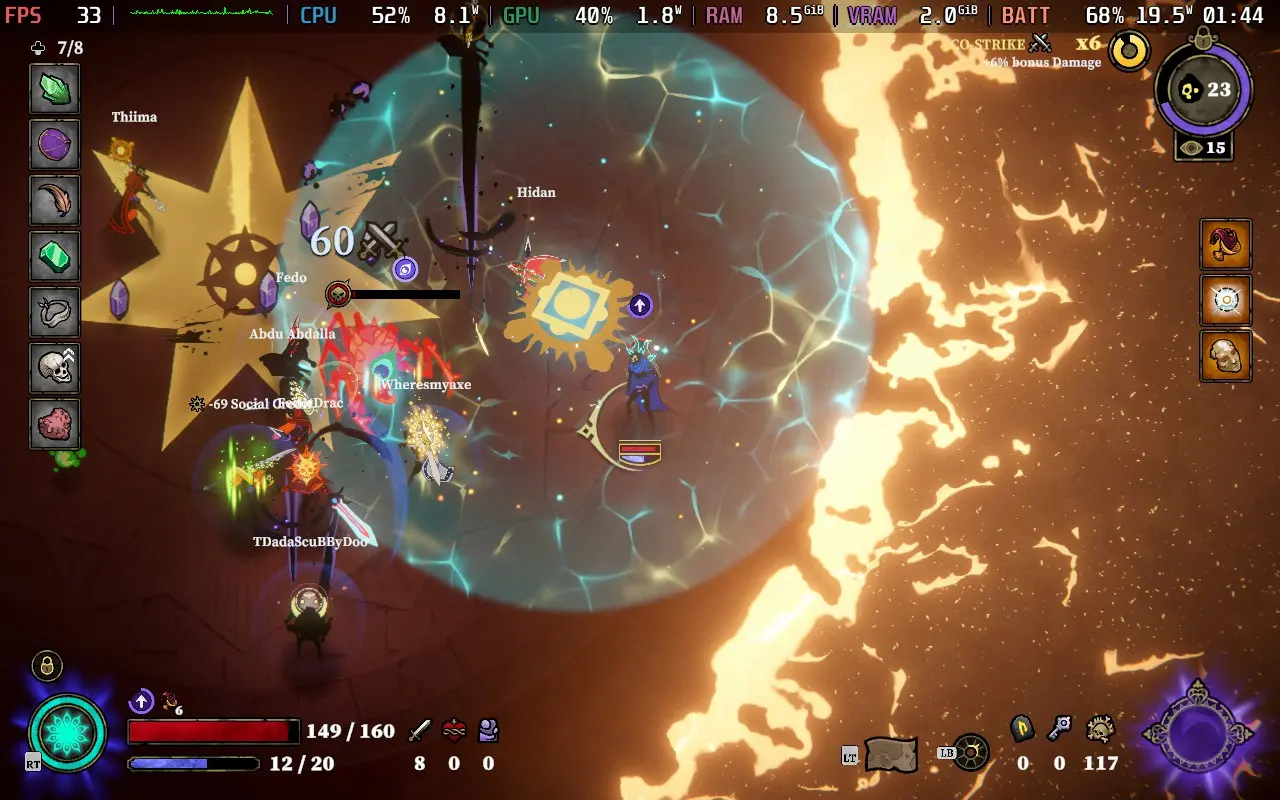
The 30 FPS limit also helps to improve battery life in moments when the Steam Deck could run the game faster, which is important as battles can last quite some time, and you don't want your battery dying while you are on a run.
Expect the power draw to be around 18W-21W, giving us an estimated battery life of around 2.5 Hours on a Steam Deck OLED and around 1.5 hours on a Steam Deck LCD model. Temperatures were around 70 °C.
33 Immortals features rebindable controls, but otherwise has no accessibility options.
33 Immortals is an interesting co-op experience that doesn't hit always hit the mark. Co-op gameplay is solid, but you can feel disconnected from your allies. The progression systems are there, but feel muted. The combat is fun, and weapons are balanced, but are held back by the reliance on co-op, meaning you'll never feel powerful by yourself.
Performance on the Steam Deck is frankly disappointing; having an entirely 2D game set in small arenas drop as low as 20 FPS feels unacceptable. Hopefully, optimizations for CPU performance can come in, as that is the only issue with the game; the controls work perfectly well, as does the UI sizing.
Our review is based on the PC version of this game.
If you enjoyed this review, be sure to check out the rest of the content on SteamDeckHQ! We have a wide variety of game reviews and news that are sure to help your gaming experience. Whether you're looking for news, tips and tutorials, game settings and reviews, or just want to stay up-to-date on the latest trends, we've got your back.
Battlestar Galactica: Scattered Hopes was provided by Dotemu for review. Thank you!
I wasn't sure what to expect from Battlestar Galactica: Scattered Hopes. In fact, I hadn't even heard of it until I was offered the chance to review it, but I love the 2004 TV series, so I was interested to see if this game could live up to that standard. And I must say, I was pleasantly surprised.
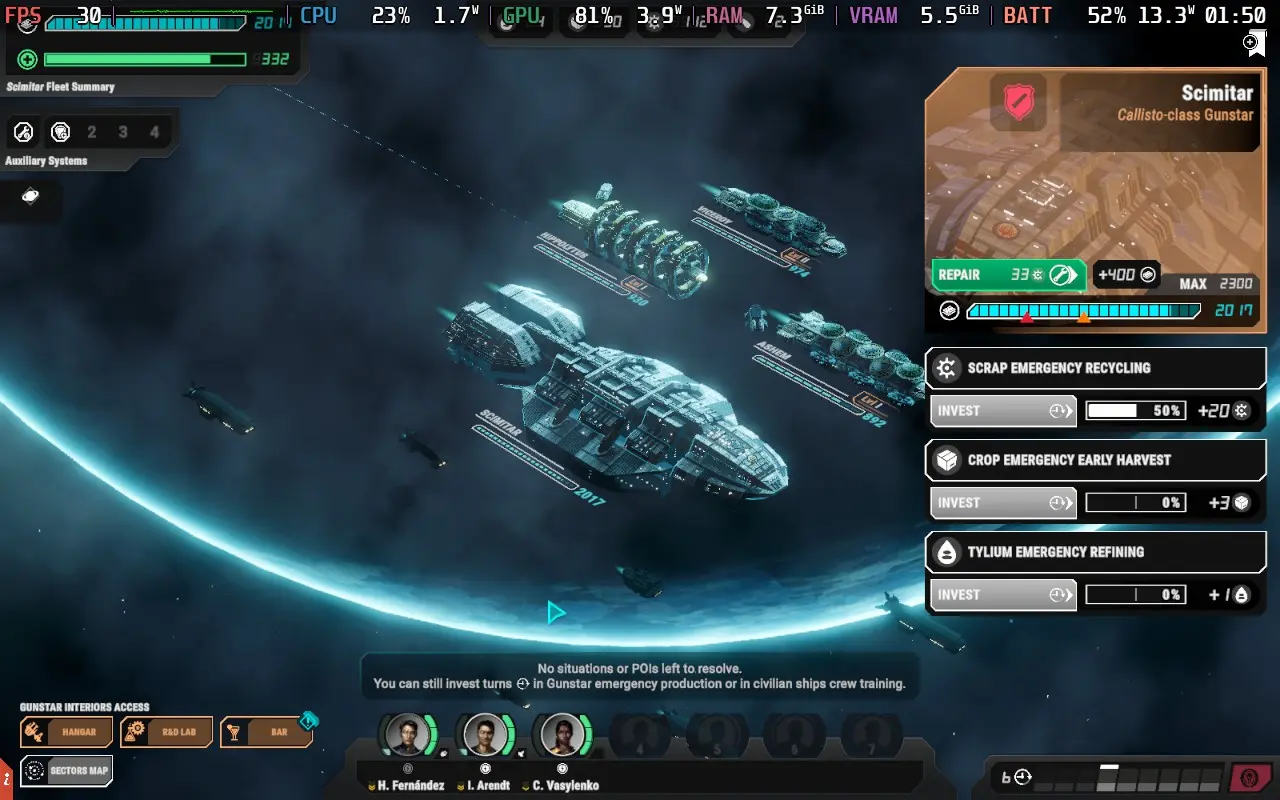
Battlestar Galactica: Scattered Hopes adopts the ever-popular roguelite approach, and given the premise of the Battlestar Galactica franchise, it makes a lot of sense for this game.
As captain of a Gunstar vessel, it's up to you to lead your ship and a convoy of civilian vessels through various procedurally generated sectors in order to meet up with the Battlestar Galactica, all while keeping the peace with the various colonist factions, upgrading your fleet and combat squadrons, and facing the ever-present (and growing) Cylon threat.
When it comes to gameplay, Scattered Hopes is a game of 2 halves. The first is managing your fleet. Here we are faced with opportunities or crises that can either help or hinder progress, as well as Points of Interest, where you can gather resources to keep your fleet alive and colonists happy.
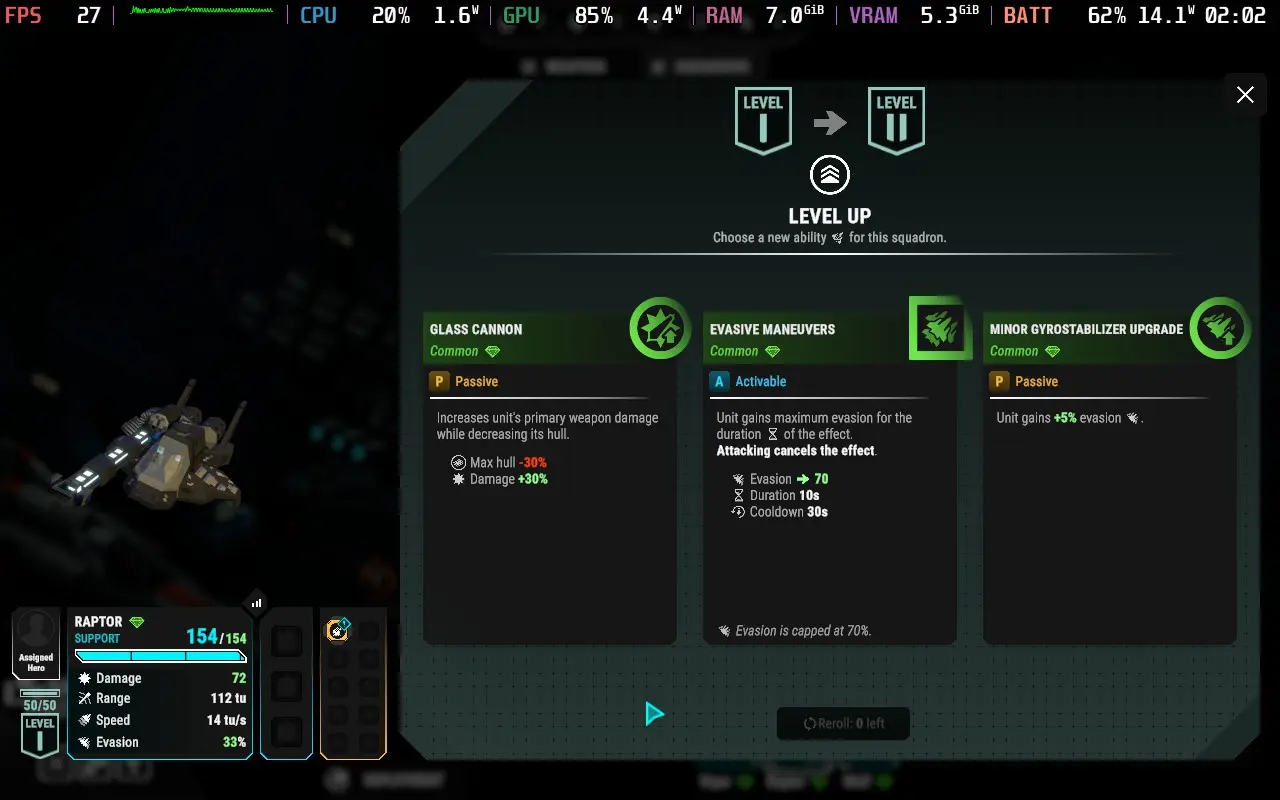
This part of the game is mostly a balancing act. You'll be trying to gauge your relationship to the 3 factions in your crew, make sure you don't run out of resources, and gather as much as possible in order to upgrade your Gunstar and your Squadrons. The Crises, Opportunities, and POIs will all feed into this balancing act. Every choice you make advances time until the next battle (and FTL jump), so while it might seem mundane in nature, there are often times when you have to make a choice about what you want to do with the limited time you have, and Crises usually give you unavoidable negative effects you'll have to contend with.
These factors together ensured that even fleet management never seemed like a boring or tedious part of the game, keeping your mind engaged throughout as you try to figure out which choice is the lesser of two evils.
The other half of the gameplay is the battles themselves. At the end of each sector, you'll face a Cylon fleet that you will have to defend against until your FTL co-ordinates are locked in and you can make your escape. While the battles are real-time, you can pause at any point, and you will be pausing a lot.
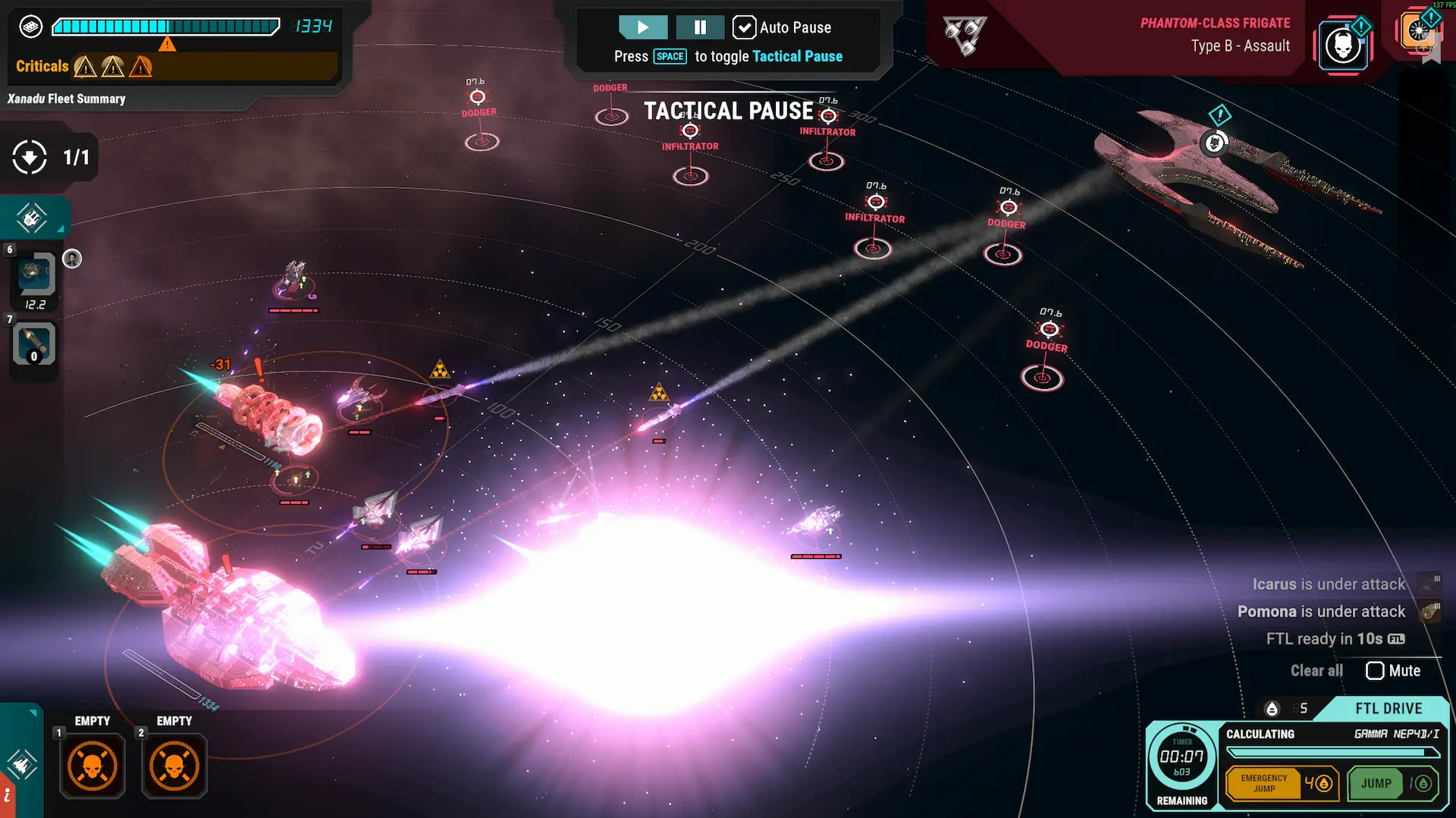
The Cylons come in large numbers, and the game almost feels like a tower defense experience. Ships will warp in on the battlefield and continue towards your fleet, while the enemy ship will fire missiles. Your ships have limited range, so your input will be in the form of constantly repositioning them in order to head off incoming threats. Using the "tactical pause" feature to think and plan your maneuvers is essential to staying alive.
As the countdown towards your FTL jump continues, the enemy fleet grows in numbers to the point where you can't realistically defend against everything. This creates a hectic atmosphere and a certain sense of dread, as you often have to let your fleet take a beating before you can jump to safety, very reminiscent of the TV series.
Once we die, the run is over, and we'll be rewarded with experience points and fate points based on how well we did. Experience points allow us to level up, unlocking more potential items and squadrons to purchase at in-sector shops, while Fate Points can give advantages in future runs.
While the Fate Points do offer some useful benefits, such as more resources to use or the ability to retry a battle if you lose, I found these bonuses to be somewhat moderate compared to other roguelites. Don't expect there to be exponential improvements in power between runs; these are modest upgrades that might give an edge if skill level almost got you through a battle.
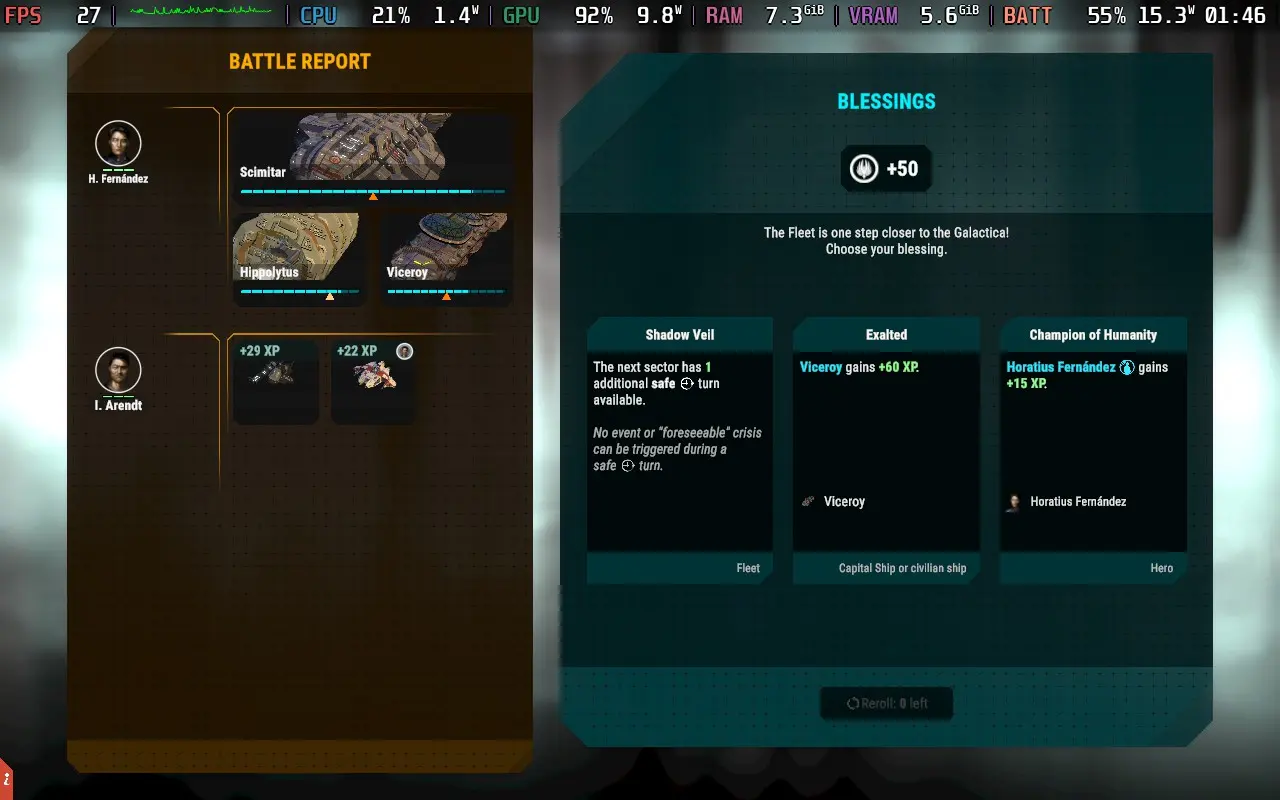
Because of this, improvement in Battlestar Galactica: Scattered Hopes will come as much from your own skills improving as you learn the game, as it will from the progression mechanics giving you advantages. Learning which ships to use where, and the best time to use your vital Gunstar abilities like a flak bombardment or nuclear missile, is crucial. This game won't be for everyone, but as space strategy roguelites go, it's a good one.
To get Battlestar Galactica: Scattered Hopes to boot on the Steam Deck, I had to go into Steam Game Properties and force it to use Proton 10.0-4; otherwise, it would crash back to Steam during the opening logos.
The game has no controller support, so you'll be using a keyboard+mouse controller layout, which the game defaulted to. Fortunately, the game is slower-paced, and using the touchpad is a perfectly fine way to play.
There are no graphical options in the game, regardless of whether you play on the Steam Deck or not. I'd recommend you limit the FPS to 30 using the in-game option. This helps with stability and also improves battery life. You won't be able to maintain 30 the entire time; certain screens do drop into the 20s, but thankfully, these are just dialogue scenes.
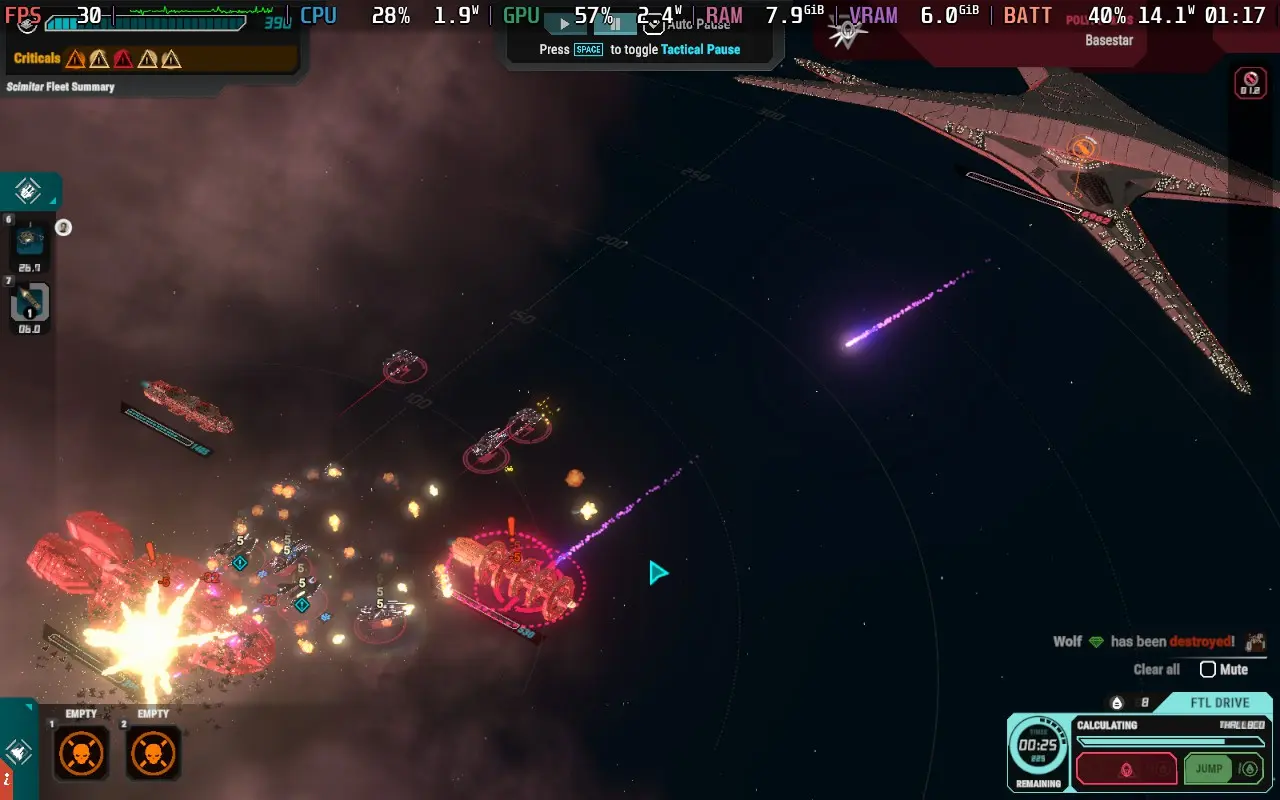
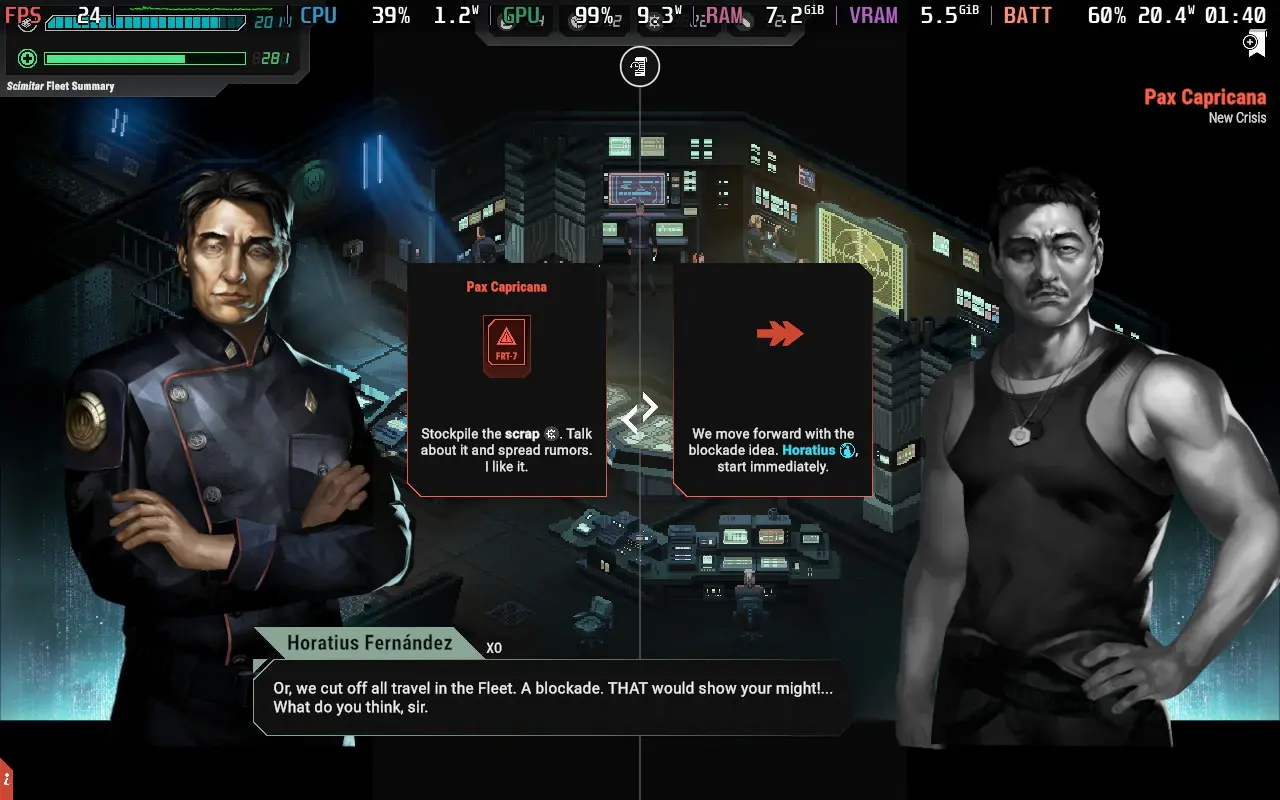
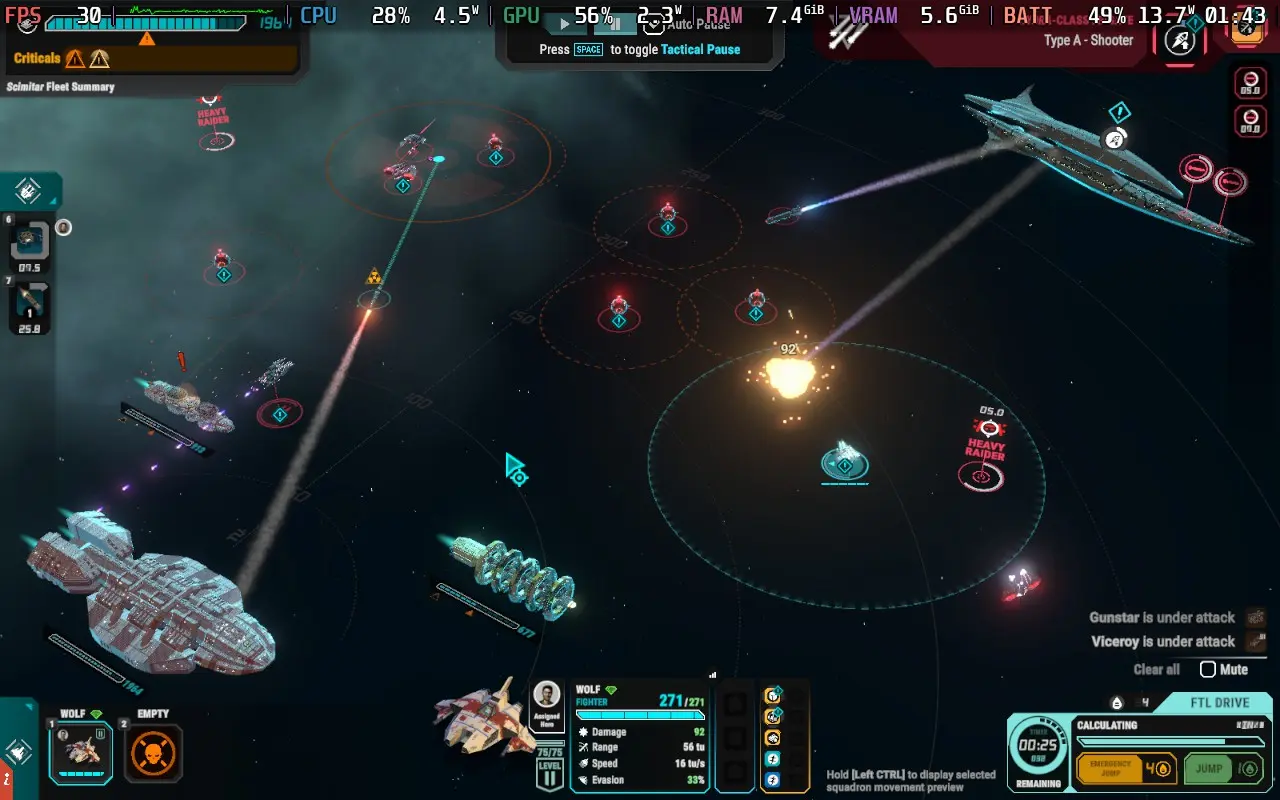
Power draw tends to be around 13W-15W during battles, spiking to 20W during fleet management, which gives us a battery life of around 3 hours on a Steam Deck OLED, and around 2 hours on a Steam Deck LCD. Temperatures were around 60 °C-65 °C.
The UI is rather small on the Steam Deck, and there is no UI scaling either, so be prepared to have some difficult-to-read text to contend with. You may wish to alter the controller layout in Steam Input to add a magnifier.
Some text is hard to read on the Steam Deck's display, and there is no UI scaling option. Screenshake can be disabled.
You can pause the game at any point during a battle to issue orders. There are also customizable difficulty settings and rebindable controls.
While the battle system is somewhat simplistic in nature, the tension created by constant crises, overwhelming enemy odds, and infighting amongst your fleet allows Battlestar Galactica: Scattered Hopes to create a great atmosphere worthy of the Battlestar Galactica name.
Performance on the Steam Deck is acceptable at 30 FPS. While the game has no controller support, almost everything is controlled via the mouse and space bar, which are mapped to the right touchpad and the A button, respectively, making it easy to control.
Our review is based on the PC version of this game.
If you enjoyed this review, be sure to check out the rest of the content on SteamDeckHQ! We have a wide variety of game reviews and news that are sure to help your gaming experience. Whether you're looking for news, tips and tutorials, game settings and reviews, or just want to stay up-to-date on the latest trends, we've got your back.
Absolum was provided by Dotemu for review. Thank you!
Absolum brought me back to childhood, when I played Streets of Rage on the Sega Megadrive when I should have been asleep. Sure, this is a fantasy setting, but the vibes were there from the second I started the game. Developed by Guard Crush Games, Absolum blends the classic beat-em-up gameplay from the olden days with the roguelike indie structure that’s so common in the new age, and the result was something more refreshing than I expected.
Despite my childhood, I never really got into the beat-em-up genre. I moved towards strategy games such as Age of Empires, Empire Earth, and the Total War series. Despite this, Absolum caught my interest as soon as it was announced. The fast-paced gameplay and a fascinating world drew my attention, and Absolum came out of the gates swinging. There is a lot to like with this title, and it is also an excellent experience on the Steam Deck.
I did run into some weird freezes before the launch, which is why my review is delayed (apologies!). A pre-launch patch fixed the problem. Phew!
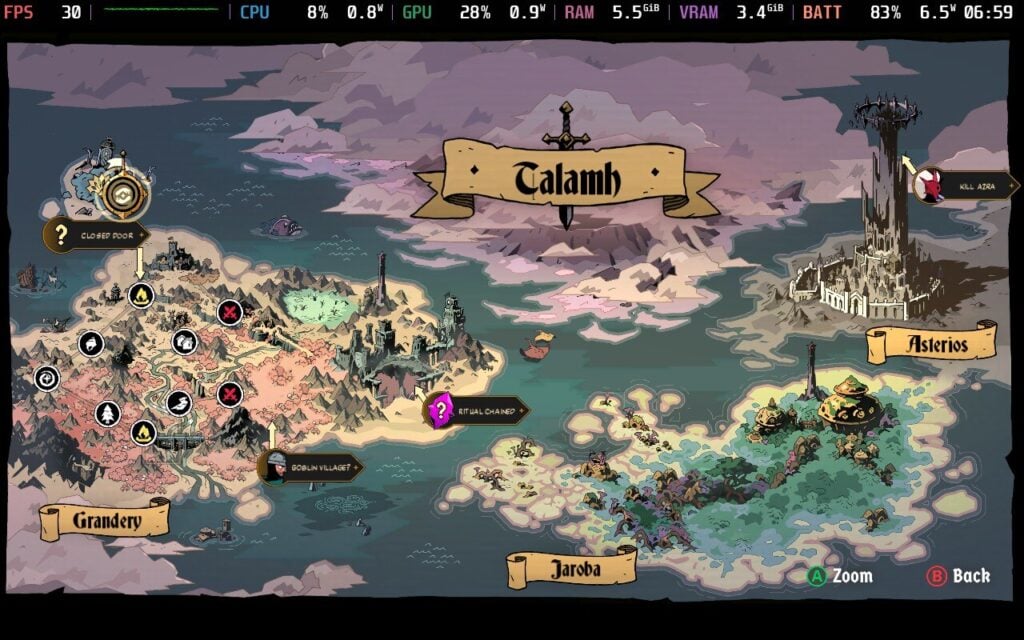
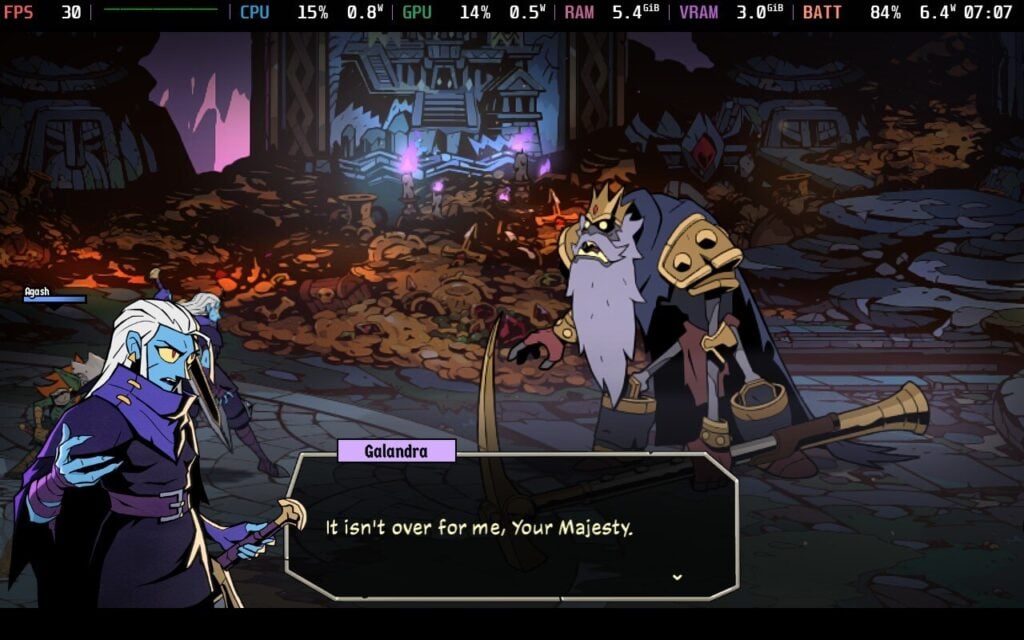
Absolum’s visual and narrative presentation hits you from the moment the game begins, and while the story beats don’t do anything unique, the characters and setting more than make up for that. The world of Talmah was shattered by wizards, triggering a magical collapse that enabled the tyrant king Azra to seize power and enslave magical people through his powerful Crimson Order. Pushed to the edge of extinction, the priestess Uchawi recruits a small force of rebels to fight against the regime, hoping to bring magic back to the world. The voice acting is excellent, and I appreciate all the characters' authenticity. Azra might feel like a typical fantasy dark lord, but I liked his portrayal.

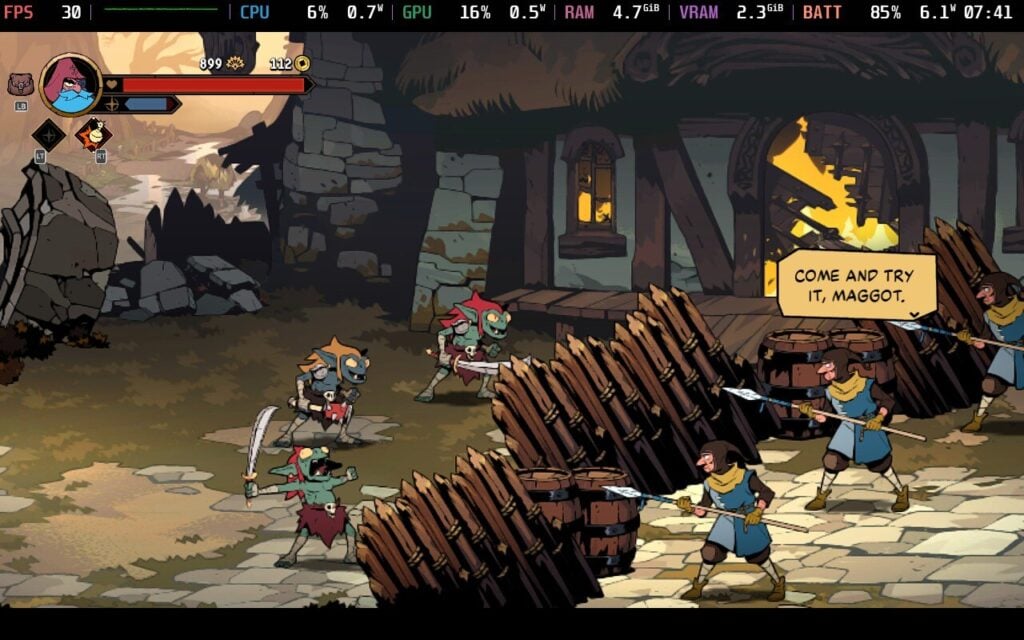
Onto the visuals themselves, the battlefields and locations look fantastic. During your journey across Tamlah in the fight against Azra, the graphics show a vibrant range of biomes. Dense forests break out into fights over babbling brooks, and I intervene in battles between goblins and the Crimson Order in ruined settlements. Possessed and broken dwarves haunt the remnants of their undergrown kingdoms, and so on. I even enjoyed the background detail, which shows how much attention has been put into worldbuilding.
Absolum is one of those rare games where you can play solo or co-op without suffering any downsides. This is incredibly hard to do, especially in narrative games, because of how people tend to play multiplayer. It’s just a fact of life.
Moving on to gameplay, this is where Absolum truly shines. I wish more games had mixed beat-em-up with fantasy elements, and Guard Crush Games has done an incredible job with it. The starting two characters have various abilities and weapons that unlock over time with subsequent runs, and combat feels great. I got tons of pleasure from beating the tar out of goblins and the Crimson Order cronies with my burly dwarf. You get to unlock more warriors by encountering them as you progress, and they all bring their own twists.
Battlefields are relatively small and linear, but they often have things that stand out. There are a bunch of destructible objects that can be broken down. Some can be weapons against foolish tyrants, while others drop extra resources. Different locations can have other characters to interact with, while others have optional areas that are only accessible with specific keys that you might pick up in various runs.
Everything looks great, and the fast-paced combat flows well, too. Few things satisfied me more than when I threw a goblin into a band of Crimson Order thugs, and the progression abilities unlocked during stages added to the appeal. The challenge is high, especially when you’re overwhelmed by enemies and during boss battles. Still, the accessibility features are stellar, offering custom difficulty sliders to change how much damage you deal and take. This superb little option adds more player choice in how they want to play.

Stylish is the word I thought of most when playing Absolum. Everything feels well-crafted with love and attention, and that shows in the visuals and animations, as well as the gameplay loop. If you enjoy roguelike games and beating the tar out of your enemies, Absolum will be a great fit.
Absolum has the Steam Deck Playable badge from Valve, and ProtonDB gives it a Platinum rating. This is well justified, as the game works really well on handhelds.
The game’s startup loading screen strongly recommends using a controller, indicating that Guard Crush Games designed it with consoles in mind. My testing confirmed that when I was testing the preview build on PC, I encountered those early crashes. While the keyboard is an option, I found the default controller option far superior.
This is good news for us on the Steam Deck, and I cannot find much to fault Absolum's performance-wise. All the controls run great out of the box. The performance is also solid, with the game running at a smooth 60 FPS with default Steam Deck settings, native resolution, and graphics set to medium. This came as a little surprise to me, but it was still lovely to see the performance problems I had pre-launch resolved.

Absolum is relatively power-efficient on the Steam Deck as things go, and despite all the animations on-screen and gorgeous visuals, this was impressive. You will see an average power draw of 12-13 watts during general gameplay without tweaks, with spikes to 15 watts during heavy combat scenes. That should get you at least 3.5 hours of battery life on the Steam Deck OLED. The only slight sore spot for Absolum's experience on the Steam Deck is the lack of font scaling. Some of the text can be small, although I did not have any difficulty reading anything myself.
If you’re like me and fanatical about battery life (it’s like an illness for me, seriously), Absolum scales pretty well with the power efficiency of the Steam Deck. If you’re willing to compromise on frame rate and a little bit of visuals, you can almost double the battery life. I found a 4 Watt TDP limit, Graphics on low, and a 30FPS framerate cap provided the best balance with an average power draw of 7-8 watts. Absolum still looks great even with low graphics settings, especially on the OLED.
Absolum is available in English, French, Italian, German, Spanish (Spain), Japanese, Korean, Portuguese (Brazil), Russian, Simplified Chinese, Traditional Chinese, and Ukrainian.

Absolum comes with a nice array of accessibility features, including Vsync, colorblind modes, motion blur toggles, and an expanded difficulty modifier that lets the player adjust damage dealt to themselves or enemies in either direction. Overall, there’s a lot to like here.
Absolum is, overall, a fantastic package. I was surprised it took so long for someone to craft a beat-em-up roguelike, and Absolum has excellent production quality across the board. The combat is diverse and well-made with punchy visuals, and the worldbuilding is better than it has any right to be. Hades, of course, has set the bar for what rogue-like games can do with narrative, and Absolum does a great job of combining all the different gameplay elements.
The challenge is up there, and I’d say the difficulty is on the high end, but the damage modifiers give all that control to the player. A near-perfect experience on the Steam Deck is just a juicy bonus. My only real gripe with Absolum is the poor experience without a controller, which is minor compared to everything positive about the game. I strongly recommend it!
Our review is based on the PC version of this game.
If you enjoyed this review, be sure to check out the rest of the content on SteamDeckHQ! We have a wide variety of game reviews and news that are sure to help your gaming experience. Whether you're looking for news, tips and tutorials, game settings and reviews, or just want to stay up-to-date on the latest trends, we've got your back.
Moros Protocol was provided by Super Rare Originals for review. Thank you!
The Roguelite FPS genre has really been kicking off as of late, and Moros Protocol is here to give us a "boomer shooter" twist to the format, with fast-paced combat, 2-player co-op gameplay, and some retro-esque visuals.
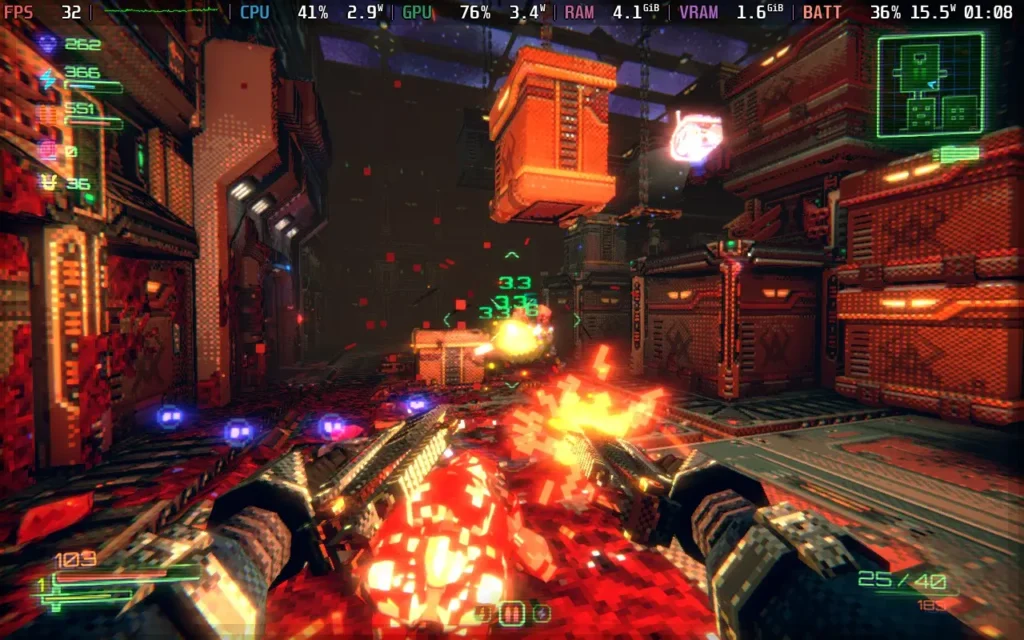
Moros Protocol pretty much throws you in at the deep end, in the body of a soldier stranded on a warship that has succumbed to horrendous creatures, with no knowledge of who you are or how you got there. The one thing up your sleeve is that if you die, you are revived in a new body, with your memories intact. Now you have to progress through the ship's various decks and find your way out of this nightmare scenario.
The game manages to vary each run by giving each level you play through a random effect, such as featuring more weapon pickups, playing during a blackout to make it harder to see, or increasing the strength of enemies for that floor, the latter 2 of which grant you additional rewards. The differences are fairly minor, but I can't say I found the game repetitive.
Moros Protocol also has a nice balance regarding weapons, from melee swords, basic pistols, pistol shotguns, and dual-wielding weapons. Ranged weapons are usually the most effective, but ammo isn't abundant in the game, so if you rely solely on your ranged weapons, you'll likely encounter ammo woes at some point. So it's best to use your melee weapon where possible. Ranged weapons are divided into physical and energy ammo, which creates a good balance where you don't just pick one weapon and stick with it; you have to change between your two ammo types and melee weapon if you want to succeed.

The action is fast-paced, and you'll mostly find yourself sprinting around tight rooms, avoiding enemy attacks, and slicing or shooting your way through enemies. The movement is nice and smooth, and with the guns and even the melee weapons feeling satisfying to use, with plenty of visual effects/feedback from enemy deaths, it all comes together to create some nice gameplay.
However, I felt the balance was slightly lost regarding the game's progression. Either I'm a bad player, or the game doesn't give you much of the currency you use to upgrade your character between runs. In some situations, even after clearing a few sectors, I still didn't have enough points to unlock any upgrades, thanks to some being more expensive than others. The upgrades are often pretty tiny in their scope, such as offering 2 additional HP, which is not much, when a single hit from a basic enemy deals several times that amount.
For the first couple of hours of playing, I felt that I had barely improved my stats and was only doing better because of experience and game knowledge. It takes a while before your upgrades become meaningful, and the difficulty spike for bosses is quite brutal, holding you back from progressing quickly.

You can't pause Moros Protocol, annoyingly, even in a single-player run. If you do need to take a break, though, progress is saved up until the current "Sector" that you're on, which roughly equates to an autosave every 5-10 minutes, depending on how fast you progress, so you can close out of the game mid-run and resume it later.
Visually, the game adopts a pixelated aesthetic, which I really like. It still combines some modern rendering techniques and is a great blend of feeling like an early '90s game but with the smoothness and refinement we would expect from a well-made modern title. Like the visuals, the sound enhances the fast-paced action with high BPM (though quiet) music and visceral sounds when enemies explode.
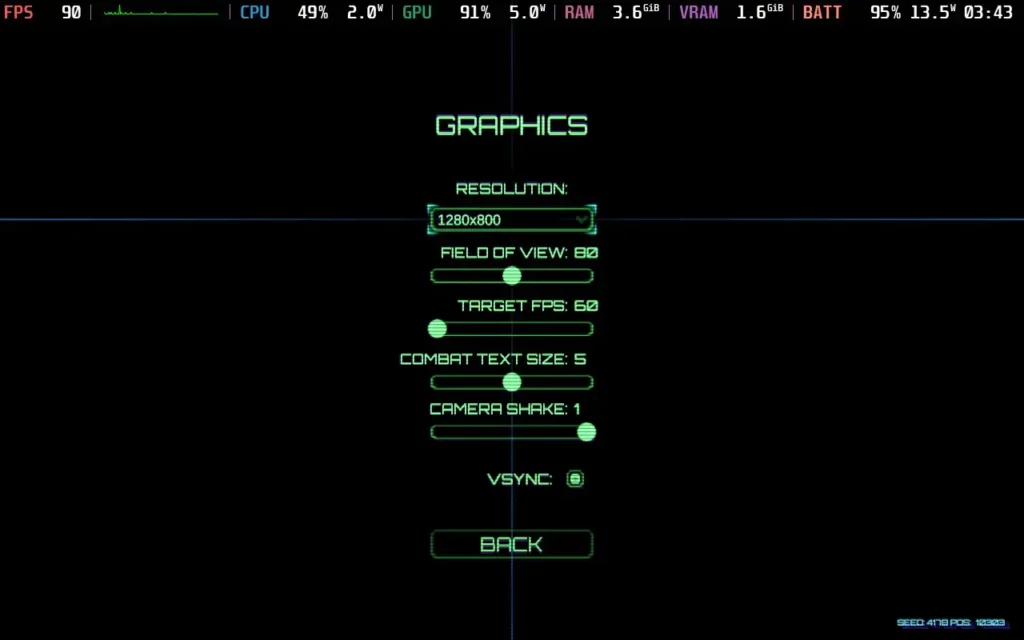
Moros Protocol does have good controller support, and it also supports the Steam Deck's 1280x800 resolution, meaning there are no black borders around the display. One thing I will say is that the game doesn't feature aim assist on the controller, which can make aiming a ranged weapon quite difficult, given its fast-paced nature.
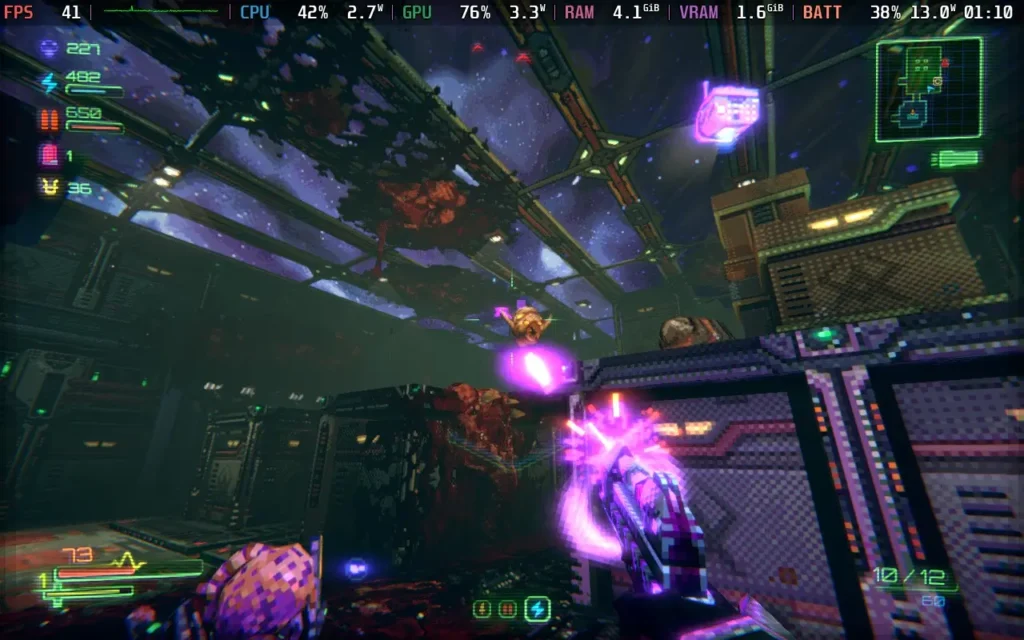
On the downside, Moros Protocol has no graphical settings, requiring you to stick close to 60 FPS, or else the game moves in slow motion, and the Steam Deck struggles to maintain 60 FPS. We frequently see dips into the 40s in larger rooms, and you can expect to be running below 60 more often than not. It doesn't make the game unplayable, but it does hamper the fast-paced feel it is sometimes going for.
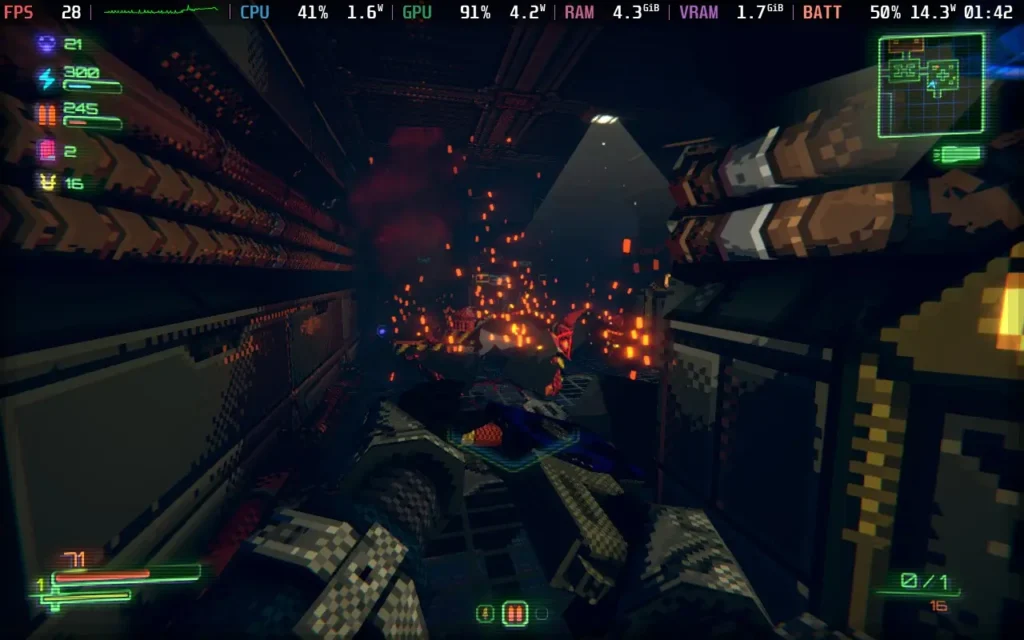
The power draw hovers around the 13W-17W mark, so we get an average battery life of around 3.5 hours on a Steam Deck OLED and 2.5 hours on a Steam Deck LCD. Temperatures were around 60-70 °C.

Moros Protocol allows you to disable screen shaking and rebind controls. All dialogue is text-based, and the text is a good size for reading on the Steam Deck.
Moros Protocol has a lot going for it: the movement feels good, the gunplay feels good, and it has co-op play. Sadly, the biggest downside for me was the grind; it takes a while even to feel like you're progressing anywhere, and the sense of getting stronger is one of the biggest pulls for a roguelite game, at least for me.
Performance on the Steam Deck is disappointing. I would still call it playable, but it's a shame that the game literally slows down when the frame rate drops, which is quite often. Hopefully, we can see some optimizations post-launch or at least some graphical settings to adjust to improve things, as a game of this style should be able to maintain 60 FPS on the Deck.
Our review is based on the PC version of this game.
If you enjoyed this review, be sure to check out the rest of the content on SteamDeckHQ! We have a wide variety of game reviews and news that are sure to help your gaming experience. Whether you're looking for news, tips and tutorials, game settings and reviews, or just want to stay up-to-date on the latest trends, we've got your back.
Rogue Waters was provided by Tripwire Interactive for review. Thank you!
I'm always in the mood for some pirating adventures. While Rogue Waters might not give you the freedom of games like Sid Meier's Pirates or Sea of Thieves, it does offer a great nautical-themed adventure that should delight tactical combat and pirate fans alike!
The story of Rogue Waters is one of classic betrayal, with your former captain turning against you in exchange for personal gain. Now, years later, it's up to you to form your crew and embark on a journey of revenge. Of course, when you were betrayed, you naturally gained immortality, as did the rest of your crew, so no matter how many times you fail, you can get up and go again.
This forms the basis for the "rogue" part of "Rogue Waters." In traditional Roguelite form, dying ends your run, but you'll carry over any currency you managed to loot to upgrade your ship and your crew and come back even stronger than before.
These upgrades take a variety of forms. Your ship always starts with some equipment, but using the currency you collect, you can open up additional cannon slots to begin with an advantage. You can also get more module slots to fit on your ship, which typically enhances your crew's abilities, such as giving them more HP or movement in the tactical combat section of the game.
On top of just equipment, your captain and the officers you recruit can also gain experience after each run, allowing them to level up and earn skill points. You can then spend those skill points to give your officers extra abilities and improve their stats.
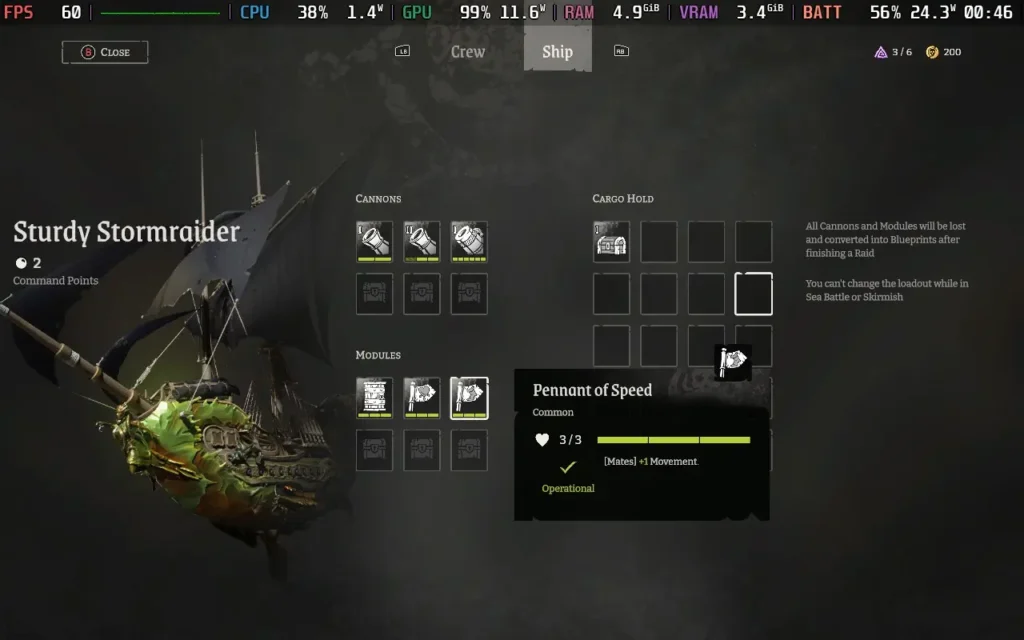
Once you've got your crew and ship kitted out, it's time to take to the seas, and the game neatly offers you three choices of "raid" to embark on. These vary in length, slightly affecting the type of loot you might find and the ships' fittings you will encounter.
The raids take the form of branching paths, allowing you to choose what you'd like your next encounter to be, although often, there isn't too much choice going on here. It's quite common to be given 2 or 3 choices, which are all ship battles. Very occasionally, you will encounter an event, which is dialogue, where there's a chance to get some free loot or heal a crew member, but 90% of encounters are ship battles. Sometimes it feels like the choice is a bit of an illusion, with the only difference between the ship battles being the lootable item at the end of it.
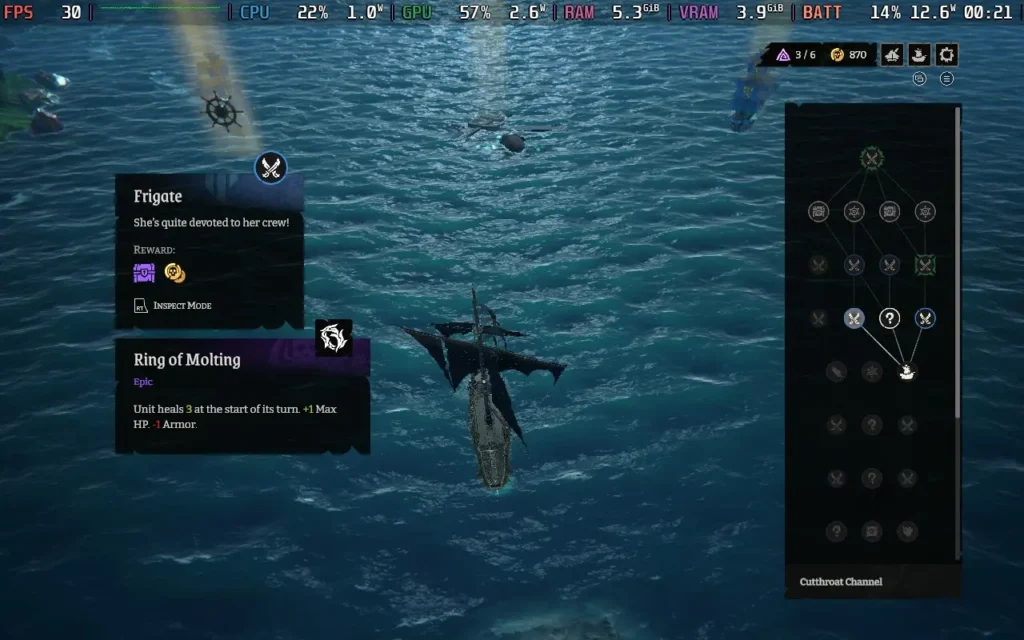
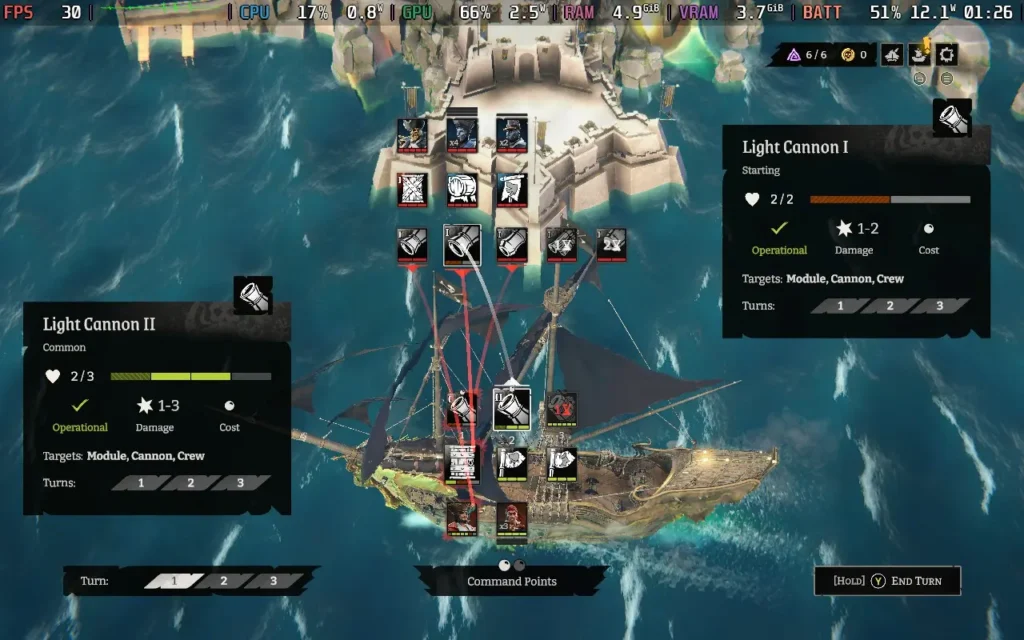
When you do enter a battle, however, things get interesting. The first stage of any battle is turn-based naval combat, where you will command your cannons to direct shots at the enemy ship or fort, damaging their cannons, modules, or crew, depending on what makes the most tactical sense to you. Certain cannons can only shoot certain parts of a ship, with Cannonbreakers specifically targeting cannons, Decksweepers targeting crew, and Shipwreckers targeting modules. You can, of course, get general cannons that can fire at anything, but these often cost more command points to fire, and you have a limited amount each turn.
In the end, I found that Swivel cannons are invaluable. These cannons can only target crew, but they cost no command points to fire, meaning you can fire them every turn for no penalty, whittling down the enemy's crew, ready for when the next phase of battle commences, the boarding battle.
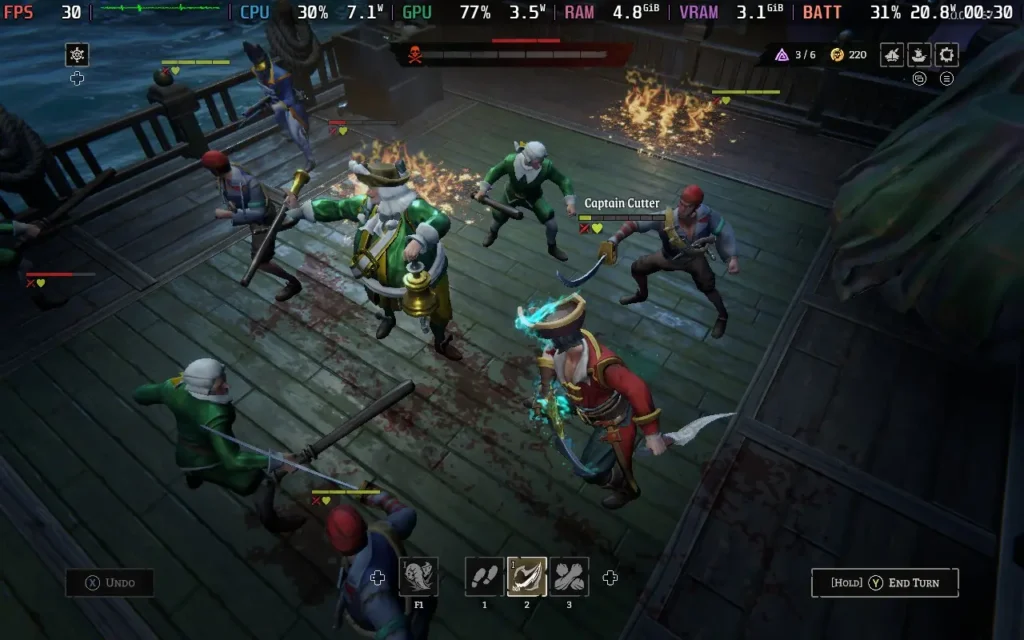
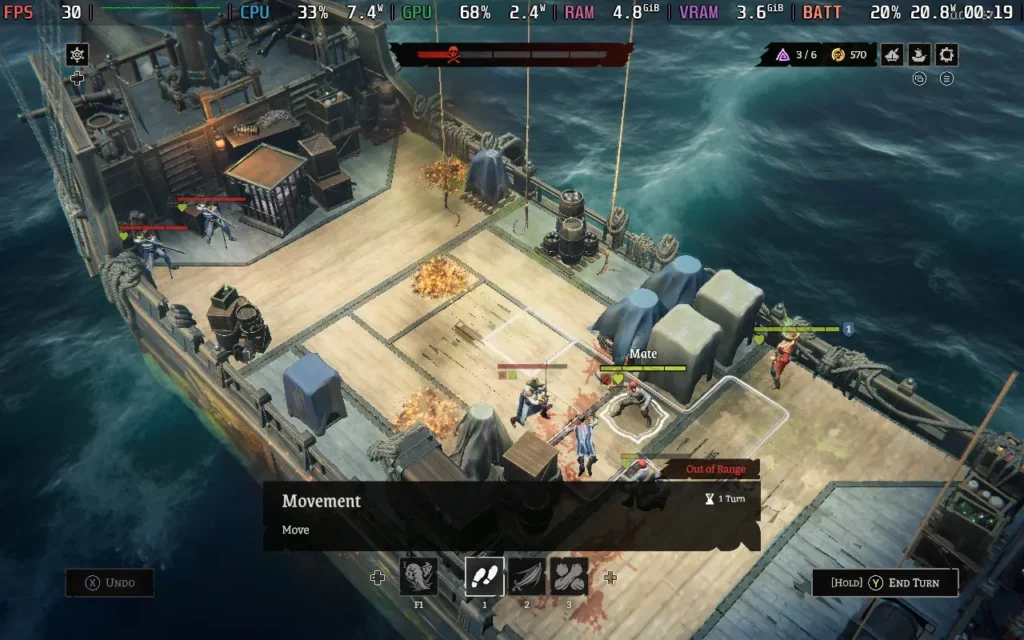
The boarding battle is where most of Rogue Waters' action takes place. This is turn-based combat, although it plays more typically like a tactical RPG at this point, with a grid-based field containing both your and the opponent's crew.
Positioning is everything in Rogue Waters. When you attack an enemy, most of your attacks will cause you to "advance," which pushes the enemy back a tile and allows you to take their place. But if the enemy gets pushed back against a wall, they take additional damage, and if they get pushed back against one of their allies, both them and their ally will take some damage. This requires you to assess where you want your crew positioned to deal the maximum damage to your opponents while considering where you'll be pushed if the enemy attacks you.
All of this, combined with the ship modules at play, ropes that allow you to swing extra distances across the battlefield, and a mixture of enemy types that you'll be facing, work together to create a great tactical experience. When you've got your crew in the perfect position and start to execute your turn, taking out enemy after enemy, it's a really satisfying moment.
Rogue Waters is also pretty nice to look at. The ocean/water effects are well done, and there are some good visual effects when ships are firing at each other with their cannons. While most of the game is played from a zoomed-out perspective, occasionally, when pulling off a melee attack, the camera will zoom in to show a rather gruesome execution of the move, which often involves a sword running through someone and plenty of blood being sprayed.
So, Rogue Waters does what it sets out to do. It's a linear-feeling game, as games of this genre often are, and the game is nearly entirely based around combat, which is saved by the fact that Rogue Water's combat is a strong foundation for the game to be built on.
Rogue Waters runs at 1280x800 and fully supports controllers, so we're off to a good start. The game has no black bars or controls, and it's just fine with the Steam Deck's controller.
Performance-wise, we have a bit of a mixed bag. The game can't hold a stable 60 FPS no matter what you do. While the game's map and naval combat tend to run fairly well, the tactical boarding combat is much harder to run, and therefore, both the options I'm giving you today are targeting 30 FPS.
I did encounter an issue where every time I rebooted the game, it would default to the "High" graphics preset, undoing the settings I had previously put in place. Hopefully, this will be fixed for the game's launch.
I debated whether to make these my recommended or the quality settings below the recommended ones. Still, I'm not keen on running my Steam Deck at high temperatures, so I've made these my recommended settings.
We have a 30 FPS Limit in SteamOS and no TDP Limit for this one. Then, in the in-game settings, we'll have VSync On, turn Anti-Aliasing Off, the Texture Quality to High, the Ocean Quality to Medium, and the World Details to Low. We set the shadow distances at 0 to disable shadows.
We could lower Ocean Quality to "Off" to save more battery life, but it genuinely looks awful. It turns the water into a flat blue plane with no visual effects or movement.
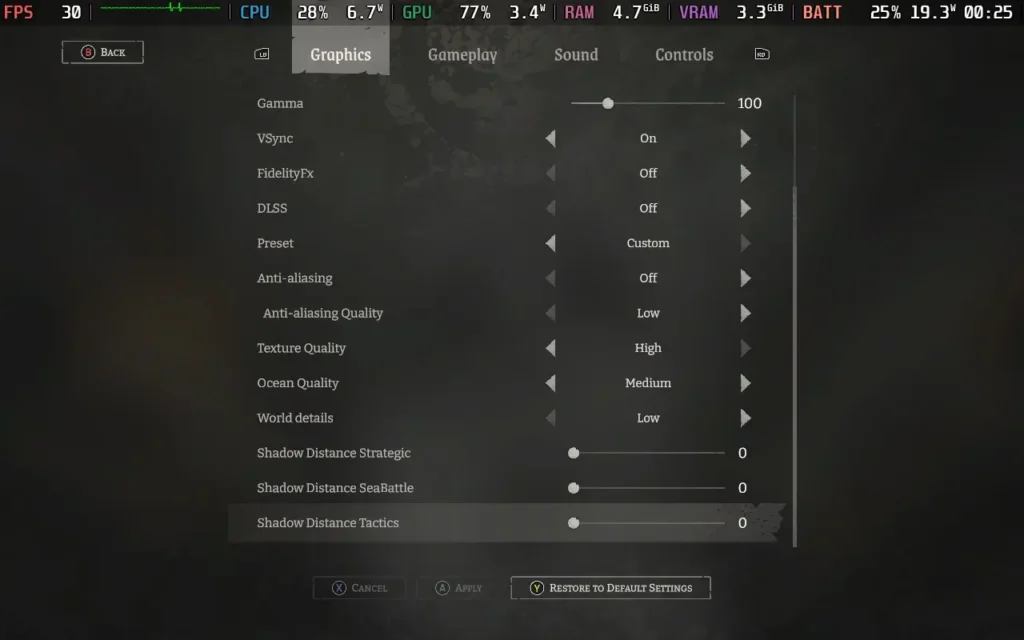
Visually, the game still looks okay. The omission of shadows is the most noticeable difference, but it doesn't make a huge impact. I think the game looks good enough, even without Anti-Aliasing or shadows.
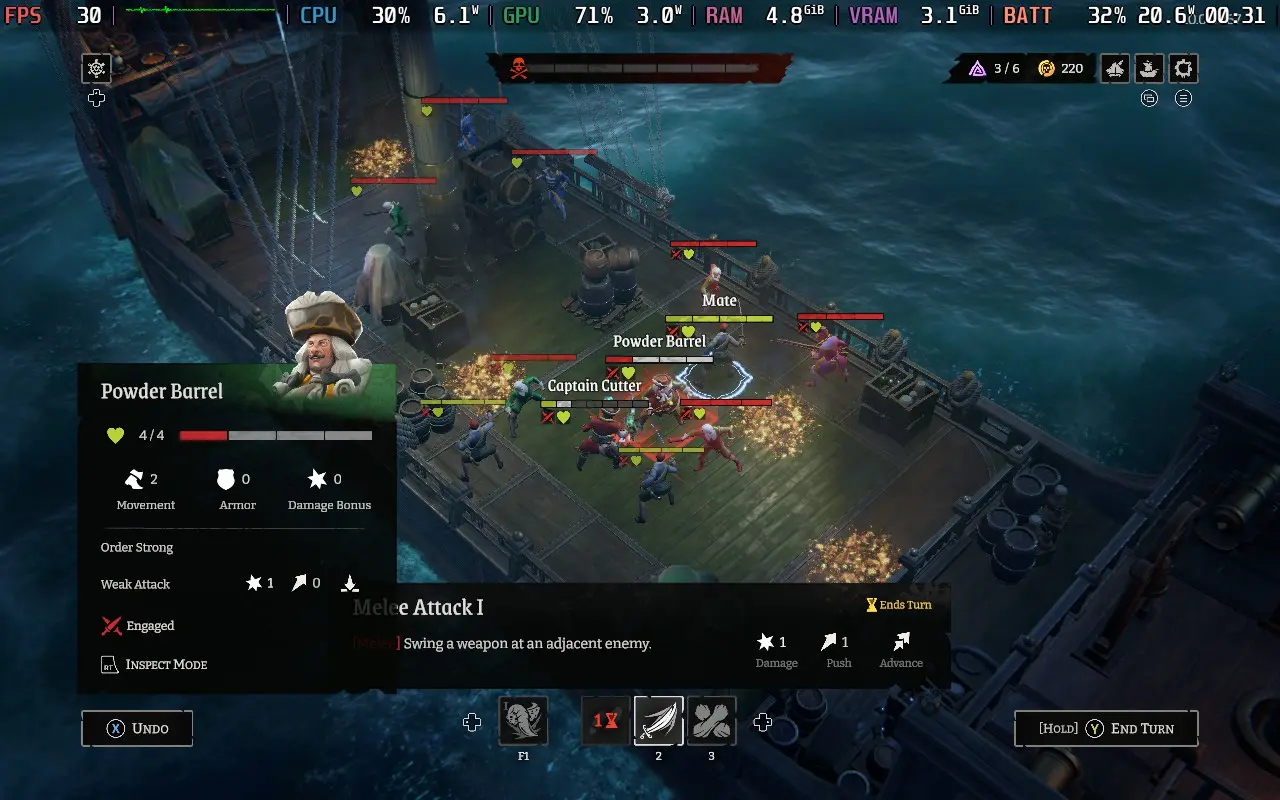
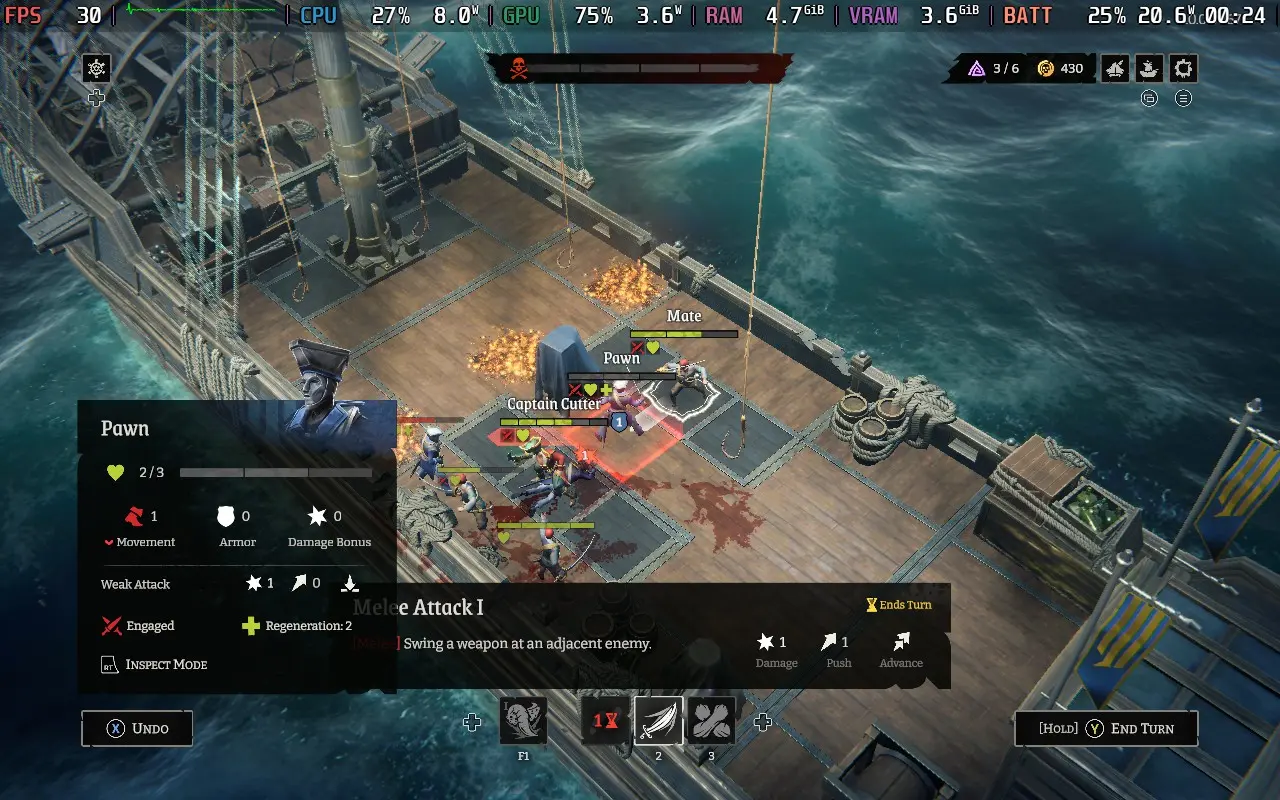
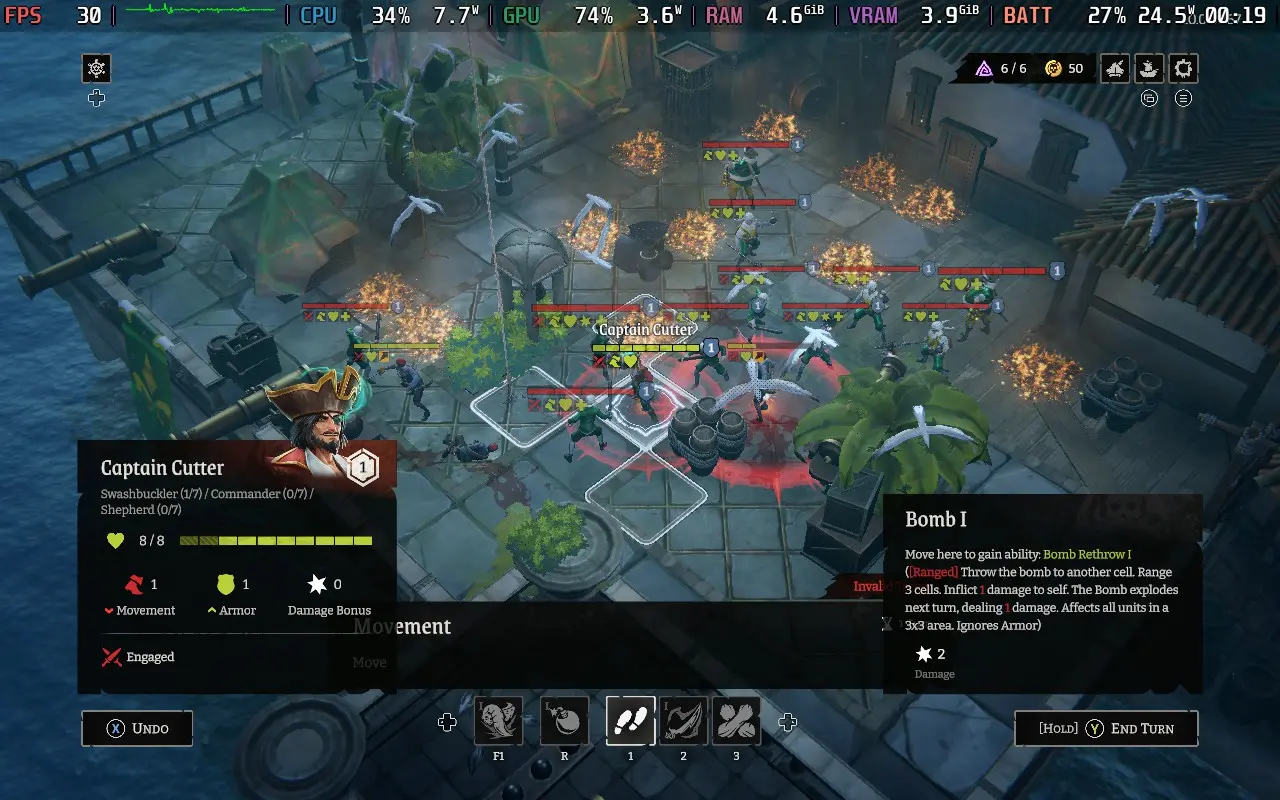
The power draw is generally around 18-21W here, but it can rise as high as 25W in intensive combat. Steam Deck LCD owners should expect around 2 hours of battery life, with Steam Deck OLED users getting around 2.5 hours. The power draw drops dramatically outside of combat, around 12W on the world map.
Temperatures were about 70-80C, with the CPU running hotter. The fan noise ramps up during the boarding combat and will quieten during the rest of the game.
For this one, I'm prioritizing visual niceties over battery life. Regardless of what you do, your battery life won't last too long in Rogue Waters, but this probably isn't the kind of game you'll play for hours on end. With a 20-30 minutes long run, this preset should give you enough battery for 3 or so runs per charge.
Apply a 30 FPS Limit in SteamOS, along with no TDP Limit. You'll want VSync enabled in the game, too, as it gets rid of the input lag introduced by the SteamOS Frame Limiter. Then, you'll want to set the Anti-Aliasing to MSAA, the AA Quality to High, the Texture Quality to High, the Ocean Quality to Medium, and the World Details to High. Then, have all the Shadow Distances at half—that's 250, 100, and 100 for those.
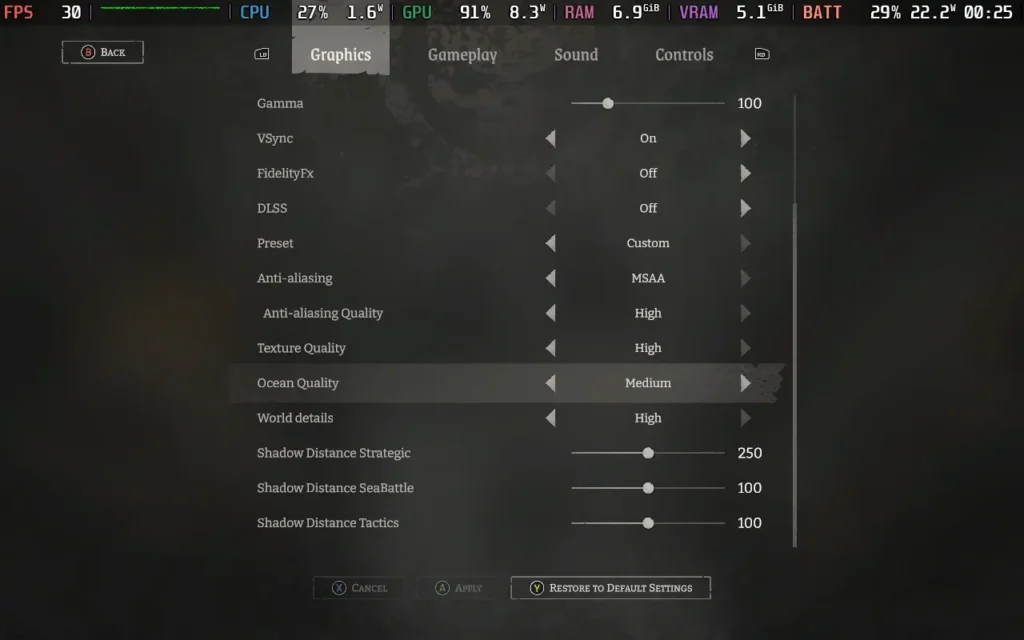
With these settings, you get good-looking water, shadows throughout the game, and a clear and sharp image. I did try running at the absolute highest, but running at those settings, especially having the Ocean Quality on High, can occasionally cause performance to dip to the mid-20s. With these settings, I did, on odd occasions, see dips to 28 or 29 FPS, but generally, we can keep 30 FPS.
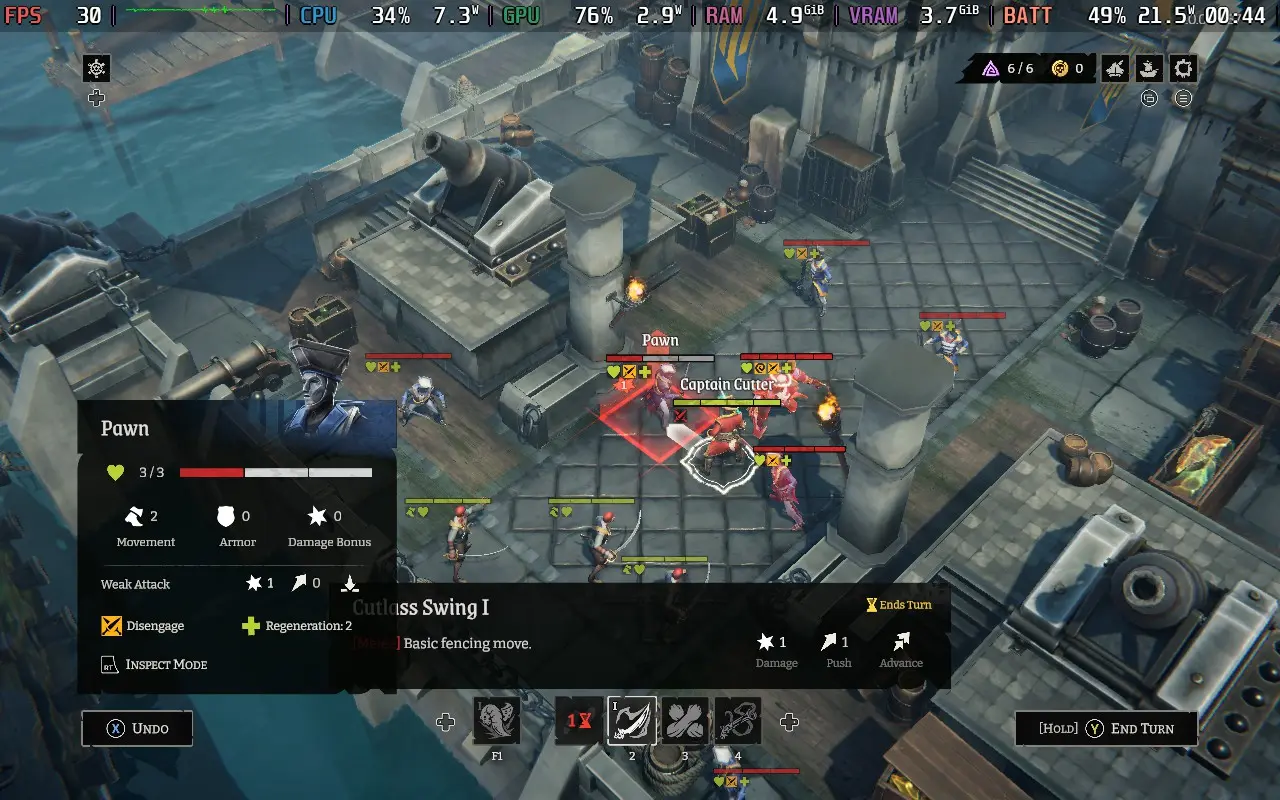
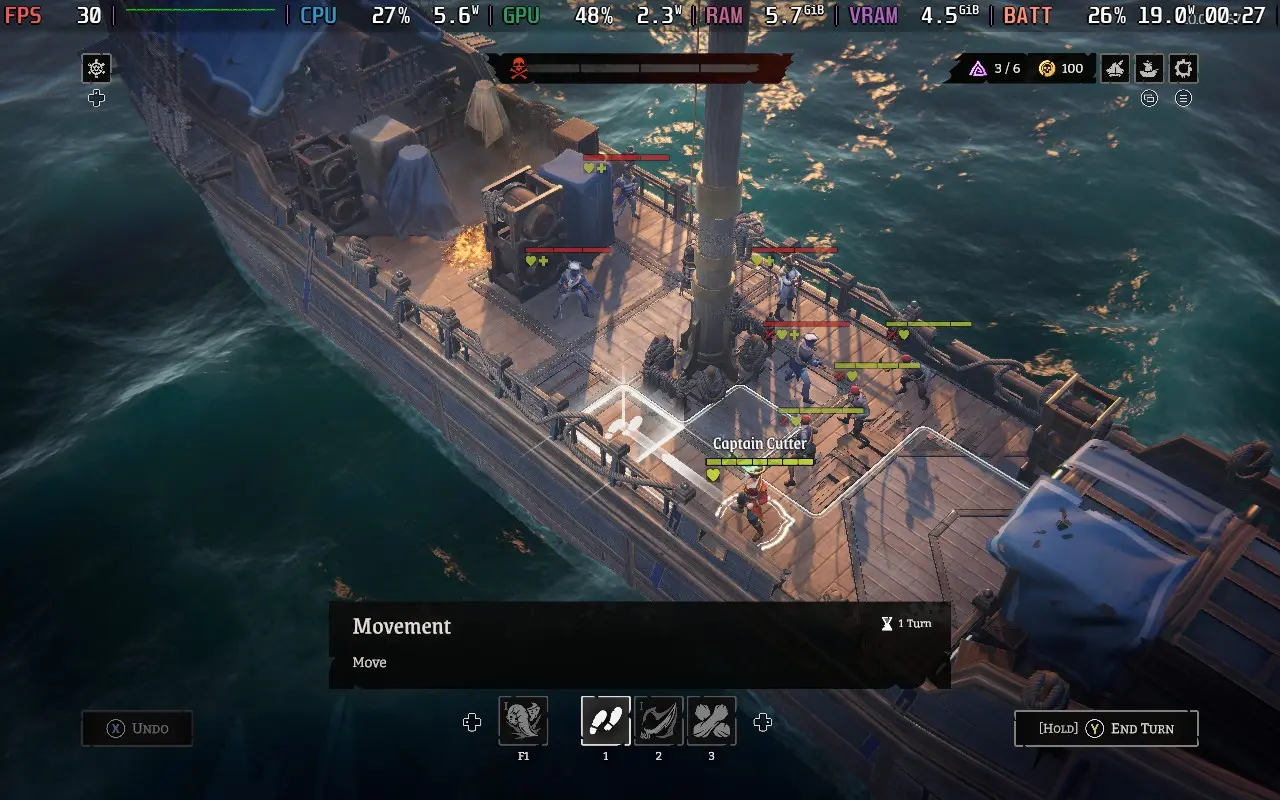
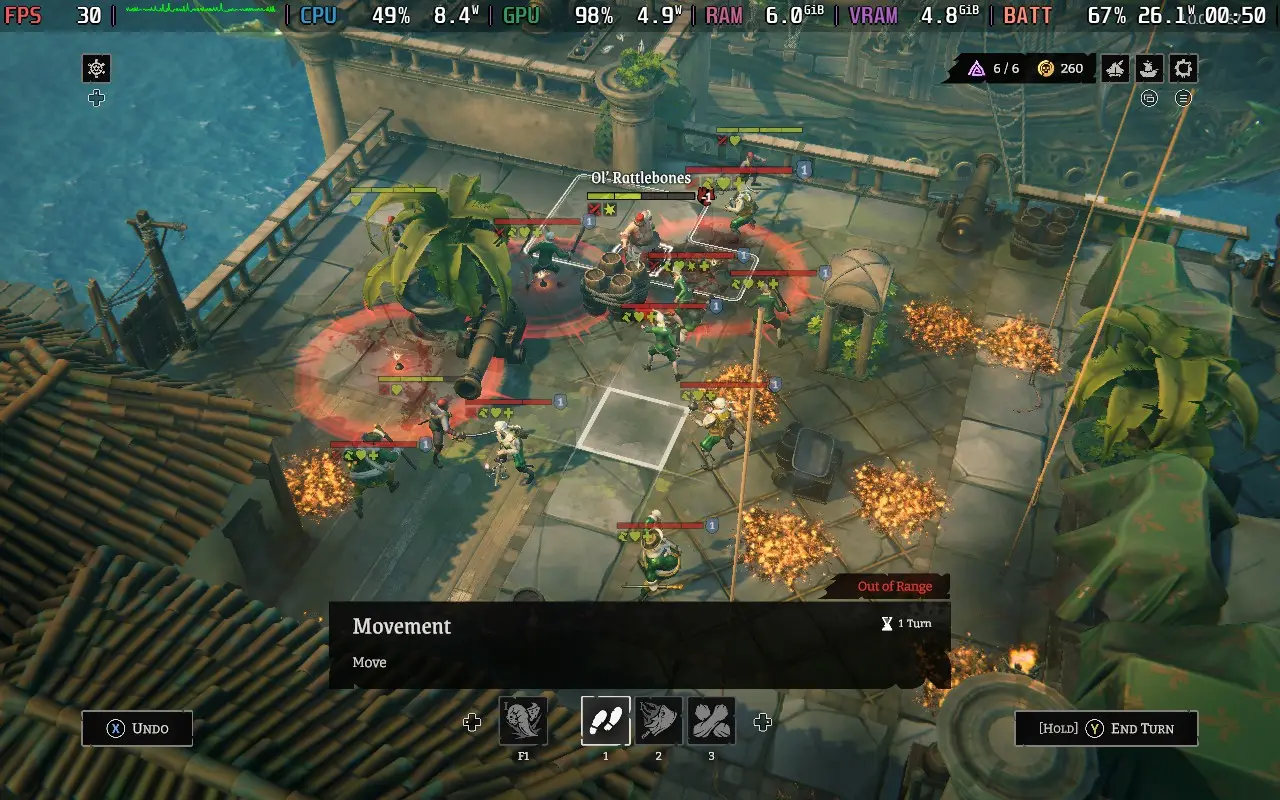
We pay the price of visual niceties with a killer power draw. However, with the game often taking around 20W-26W from the battery, don't expect more than 1.5 Hours of battery life from a Steam Deck LCD, and you might be able to squeeze 2 hours from a Steam Deck OLED.
Temperatures are very high, at around 80-90C during boarding combat. The fan will be loud during these sections, although temperatures and fan noise drop outside of combat. This is the main reason I'm not recommending these, as the CPU often creeps around the high 80s in combat, and I'd rather not stress my Steam Deck out that much.
Rogue Waters has some accessibility options. You can disable blood if that's not your thing. You can also disable camera shake and sway if prone to motion sickness. There is also HUD Scaling and Font Size, which I had set to 105 and 22, respectively.
Rogue Waters is a fun pick-up-and-play pirating adventure. It's not the open sandbox that most pirate games aim for, but it's a fun time nonetheless. If tactical gameplay is your guilty pleasure, then there's plenty to enjoy about Rogue Waters' deep and satisfying combat mechanics, and I'd recommend giving it a try.
Steam Deck performance is a little worse than I would have hoped for such a game. Graphics settings seem to have a minimal impact on performance, with the CPU seemingly the bottleneck here, so don't expect more than 30 FPS out of this game. Still, given its nature and the game's good controller support, it can play fine on the Steam Deck. The game also autosaves after every battle, so don't worry about exiting if your battery life is low.
Our review is based on the PC version of this game.
If you enjoyed this review, be sure to check out the rest of the content on SteamDeckHQ! We have a wide variety of game reviews and news that are sure to help your gaming experience. Whether you're looking for news, tips and tutorials, game settings and reviews, or just want to stay up-to-date on the latest trends, we've got your back.
Dead Cells is a 2D rogue-lite that is heavily inspired by the metroidvania genre. You will treck through gorgeous, unique environments fighting enemies with an array of weapons and items. The game will require precision and thinking on your feet as you'll have to roll, jump, and climb your way through obstacles and weigh the choices of everything you pick up to become a deadly force to be reckoned with. After each death, you will be able to come back and buy permanent upgrades, and then head right back into the non-linear world where you will find even more secrets, hidden passages, and much more.
Dead Cells is quite possibly one of the greatest rogue-like games I have ever played. The incredible visuals, detailed landscapes, and addicting gameplay loop all come together seemlessly in an amazing combat system that feels fluid with its varied weapons and dodging. This is only made better with the free updates it has gotten, as well as the DLC that have been released for it, which add in new locations, weapons, bosses, and much more. Speaking of which...
The Castlevania DLC for Dead Cells was provided to us by Motion Twin and TinsleyPR for review. Thank you!
The Dead Cells: Return to Castlevania DLC released 3 days ago and I have to say, whoever came up with this idea deserves a large raise. I don't recall one time I felt a crossover fit so well into a game. 2 new biomes, 14 new weapons, 3 bosses, 20 outfits, new enemies, over 60 added music tracks, and a new storyline featuring Richter and Alucard are all part of this $10 package and it is incredible.
After you die a couple times, you will be able to start accessing the Castlevania content, which will be confirmed when you see red bats fly across your screen. From there, just find Richter in the prison and he will start you on your journey into the new storyline.
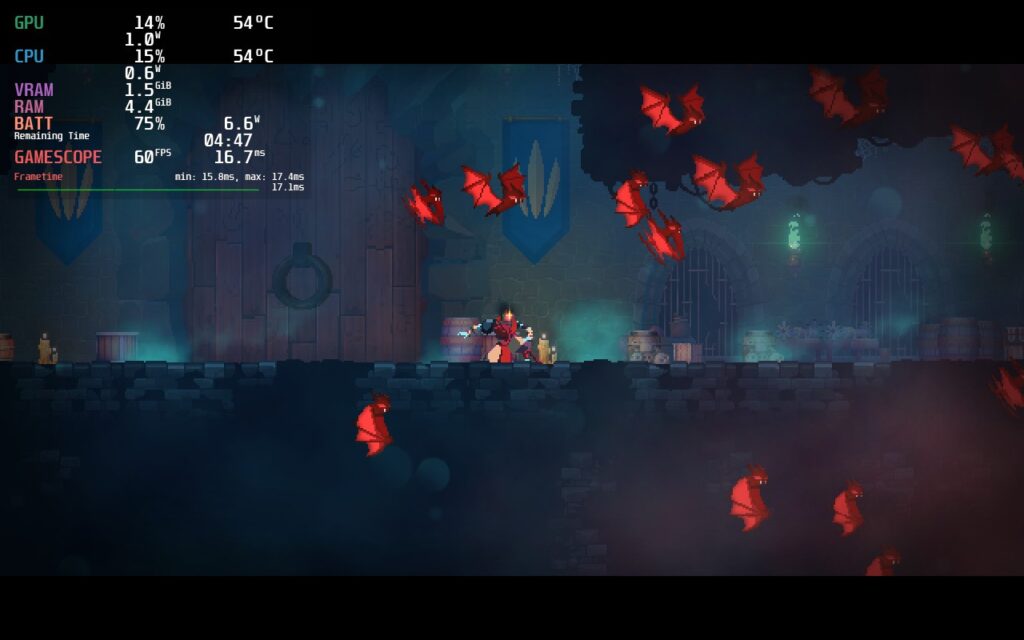
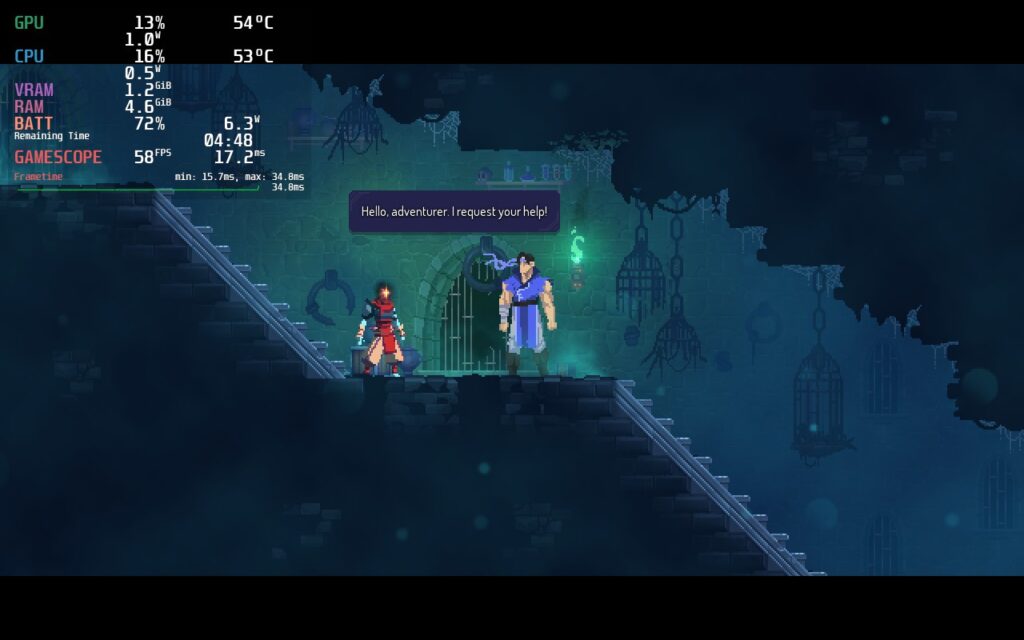
There is so much I can really say about this expansion, but I can't stress enough how incredible it is. The new weapons, like the Cross, Morning Star, Bible, Vampire Killer, and Holy Water, fit in perfectly, the outfits are great, the music tracks are fantastic, the biomes are gorgeous, and the boss fights...oh the boss fights are epic. I had just made it through Dracula's castle and I thought I was heading to fight him, but no, I was pulled down by a purple chain to be killed by Death, which was an insane battle.
On top of that, being able to put on outfits of Castlevania characters and make yourself look like Richter, Simon, Alucard, Maria, Trevor, and even Dracula while fighting classic enemies of the franchise like Medusa, Werewolves, Buer, Armor Knights, Throw Masters, and more! Overall, for $10, this feels like a steal. And for those who don't have it, there is a bundle for $25 for both the base game and this expansion. I highly recommend it if you haven't taken the dive yet.
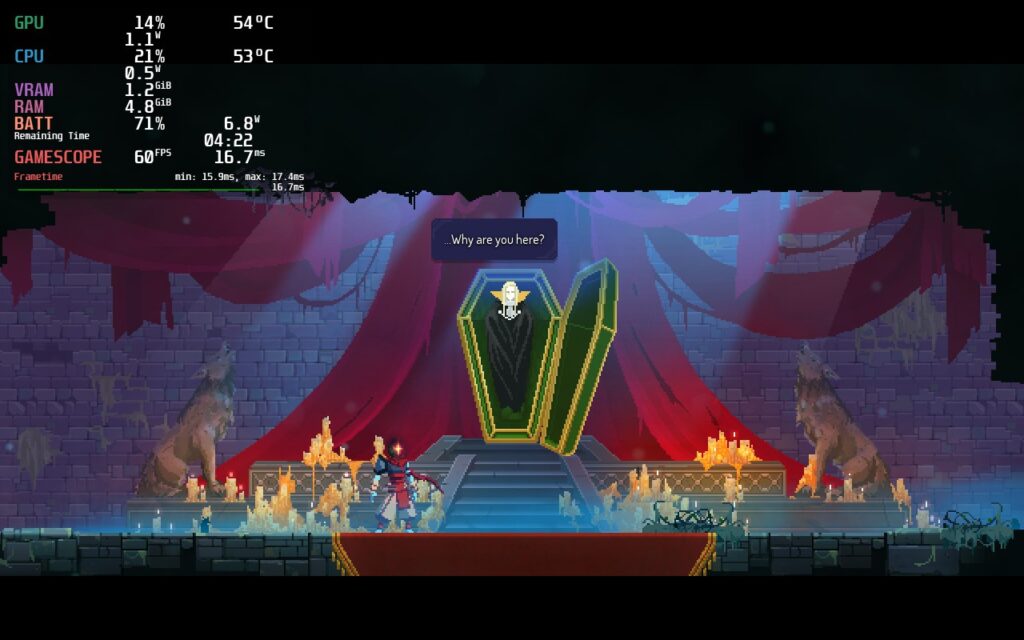
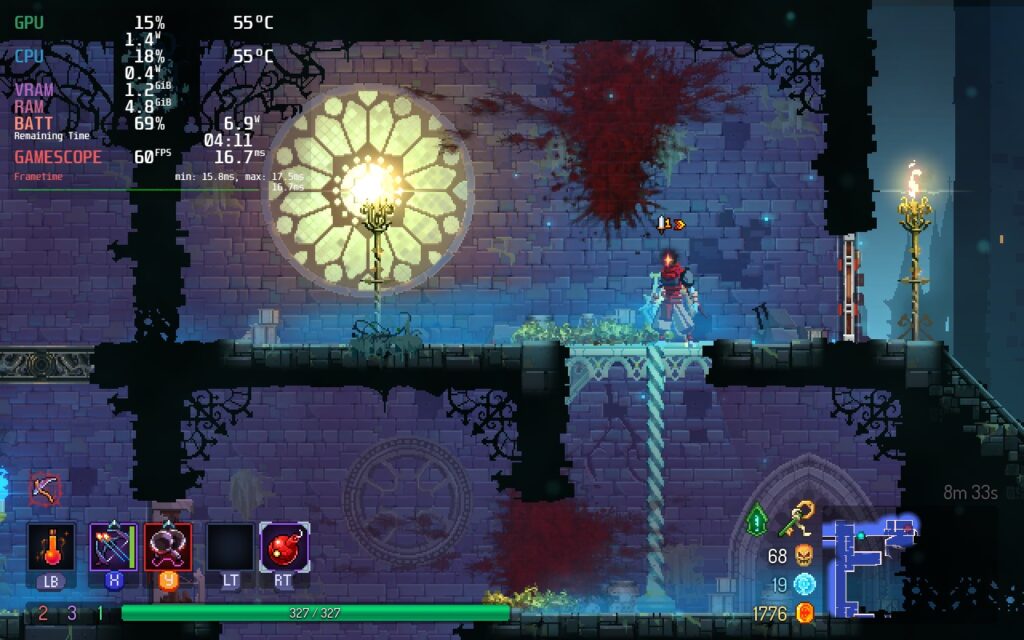
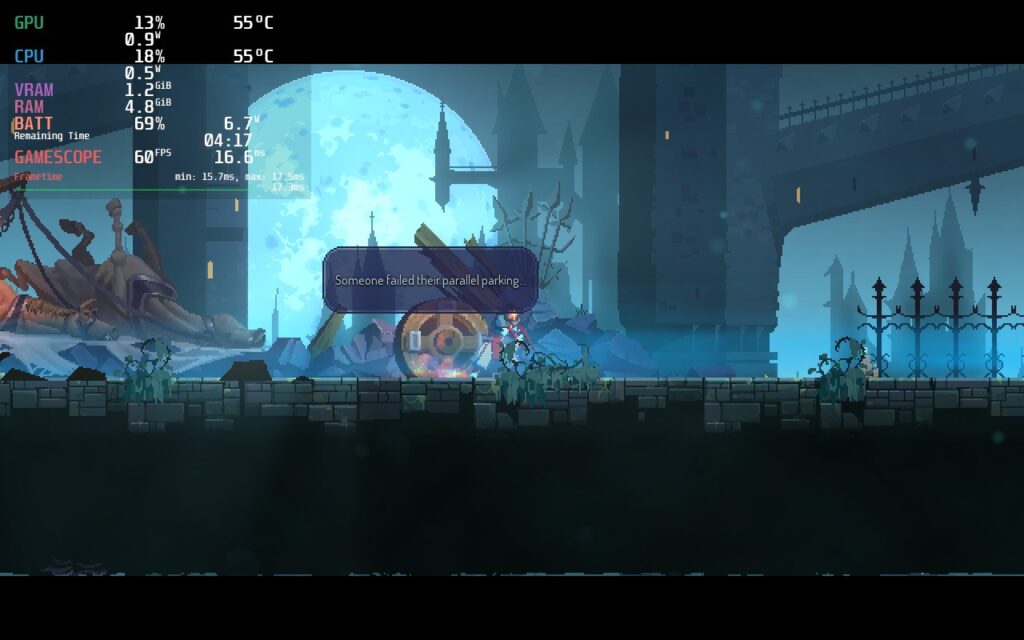
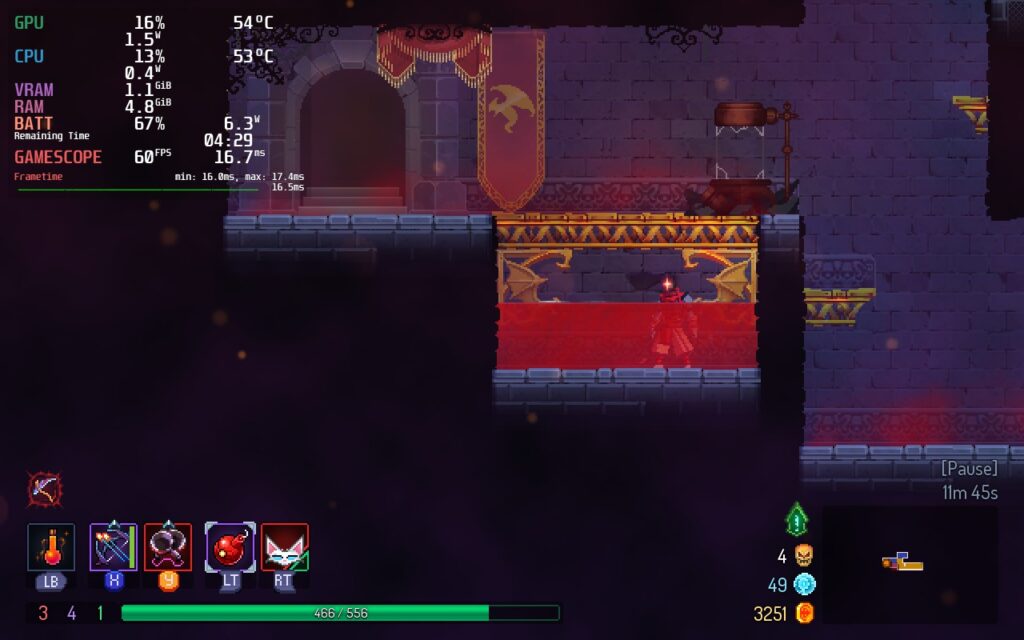
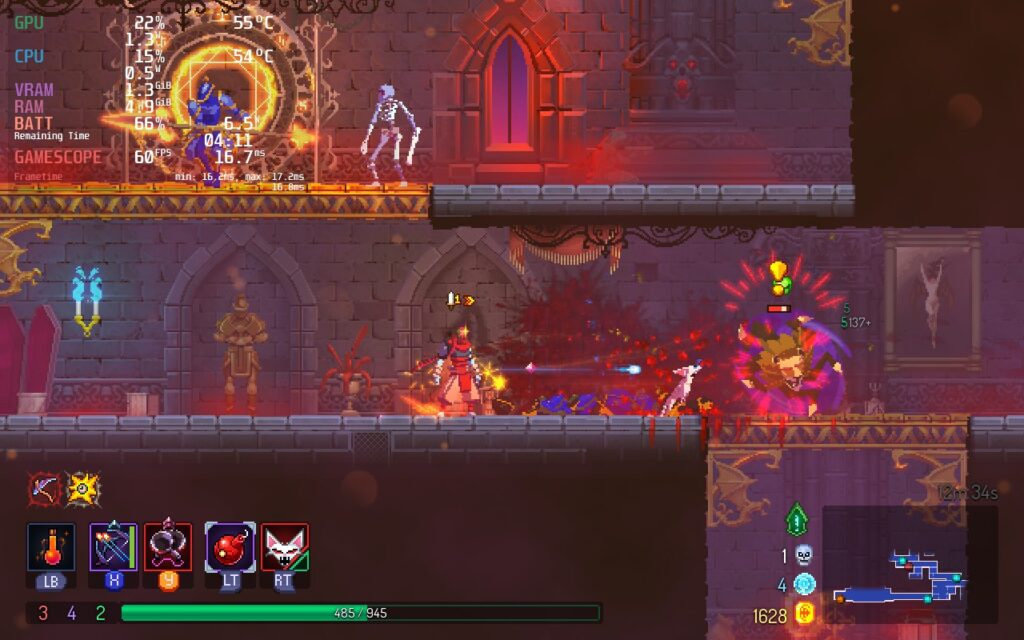
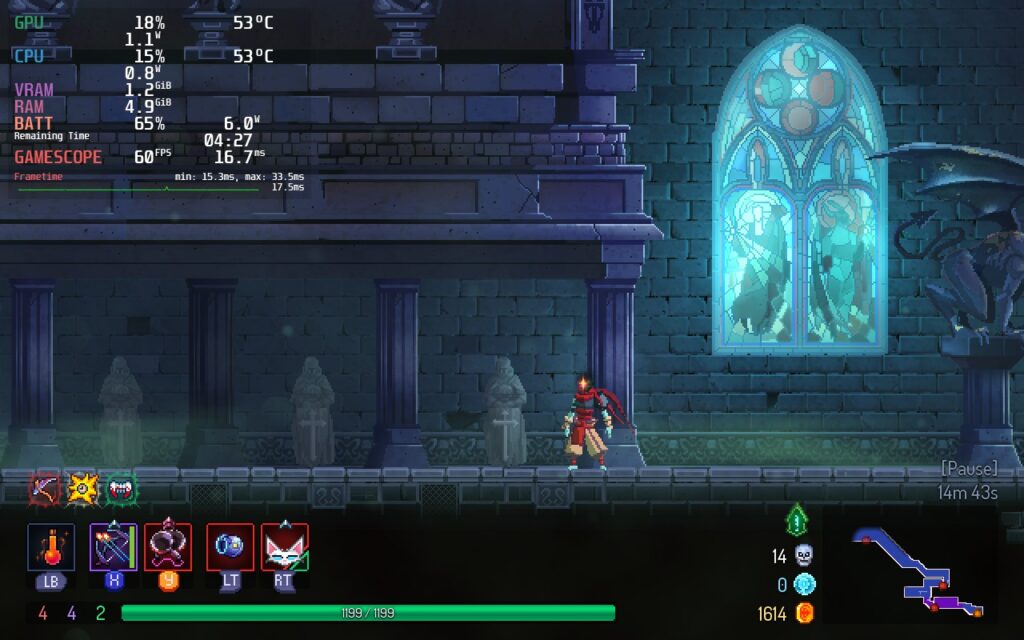
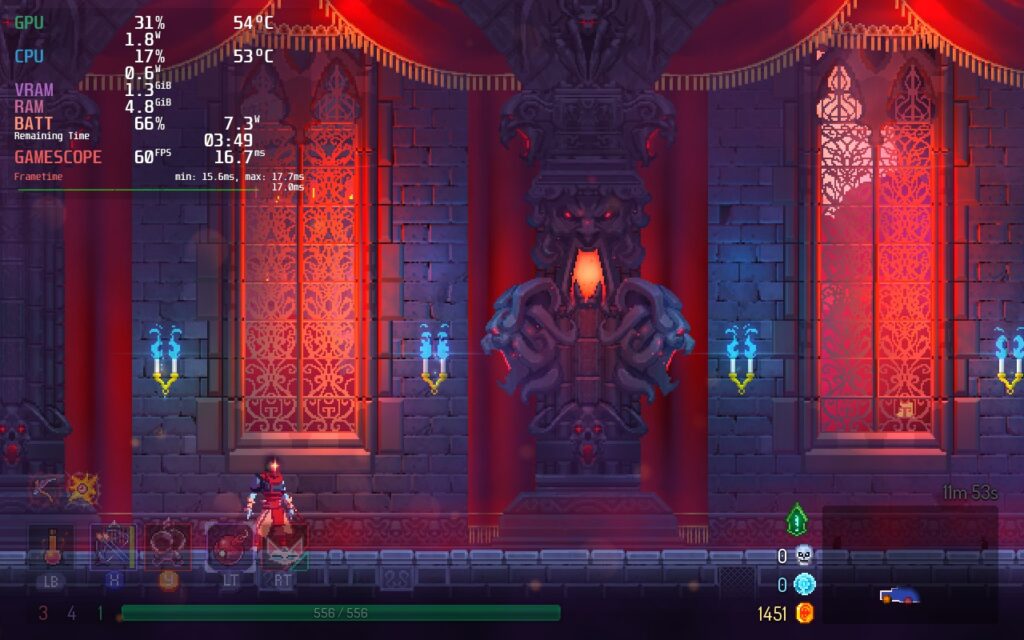
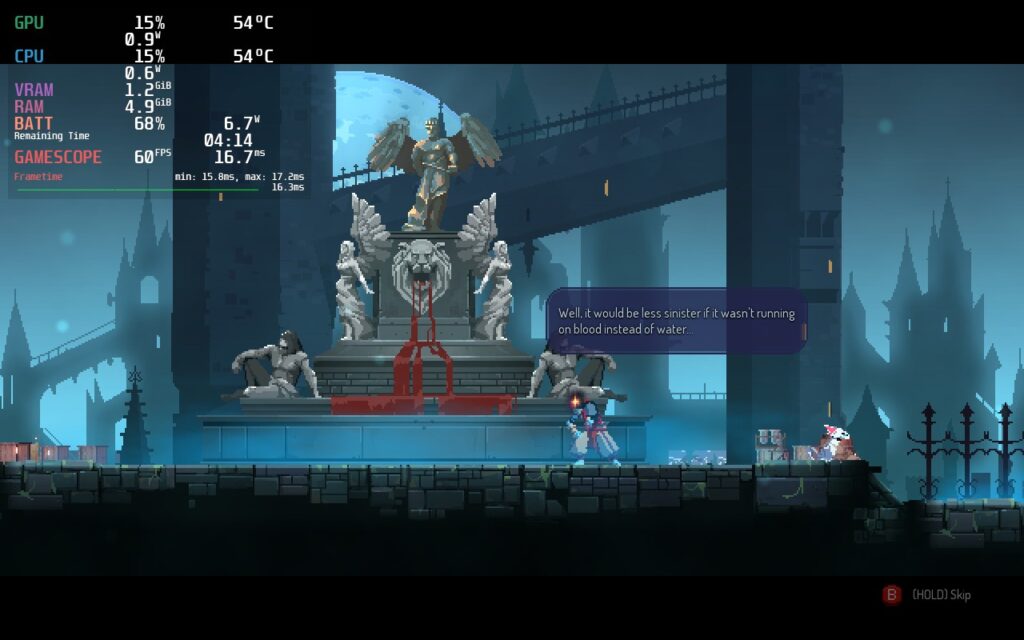
With how amazing Dead Cells is, it's only made better by how perfect it runs on the Steam Deck without any changes! The game will drain around 6W - 8W for a battery life of 6.5 - 7 hours at a solid 60 FPS. There are some small stutters here and there, but I only noticed because I had the overlay on, otherwise, I wouldn't have at all!
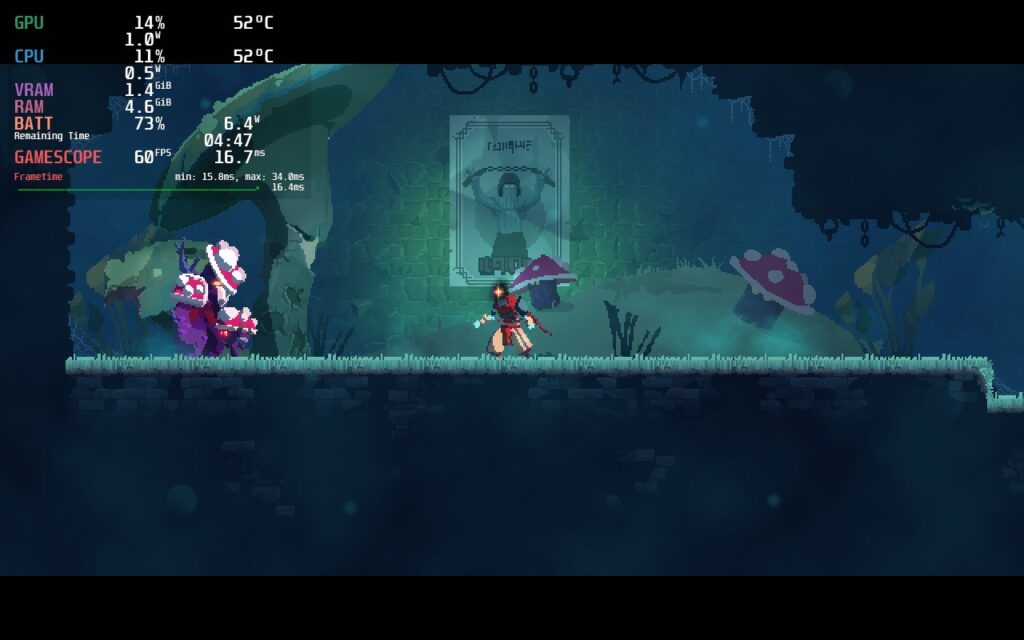
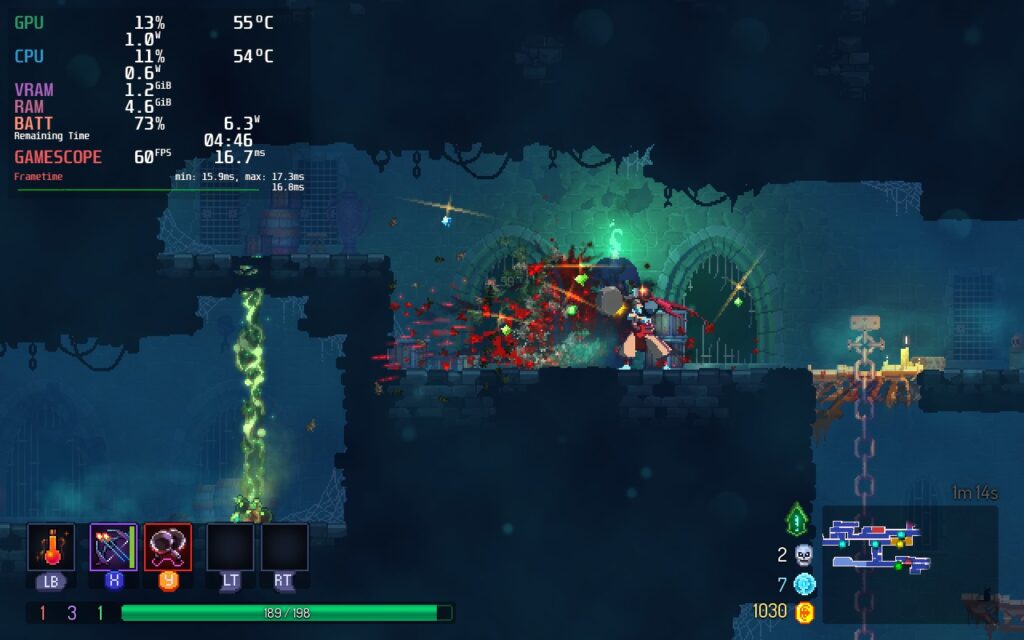
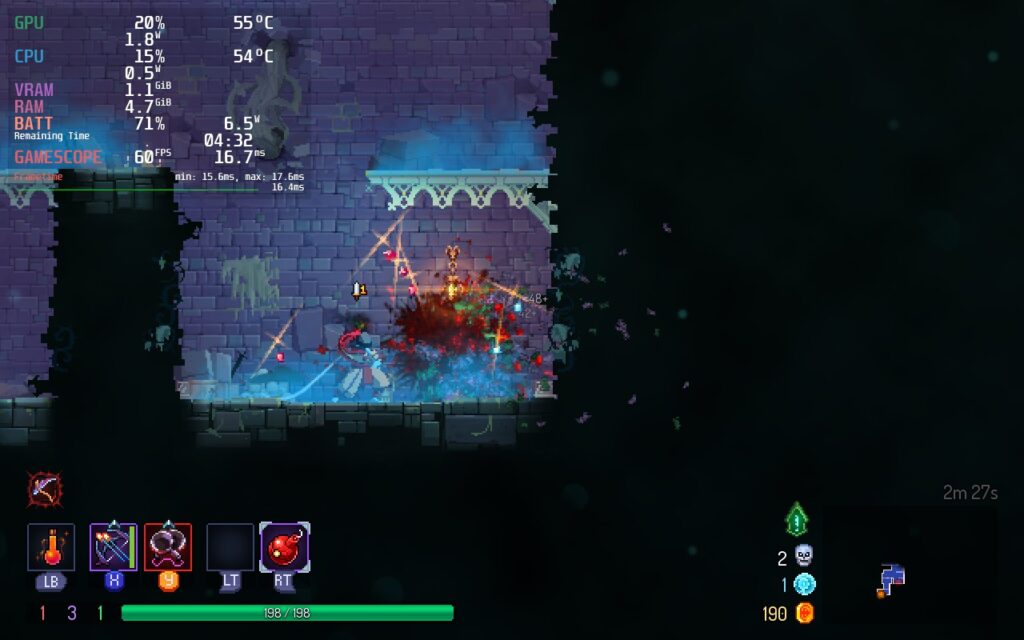
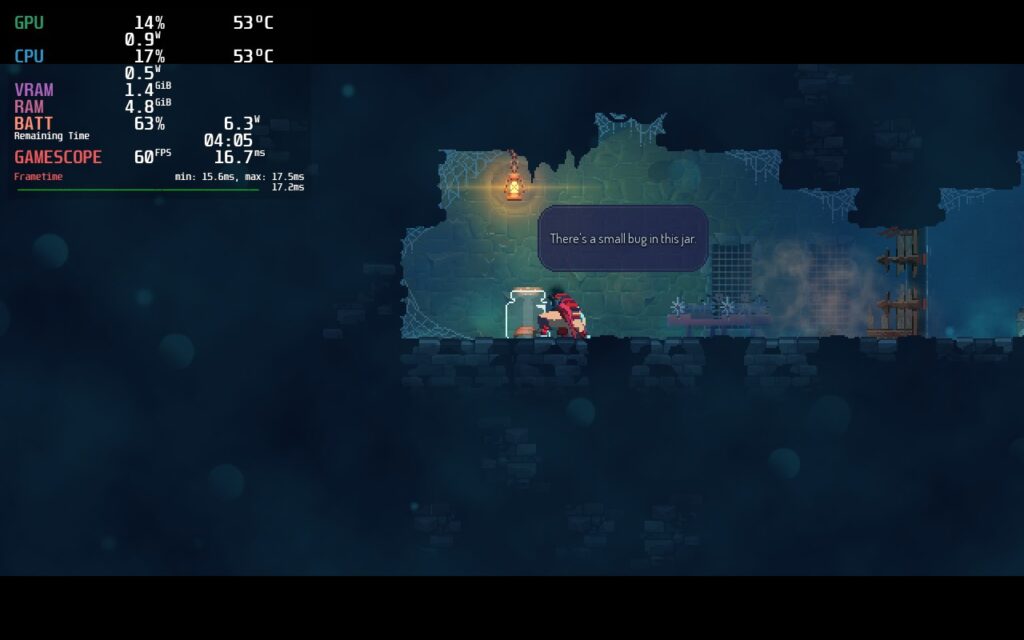
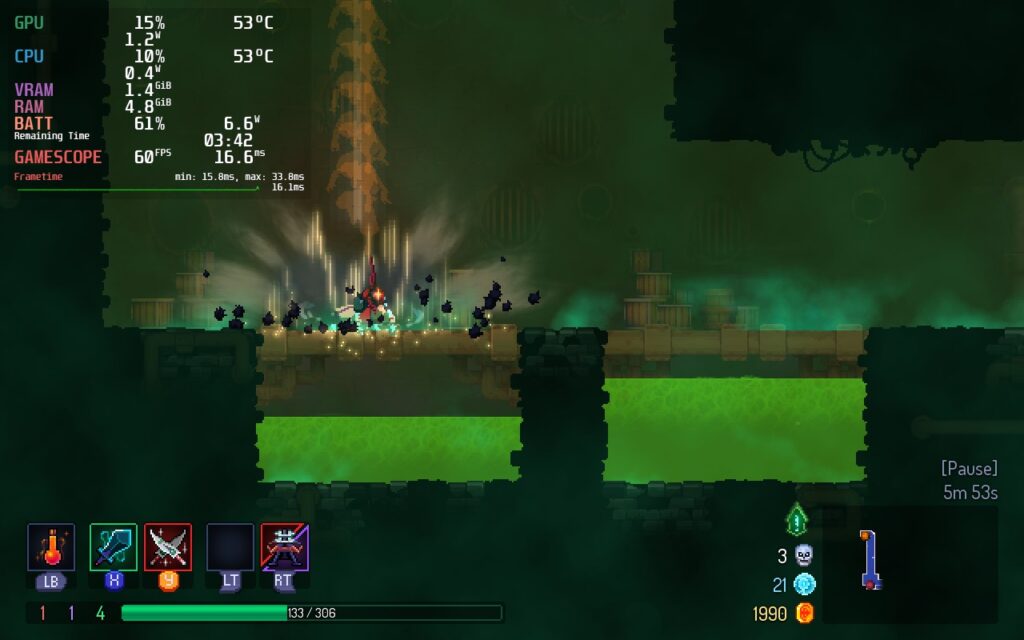
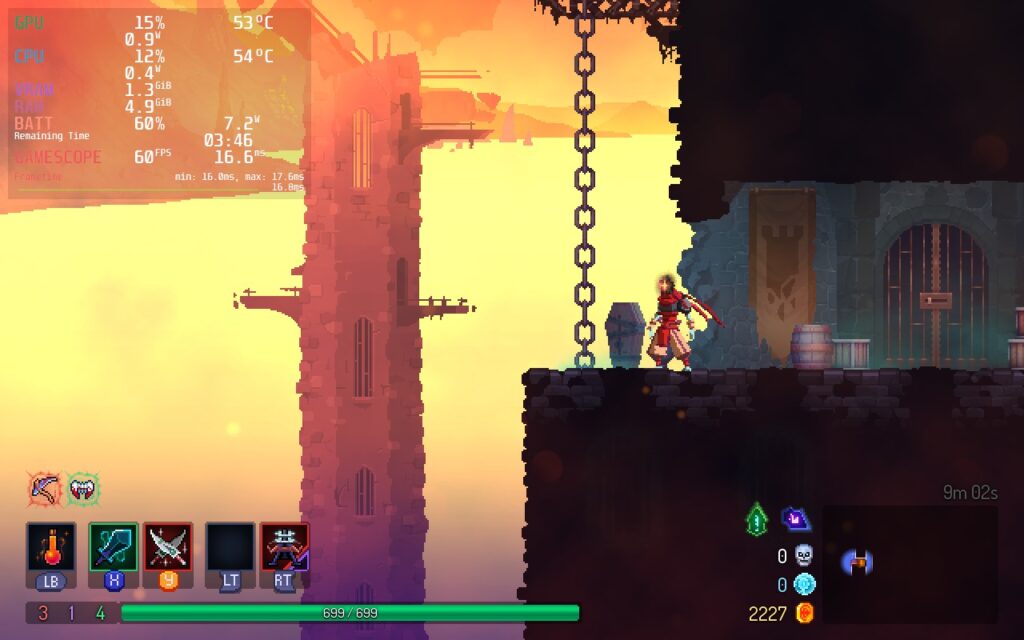
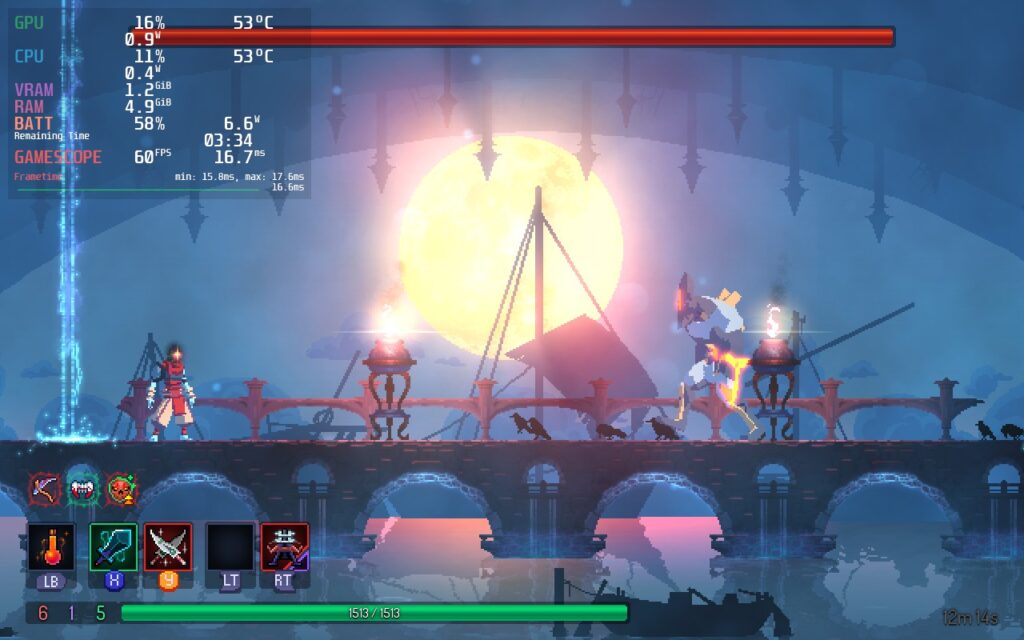
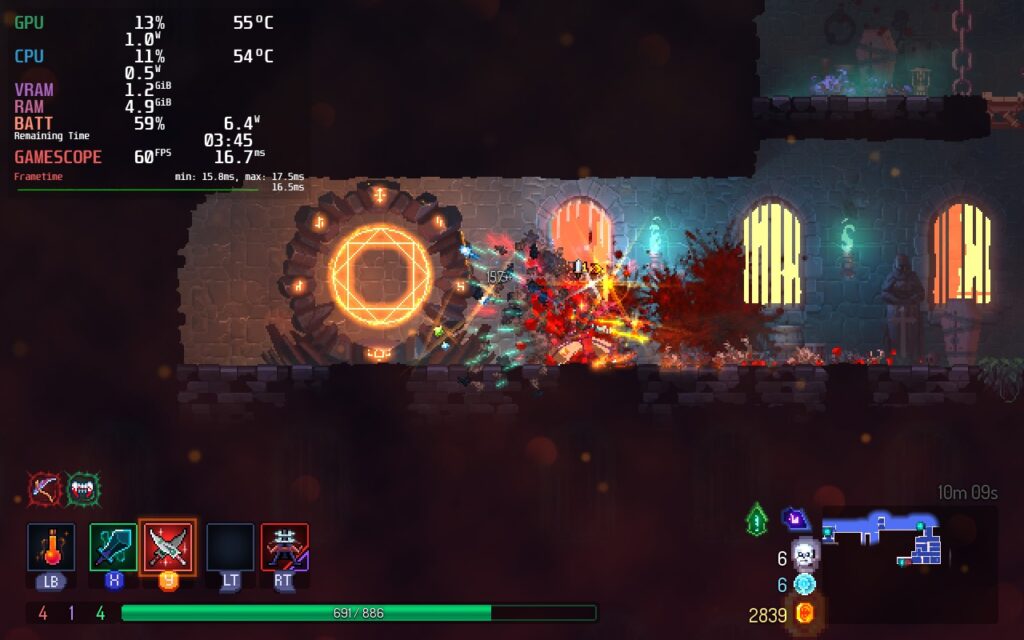
I had no issues with controls or visual bugs that appeared. In cutscenes, the screen would turn into letterbox format, but it went right back to the 1280x800 resolution it supports. To make things even more appealing, Dead Cells is being played through a native Linux build, and it runs fantastically.
Dead Cells is one of my personal favorite games. I am a huge fan of roguelike and metroidvania games, and this game does a wonderful job blending the two and refining it to a tee. And with the release of the incredible Return to Castlevania expansion, there is even more reason to jump in now if you haven't. If you don't have this expansion, I highly encourage checking it out, it is $10 well spent! Thankfully, you will also be able to fully enjoy it on the Steam Deck with no compromises needed, making it one of our Best on Deck games! Dead Cells and the Castlevania DLC are essentials to your Deck's library.
Our review is based on the PC version of this game.
If you enjoyed this review, be sure to check out the rest of the content on SteamDeckHQ! We have a wide variety game reviews and news that are sure to help your gaming experience. Whether you're looking for news, tips and tutorials, game settings and reviews, or just want to stay up-to-date on the latest trends, we've got your back.
Dust & Neon was provided to us by Rogue Games and Keymailer for review. Thank you!
Dust & Neon is a roguelike twin-stick shooter set in a futuristic wild west filled with robots! As a robot yourself, you will go on an epic quest to fight armies and partake in insane boss fights, all while unlocking abilities and finding the right weapons amongst thousands of different ones. Dying and coming back stronger with passive ability upgrades to beat the missions in front of you will be imperative as well. Now pick up your guns and get ready for a challenging top-down shooter that will keep you on your toes.
I first played Dust & Neon during the Steam Next Fest last week and it quickly became one of my favorite demos. The visual aesthetic of the game is right up my alley, vibrant and simple, while the gameplay loop is engaging and addicting. I do love randomized items/weapons and roguelike systems in games and I feel this one does it really well too. The randomized weapons keeps me trying to crawl up the power while managing if I will need a certain capacity or accuracy, while the passive upgrades I get after dying influence some of my choices in terms of spending money to get certain weapons initially.
You do have to reload your gun manually by pressing the X button, which some might not like, but I feel it adds to the challenge and charm of the game (also the gun showing on the right side when reloading is awesome). Combine the aiming, shooting, rolling, sliding to cover, and swapping between equipped weapons, Dust & Neon is such a fun game to play. And what makes it even better is how well it runs on the Steam Deck!
Booting up Dust & Neon, I noticed it was automatically set to the highest graphical quality. Luckily, the game runs fairly well at max! 60 FPS with the max settings brings in around 13W - 17W battery drain depending on the location and amount of enemies on the screen. While this is fantastic, there is a change or 2 that we can make to really get the maximum battery life out with the game still looking wonderful.
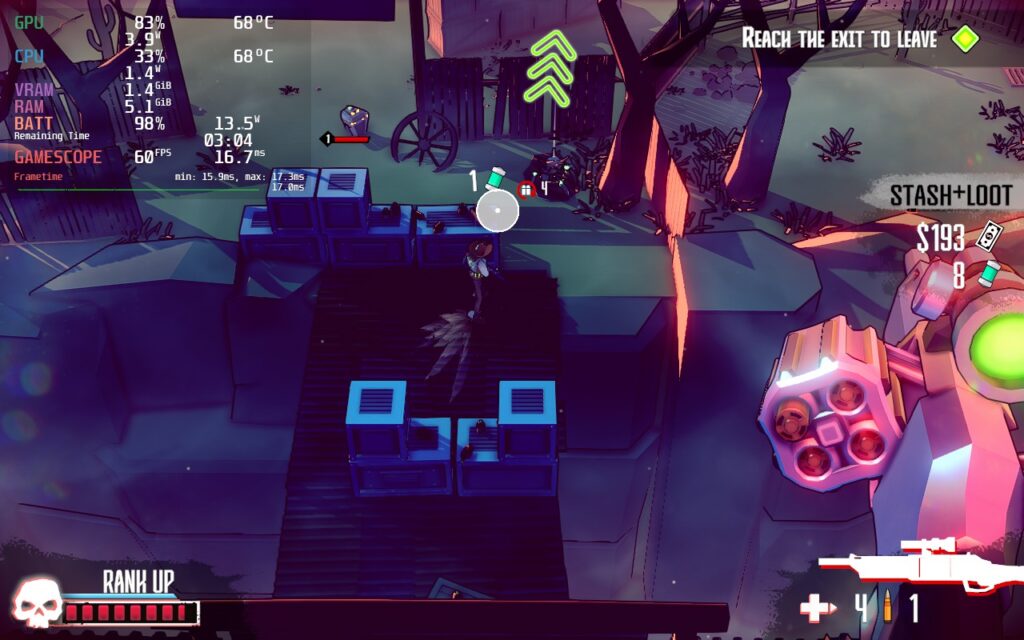
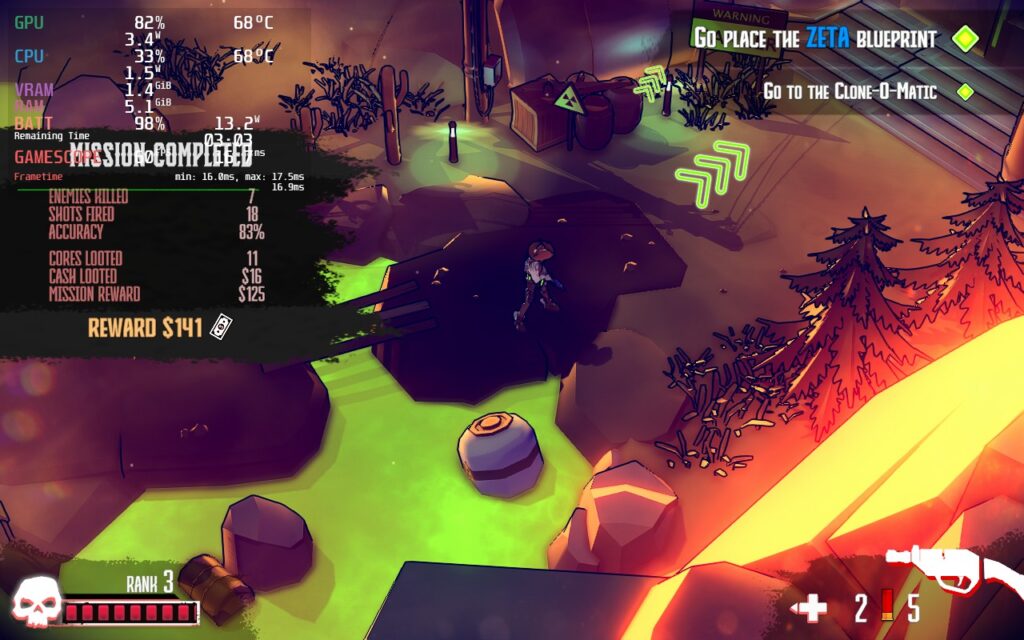
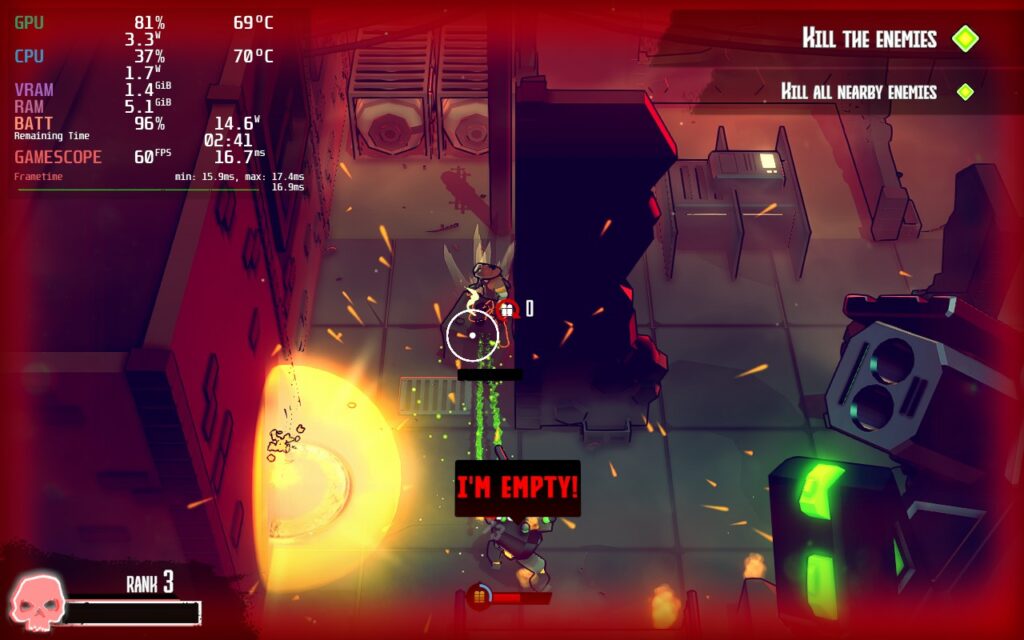
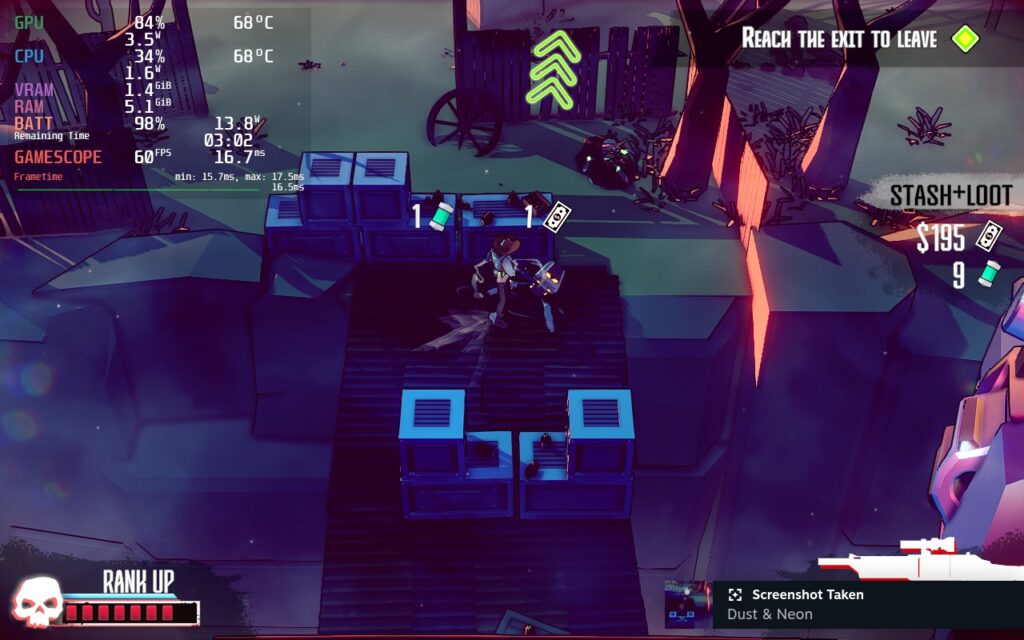
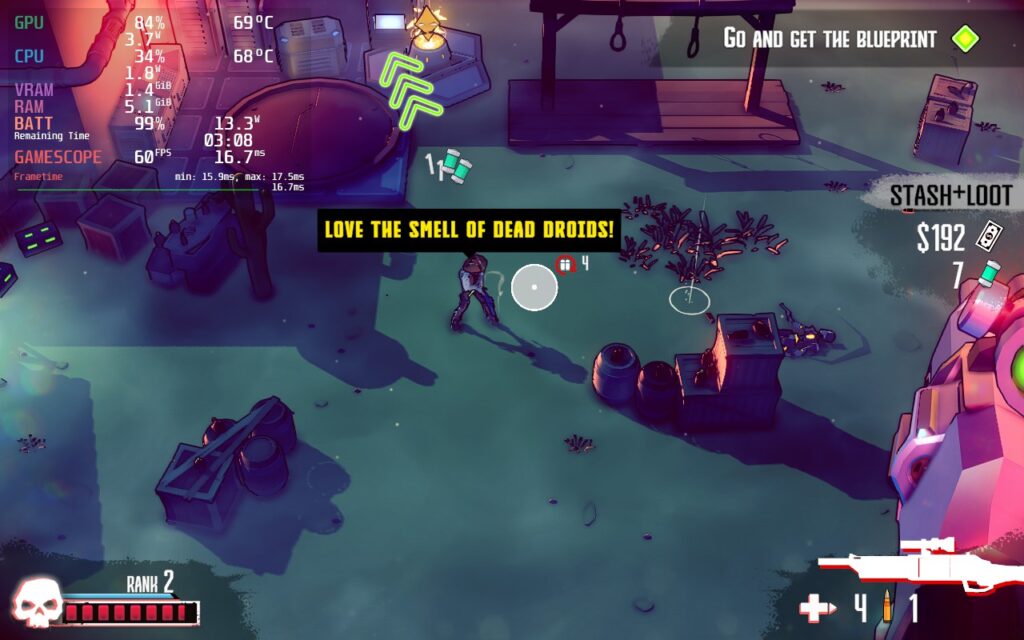
In this case, I wanted to retain the pleasing visuals and their crispness while bringing battery drain down. Luckily, I was able to do this just by turning the graphics down to medium. This primarily got rid of some detailed shadows, but overall kept battery drain around 11W - 12W. I did see once or twice where drain went a little above 13W, but this was far and few and overall added an extra hour or so of battery life. This is easily the recommended build I would say others should use.
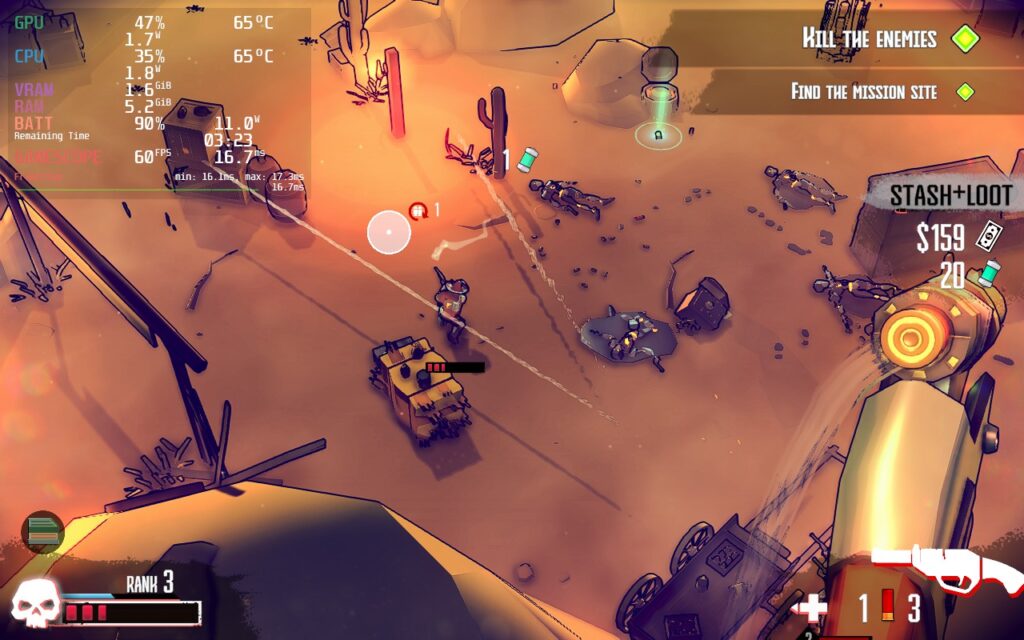
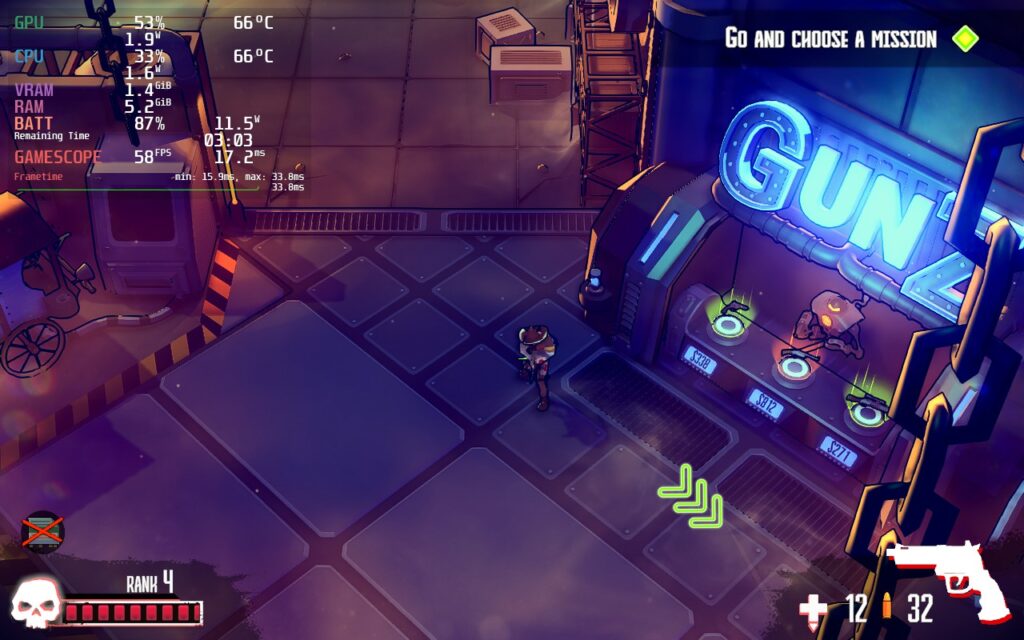
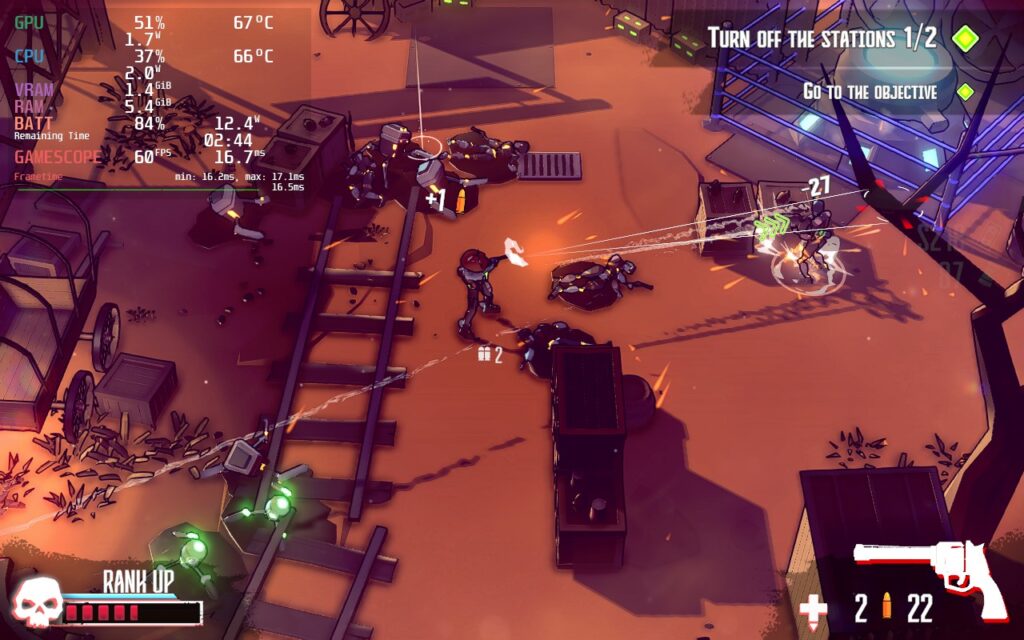
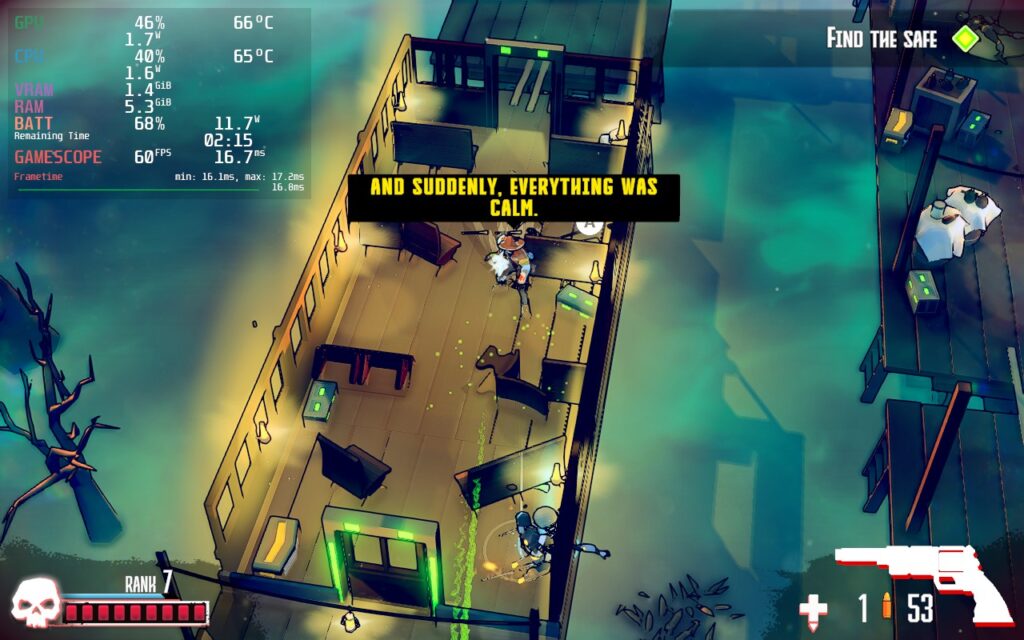
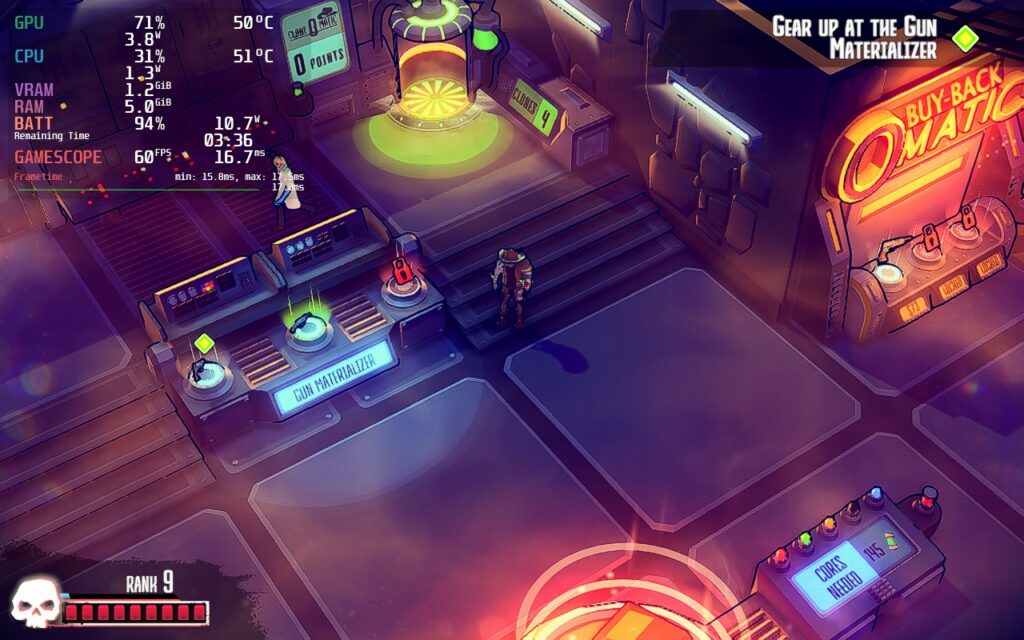
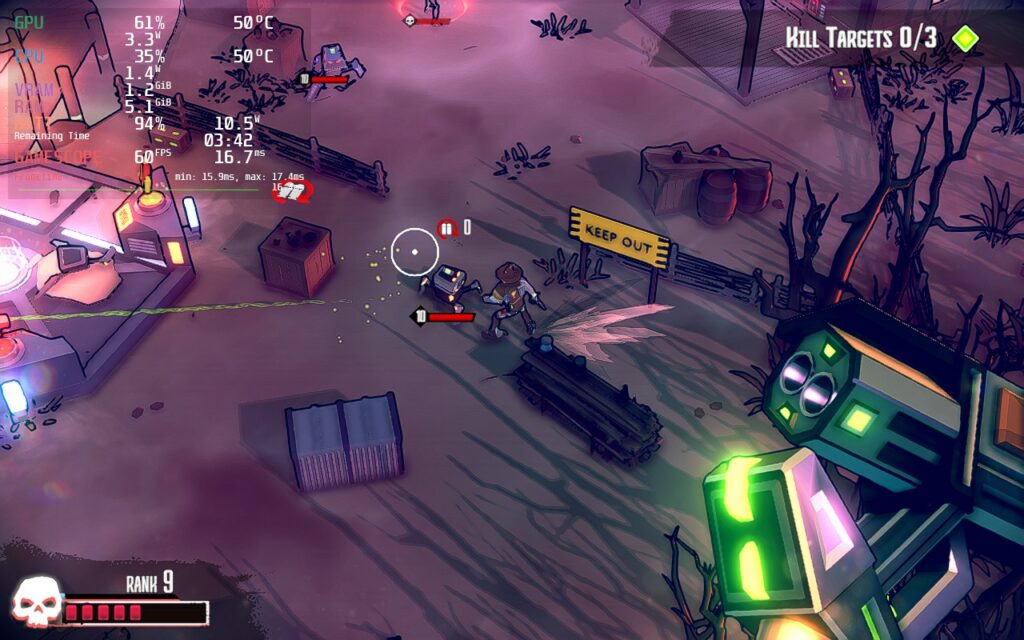
For a battery build, I elected to keep the graphics settings the same to keep the better shadows, but use Steam to force a 1024x600 resolution. This keeps the game looking quite nice still, with a slight bit of bluriness, but ends up saving around 2W drain with a stable 60 FPS. It looks a little worse, but if you're saving as much battery as possible without compromising visuals, this will be the way to do it!
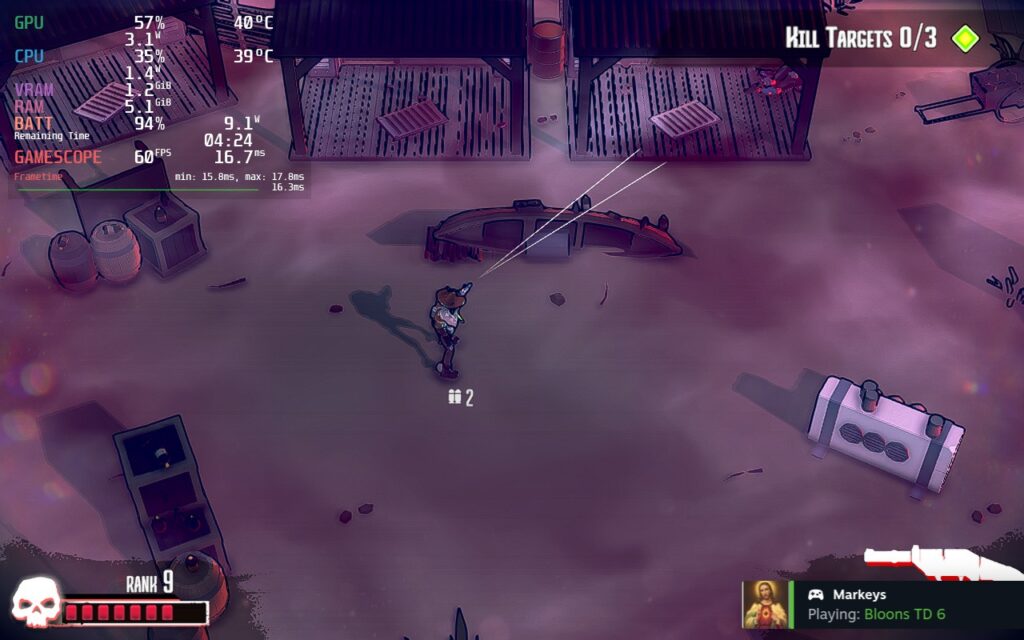
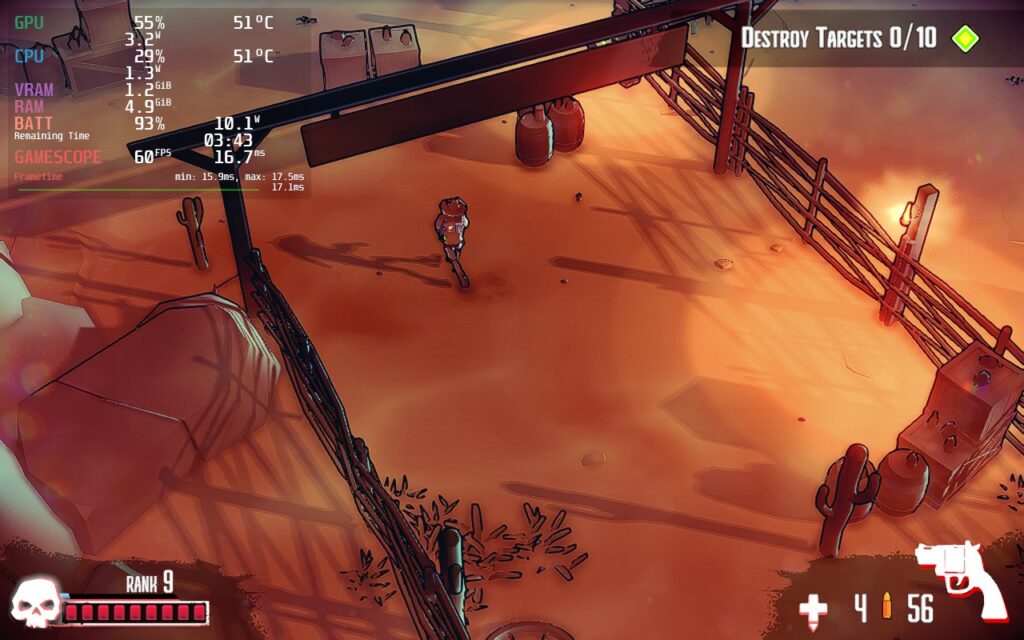
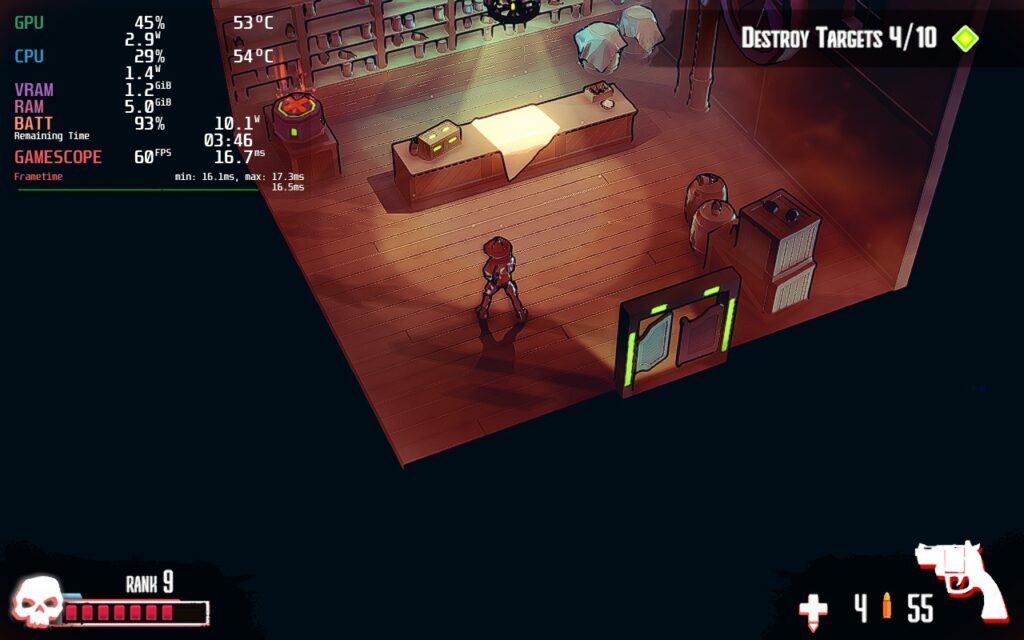
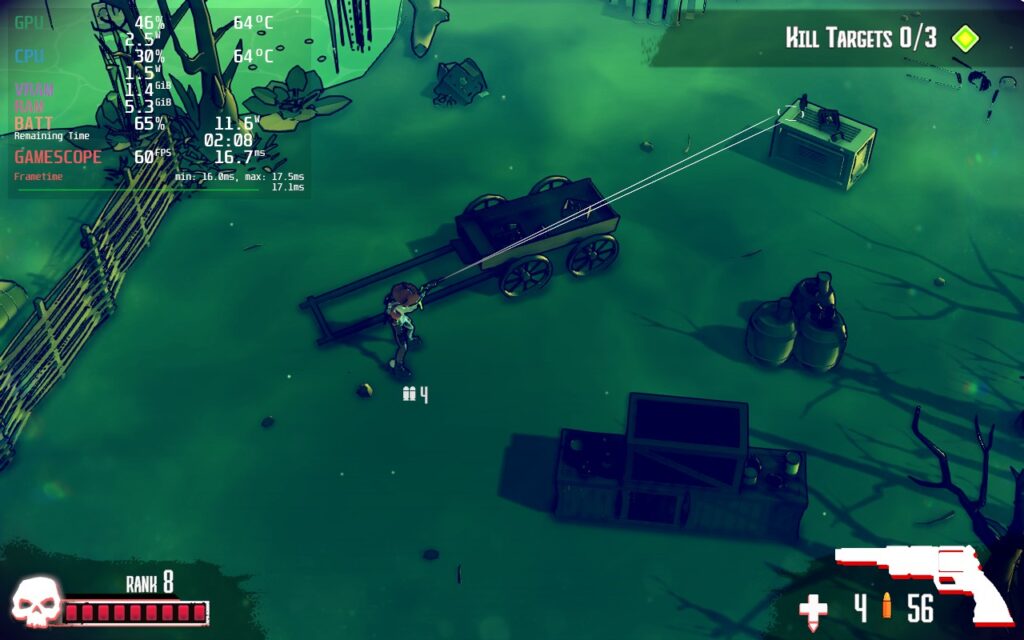
Other than that, I had no controller issues or visual bugs. The game also displays at a full 1280x800 resolution and has cloud saves!
Dust & Neon is an incredible top-down shooter that shines with its gorgeous visuals and addicting gameplay. The game can get really intense in fights and feels quite rewarding when getting a new weapon that starts killing enemies in 3 hits instead of 4 or an overpowered shotgun that one-taps some enemies. Switching from actively shooting robots to rolling for cover to reload, then rushing around the corner and emptying the revolver's ammo into a group of bots feels fantastic. And while our recommended settings change the graphics quality, the game can be fully enjoyed and played without changing anything, making this our newest Best on Deck game! As one of my favorite Next Fest games, this is one I highly recommend adding to your Steam Deck library.
If you enjoyed this review, be sure to check out the rest of the content on SteamDeckHQ! We have a wide variety game reviews and news that are sure to help your gaming experience. Whether you're looking for news, tips and tutorials, game settings and reviews, or just want to stay up-to-date on the latest trends, we've got your back