Forza Horizon 6 was provided by Xbox Game Studios for review. Thank you!
After an excruciating 5-year wait, the Forza Horizon series is back, and Playground Games has chosen the most anticipated location yet for this adventure: Japan.
With the bright lights of Tokyo, the narrow streets of sleepy villages, twisting mountain roads, and beautiful forests, the world of Forza Horizon 6 is the most varied environment in a Forza Horizon game to date. Slap a massive festival site in the middle of it all, and we're back to racing!
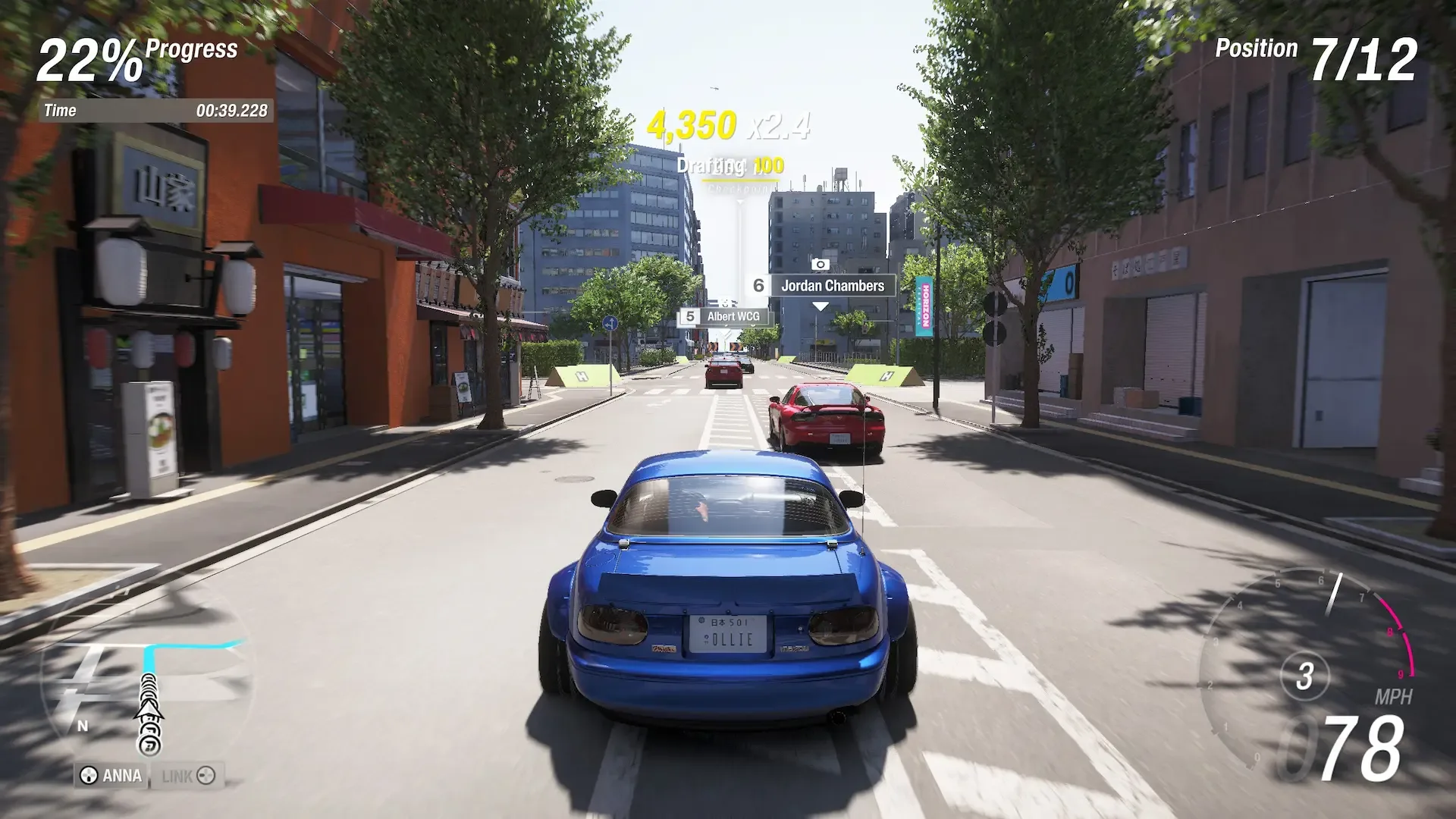
Forza Horizon 6 plays it safe with its gameplay formula. If you've played any of the Forza Horizon games, this will be a familiar format. You have your various race events, such as dirt, road, and cross-country. Then you have your speed traps, drift zones, and danger signs to keep you busy while you explore the map, as well as the ever-popular collectibles, in the form of boards and mascots.
This is all unchanged, aside from a couple of additions and returning features, such as Car Meets, which reappear for the first time since Forza Horizon 3, where you can gather with your lobby and check out other people's rides, and Touge racing, where you'll race on tight mountain roads in a 1V1. Just don't expect anything too new and surprising with what Forza Horizon 6 offers. There is also a neat feature where you can find cars for sale around the map, allowing you to pick up rare bargains, in addition to Barn Finds and "Treasure Cars", which are hidden in the world.
Car physics are likewise unchanged; it embraces the same "simcade" style of previous games, offering a degree of realism while also allowing you to drive through pretty much everything that isn't a building. This is exaggerated even more in Forza Horizon 6, as even trees can now be driven through, which is a good thing, as I'll point out later. Fun is the order of the day here, and the game delivers on that as well as the previous iterations have done.
The "story" is pretty identical to previous entries. You'll gain progress in the form of Wristbands through completing events and challenges. To earn a Wristband, you'll need to unlock and then beat a special event, either a Horizon Rush event, which is a time trial on specially-made tracks, or a "Showcase" event, where you'll race against another type of vehicle, much the same as previous Horizon games, such as a Gundam or, I presume, a C-130 cargo plane.
Exploration is still fun and rewarding, and it's perfect when you just want to drive around in your favorite car without the hassle of racing. The world map I found to be more interesting than the previous foray into Mexico, which never really grabbed me.
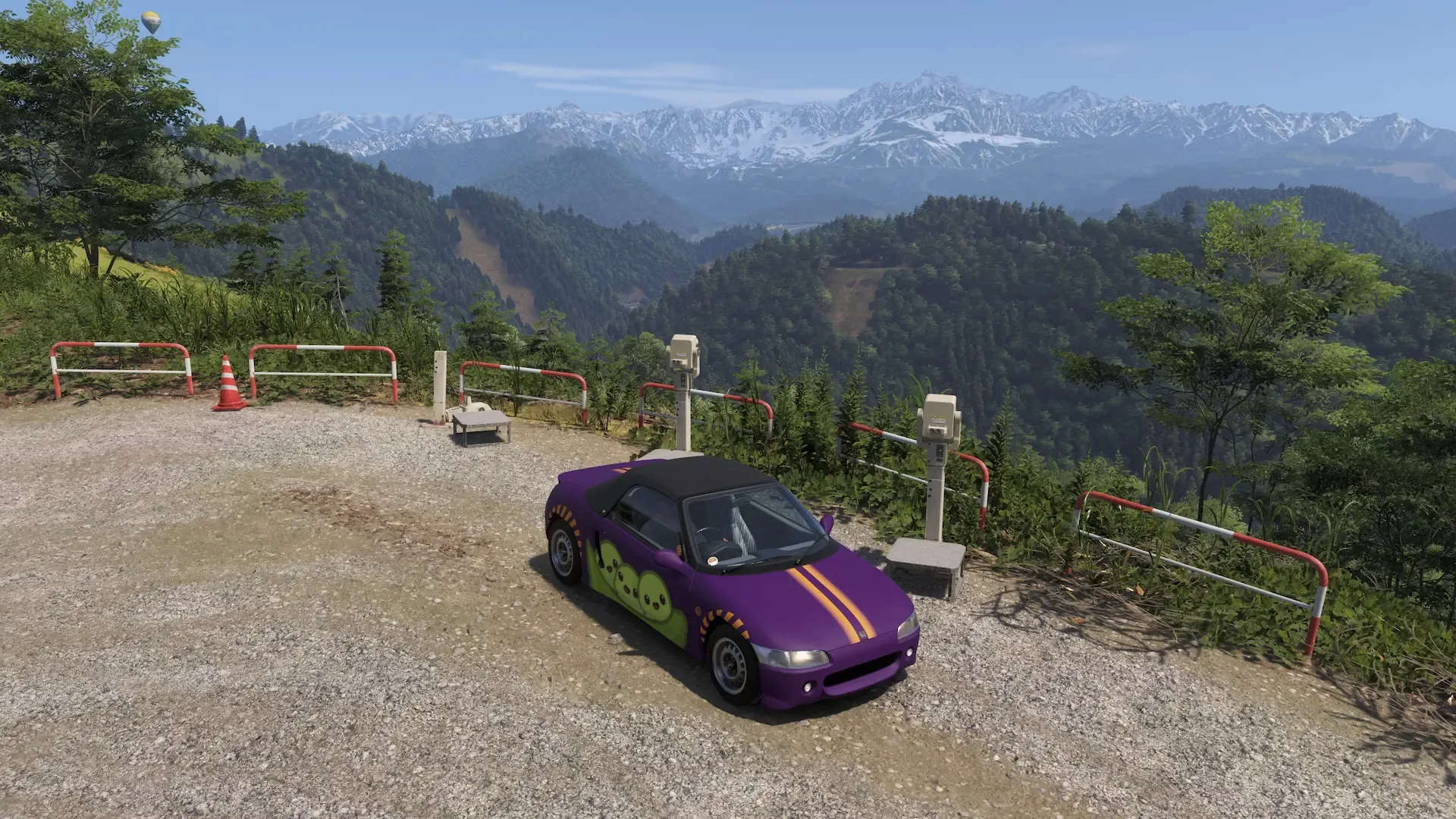
Visually, Forza Horizon 6 impresses in its environment. The density of flora is striking, with plenty of forests and dense undergrowth foliage present; it really helps to bring the depiction of Japan to life. And as I said, it's a good thing we can now drive through any tree, given the sheer volume of them.
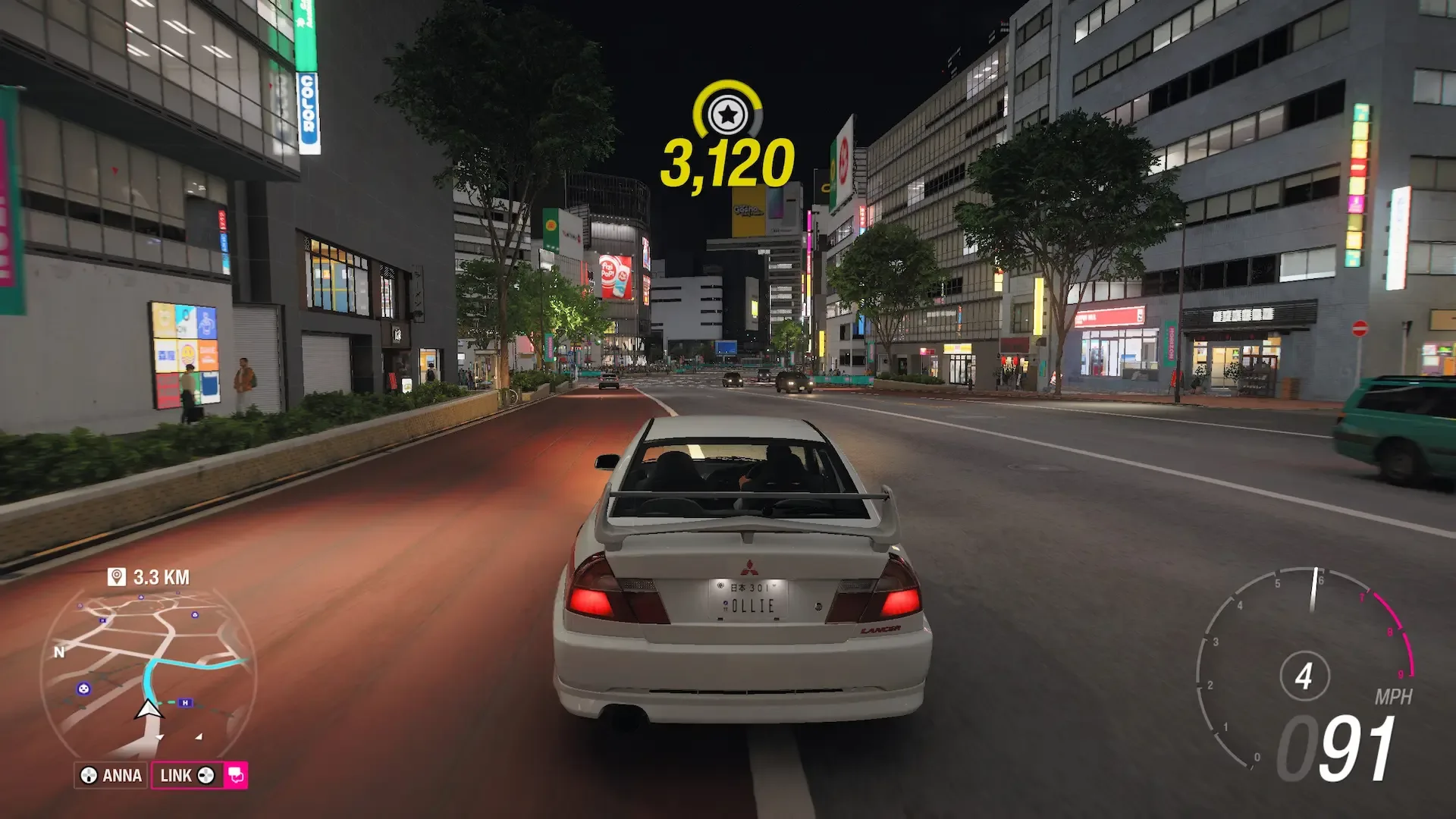
The depiction of Tokyo city itself I found to be less enticing. I was looking forward to blasting through a big city, with bright, vibrant neon lights shining on rain-soaked streets, but, to be honest, it all ended up looking a little... flat. Whether it's the cooler temperature grade applied to the screen compared to Forza Horizon 5's Mexico, or the fact that there's often no sunshine in Horizon 6 due to the frequently overcast Japan, the world does sometimes feel a little... bland.
The game excels when you're out in the rural areas, enjoying the forests and quaint villages that line the twisting country and mountain roads, and then up to the ski slopes in the far north for some rallying. The city ends up feeling cold and ironically lifeless by comparison. The neon signs are there, but they don't really "pop", one of the biggest draws of Tokyo, and it feels like they missed a beat depicting it here. Shibuya Crossing is present also, but with low traffic and pedestrian density, it feels... off.
You also have your "estate" in the game, which gives you a big, open space where you can create and design your own custom playground, whether that's a race track, a parkour challenge, or anything else you can think of. You're also able to invite friends over so you can try out what you've made together.
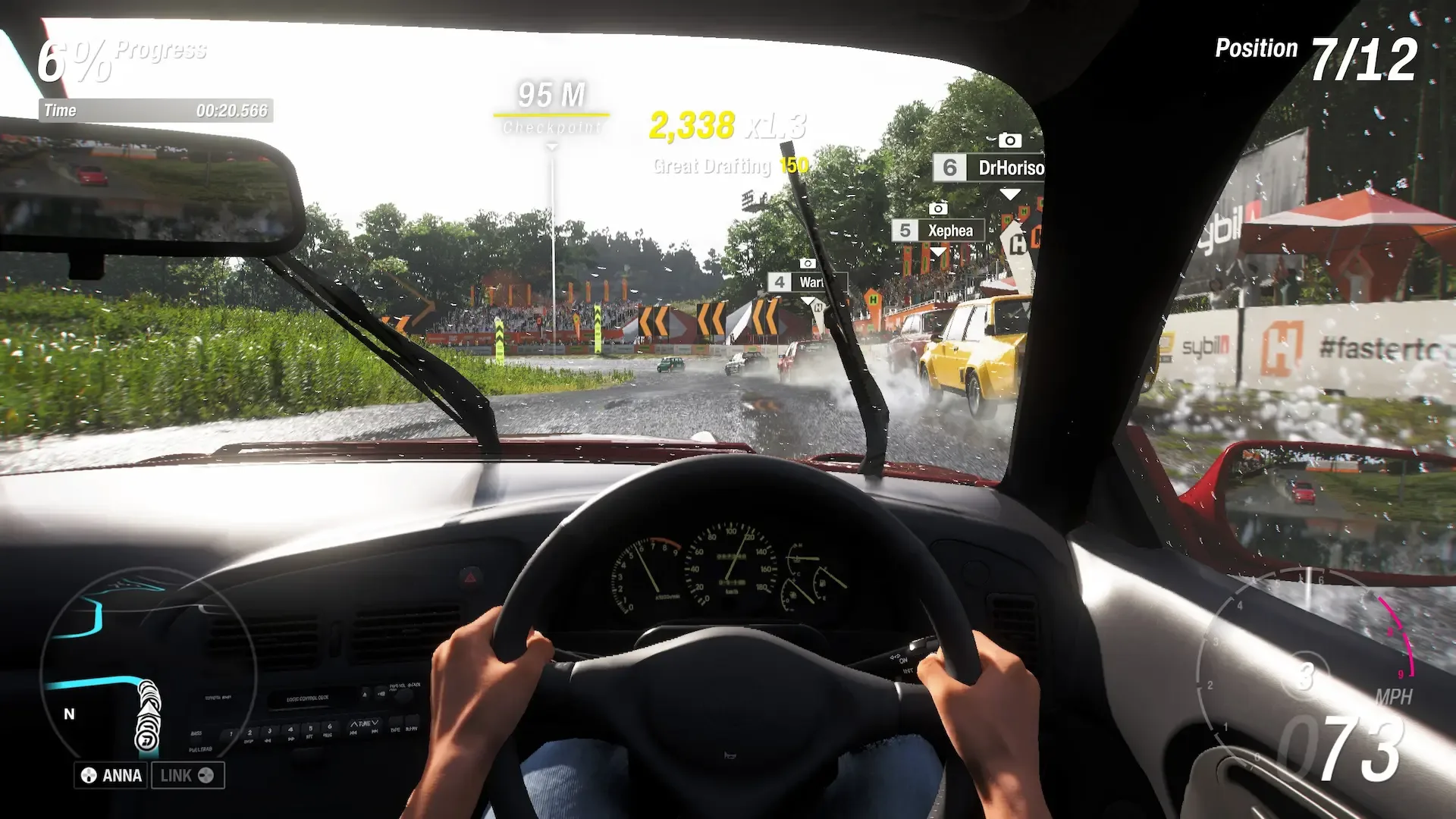
As far as the cars go, there's some improvement, but it is fairly similar to the detail found in Forza Horizon 5, which isn't a bad thing; they still look great. I do wish rain effects were improved in the interior camera, though. They've been the same since Forza Horizon 4, and with Drive Club way back in 2014 showing us how good they can look, it's a shame to see such a basic implementation still.
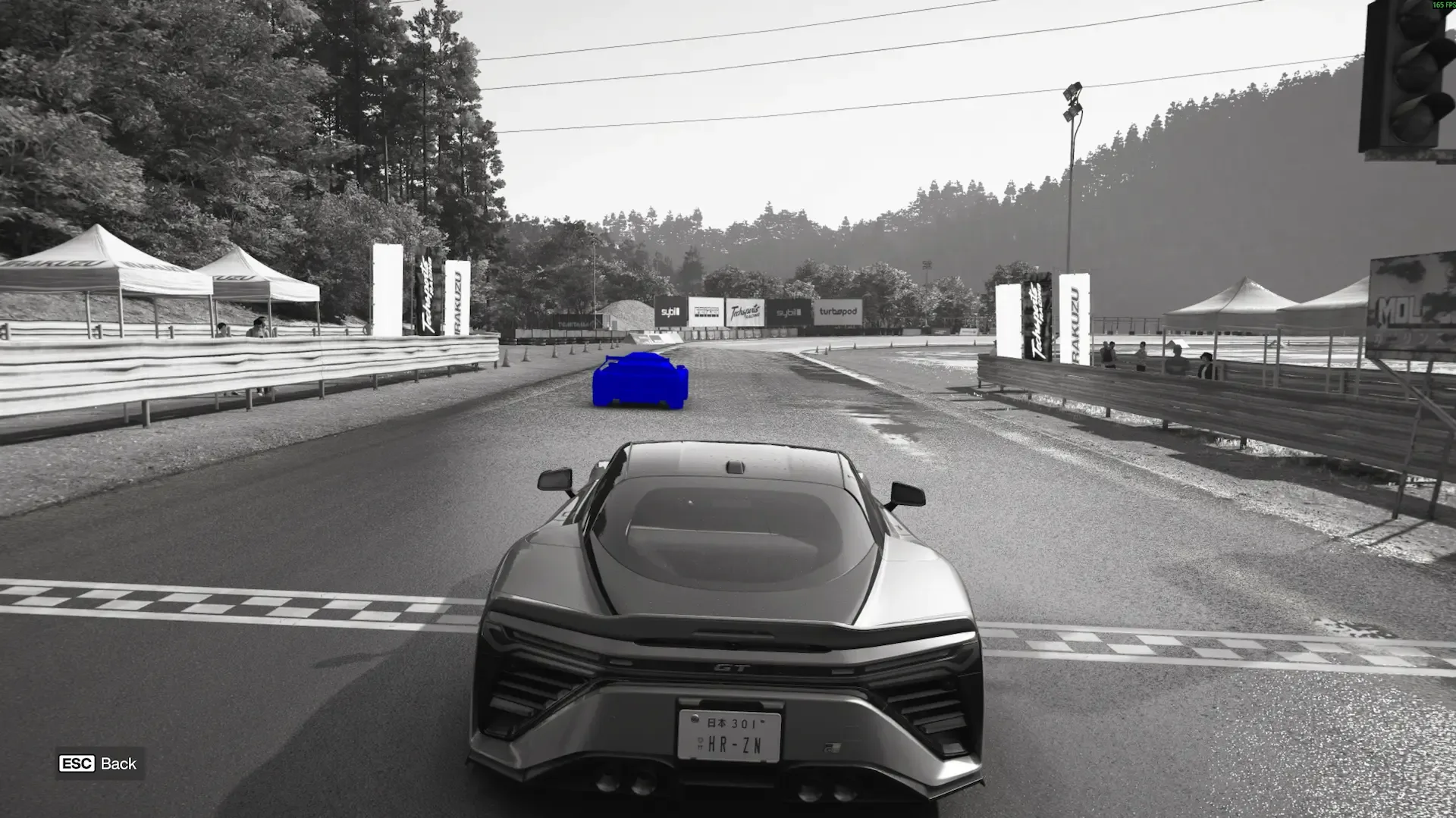
I also encountered some visual disappointments, such as shadows on distant cars not being visible, certain objects not loading in until you were too close, and grass visibly becoming denser just a few meters in front of your vehicle, even on the highest settings. Attention to detail on the interiors of cars was a tad disappointing too, with things like the clocks on vehicles not matching the in-game or real-life clock, something past Forza games have done.
Overall, while there are visual improvements in Forza Horizon 6, it isn't quite up to the standard I was hoping for, especially with last-generation consoles now being ditched entirely. The addition of ray-traced reflections and global illumination is nice, but other areas of the game seem to have been, dare I say, neglected.
The sounds in the game are fantastic; not only is the soundtrack blood-pumping, but the cars sound more refined than Forza Horizon 5's, with plenty of throaty (and occasionally whiny) JDM engine noises awaiting you. It sounds less artificial than before, especially the car idling noises at the starting line. The audio mixing was slightly off for me by default, and I would definitely lower the music volume a fair bit to fully enjoy the sound of your car.
Forza Horizon 6 also likes to give out cars (and money) like candy. It's been a bugbear of mine in the Forza series for a while, but Forza Horizon 6 continues the tradition of your car collection not really being something to be worked for. Within the first hour, you're plied with free cars. By the time I had over 90 cars, fewer than 10 were purchased. It's one area where the Gran Turismo games excel, and one that Forza has increasingly disregarded. Wheelspins return, and while I do get a thrill out of them, it is one of the main ways you'll be receiving your cars and money, which is a shame in a racing game.
Speaking of cars, while Forza Horizon 6 doesn't really expand the car roster in terms of size, you have around 550 to choose from, it does have a great selection to choose from, especially Japanese cars, where the team has made a special effort to make sure all your favorites are in there. Mitsubishi Eclipse, Toyota SERA, Subaru Legacy, Nissan Silvia, and all the big names like Impreza, Skyline, Lancer, the chances are your dream Japanese car is in the game.
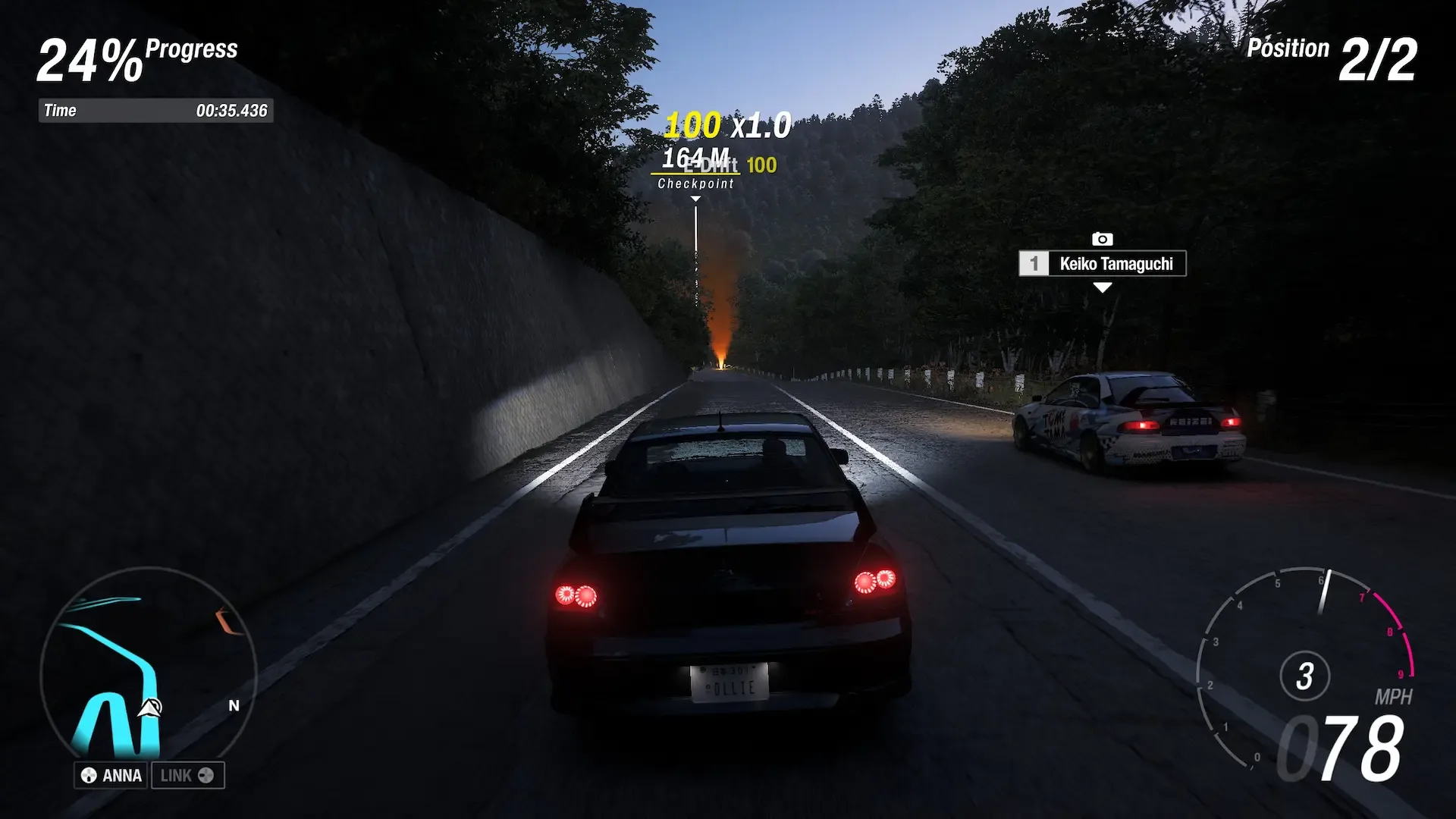
Forza Horizon 6 has been confirmed to run on the Steam Deck since it specifically appeared on the spec sheet for the game, and it's good to see it actually does perform well. However, there are a few changes to make that enhance the experience.
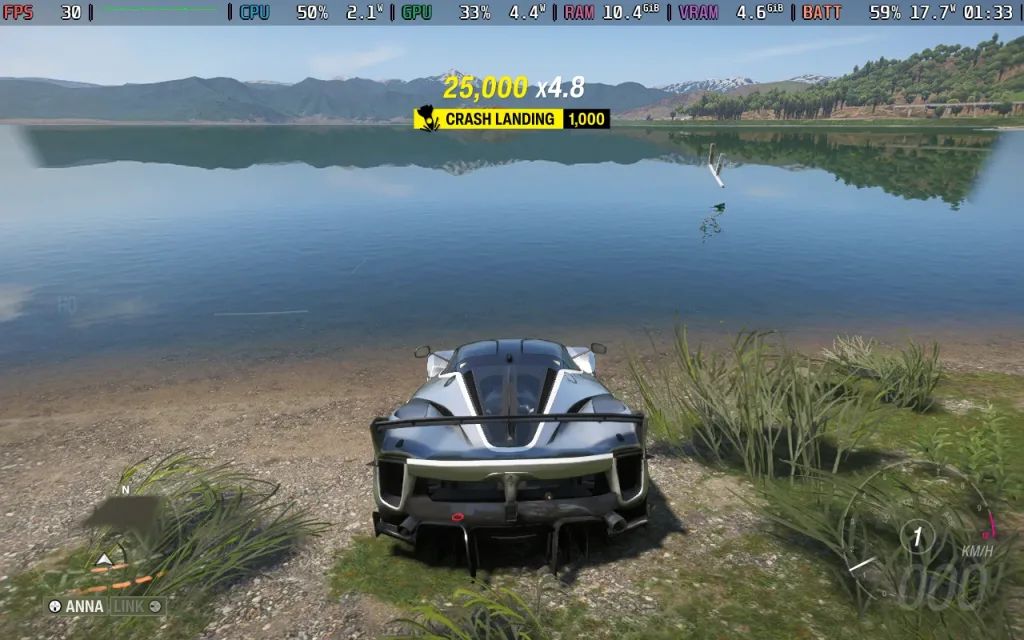
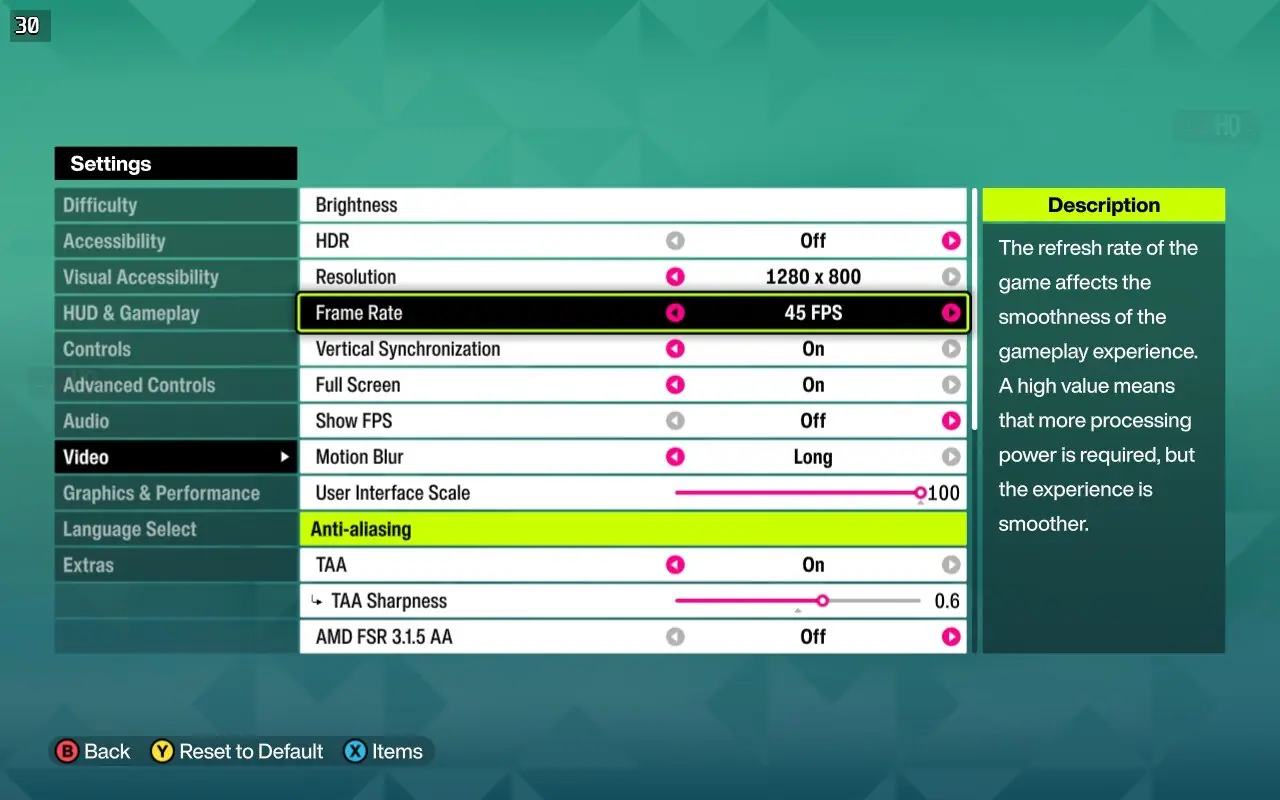
The first is setting the in-game FPS cap to 45fps and using the Steam Deck Quick Access Menu to cap it to 30fps. This is a better cap, though there will be a bit more input lag as you'd expect. The other change is setting the game to 1280x800 resolution if you want to play with the full 16:10 display, but frame times can get a bit worse in the city area.
I noticed the GPU usage wasn't too high, and forcing the Manual GPU Clock to 1600MHz helped here. This does use up more power, but the result is better as far as I'm concerned on the OLED model. Barring this, I also recommend setting Motion Blur to Long instead of Short since the former is recommended for lower frame rates. You can also turn this off based on your liking. I usually turn off motion blur in most games, but I've always liked the Forza Horizon implementation across every game I've played.
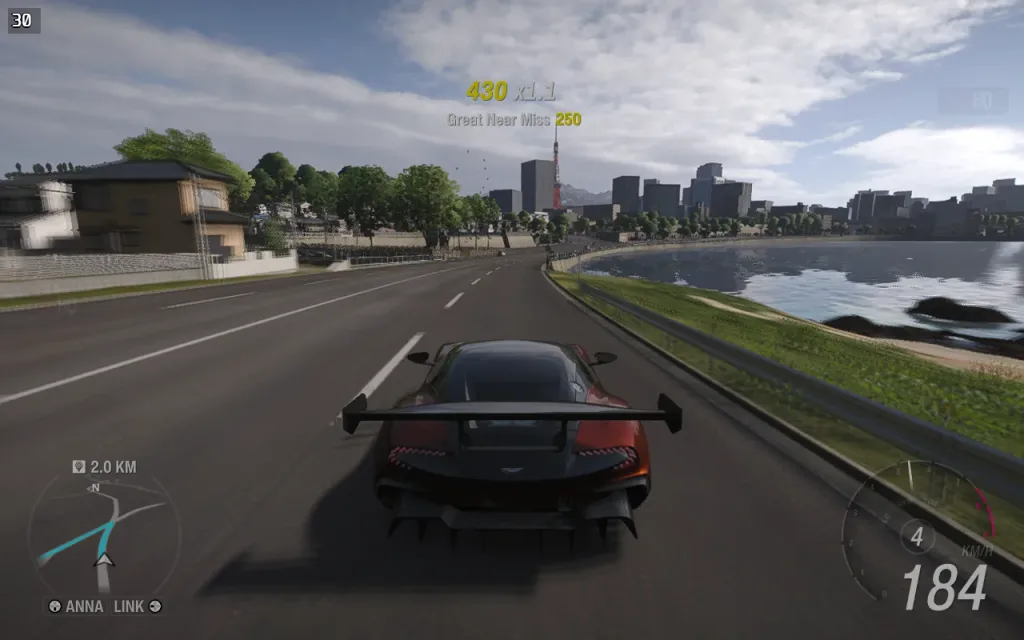
The Anti-aliasing option here defaults to TAA, and you can play around with the sharpness level to see how you like it. My preferred setting is 0.6 here. As for HDR, right now, there are no settings to tweak the brightness on the Steam Deck OLED with HDR, so I cannot give you recommended settings for that aspect.
There is a way to turn the settings down below the Low preset to get better performance, and I do not recommend it, as turning off shadows makes the game look awful. I also tried playing at a lower resolution, FSR ultra performance, and the Very Low preset. Even with those settings, you can't get close to a locked 60fps on Steam Deck.
These settings are the perfect blend of getting as stable an experience as possible without degrading the visuals too much. Forza Horizon 6, even on its low preset, is a very good-looking game on the Steam Deck's display. I also tested it out docked via the Steam Deck Docking Station. It doesn't hold up as well as expected with the same settings, and this is where I opted to use my ROG Ally Z1E in turbo mode. I was able to get it to 1080p 30fps on the medium preset, and I found it delivered a good complement to my portable Steam Deck 30fps experience.
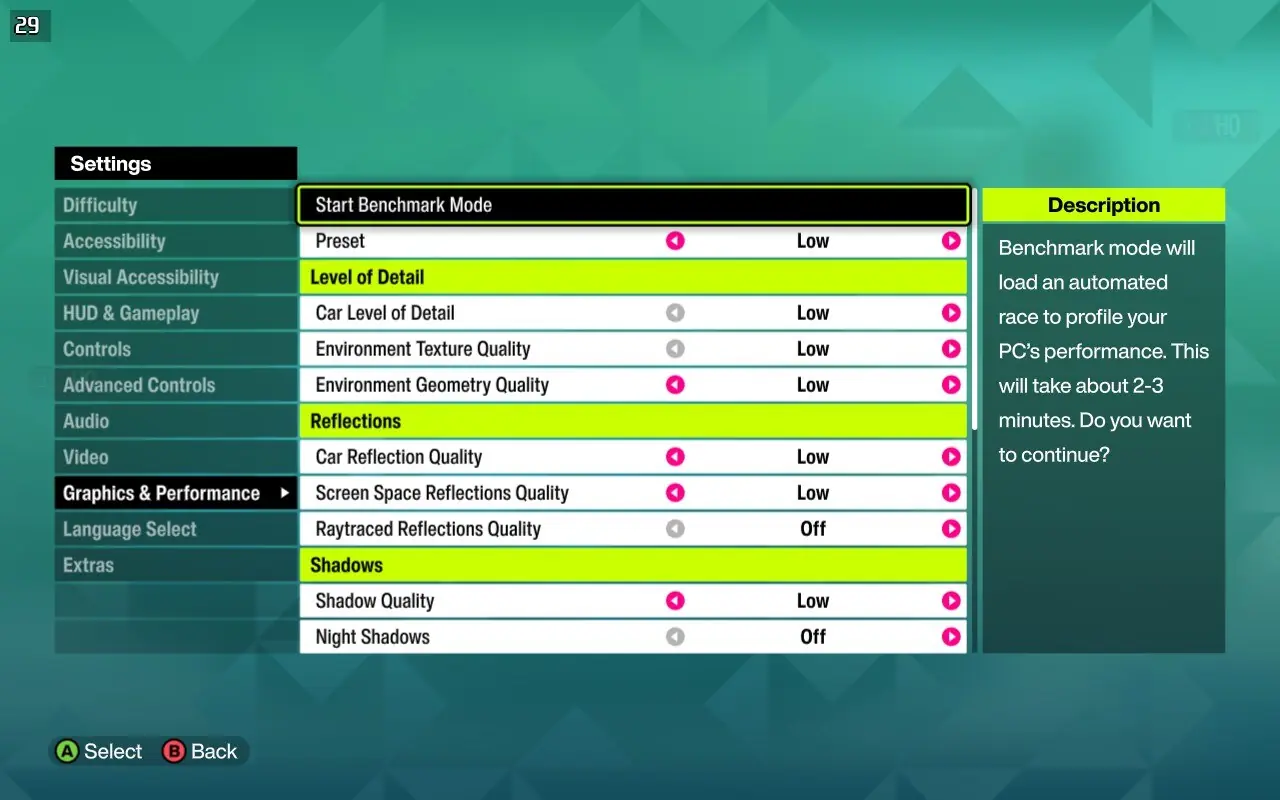
The developers have noted that there will be more Steam Deck optimization, and if anything major changes in the future, we will revisit this. Until then, Forza Horizon 6 delivers a very good portable experience on Steam Deck, both online and offline.
Forza Horizon 6 has an absolute plethora of accessibility settings, as we've come to expect from the series. We obviously have the basics like subtitle support, as well as driving assists, but we also have plenty of added extras to make this game playable by as many as possible.
These include a very customizable high contrast mode which lets you assign bright colors to differentiate parts of the world for those with vision impairment, proximity radar with audio cues to alert you to nearby vehicles, the ability to play the game in slow-mo (offline mode only), or allow you to progress even if you don't win the race, as well as audio cues that can read out your current lap, current position, and if you just gained/lost a position.
Forza Horizon 6 plays it safe in almost every aspect. Whether that's a good or a bad thing depends on whether you enjoyed the previous entries in the series, and whether or not you were hoping for something new. The rural areas of the map are a delight, but the city of Tokyo left me feeling disappointed with its relatively bland depiction and empty streets. The cars are still great fun to drive, with a huge showing from Japanese manufacturers this time around, and exploration is as rewarding as ever.
Our review is based on the PC version of this game.
If you enjoyed this review, be sure to check out the rest of the content on SteamDeckHQ! We have a wide variety of game reviews and news that are sure to help your gaming experience. Whether you're looking for news, tips and tutorials, game settings and reviews, or just want to stay up-to-date on the latest trends, we've got your back.
Screamer was provided by Milestone S.r.l. for review. Thank you!
Having played the original Screamer series back in the 1990s, I was curious when I heard about this new "Screamer" title coming from the team at Milestone. It doesn't take much to realize, however, that this game is Screamer in name only and bears almost no resemblance to the original franchise. Instead, this new title opts for a futuristic world, blending the styles of a realistic environment and anime-styled characters, with plenty of neon-lit streets, flashy cars, and even flashier technology.
Screamer's "Tournament Mode" follows the story of 5 teams, each of which has entered the "Screamer Tournament", a street-racing tournament organized by a mysterious host, for their own personal reasons, ranging from revenge to financial burdens to fame. This campaign is the main mode of the game, but there's also arcade races for fun, split-screen, online multiplayer, and time trials with leaderboards.
It plays almost like a narrative-first game, unusual for a racing game. The story is told with fully voiced dialogue, with pretty much every race flanked by conversations, and sometimes you're treated to a nicely animated cutscene. This really helps flesh out the characters more than expected, exploring the motivations behind each participant and their relationships, with many of the characters taking part linked in some way by a web of connections. While I didn't find myself getting too attached, I did root for certain individuals to come out on top.
One thing that immediately hits you with Screamer is the unique driving mechanics at play. Some games may have one or two gimmicks up their sleeves to make them stand out, but Screamer appears to have taken inspiration from a wide variety of games, while adding some of its own flair.
The cars feel weighty, making it difficult to take corners without using drift mechanics to throw them around at high speed. Drifting uses the twin-stick system seen in games like Intertial Drift, where the left stick steers the car, and the right stick controls your drift. I'm not a big fan of its implementation here, but it is easier to control than Intertial Drift, and as I played through Screamer's campaign, I found myself enjoying it more and more as a way to keep the player on their toes.
While the game does have automatic gears, you'll still get rewarded with a speed boost for manually shifting gears. Personally, I don't mind it, but automatic gear shifting feels more natural for arcade racers like this.
And then there's boosting. By spending time at high speeds and shifting up precisely, you'll earn Sync Points, which are essentially your boost. To maximize use, you'll need to hold down the shift button and release it to increase speed. Using boost will also increase a secondary bar, which you can use to shield yourself or attack other drivers to temporarily disable them with the R1 button.
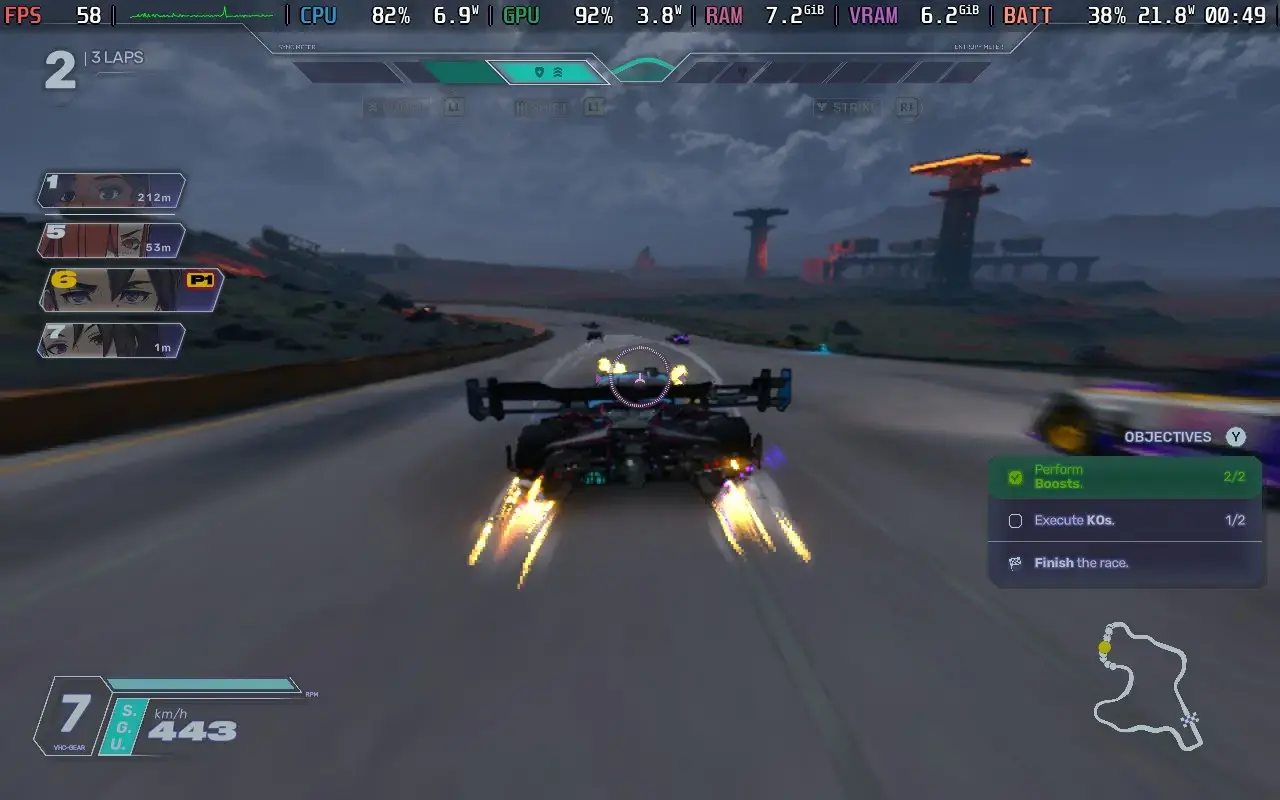
This might sound overwhelming, but the game introduces these mechanics gradually over several races. In fact, the attack mechanic isn't even mentioned until you're quite far into Tournament mode, and once you get the feel for the controls and throw in the excellent heart-pounding selection of music, it makes Screamer a very engaging game to play.
You aren't just holding the accelerator and driving around a circuit; you're constantly balancing the steering and drifting sticks to hold good lines through corners, planning when you can next use your boost on a good straight, and keeping the rev counter in your peripheral vision to hit that shift up button when it turns golden, and later, lining up your car to strike your opponent's. This is some good, hectic, arcade racing.
That's not to say it's all sunshine and neon rainbows, though. There were a couple of annoyances for me during my time with the game.
For some races, it isn't even necessary to place well; you just have to drive for the sake of driving. It's strange, but some races have very arbitrary win conditions, such as boosting a certain number of times while drifting or colliding with opponents, which defeats the purpose of racing.
When it comes to these extra objectives, it doesn't matter if you win or lose the race; if you didn't boost while drifting the required times or collide enough with your opponents, you're failing the mission. I feel like such objectives should at least be optional, with players receiving a bonus for completing them. However, there is no distinction between objectives; all must be fulfilled in the race in order to progress the storyline.
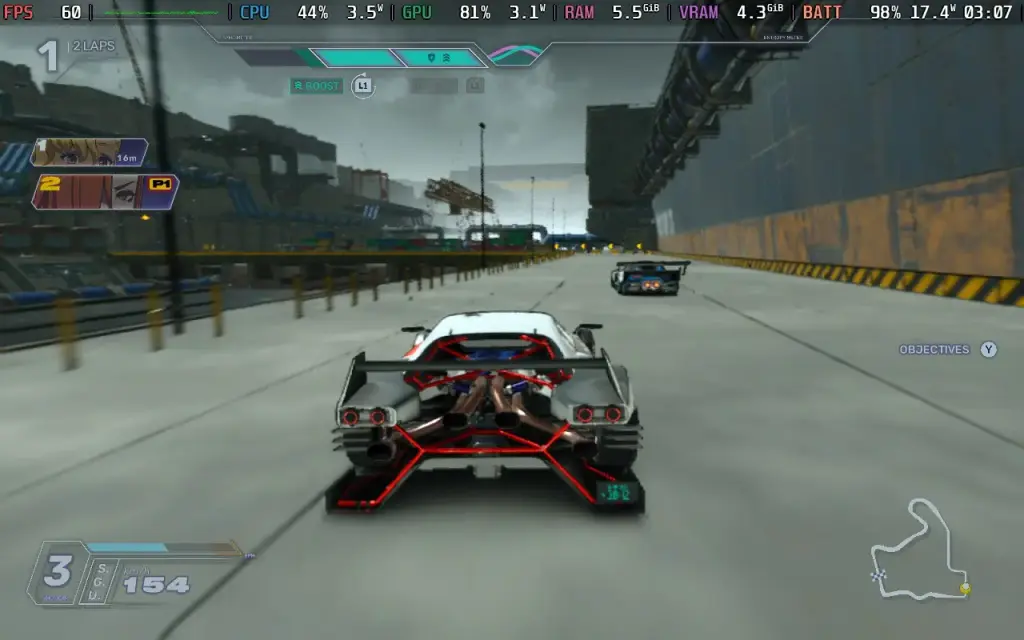
Then there's the balance of the cars and track layouts. Visually, the tracks are great, and even the designs are quite interesting. The problem is that the track layout, or should I say the corners, often doesn't match how the cars drive. As I said before, the cars in Screamer are weighty and hard to turn without drifting; it's often preferable to hit a wall at a corner rather than brake for it, and that happens quite a lot.
Depending on your car, some corners feel almost impossible to navigate without significant braking, which is fine; I expect to have to brake in a racing game, except the AI cars in the race seem to take these corners with no issue. Some cars behave as though they are driving on ice or are literally bricks with wheels, and it's just not a fun experience to drive them. I dreaded certain missions where I was forced to use those cars, especially as other cars in the game feel great to drive and don't have these issues.
Screamer gets off to a pretty good start on the Steam Deck. The game does run at 1280x800 by default, filling the Steam Deck's display.
I encountered an issue where cutscenes would appear entirely black, requiring the player to skip them to continue. The review build I was using was set to use Proton 9 and did not work with Proton 10, so I recommend you force the game to use Proton GE 9-27, which allows the cutscenes to play.
As for settings, I set the game to the Low preset, which sets everything to its lowest, then switched the Scaling Type to FSR 4 and set the Scaling Mode to Quality. I also used the in-game framerate cap to limit the game to 60 FPS.
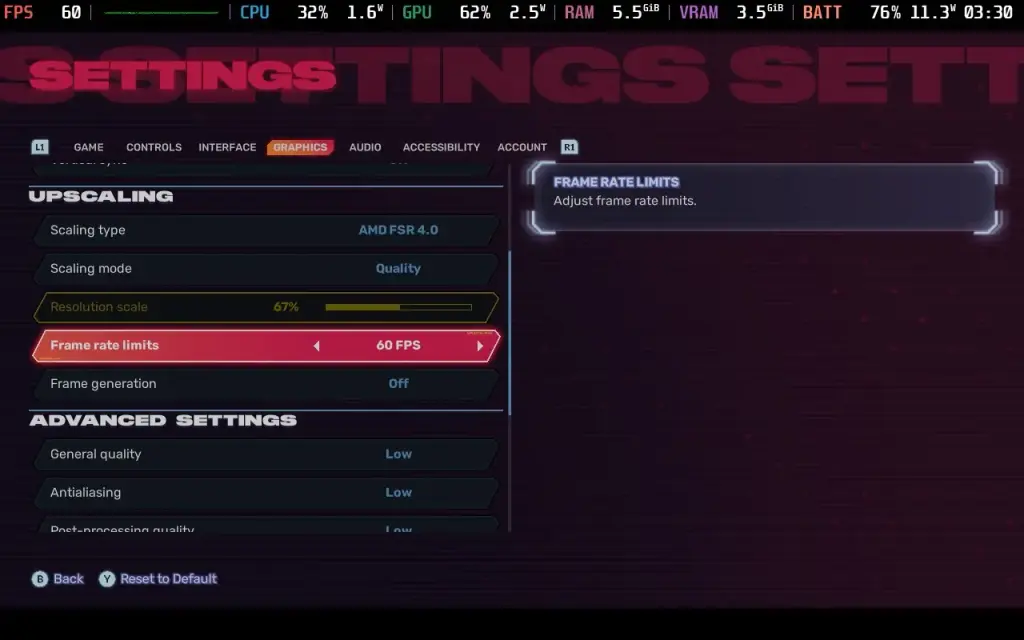
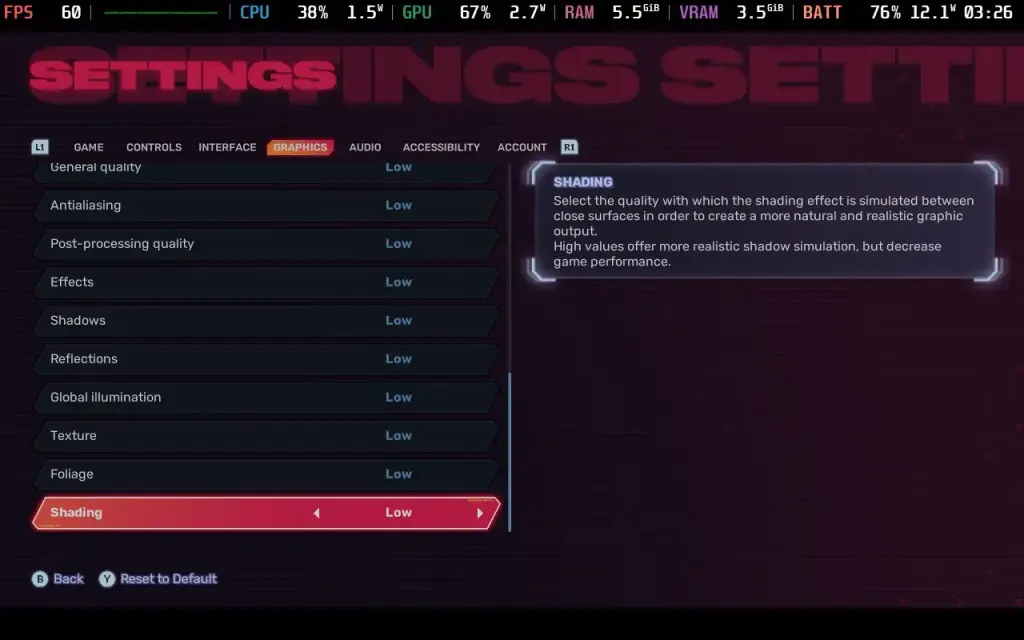
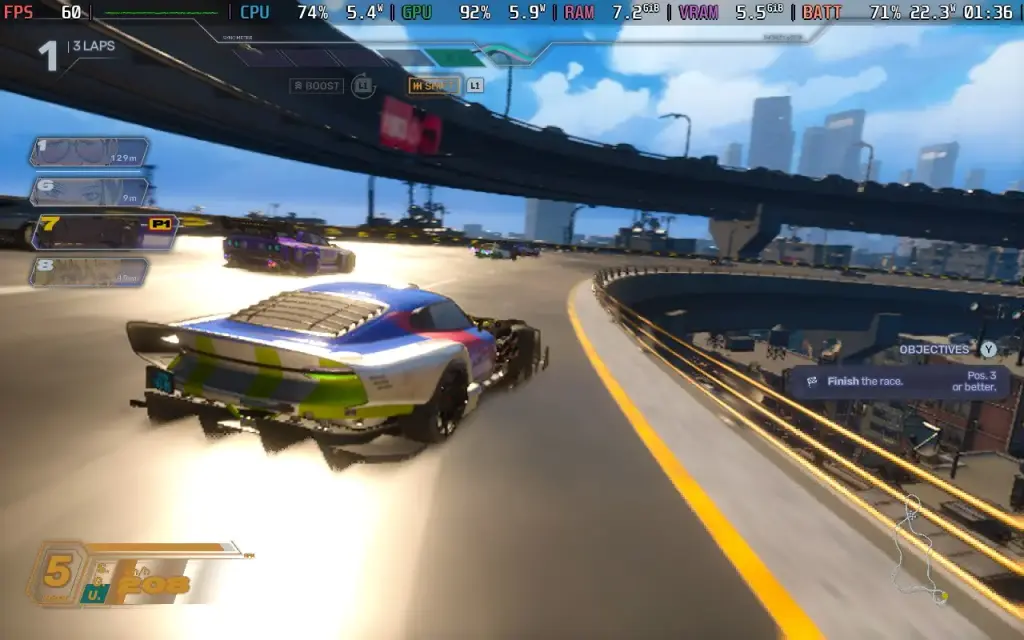
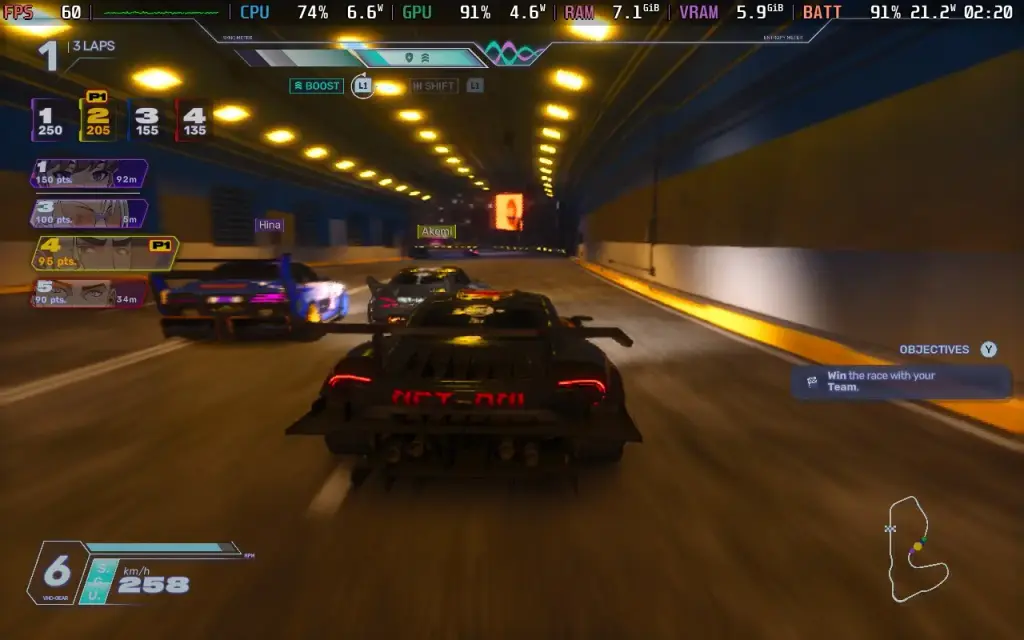
When it comes to performance, Screamer pretty much maintains 60 FPS throughout, except on some tracks where the game stutters for the first few seconds of a race. It soon sorts itself out, and I presume this is because the game occasionally uses large amounts of VRAM and has to offload assets to slower RAM.
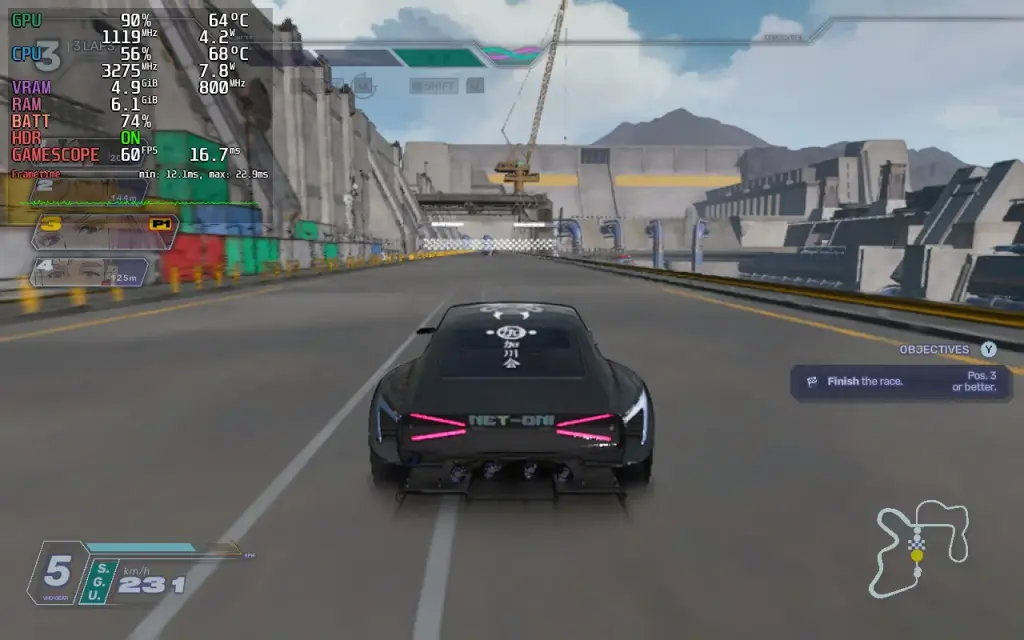
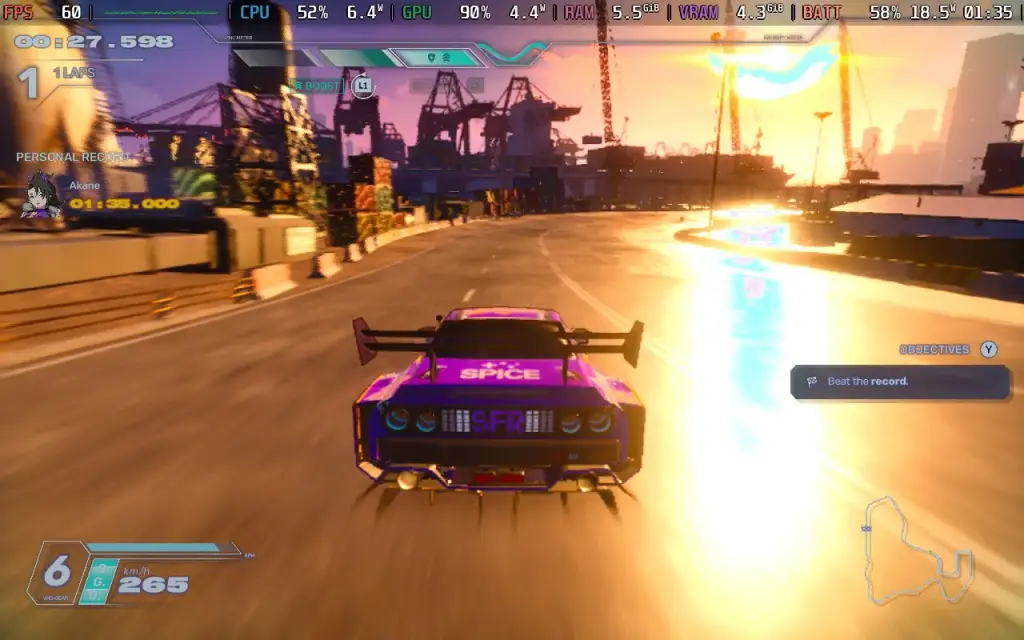
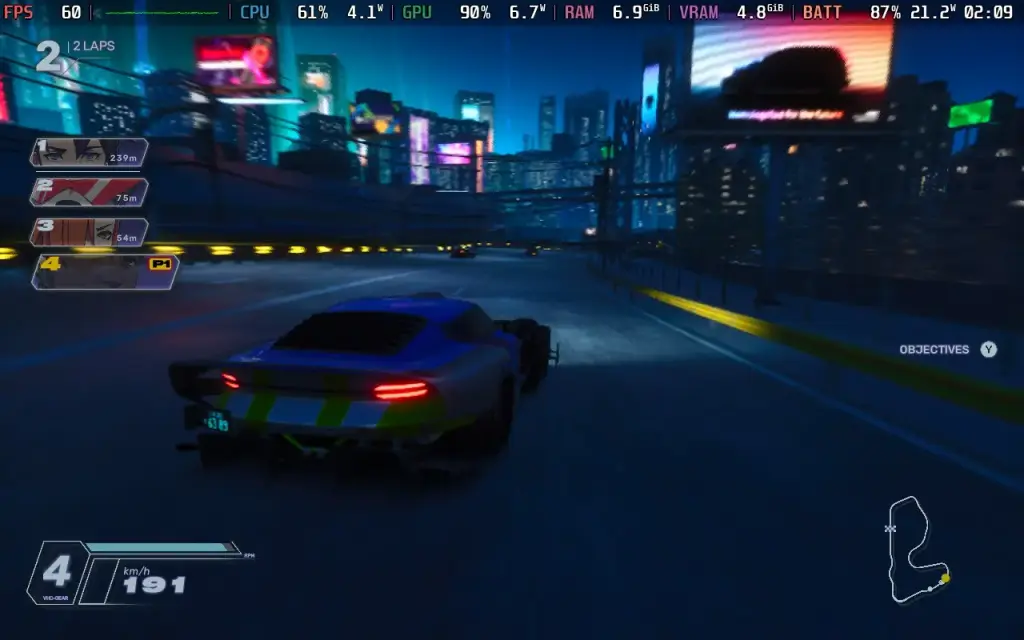
Power draw is stable around 21W-22W while racing, meaning Steam Deck OLED users can expect around 2.5 hours of playtime, Steam Deck LCD users around 1.5 hours. Temperatures were around 60C-65C.
Screamer has driving aids, such as auto-accelerate, as well as braking, steering, and drift assistance, to make controlling the car easier. You can also play the game in slow-motion in offline game modes to give yourself more reaction time. There is a one-handed mode, which enables additional assists and moves all controls to either the left or right side of the Steam Deck. There is a colorblindness filter option as well as subtitle settings, such as font size.
Screamer combines a variety of unique driving mechanics to create an engaging driving experience. Backed up by an electrifying soundtrack and some flashy visuals, Screamer should be on any arcade racing fan's wishlist. There are some curious design choices regarding car balancing and objectives in the story mode that can frustrate some missions, but by and large, Screamer is a positive experience.
Performance on Steam Deck is better than expected, and as long as you keep the settings on low, you can enjoy a (mostly) smooth 60 FPS experience here.
Our review is based on the PC version of this game.
If you enjoyed this review, be sure to check out the rest of the content on SteamDeckHQ! We have a wide variety of game reviews and news that are sure to help your gaming experience. Whether you're looking for news, tips and tutorials, game settings and reviews, or just want to stay up-to-date on the latest trends, we've got your back.
Sonic Racing: CrossWorlds was provided by SEGA for review. Thank you!
It's been a hot minute since we've seen both Mario and Sonic, two titans in their own right, compete against one another in the same year, especially so in a genre that wouldn't be considered their "main" offering. With Mario Kart World launching only a few months ago on the Nintendo Switch 2 to critical and commercial acclaim, Sega certainly doesn't have it easy, but with Sonic Racing: CrossWorlds… y'know, it's not as clear-cut as it has always been.
While Mario undoubtedly offers a more refined and succinct experience time after time, the blue blur has always provided something slightly more obscure, coarse in nature, and has, especially damning considering its rich, character-driven history, felt less cohesive, bordering on sterile at worst. To offer the TL;DR early, then, to alleviate the undue despair such a statement may cause: Sonic Racing CrossWorlds offers a flashy alternative to the go-to Karting experience, whilst also feeling entirely chaotic, both in a positive and negative light, albeit with little-to-no control to provide the much-needed balance it so desperately deserves.

It's absolutely still fun, but the cohesiveness of the core experience is lacking. Racing itself, specifically being the way each class of character and vehicle, Speed, Acceleration, Power, and Handling, feels on the racetrack, is an arcade-infused joy. Drifting is satisfying, with the longer drifts building up a boost of up to three levels, for speed-infused bliss. What's more, you can change the direction a drift is initially facing while still maintaining and raising the boost level, lessening the need to keep an original drifting course, possibly to your detriment. This is not to say that racing is the antithesis of Mario Kart's, but many choices are certainly influenced by years of competing with the moustached menace.
Some mechanics were introduced in previous titles due to earlier competing entries, such as aerial tricks in Sonic & All-Stars Racing Transformed, my favorite in the series. By completing multiple tricks in the air, all achieved with simple right analogue stick inputs, you'll receive a measly to moderate boost, depending on the number of tricks managed. It adds an appreciated busyness in the moments your wheels aren't touching the ground, not including the transformations, which we'll touch upon soon. But, in actuality, it looks straight up absurd. The speed at which the tricks can be pulled off is astronomically fast, and to witness the spectacle of a few or more vehicles bombastically breakdancing in the air together is farcical.

Also somewhat laughably, albeit positively, were the moments that feel the most grounded, specifically the moments where no ground is involved. The two transformations available in CrossWorlds are the same as they were in Sonic & All-Stars Racing Transformed, Boat and Plane, and offer some of the most refined mechanics found throughout the entire experience. The freedom afforded by both, particularly flying, is the inverse of the feeling when on the road, and there's a mechanical distillation when all things are considered.
These sections offer a much-needed break, punctuating the chaos. It's appreciated nonetheless, whether it's down to the simplified course structure on these stretches or the slight mechanics change throughout. Boosts on water, for instance, can be charged when going straight and let off a small to medium jump, depending on the level of boost obtained. And, naturally, flying gives you complete control of both the horizontal and vertical axis, with various paths often available due to this. It's certainly nothing new when considering Transformed did it back in 2012, but it feels as good now as it did back then.
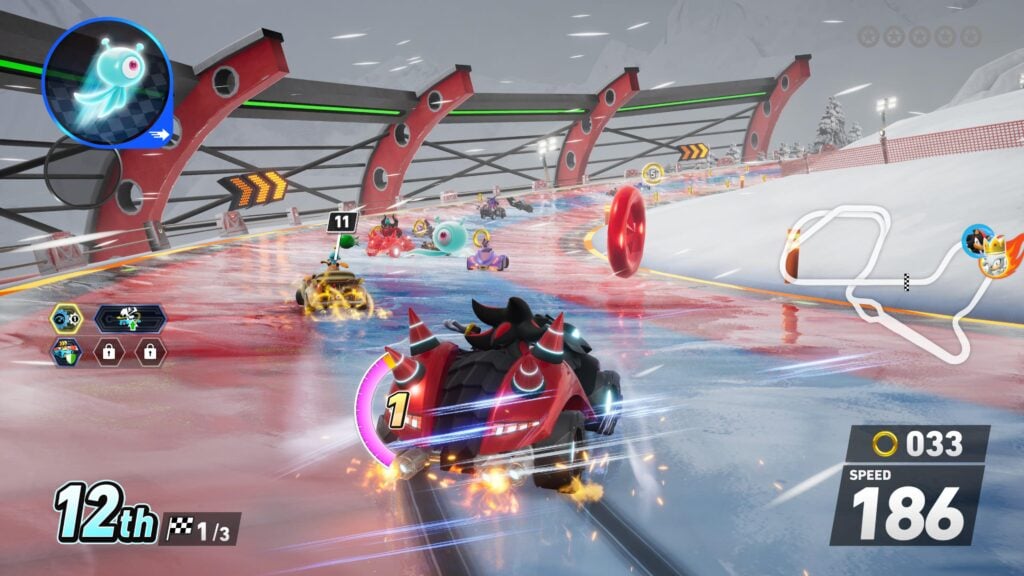
So, let's talk about this iteration's significant change, which is Travel Rings. These Rings appear at the end of the first lap, allowing the leading player to choose the location of the second lap, which changes the race course entirely. This change only happens for the duration of the second lap, but with the chance for modifiers to be placed on this new lap, it does have the potential to alter the leaderboard somewhat. One journey through a Travel Ring found me with an ever-charging boost item, whilst another found purple rings that afforded me a momentary boost when driven through handsomely littered throughout the course, influencing my route somewhat to maximise the boosts available to me.
Broadly speaking, though, the change of one of the 24 locales for only one of the three laps did little to add to the overall excitement of any particular race. Bar a few standout courses such as Chao Park and Wonder Museum, there was little that excited outside of providing a change for change's sake, even if the inclusion of said modifiers, however brief they were, kept things fresh.
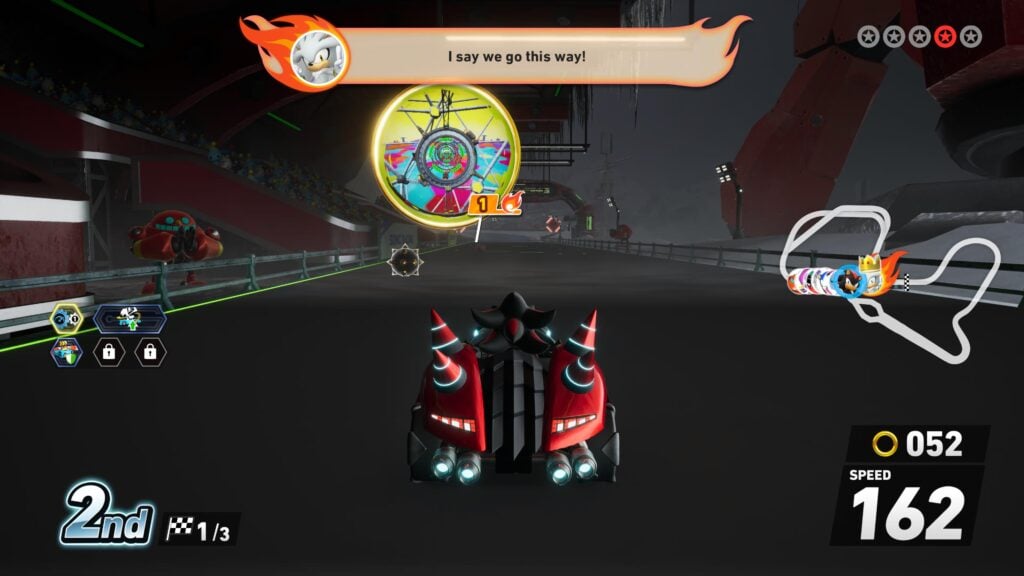
Mechanically speaking, the second half of each race is the items, which I found abhorrent at worst, and straight-up annoying at best. They feel entirely unbalanced and at odds with the rest of the racing, shifting the joyful, chaotic nature of the game to a frustratingly crude variant in no time at all. Whilst the standard assortment of weaponized tropes is here, like an item you place behind you, a homing attack, and so forth, the impact it has on any opponent, and naturally yourself when you inevitably get hit by one, feels far more severe than it needs to. It all but brings you to a near stop, and climbing up the placings isn't quite as appealing with the threat of it happening all over again. There's a thoughtfulness and a sublime subtlety with Mario Kart's item balancing, and it's simply not felt here.
Sonic Team boss Takashi Iizuka spoke to GamesRadar+ before launch, stating, "Anything that was very stressful for players, anything that always allowed people to come back from behind and win all the time needed to be removed from the concept. And then we'd go back in and playtest some more and find ways that we could balance and get it to feel the right amount of stressful and chaotic, but still lots and lots of fun, and always feeling fair to the racers.". With such a statement initially exciting, we all know the disappointment felt when you get "Mario Karted" near the end of a race, after all, it's doubley disappointing to know this was an explicit consideration that somehow feels worse than ever before. It's arguably the most significant negative of the game, and one that feels overwhelmingly all-encompassing considering their prevalent nature in each race.
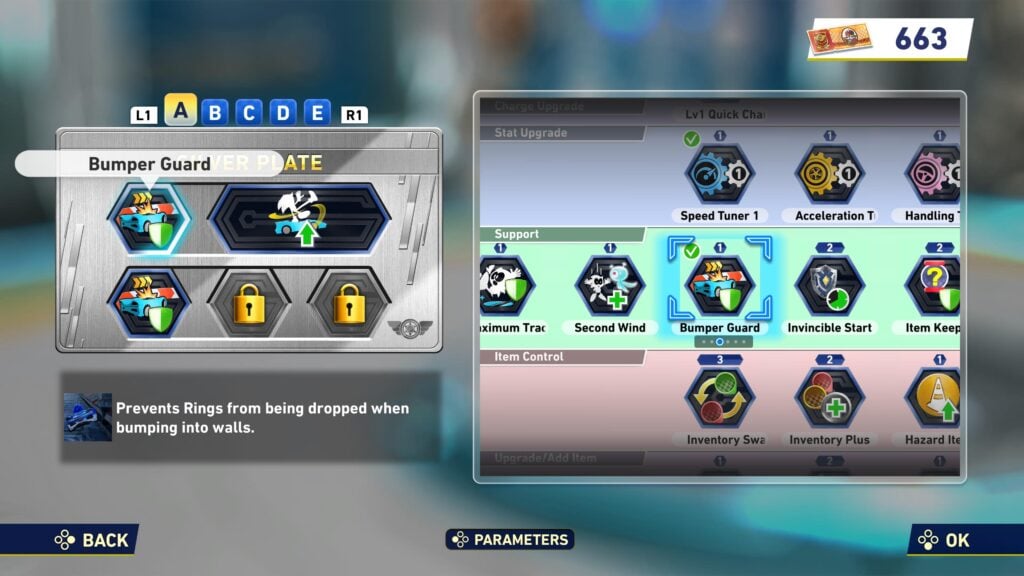
Items and the chance of coming across the correct item at the right time often felt like some of the only considerations to be made with each race, character, and vehicle, notwithstanding. Another new addition to CrossWorlds is the inclusion of Gadjets, which alleviate the restrictive design of the items. This new system allows you to equip perks, of which only a number can be fitted, with greater numbers being equippable after levelling up your license through continued racing. These grant various boons, such as starting the race with a boost item or increased handling when using a Speed vehicle.
The more effective a gadget, the more space it takes up on your license, but thankfully, you can swap between multiple saved licenses between races, should you need to switch up your approach. My favourite? One that prevents rings from being dropped whenever you bump into a railing, an outright inevitability considering, and forgive me if I haven't harped on about it enough, the absolute chaos and carnage ever present.
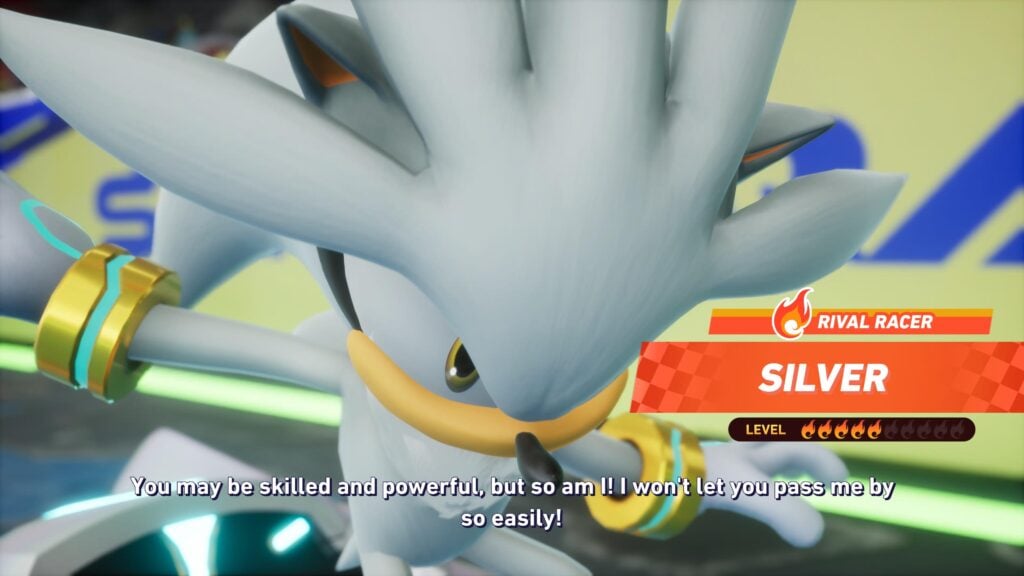
Sonic Racing: CrossWorlds got the Verified badge ahead of its release, so I was hoping it would be pretty decent on the Steam Deck. And I can happily say it's playable on the go, but I wouldn't play it straight out of the box.
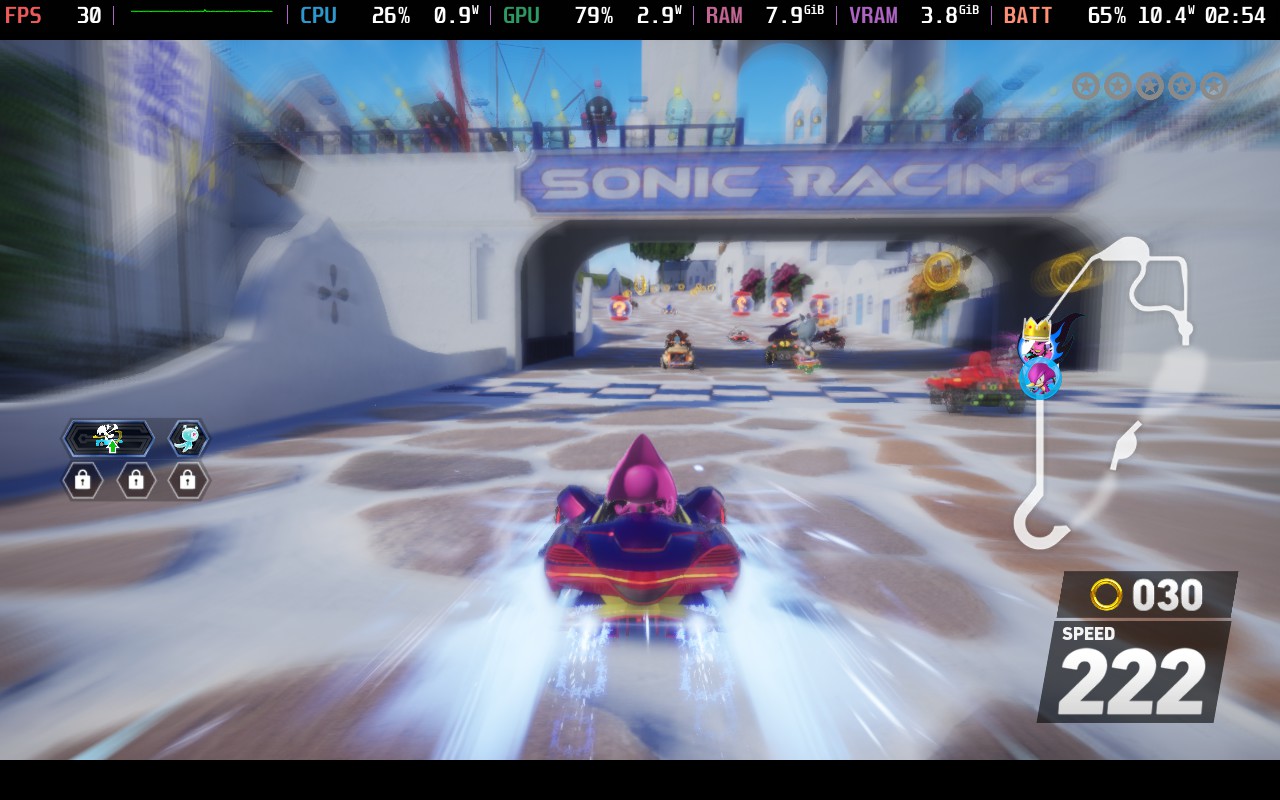
The game starts off on the lowest possible settings, with graphical quality on Low, rendering scale at 50%, and framerate capped at 30. This makes the game very pixelated and not as smooth as I am used to in cart racers. But the races never went above 8.5W battery drain, so if you are looking for the longest battery life, this is going to be the way to do it. However, I wanted to push and see what was possible while balancing visual quality, framerate, and battery life.
Online servers were down at the time of testing, so I can confirm offline play is possible.

Choosing recommended settings for Sonic Racing was a tough one, but ultimately, I went with the most enjoyable for me personally. Despite the default settings being on the lowest with a 30 FPS limit, it can handle higher. So, after some testing, I discovered that it can run on the highest possible settings and hit 60 FPS if the render resolution is set to 75%. Overall, the game still looks really gorgeous, and I couldn't tell the difference, but with the render resolution lowered, it can hit 60 FPS with ease and stick to an average 15W - 17W battery drain.
There will be some spots where battery drain can spike, like when switching to new worlds or a ton of racers are around you, but it never truly drops below 60 or goes above 20W battery drain. There was one map I raced on that consistently stuck around 19W drain, but most are around that 15-17 average. Oddly enough, the most intensive area I was able to find is actually customizing your vehicles, which brings FPS down to the 50s and maxes out the battery drain.
This is exactly the experience I was hoping to have in a kart racer on the Steam Deck, and even with some higher battery drain, it's just fantastic. The model looks sharp, the framerate feels smooth, and it was just a blast to play like this. If you want 100% render resolution, you could set the framerate to 40 FPS, and it should be playable, but it's not nearly as enjoyable as 60.
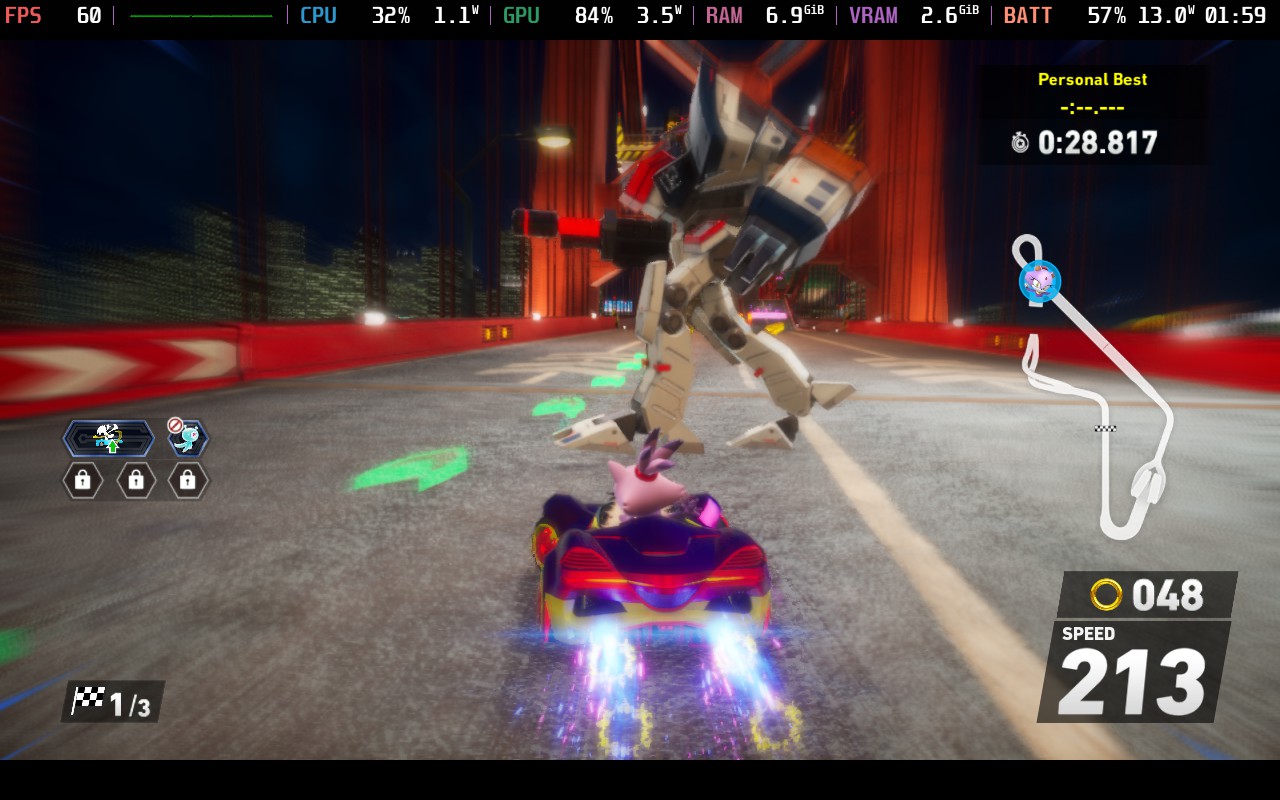
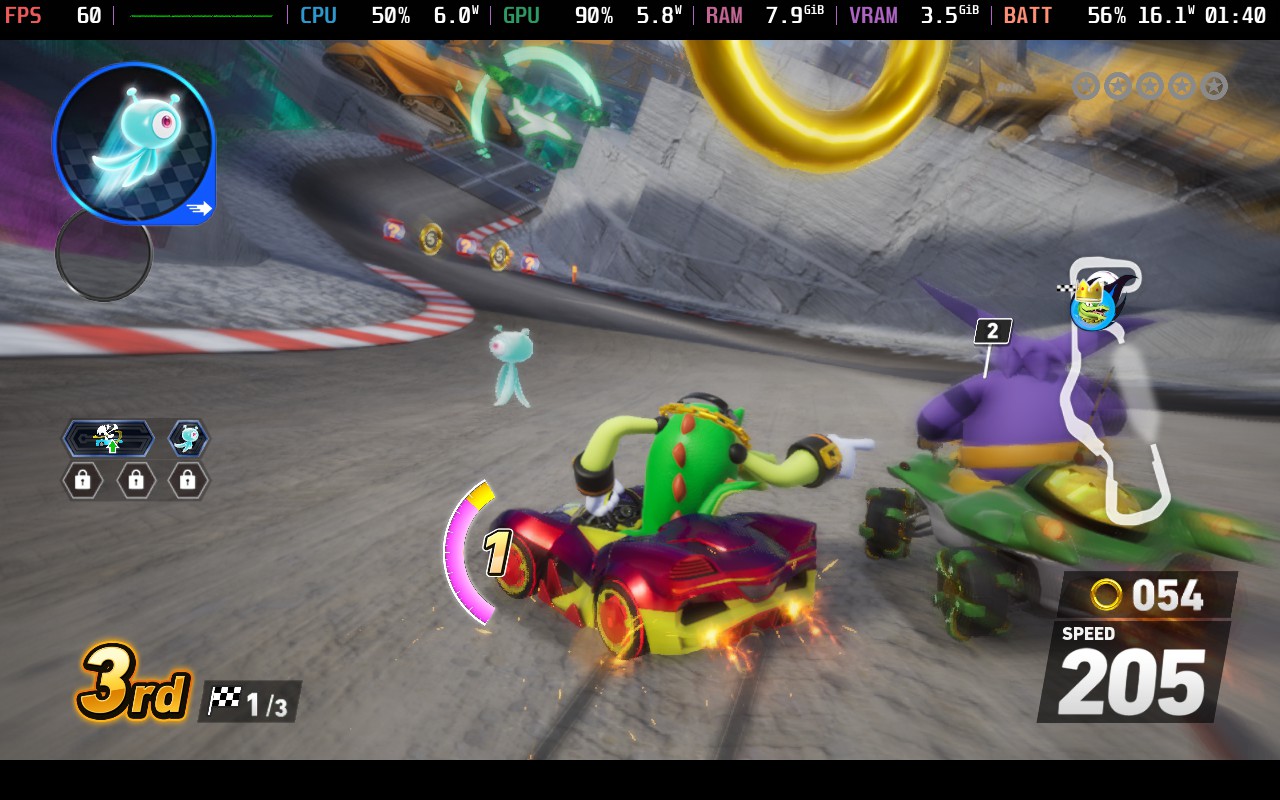

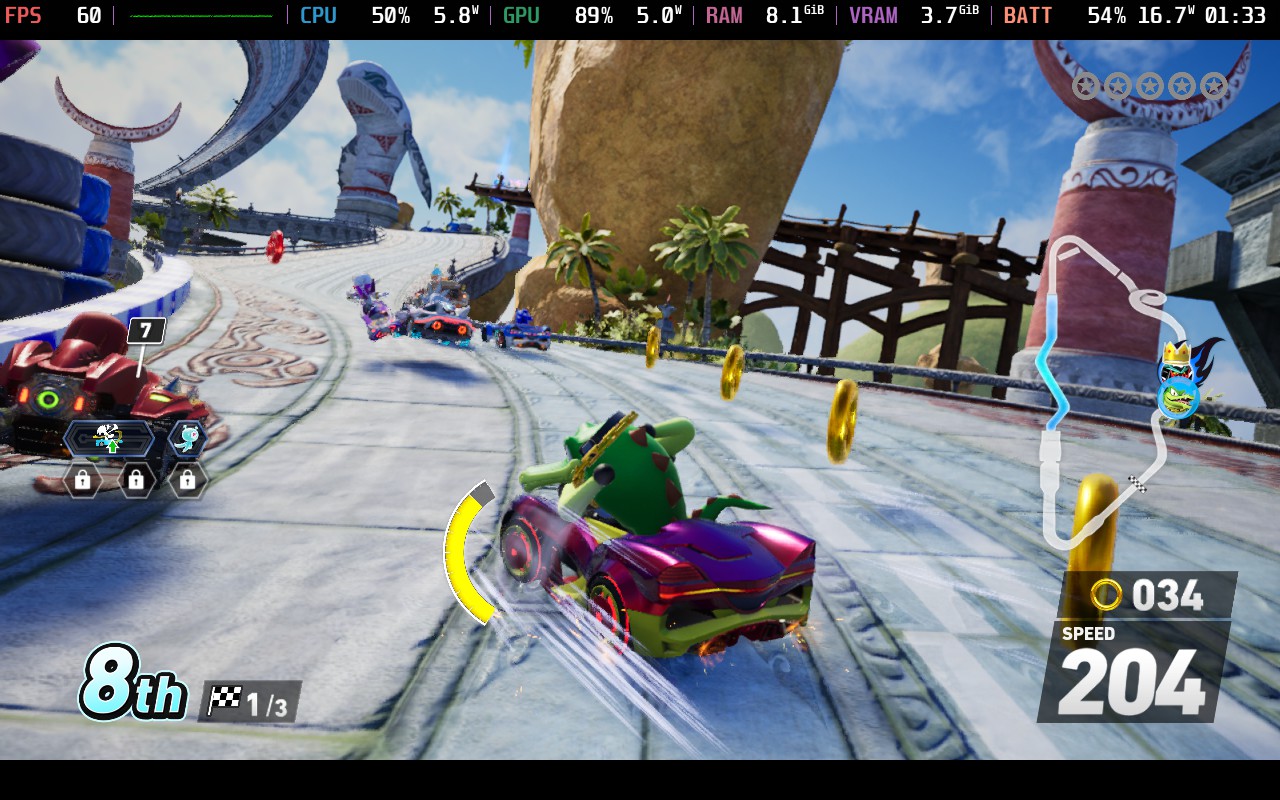
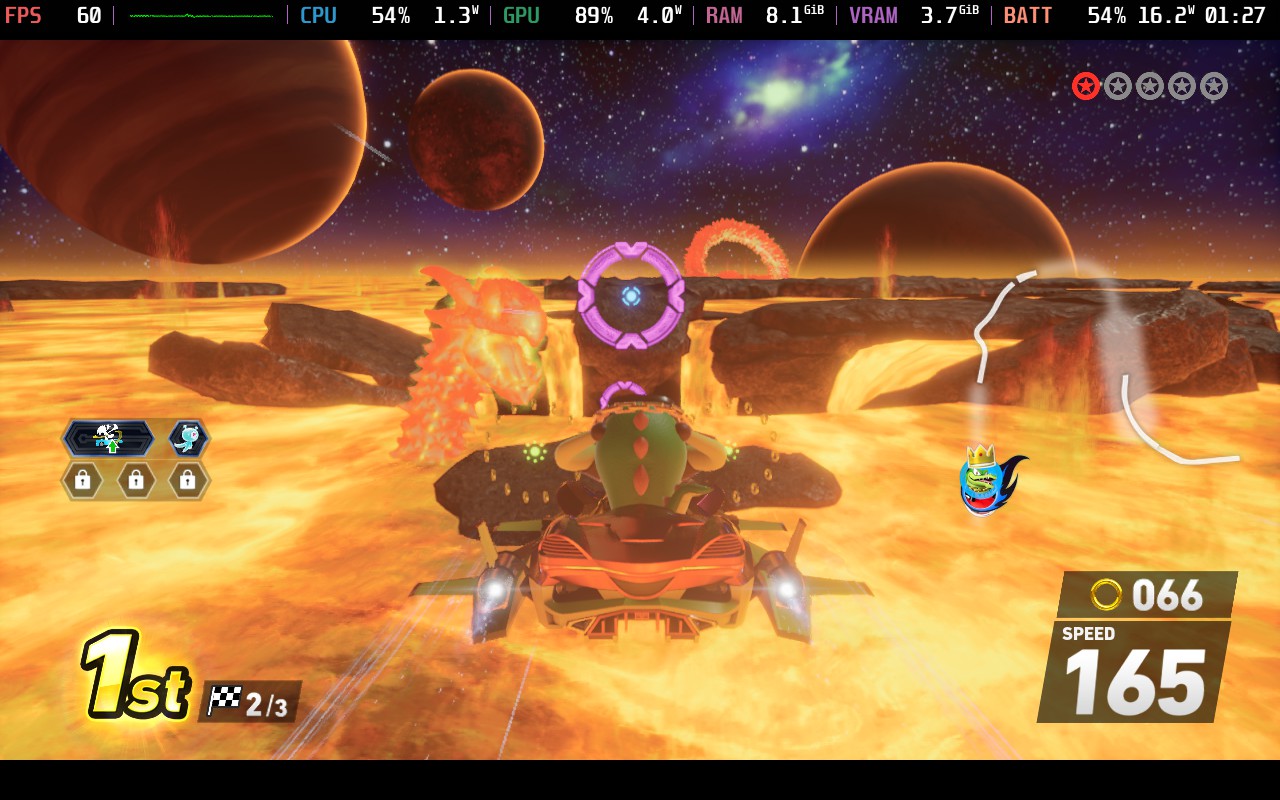
The default settings for the game are generally the best for battery life, since it is the lowest possible setting, but I didn't like how the game looked. However, if we turn the game to the highest possible settings with 100% render scale and just set the framerate to 30, we have a gorgeous-looking game that still has a decently low battery drain. It sticks around 10W - 11W on average, which is pretty fantastic given the visuals, and it's running at 100% render scale. This is a great way to play if you need an extra hour and a half or two of battery life.

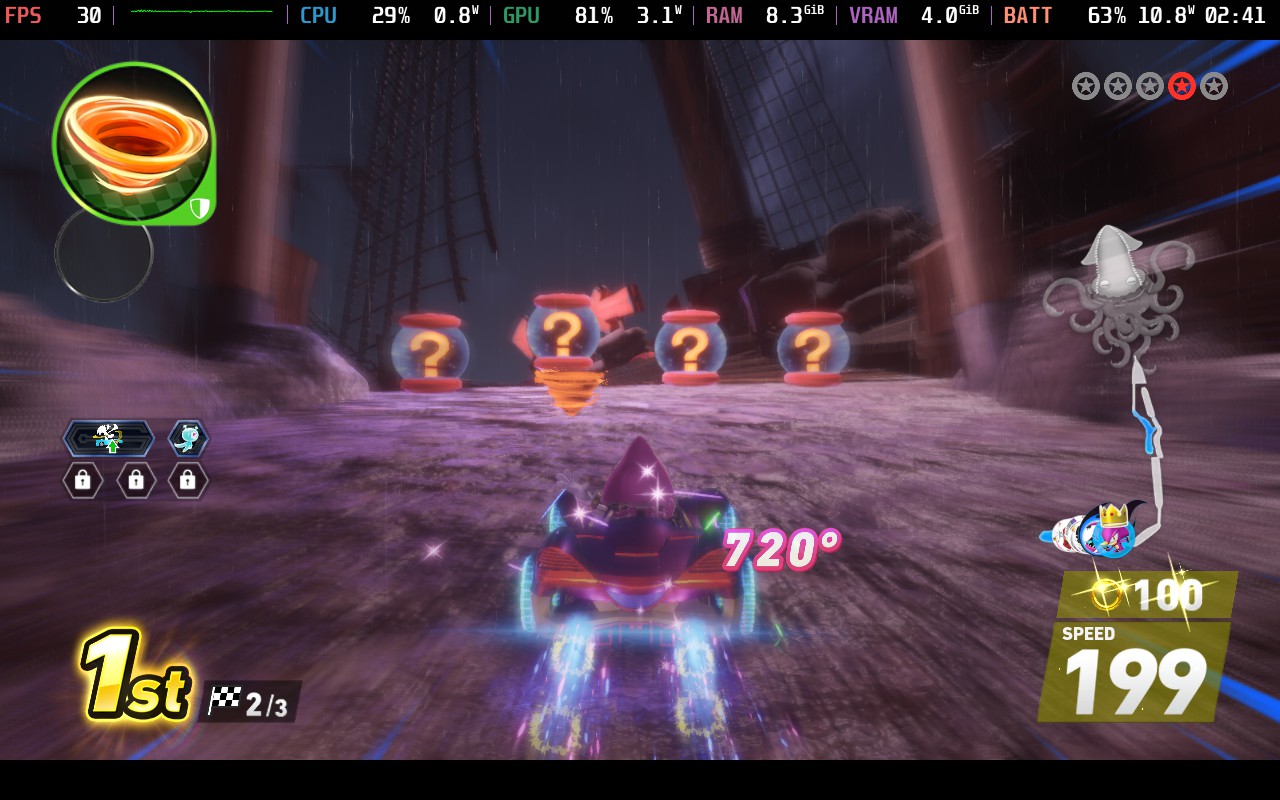

The game allows you to change the race camera style, different UI toggles to hide other elements, customize input, toggle gyro tricks, change the language and voice, move different audio sliders, and change some online settings here and there.
The game doesn't support 16:10 resolutions, but it does have cloud saves and controller support. There are no HDR settings.
It's a confusing recommendation, to be sure. In isolation, nothing here stops Sonic Racing: CrossWorlds from having the potential to give moments of indisputable joy, even if the frustration felt when it came to the items did its best to ruin the fun. The issue is that managing to play CrossWorlds without likening the experience to Mario Kart, a game so strongly synonymous with the genre that it is nigh-on impossible not to make comparisons, is not a luxury most can afford.
With that in mind, it falls short in most regards. Whether the expanded roster, soon to include Joker from the Persona series, Hatsune Miku, Steve from Minecraft, and, of course, SpongeBob, is enough to garner enough continued interest and build upon the CrossWorlds moniker is up to you, but the core experience remains the same.
Our review is based on the PS5 version of this game. Steam Deck Performance and optimization will come soon.
If you enjoyed this review, be sure to check out the rest of the content on SteamDeckHQ! We have a wide variety of game reviews and news that are sure to help your gaming experience. Whether you're looking for news, tips and tutorials, game settings and reviews, or just want to stay up-to-date on the latest trends, we've got your back.
Wheel World was provided by Annapurna Interactive for review. Thank you!
Cycling games are pretty few and far between, while you've got more "sporty" games like The Descenders, Wheel World instead focuses its aim on more traditional cycling, with a few twists, of course.

In Wheel World, you take on the role of Kat, who, along with a spirit in the form of a skull, must embark on a quest to upgrade a rusty bike into a "legendary" one. But to get there, Kat must earn enough reputation and upgrade their bike to take on increasingly experienced cyclists in races. Thus begins Wheel World's gameplay loop.
It's not a long game, and you can fully play through the "story" in just a few short hours. You can explore the map to find free parts, complete optional challenges to earn "coupons" which you can spend on buying parts, and then upgrade your bike's stats so you can take on races, which, would you believe it, gives you more parts!
Wheel World is all about upgrading your bike, and not everything is a straight upgrade, either. You might get a new frame that increases your "power" but lowers your handling. More power is great for rural racing, where top speed is the key, but if you're racing in the city, you'll want something that can handle those tight turns, so modifying your bike between races is key to success.

You are constantly upgrading and refitting parts on your bike in Wheel World, which is a great feeling for a while, but it does begin to wear thin. So it's probably a good thing that, as I said at the beginning, the game is shorter. Sure, you will be doing races, some planned, others impromptu, with cyclists you find out on the streets, but there isn't a lot of variety in the game.
The whole time you are playing Wheel World, you are working towards your goal; there isn't much "side content" to go at here, besides some basic challenges you're likely to complete when just playing through the races anyway. Even the leaderboards for the game appear to only work with Steam friends, not globally, and there is no multiplayer component, so the replayability value is close to zero once you've played through the game.
Fortunately, the riding mechanics themselves are simple and feel good, with just an accelerate and brake button, alongside the ability to boost and bunny hop. Beyond that, it's down to player skill and choosing the right bike parts to win your races. You must pay attention to get around these courses, and for the few hours the game lasts, it is a good time.

Visually, the game is quite striking, with a pretty unique art style that works well, although it leans on the basics. There isn't much sound in the game, but it does capture the sound of cycling, allowing you to hear the sound of your tyres on various terrains. This brings back some childhood memories of when I used to cycle often. The music also gives an almost retro 1980s vibe to the game.
I encountered some issues in the game, however. A couple of times when racing, my bike sort of "fused" with another racer's bike, resulting in us being stuck together and unable to continue the race properly. I also had some weird physics reactions to hitting certain objects in the game, such as being thrown up in the air when hitting a wall once.
Wheel World isn't a full priced title, so it's up to you whether you're prepared to pay the price for what is realistically going to be little more than 5 hours of playtime, and you're unlikely ever to go back and play this one again, but the 5 hours you do have will be a pretty fun time.
Wheel World supports 1280x800 resolution and is perfect for playing on a controller, so we don't have any concerns there.
Performance is a bit more troublesome. The game seems to be pretty CPU-intensive, which harms its performance on the Steam Deck; therefore, we should limit the FPS to 30 using the in-game Framerate Limit option.
Because the issue is CPU-based, lowering graphical settings doesn't offer much benefit, so I recommend that you play the game at Medium. Check the image below for the exact options I used.

With these settings, most of the game will run at 30 FPS; however, the big city on the map will get frame drops, particularly during races. Expect frequent drops into the mid-20s during city races, occasionally stuttering down to around 20 FPS. The game is still playable, but you might have a harder time while racing in the city.

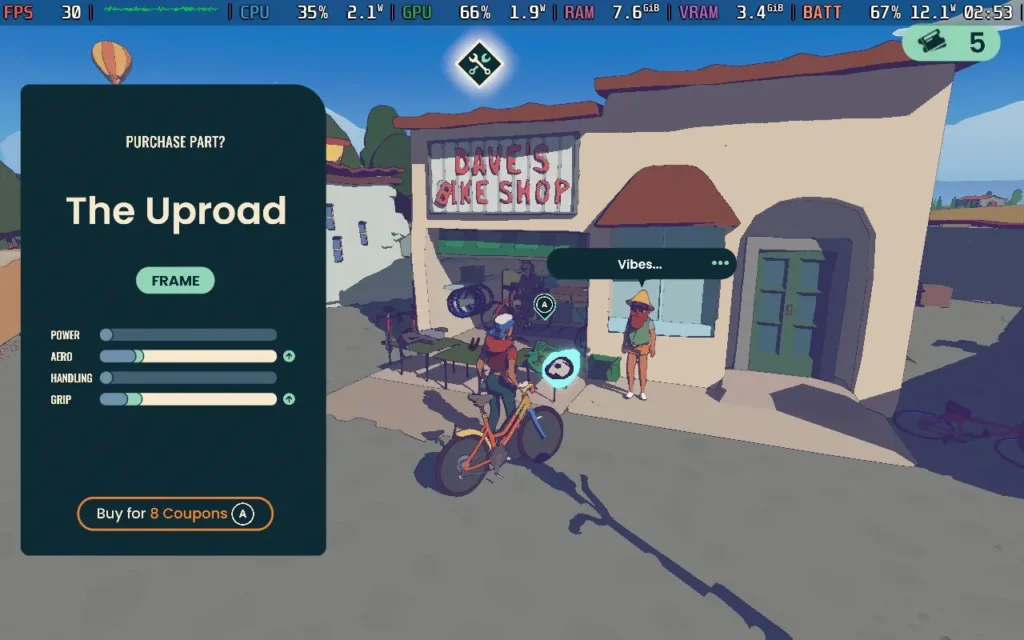

Power draw for the most part is about 12-16W, but can go up to 19W in intense situations. Temperatures are around 55-60 °C. You should expect to get around 3.5 hours of battery life from a Steam Deck OLED and around 2.5 hours from a Steam Deck LCD.
Wheel World has no accessibility options. No dialogue is subtitled.
Wheel World is a fun time, but it might have been the framework for something grander. It's a solid foundation, and ultimately, it will be down to each player to decide how much the game is worth, but at the MSRP of $20, it falls right between the line where I would have to seriously consider whether or not the 5-hour playtime justifies the price tag.
As for Steam Deck support, Wheel World isn't the best. It's playable, but performance issues have plagued the game since early playtests and still do, so don't expect to maintain 30 FPS the entire time, no matter what settings you try.
Our review is based on the PC version of this game.
If you enjoyed this review, be sure to check out the rest of the content on SteamDeckHQ! We have a wide variety of game reviews and news that are sure to help your gaming experience. Whether you're looking for news, tips and tutorials, game settings and reviews, or just want to stay up-to-date on the latest trends, we've got your back.
It should come as no surprise that Mario Kart, as a franchise, has been with me for the vast majority of my childhood up to the present day. I grew up playing Mario Kart 64 at my local youth club, desperately trying not to get the well-worn Trident controller that wouldn’t turn left as well as the others. I was baited into switching Secondary schools by my parents under the promise of receiving a Gamecube, alongside a copy of the recently released - and outright incredible - Mario Kart: Double Dash!!, which I subsequently came to find years later had been purchased for me for my birthday, regardless of said baiting. The various portable iterations, specifically Mario Kart DS and Mario Kart 7, were obsessions of mine, much to the chagrin of anyone who wanted to see me without a DS or 3DS in hand. And, although brilliant, I developed motion sickness from prolonged sessions of Mario Kart Wii, presumably due to playing with the motion controls and the included wheel accessory.
Mario Kart as an entity is a joyous comfort, whimsical in its execution time and time again, and a juggernaut in the sales department. Mario Kart 8 / Deluxe has sold a staggering 76,660,000 units since it first released on the ill-fated Wii U back in 2014, managing double the sales of Mario Kart Wii’s colossal 37,380,000 units sold. So, when Mario Kart World was announced not only as a game in its own right but as a launch title for the long-awaited sequel to 2017’s Nintendo Switch, it just made sense. It was exciting, make no mistake, but it was certainly a safer bet compared to the reinventions that, say, The Legend of Zelda: Breath of the Wild afforded us.

In one word, Mario Kart World is fantastic. It effortlessly oozes character from its ever-so-colourful pores, begging to be experienced, and makes such an ask incredibly approachable and inviting; you’d be mad not to take it for a spin. At the same time, it certainly feels familiar, but World shakes things up as far as sticking to the tried and true allows, in just giving you *more*. More ways to play, more ways in which to traverse, be it wall riding, grinding on rails, and the like, more racers and, subsequently, more chaos.
The doubling of the racers - now 24 players per race, up from 12 in past titles - plays a significant part in shifting how each race feels in that there’s, naturally, more competition, and more items flying about to give you the most minor, yet frequent, bouts of pocket-sized rage that Mario Kart knows how to deliver best. It’s more, more, more. Balancing each “more”, though - and I promise I’ll stop saying more now - is masterful in its execution, with each particular addition having a distinct, considered reaction, always clearly on show.
With the tracks now having to accommodate the increased player count, they’re significantly wider to make the inevitable collisions happen just a bit less. But, should they occur, the knockback effect that was so prominently felt between the three weight classes in previous games has been dramatically reduced. This means you won’t feel it as much when you do find yourself hurtling towards a Bowser, questionably draped in leather Biker apparel (more on that later), when you’re playing as Baby Rosalina.
And you’ll no doubt get smothered in the varied assortment of items available, new and returning alike, so the recovery time between such hits has been reduced to still give you a fighting chance should you find yourself the apparent punching bag of the match. The core experience has been masterfully fine-tuned, never diminishing the well-loved “Mario Kart factor” known and loved by millions of players, and such a delicate feat is truly commendable.

Where Mario Kart World deviates from delivering *just* the norm is in changing how the tracks themselves are experienced. As the name of the game would suggest, World offers us, well, a world. No longer are the tracks instanced experiences as they have been since 1992’s Super Mario Kart. Instead, they find themselves housed within a varied and interconnected environment, allowing races to *mostly* flow from one track to another, to varying degrees of success. During a regular cup in Grand Prix, when one race finishes, most of the next race is spent traveling across the various anastomotic paths and roads, leading to a final “last lap” on the destination track.
The tracks in World are superb, whether new or returning and reimagined or reworked, but the disappointment of only getting to experience one lap each time, unless it was the first track of each cup, was felt time and time again. What’s more, the roads and paths you’ll spend the vast majority of each cup racing on are essentially the same, with only noticeable terrain changes - a regular road to snow, grass to sand, and so forth - standing out. These paths are often the widest, too, and even with other traffic throwing hazards and distractions alike your way, they frequently feel the most sparse and devoid of the readily available excitement so easily achieved in the core tracks themselves.

Where this does work is in the excellent Knockout Tour mode, which is new in Mario Kart World. Knockout Tour is one long, continuous race across 6 different areas in what can only be described as a 24-player battle royale. With each checkpoint passed, the number of racers dwindles, with the bottom 4 being eliminated each time. Mario Kart is known for elation-inducing moments, but those particular moments of the past pale in comparison to the fervour felt during the long and arduous 10-minute sprints that will have you, quite literally in my case, in the edge of your seat… usually cursing as you find yourself getting intimate with a Blue Shell once again. It’s here where the design of the open world makes a stronger case for itself and, whilst still sparse, the frantic nature of Knockout Tour manages to make up for it in spades.

This is even stronger online, where every match reinforced the unfortunate fact that, yes, I’m not nearly as good at Mario Kart as I thought I was. The chaos felt here was tenfold what the single player could ever muster, but due to the near-immaculate balancing mentioned earlier, nary an unfair and unwarranted frustration was felt. As is the case with most of Nintendo’s online offerings, there are some notable omissions, such as the ease of playing with friends. You can create and join a room via a code, but being able to party outside of this and search for a Race/Knockout Tour/Battle is strangely absent. It’s certainly not the biggest of gripes, granted, but still one nonetheless.

A few other notable Nintendo-isms are also found throughout, such as a seemingly intentionally obtuse character select screen. The cast of characters available - well over 24 strong - ranges from the expected - Mario, Luigi, Bowser, and the like - to the various enemies and critters found across a range of Mario titles, such as Monty Mole, Cheep Cheep, and the internet’s favourite, Cow. Moreover, the “main cast” has various outfits, unlocked by picking up food items from the various Yoshi restaurants scattered around, either during a race or out in Free Roam.
Instead of presenting such an eclectic mix of cosmetics in a fashion that made sense, ala Mario Kart 8 Deluxe, allowing you to select a character, only for it to give you the customisations in a freshly opened window, Mario Kart World throws every possible variation on the screen as its entity. This results in a vastly overinflated character select screen featuring 10 variations of Mario, 5 of Rosalina, and so on. It seems so egregiously against Nintendo’s ethos of simplification and approachability that it performs a 180 and appears to be the most Nintendo thing ever. Why wouldn’t they do what they’ve done in the past, which made sense? That would just be bizarre.

What unfortunately sticks to that simplification and approachable design language is the marketed star of the show, Free Roam. Not only is it relegated to a small prompt in the corner of the screen, should you wish to enjoy it, but it lacks not only content, but life itself leaves a lot to be desired. Countless challenges and collectables are available, with P Switches offering bite-sized challenges such as jumping between wall riding sections in quick succession, Question Blocks unlocking decals, and Peach Coins being tucked away in the most challenging of corners.
It’s difficult to drive 30 seconds in any direction without finding something that catches your eye, but it’s not enticing in the same way as, say, something out of the ordinary would in The Legend of Zelda: Tears of the Kingdom. It deserves to be looked at, but not necessarily to get excited about. What Free Roam is perfect for are those fleeting moments when you have a spare moment and need your minute motorised Mario fix. Incidentally, it’s also the perfect mode for younger children to explore and, through their eyes, could easily be as magical and mesmerising as travelling Hyrule Field was for many of us in 1998’s Ocarina of Time.

Regardless of what you are doing and however chaotic your activity of choice may be, the new Nintendo Switch 2 manages it effortlessly, both when docked and in handheld mode. Mario Kart World is a pleasure to look at, featuring 1440p on the former and 1080p on the latter, all running at a smooth 60 FPS. The inclusion of HDR does wonders, with Mario et al. popping with colour and character like never before.
Each of the small details - karts bouncing as you turn them, happily chugging as they sit idle, and so forth - adds to the bountiful charm found throughout. The only area where the frame rate deviates from the 60 target is when using the in-game camera, which is then limited to 30. Finally, the significantly improved loading times afforded by the vastly superior read/write speeds in the Switch 2 work wonders, loading nearly instantly, game-wide.

Mario Kart World is, simply put, more Mario Kart. It excels where it has always excelled, delivering effortlessly enjoyable and approachable racing to an exceptionally high standard. Countless other kart racers have come and gone throughout Nintendo’s storied 23 years of leading the pack, and that doesn’t look to change anytime soon. Some strange omissions plague World’s otherwise immaculate offering, such as the lack of other Nintendo characters and a way in which to listen to the sublime music outside of the racers - both of which were available in Mario Kart 8 Deluxe in post-release updates - but I’m very excited to keep on playing for years to come, looking forward to the inevitable additions that Nintendo would be mad not to capitalise on.
Our review is based on the Nintendo Switch 2 version of this game.
If you enjoyed this review, be sure to check out the rest of the content on SteamDeckHQ! We have a wide variety of game reviews and news that are sure to help your gaming experience. Whether you're looking for news, tips and tutorials, game settings and reviews, or just want to stay up-to-date on the latest trends, we've got your back.
Monster Energy Supercross 25 was provided by Milestone S.r.l. for review. Thank you!
When it comes to Supercross games, your choices are pretty limited, with the main choices being THQ Nordic's MX vs ATV series and Milestone's Monster Energy Supercross series. Fortunately, Monster Energy Supercross 25 is a decent entry into Milestone's series. While it may not offer a huge step-up from previous entries, it's a great entry point for newcomers.
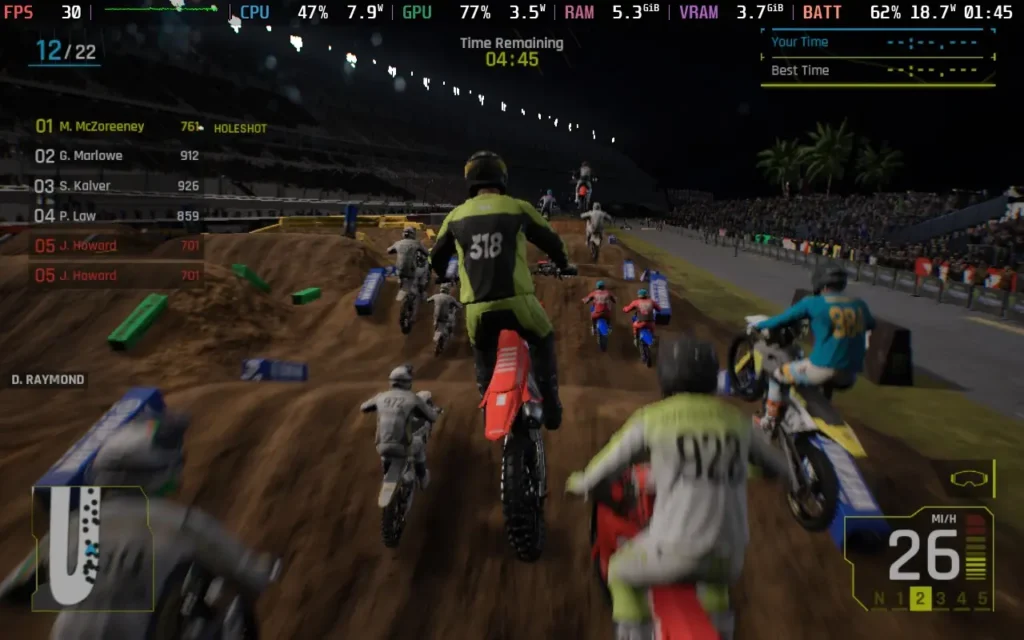
Monster Energy Supercross 25 offers a variety of game modes. Quick play lets you do a single event to play one-off sessions or a tournament, and these have adjustable session length, difficulty, and weather conditions.
Rhythm Attack lets you play a 1V1, essentially the bike equivalent of a drag race, a Time Attack mode to practice your riding, and a Championship mode, which lets you make up your championships with custom settings and choose your tracks. There is split-screen for two local players, but I wouldn't recommend that on the Steam Deck due to the extra system resources it will require, and online modes to race against friends wherever you are.
However, the main mode is the career mode, which has all the usual trappings of the modern career system in these games, complete with the somewhat silly fake social media system allowing you to interact with fellow drivers and fans. On the plus side, you can research upgrades to your bike and improve it, and the current contract you have with a team offers neat little objectives for you to aim for as you progress through the races, as well as a level/rank system to give a sense of progression, too.
Finally, there is the track editor, which lets you create tracks in the stadiums, although it is more basic. The game does have Steam Workshop support, so you can share and download community tracks, too.

Now, onto the most important part of Monster Energy Supercross 25: the riding physics and control. Well, if you choose advanced physics, it would be quite decent. It requires the player to exercise good weight distribution, throttle control, and track positioning to have any hope of succeeding. You'll need to steer carefully to avoid sliding and falling off. It's pretty brutal, but ideal for experienced players.
If you're a more casual player or new to the concept of dirt bikes, you might want to opt for simplified physics. This controls more like an arcade game, being much more forgiving with how you have to control the bike. You will still have to drive well and pick the right driving line to beat the AI, but you're less likely to fall off, and you don't have to worry about distributing your weight as much mid-air.
The downside of the simplified physics mode is that it can sometimes act a little oddly, allowing the bike to make some erratic movements, like quickly spinning around at low speed, and sometimes your driver kind of sticks to the bike instead of flying off.
However, either mode airs more on the "simulation" side than the "arcade" side of racing. You will need fine control and understanding of the game's physics to ride well. Steering hard and accelerating on either mode will cause the bike to spin and throw you off, for example.

Much like the riding, the AI in the game is quite difficult. Even on the "Very Easy" setting, winning wasn't guaranteed. I generally placed in the top 3 but was never more than 5 seconds ahead of the pack. The game also slightly suffers from "Mario Kart Syndrome", where it seems to pick a driver significantly faster than all the others to challenge you. It's not uncommon to see 1 AI rider with a fastest lap 2-3 seconds faster than any other AI rider.
The AI difficulty is adjustable, with five settings, so if you are a pro at these kinds of games, you should still find a setting that poses a challenge. Still, newcomers or people not used to racing games might find it frustrating to win a race even in the easiest settings.
The environments vary a little, but they are, for the most part, based in stadiums on your standard Supercross tracks, meaning many of them can kind of blend together in your mind. There are some exceptions, though, with some tracks in outdoor environments more akin to a Motocross race.

Visually, Monster Energy Supercross 25 holds up quite well, even on the lower settings you're restricted to on the Steam Deck. The ground changes texture and material depending on the weather, and grooves form in the mud as bikes wear down the terrain. Although this is mostly visual, there are plenty of crowds to build the atmosphere.
As for the audio, there's a lot of bike revving, as you would imagine, and it can get a bit much after a while. The music in the game is also quite "noisy," just heavy drums and guitars. It almost sounds like it's overloading the speakers sometimes, and it isn't all that nice an experience, so you might want to fine-tune the audio levels yourself.
Monster Energy Supercross 25 supports 16:10 resolutions and good controller support; controllers are the best way to play the game.
Regarding performance, we have to aim for 30 FPS with this one, but we can get away with a few visual features. Most of the settings are on "Low" (instead of "Off"), so we do get some niceties like reflections and ambient occlusion. I also lowered the resolution to 1152x720 as it gains us the 2 or 3 FPS needed to keep a more stable 30 FPS. We're using the in-game frame limiter here, not the SteamOS one.


Using these settings, the game hits 30 FPS most of the time. At the start of races, the frame rate can dip to around 28 FPS, but it picks up within a few seconds as the grid of bikes separates. Surprisingly, the game is more CPU-heavy than GPU-heavy, so the main aim of lowering graphical settings is to free up power for the CPU.
Very occasionally, there are some serious stutters, where the game may freeze for around 250- 500ms; it only tends to happen once per track, but it is quite jarring. For this reason, I would be hesitant about playing online on the Steam Deck, as the slightly unstable framerate and occasional stutters might present issues in online play.

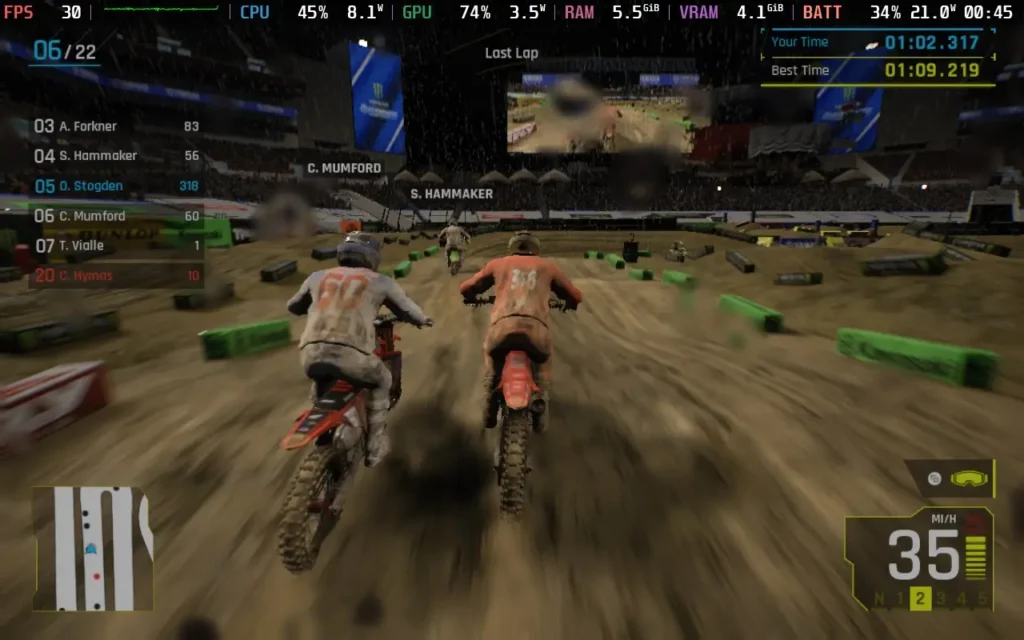

The power draw with these settings is higher, mostly due to the CPU, which ranges between 18W and 21W in most races, dropping to around 15-16W in the 1V1 races. Temperatures are also fairly high, being around 65C-75C. Expect about 2.5 hours of battery life on a Steam Deck OLED and around 1.5 hours on a Steam Deck LCD.
The main accessibility features of the game involve simplifying riding. You can automate things like gear changes and weight distribution, and use simpler physics that are less punishing when taking turns or landing jumps. You can also increase the font size in menus, which I did by one notch for the Steam Deck, because my eyes are trash. You can also apply a colorblind filter and lower the game speed, effectively playing in slow motion to help with reaction times.
Monster Energy Supercross 25 is a solid entry into the series, with plenty to keep you busy as a solo player and in online modes. Some riding physics can seem slightly off at low speeds, but it generally holds up and offers a suitable challenge. The AI is unforgivingly brutal, but for seasoned players, this should be a blast; newcomers might need a bit more time to get up to speed.
Performance on the Steam Deck is at least playable; we have to keep settings low and play at 30 FPS, but the game is playable, at least in the offline modes. Controller support is excellent.
Our review is based on the PC version of this game.
If you enjoyed this review, be sure to check out the rest of the content on SteamDeckHQ! We have a wide variety of game reviews and news that are sure to help your gaming experience. Whether you're looking for news, tips and tutorials, game settings and reviews, or just want to stay up-to-date on the latest trends, we've got your back.
MotoGP 25 was provided by Milestone S.r.l. for review. Thank you!
My experience with superbike racing games is pretty limited. In fact, the only superbike racing game I've played was MotoGP 06 on the Xbox 360, and my memories of that game are of me repeatedly falling off and sliding down the tarmac on my face. While my racing skills have not improved and have quite possibly declined over the past 20 years, the MotoGP series is still going strong, and MotoGP 25 carries on that legacy, albeit with a bit more accessibility than in the past.
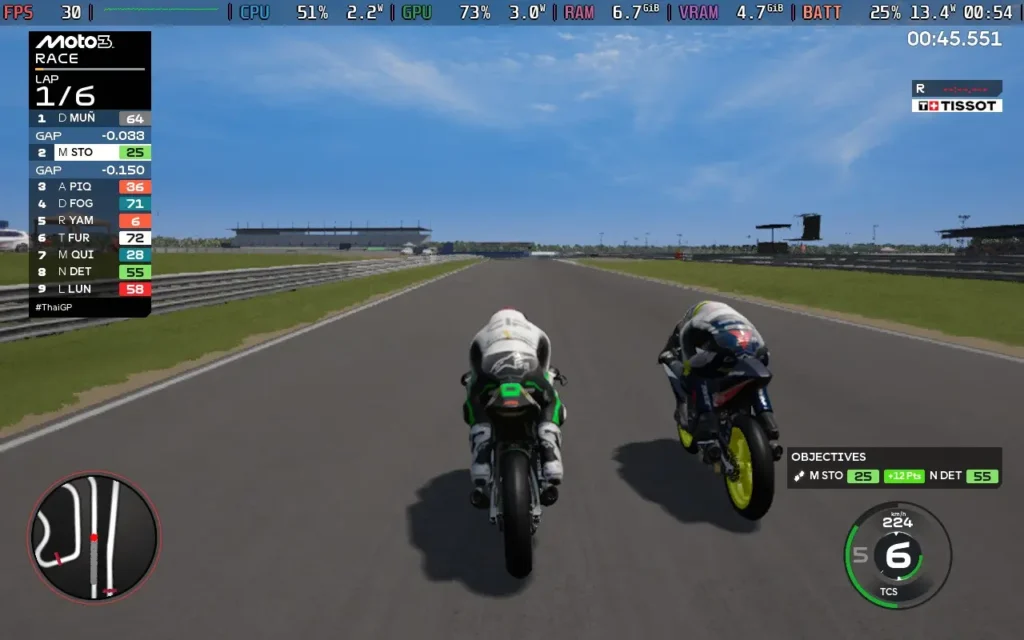
Going straight into the riding feel of the game, and I have to say it feels great to control. There's a good amount of scalability in how "realistic" you want the physics to be. Playing on the more "pro" settings brings back the nightmares I had from MotoGP 06, where going off the racing line, or steering/accelerating slightly too hard, will fling you off your motorcycle and into the gravel, but there's also far more beginner-friendly "arcade" settings.
The "Arcade" settings aren't arcade in the sense of playing a game like Road Rash or Burnout Paradise, but they make riding much more accessible to your average player. If you're fully steering and hit the accelerator on the apex of a corner, it will still throw you off the bike, so the game still demands some fine control. Still, I found this riding style much more enjoyable as someone predominantly used to cars in racing games.
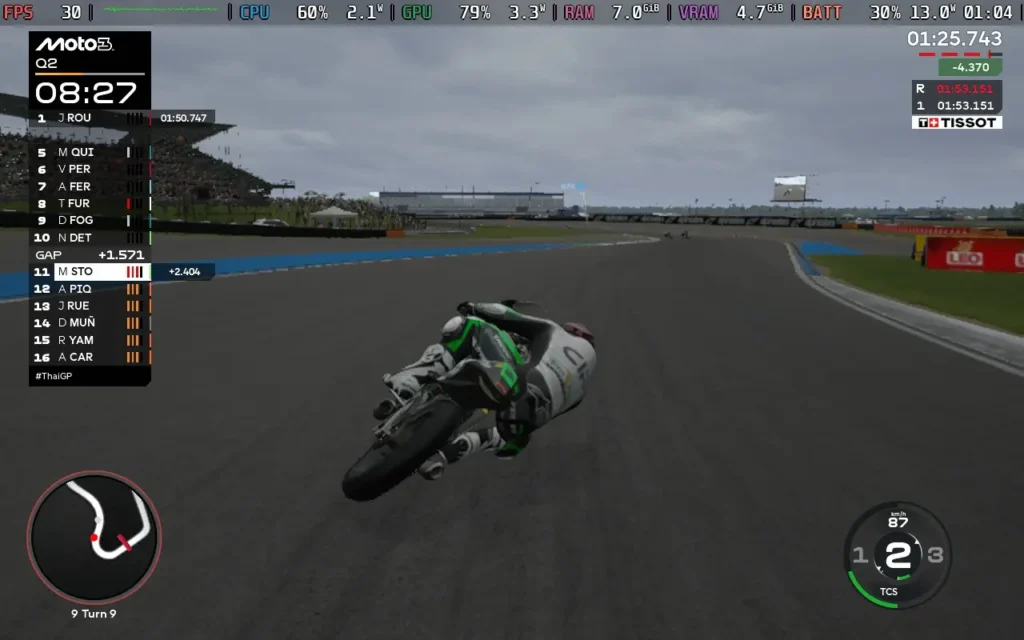
There are a few modes that you can enjoy in MotoGP 25. You can do a "quick" race for yourself, setting up an entire session with practice, qualifying, and a race. You can play online multiplayer, you can do the MotoGP Academy, which are short tests of skill, and you can play in the game's career mode, which is probably what most players will be doing.
There's also a "Race Off" mode, like a sub-section in the game, where you can ride minibikes around kart-like circuits, or Motocross bikes on tarmac circuits. It can be a fun and silly diversion from the main game, with smaller grids and unique environments.
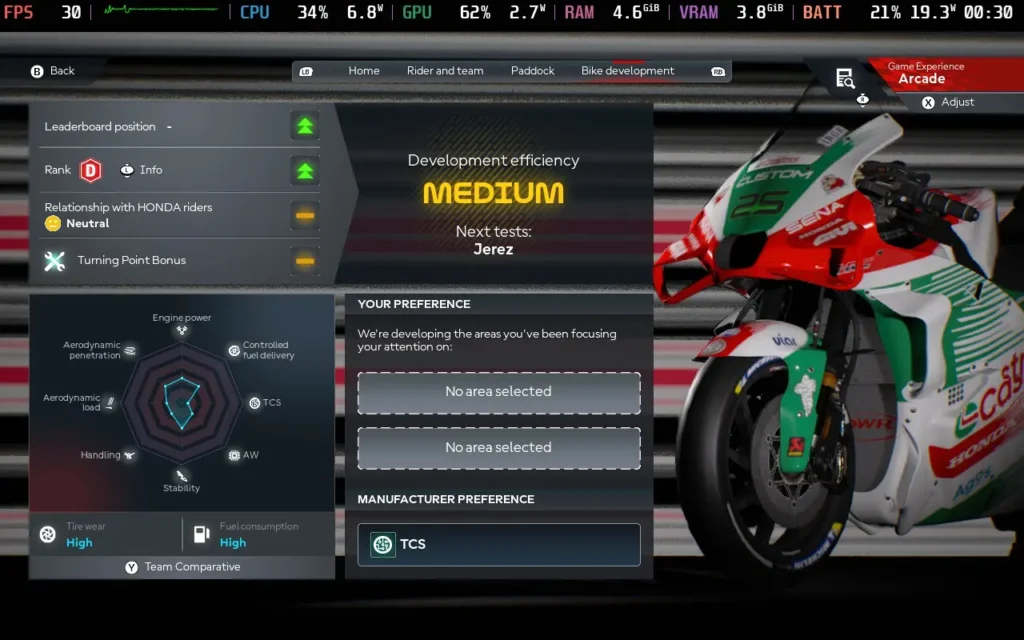
The Career mode is as expected if you've played a Milestone racing game before. You play through a series of races, gradually building relationships with other riders and improving your vehicle via Bike Development. And yes, MotoGP 25 also has the silly fake social media system where you can respond to comments with a positive or negative statement, affecting your relationship with other riders. As one option always seems better, it's still baffling why this system makes it into the games.
What is pretty neat, however, is that the game allows you to play Moto3, Moto2, or MotoGP categories. If you're not too confident, you can select a lower vehicle class and enjoy a slightly more manageable ride. They're still fun to drive, but you'll be going about 80MPH slower on a Moto3 than a MotoGP, a bit like Formula 3 compared to Formula 1.
Another point I wanted to make was that the AI, much like the riding physics, is highly flexible. The game allows you to select AI difficulty based on a percentage, meaning you can lower it as low as 20%, where I was, on average, about 15 seconds a lap quicker than them. I bumped it up to 40% to see the difference, and I was around 5-6 seconds a lap quicker. Having them at around 50-60% seemed like the sweet spot for me as a new rider. However, the fact that they can go much higher shows that the AI should present a decent challenge for most players.
When it comes to the visuals, MotoGP 25 holds up pretty well. You're still treated to some nice visual effects even with lower settings. Riders are animated well, allowing you to see small movements for gear shifts and throttle adjustments. You can even choose from multiple camera angles, including an in-helmet cam, which is as disorientating as you might imagine.
One thing I did notice, however, is that during the race, there is no music at all. I understand that the developers perhaps wanted to focus on the sound of the engines, but at the same time, racing games customarily have background music as you race, and it feels a little odd for that to be absent here. There is your generic "Hype" music that plays in the menus.

MotoGP 25 is a solid little racer. If you're familiar with Milestone racing games, you know how this one goes, but if you like their formula and motorcycle racing, then I think you'll have a good time with MotoGP 25. Nothing immediately stands out as a "problem" to me, and while there are a couple of things I'd have liked, such as music in races, it's a fairly minor issue, and I might be alone on wanting that.
MotoGP 25 supports 16:10 resolutions, including the Steam Deck's 1280x800, so there are no black borders around the screen. It also has great controller support; I wouldn't recommend playing this game on a keyboard.
Things aren't so rosy when it comes to performance, though. While the game offers many graphical settings, the scalability doesn't seem to be there, with the difference in performance between Low and Ultra being fairly small.
In the end, to lock 30 FPS in all racing situations, I had to pretty much set the graphical settings as low as possible and then set FSR3 to Performance. Stress testing the game with a full grid of superbikes on a rainy track, I only got it to dip as low as 31 FPS, but at points, it exceeded 50 FPS.

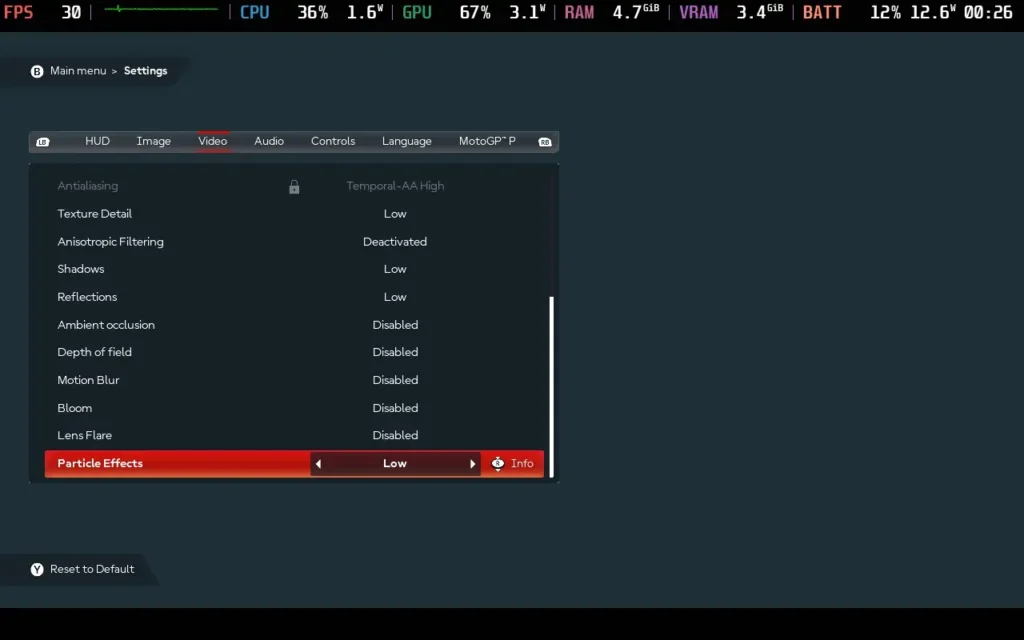
Unfortunately, MotoGP 25 is a game where you want absolutely no frame drops, as it's a highly precise racer, so I'd rather keep the framerate steady instead of aiming for 40 FPS and having drops into the low 30s on occasion. We do get the occasional stutter, but it doesn't affect playability.
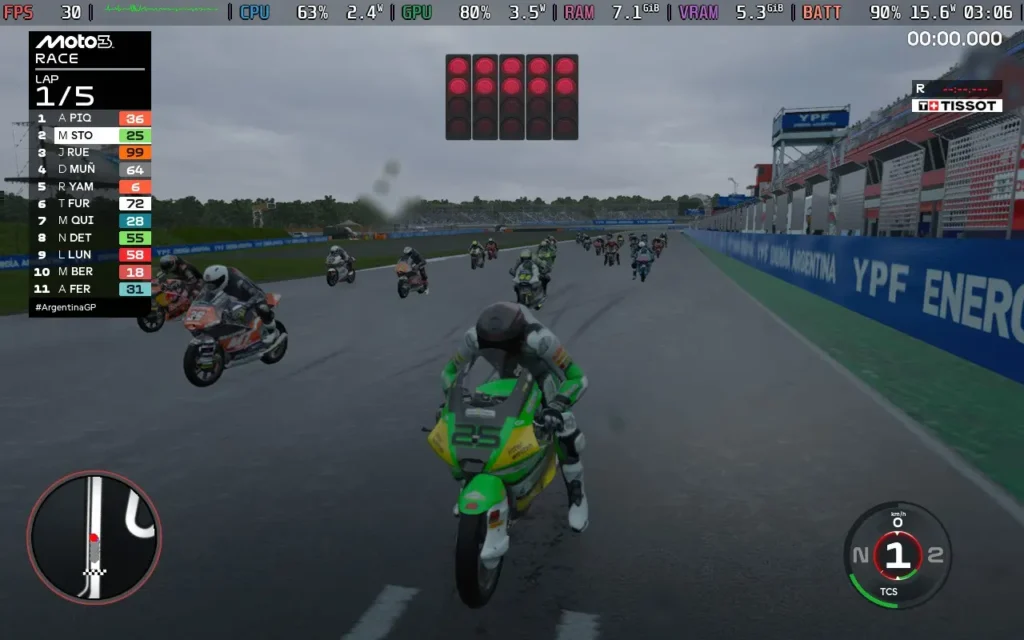
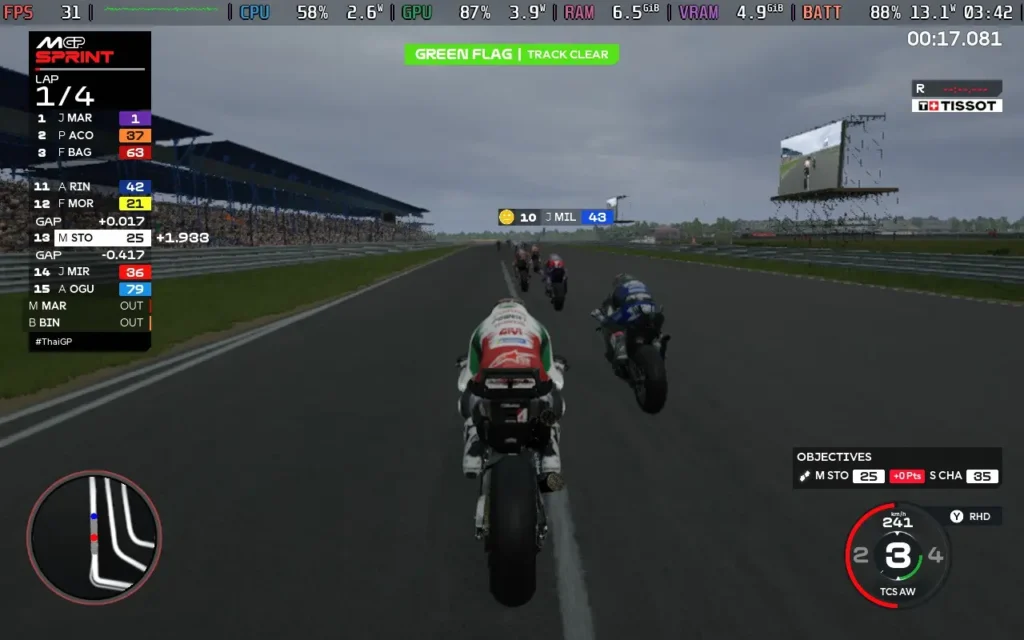
The power draw is around 13W-16W, but it varies depending on the track and weather conditions. Temperatures were around 65C-75C, again, varying. Expect battery life to be about 3.5 hours on a Steam Deck OLED and around 2.5 hours on an LCD model.
MotoGP 25 has many driving assists, with Pro and Arcade riding styles available. It can help you with automatic throttle, braking, and steering (while in corners). You can also have an automatic transmission/clutch, suggested line, and rewinding if you make a mistake. The game can also be played in slow motion in offline game modes.
MotoGP 25 is another entry in a long line of games. I don't think it does anything revolutionary, but playing it safe while offering slight improvements might be enough for players who haven't played a MotoGP game in a while. There's nothing glaringly wrong with MotoGP 25, so this is a safe choice if you're after a Superbike racing game.
Thankfully, we can lower the settings enough to get a playable Steam Deck performance. The image becomes a little fuzzy, but maintaining the 30 FPS is crucial, and we can just about manage it. The controls work fine, and I can say that the game is fully playable on the Steam Deck.
Our review is based on the PC version of this game.
If you enjoyed this review, be sure to check out the rest of the content on SteamDeckHQ! We have a wide variety of game reviews and news that are sure to help your gaming experience. Whether you're looking for news, tips and tutorials, game settings and reviews, or just want to stay up-to-date on the latest trends, we've got your back.
Assetto Corsa EVO was provided by 505 Games for review. Thank you!
Assetto Corsa EVO is in Early Access and the content and performance of the game is subject to change, this review is based on Version 0.1.4 at the time of writing.
I was very excited to hear about Assetto Corsa EVO when it was first announced and even more excited when I got to review it. The game takes a slightly different approach to its predecessor, Assetto Corsa Competizione (ACC). It's more akin to the original Assetto Corsa, with a focus on the single-player experience, whereas ACC was largely focused on hosting online leagues and tournaments.
In fact, Assetto Corsa EVO does not currently have multiplayer elements, although multiplayer is planned for later in 2025. Instead, we are presented with more of a foundation for what is to come rather than a complete game.
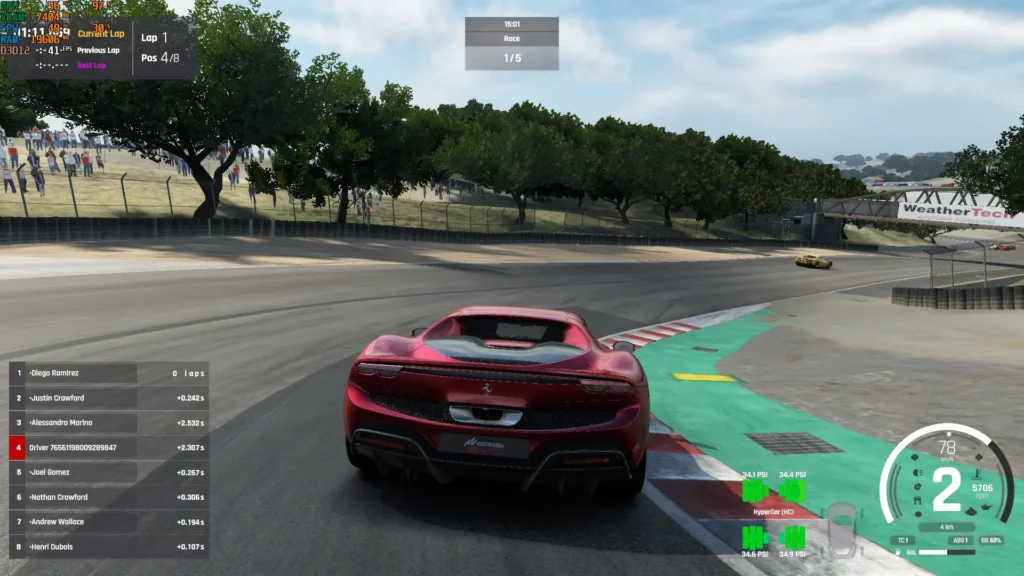
The best word to describe the content available in Assetto Corsa EVO right now is 'barebones.' Regarding ways to play, there are only single-player practice sessions around a choice of 8 tracks, based on 5 locations, and quick races, also on those tracks. You'll also have 20 cars to drive, from an Abarth 695 to a Porsche 911 GT3 or Ferrari 488.
So, in terms of content, the game is quite lacking, especially considering the price tag of $39.99; you are definitely purchasing Assetto Corsa EVO to invest in its development to become the game that developers are saying it will be.
The main aspect of a driving simulation game like this is the physics. And I will say, the physics of Assetto Corsa EVO feel great. I was playing on an Xbox gamepad, and while games like ACC could be difficult to play on a gamepad, Assetto Corsa EVO doesn't feel that way. With some basic assists in place, as long as you drive well, it's perfectly possible to have a clean (and fast) race using just a gamepad. I think this is a great thing for EVO, especially as it caters to those interested in a single-player experience and not just online leagues.
That doesn't mean a wheel won't be faster or safer, though. If you start getting into a skid, the force feedback makes it much easier to correct. Likewise, when my Ferrari 296 began fishtailing on Laguna Seca, it was difficult to regain control on a gamepad due to the lack of force feedback. After a few poor reactions, the car spun completely.
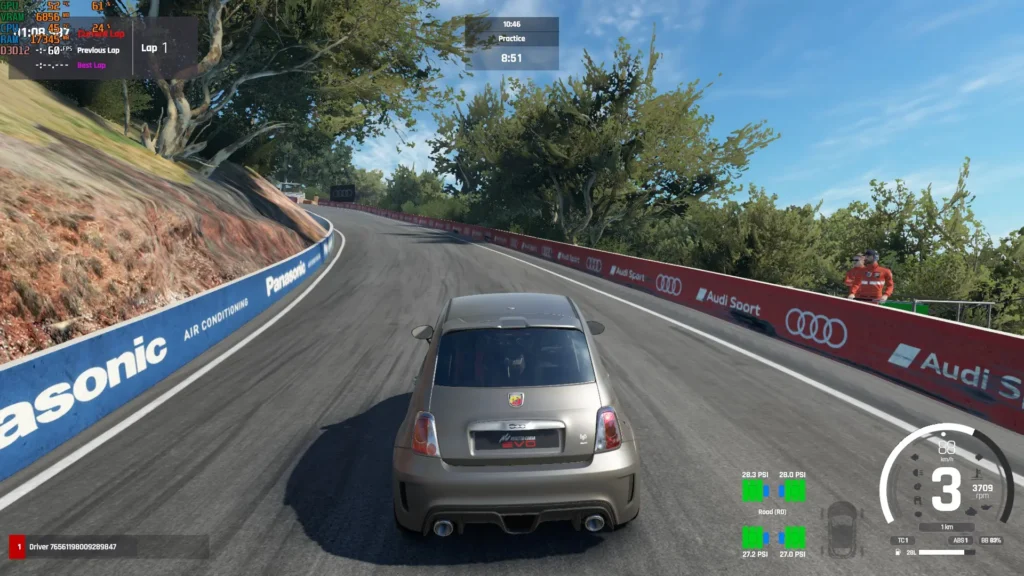
Likewise, how your car drives changes drastically depending on the surface you're on. While it's easy to maintain control on the track, put a wheel onto the grass or dirt, and you can expect a sudden loss of traction, as you would in real life. Even worse, the terrain isn't smooth anymore, and your car can easily bump into the air from the rough terrain, making braking or steering difficult. Rainy weather also makes controlling the car a challenge; you'll need to maintain good throttle control at all times or risk spinning your wheels, and you'll need to compensate for the wet track by braking far earlier than you would expect.
So the physics seems pretty solid, but how about the AI, seeing as they are your main (and currently only) opponents in Assetto Corsa EVO? They're a bit of a mixed bag, but they do the job pretty well when left to their own devices. There are a couple of oddities, such as their habitually scraping against the pit wall on Laguna Seca, which could cause them to spin out or veer across the track in reaction to the collision. They will also make natural mistakes, such as going slightly offline/off track or accidentally cutting a corner, making them seem more human-like.
The problem with the AI comes when they have to interact with the cars around them. While the AI seems to cope fairly well with side-by-side racing, they seem less competent when you're in corners. If you brake slightly too much, the AI doesn't seem to respond and will simply hit into the back of you, and once you're spinning and they're pushing you, they will continue to accelerate, a move that would get you banned in an online league.
The AI seems to position itself quite well in response to the cars around it, but it doesn't seem to want to compromise its own race by slowing down in order to avoid a collision, something that is part of (serious) racing. I can't be too harsh on the AI, it does do a decent job of simulating perhaps a rookie human driver, but it's no replacement for racing against skilled fellow humans.
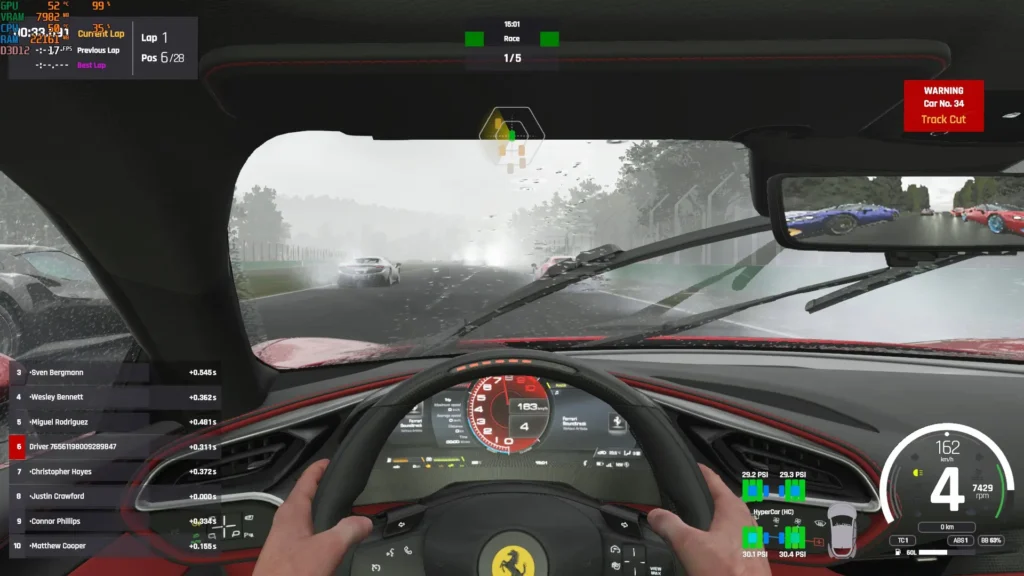
Now comes the presentation, which Assetto Corsa EVO crushes. The game looks pretty great, and even in the lowest settings, the cars can rival the appearance of other games like Gran Turismo and Forza. On the higher settings, the detail is beyond those games. Track environments are detailed, plenty of trees and foliage (depending on graphics settings), and the rain looks great on the windshield. The sounds likewise have a lot of detail; they are not just one-note sound effects, and the engines feel like they have depth.
Unfortunately, this comes at a cost. The game is difficult to run, even on a mid-range gaming PC. With my Ryzen 5 5600 and AMD RX 6600 XT (8GB), a full-grid (30 cars) race in the rain is unplayable even on the lowest settings at 1080p. If I lower the grid to 8 cars, I can play at around 30 FPS at 1080p Very Low settings. This seems like a VRAM issue, as even on the main menu the game is using 7GB of VRAM. So, I wouldn't recommend you purchase Assetto Corsa EVO unless you have a graphics card with at least 12GB of VRAM.
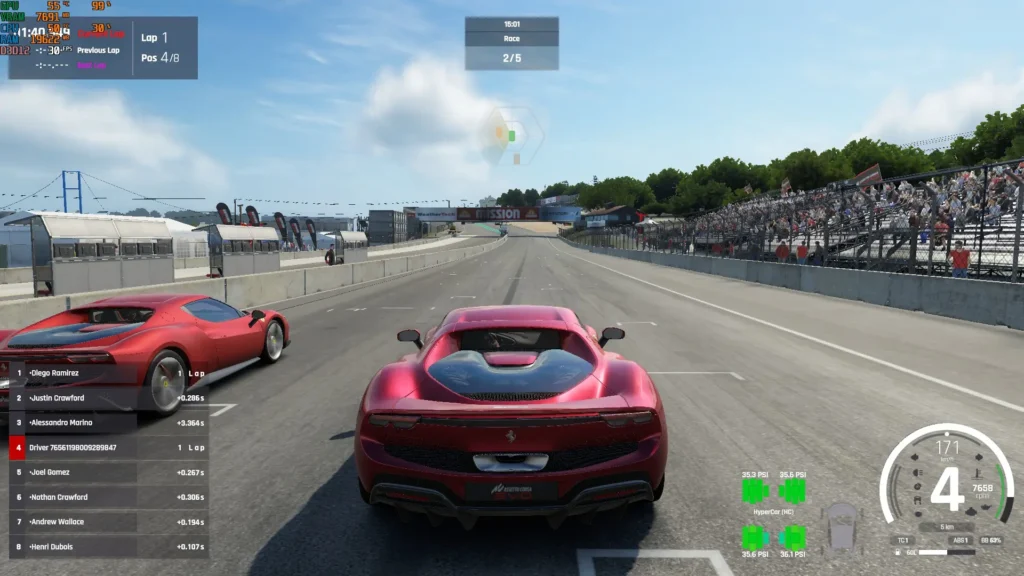
Unfortunately, Assetto Corsa EVO struggles to run on the Steam Deck. While I could get into a practice session on Mount Panorama, this was only by lowering the settings to the absolute lowest they could go, along with FSR 3 on Ultra Performance quality. The game still used over 7GB of VRAM to accomplish this.
The frame rate was actually decent, often above 50 FPS, but the high VRAM usage makes the game unstable. As soon as I attempted to start an actual race, my Steam Deck crashed entirely to a black screen, forcing me to hard reset the device—even with a 4G UMA Buffer set in the BIOS.
While we may see optimizations in the future, the game is using 7GB of VRAM on a track with a single car and no weather conditions to manage, which means that it's unlikely we'll see the game run well on Steam Deck.
Assetto Corsa EVO has rebindable controls and some driving assists, such as ABS and Traction Control, but no general accessibility options.
Assetto Corsa EVO, in its current state, has some promise. Assetto Corsa EVO's The driving physics is impressive and some of the best I've experienced. The graphics and sounds are also fantastic. But right now, the content is thin on the ground, the AI needs to be polished, and the game's optimization is poor. Is it worth the $40 price tag? At the moment, no. Only those who wish to support future development should buy the game right now, as there isn't much of a "game" to speak of as of writing.
And due to the poor optimization and high VRAM usage, Assetto Corsa EVO, unfortunately, isn't playable on the Steam Deck.
Our review is based on the PC version of this game.
If you enjoyed this review, be sure to check out the rest of the content on SteamDeckHQ! We have a wide variety of game reviews and news that are sure to help your gaming experience. Whether you're looking for news, tips and tutorials, game settings and reviews, or just want to stay up-to-date on the latest trends, we've got your back.
Test Drive Unlimited Solar Crown was provided by Nacon for review. Thank you!
Test Drive Unlimited Solar Crown has been one of the most eagerly anticipated racing games. With the Test Drive series lying dormant for over ten years, I wondered if Test Drive Unlimited Solar Crown would bring the series back to its former glory experienced on the PS2 and Xbox 360, offering players a large map to explore, a car collection to build, houses to buy, and a social experience as you meet other drivers.
Sadly, while Test Drive Unlimited Solar Crown does tick some boxes, I think most fans will be left wanting.
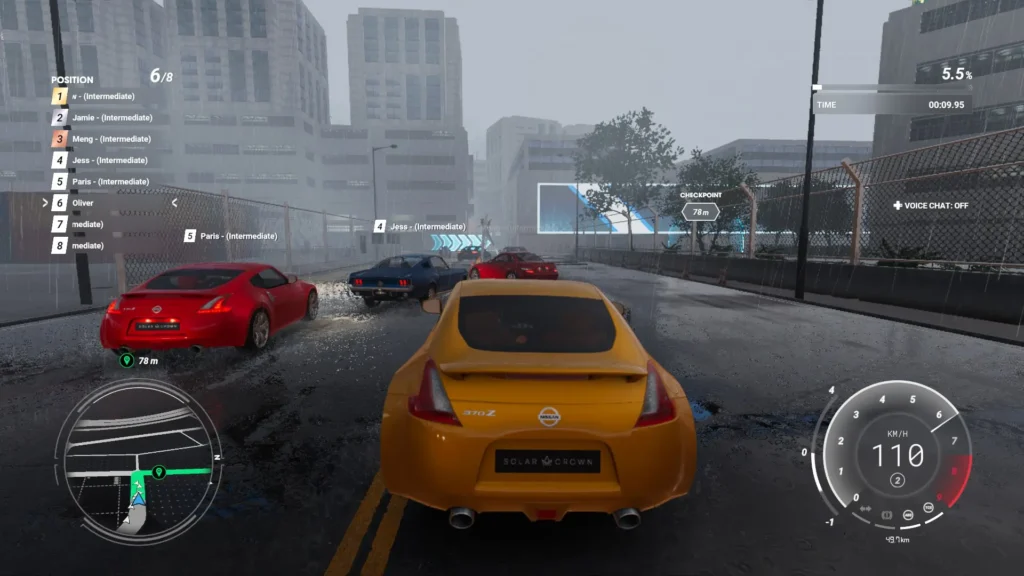
Test Drive Unlimited Solar Crown seems awkward between the classic open-world racer of Test Drive Unlimited 1/2 and the modern open-world racers of The Crew and Forza Horizon series. It tries to be a jack of all trades and becomes a master of none.
The car physics, for example, is a highlight for me. The cars are made to feel weighty and realistic, and it feels good to drive them. The sounds are pretty decent, too. They're not as good as The Crew Motorfest sounds, but they help drive home the power of your cars.
Unfortunately, although the car physics are reminiscent of the Test Drive Unlimited games of the past, the open world is straight out of what you might find in Forza Horizon or The Crew: a more dense environment with plenty of debris and clutter. The two don't mix well. In Forza or The Crew, you can largely push through most debris with little penalty, but with Test Drive, in the pursuit of realism, hitting a safety barrier or a lamppost can easily halve your speed from 140 MPH to 70 MPH, ruining your race.
When driving through downtown Hong Kong, there are plenty of lamp posts, barriers, fences, hedges, and lines of trees. It becomes very difficult to avoid them. It is frustrating that a slight slip-up can cause such a catastrophic result, and it can quickly descend into figuring out how to go around the 90-degree corner without touching any bushes or scenery.
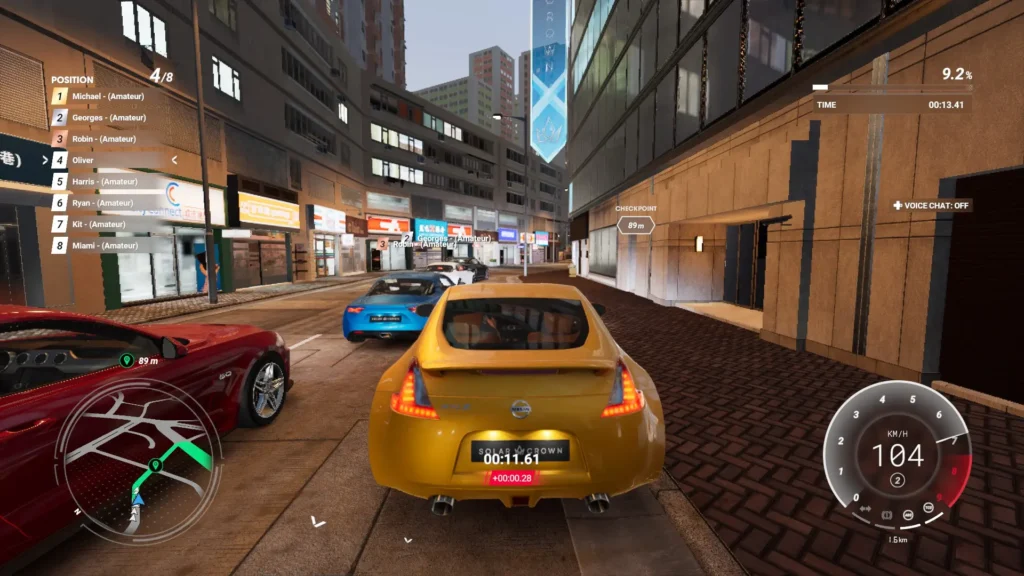
The game's AI exemplifies issues like this. The game uses a performance point system, similar to what almost all racers do now. But in Test Drive Unlimited Solar Crown, the AI with more performance points seems to mean, "We go faster on straight now." You may have your car at the performance point ceiling for the event, but that doesn't mean an AI won't breeze past you going 30 MPH faster than you are, only to brake excessively for the upcoming corner so you can overtake easily.
The AI seems to operate on a different level to players, having impossibly fast cars occasionally and then purposefully slowing down at points that allow players to catch up. It feels like you're playing a racing game from the '90s or '00s when this kind of thing was common before developers figured out how to make competent AI that followed the same rules as the player had to. The fact that many events have cars at performance level 400 and others at 550, competing at the same speed as each other, proves that the AI is programmed to go at set speeds and isn't using their car. It isn't very pleasant.
Perhaps the most egregious of all is that this game has no AI difficulty option. So, if you find the AI too difficult or easy, you'll just have to deal with it. If you're not an experienced racing game player and losing every race, you can't do anything about it.
This may be a victim of the game's online-only, almost MMO-like setup. The game tries to matchmake every time you start a race, with the developers clearly intending for you to play with players, and the AI is only a fallback if no players are found. Unfortunately, Test Drive Unlimited Solar Crown did not have a very good launch, and player numbers are thin, meaning you likely won't find any players to play with. In all the races I did for this review, I found 0 players while matchmaking, so you best hope you can compete with the AI.
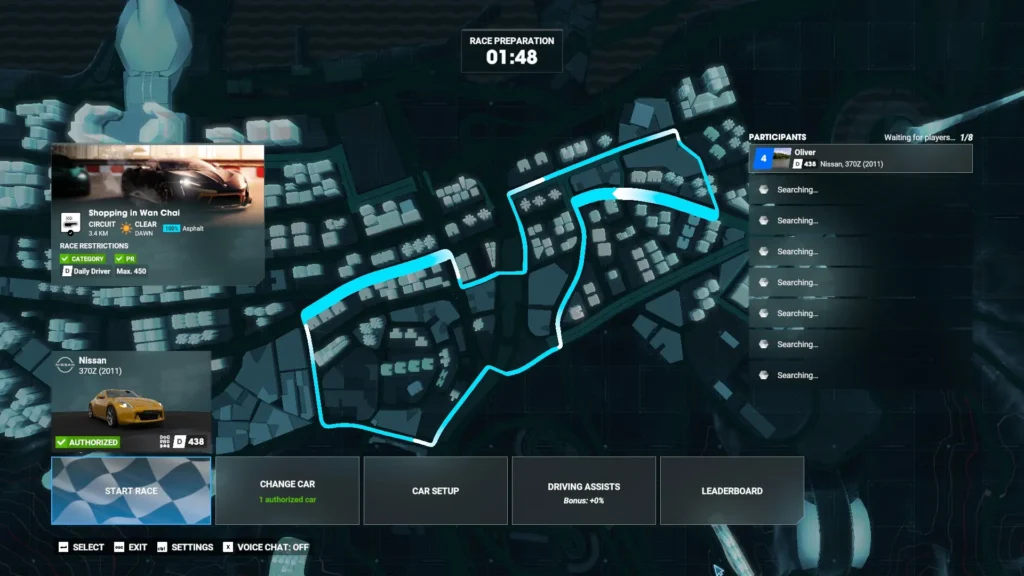
If you were like me, you would probably be excited to hear that the world of Test Drive Unlimited Solar Crown was a 1:1 recreation of Hong Kong Island. Unfortunately, what makes Hong Kong, well, Hong Kong, is the bright lights and the bustling streets. This is a heavily urbanized area, and the game just does not pull that off. The world is empty and bland, there are no pedestrians to speak of, and traffic is light, likely for gameplay purposes. There's also no traffic during the races, which is pretty disappointing. And with traffic being handled server-side, I occasionally experienced some lagging and random pop-outs.
Yes, some of the streets light up in some colors at night, but even then, there's a tremendous lack of bright signage for shops and businesses. Occasionally, your car will light up pink as you pass a certain store on the side of the road, but that's about it. The fact that the developers seemed not to emphasize the critical points of the city of Hong Kong makes you feel like they may not have even researched the area properly or at least didn't care enough to represent it well.
There's also a feeling of blandness and emptiness in what you can do. Games like Forza Horizon have activities in the game world, such as drift events, jumps, slaloms, and speed cameras/zones. Test Drive Unlimited Solar Crown seems to have limited itself to just Speed Cameras and the odd collectible immediately highlighted on your map whenever you go anywhere near it. You get bonus reputation for exploring and finding all the roads in the game, but it feels like there isn't much point in doing so, as there's not much to find beyond the odd car wreck that you can restore and some credits lying around.
I went exploring in the rural, driving offroad, which felt a bit too icy for my liking, and there was just... nothing. On the dirt roads, there was no traffic or any hidden secrets. No special places were hiding some treasure, no hidden buildings that unlocked a new feature. There just seems to be very little reason to explore the world.
Unlike previous Test Drive Unlimited games, you can't find houses to buy that expand your garage space, which is a crying shame, as I know that was a much-requested feature of many fans of the series, including myself.
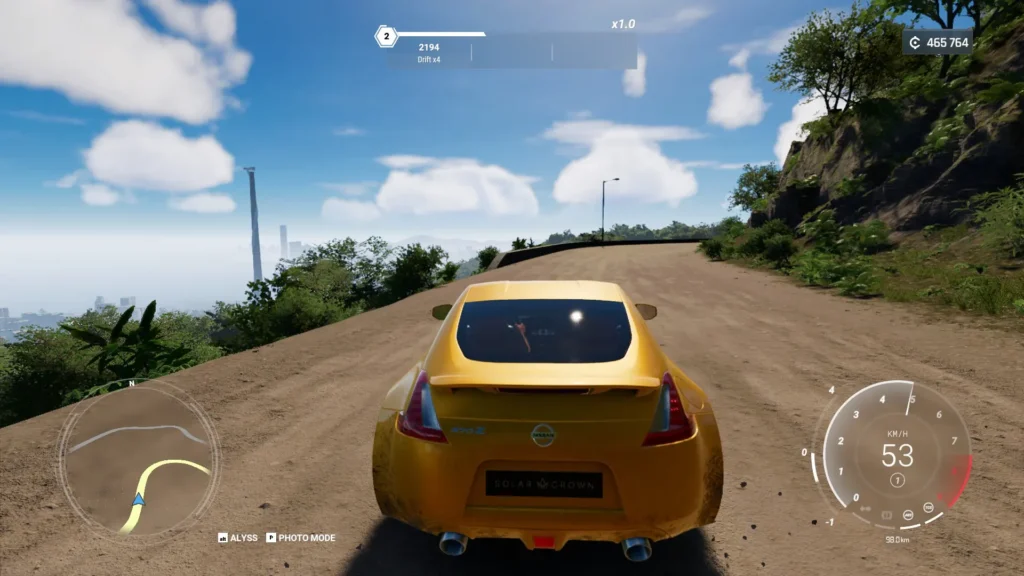
The progression is also a bit of a bugbear with me, with most cars (nearly all) being locked behind level walls, meaning you need to earn enough reputation to buy a car, not just credits. You may have been able to afford that car you saw, but to purchase an upgrade to your first car, you'll need to play for several hours to earn enough reputation. By this point, you'll have finally earned the right to buy that Alfa Romeo 4C with that powerful 240HP engine... Except I started in a Nissan 370Z with a 350HP engine...
Visually, the game looks okay, but I can't tell you too much beyond that because Test Drive Unlimited Solar Crown is an unoptimized mess. Running at 1080p Medium settings, my Ryzen 5 5600G and RX 6600XT PC varied between 25 FPS and 60 FPS, depending on my area. Given that I can run Forza Horizon 5 at 1440p Ultra at a rock solid 60 FPS, AND it looks better, this is a pretty dire set of affairs. I couldn't test and see how it looks on High or Ultra, as I don't have access to a high-end gaming PC that can handle that, even at 720p.
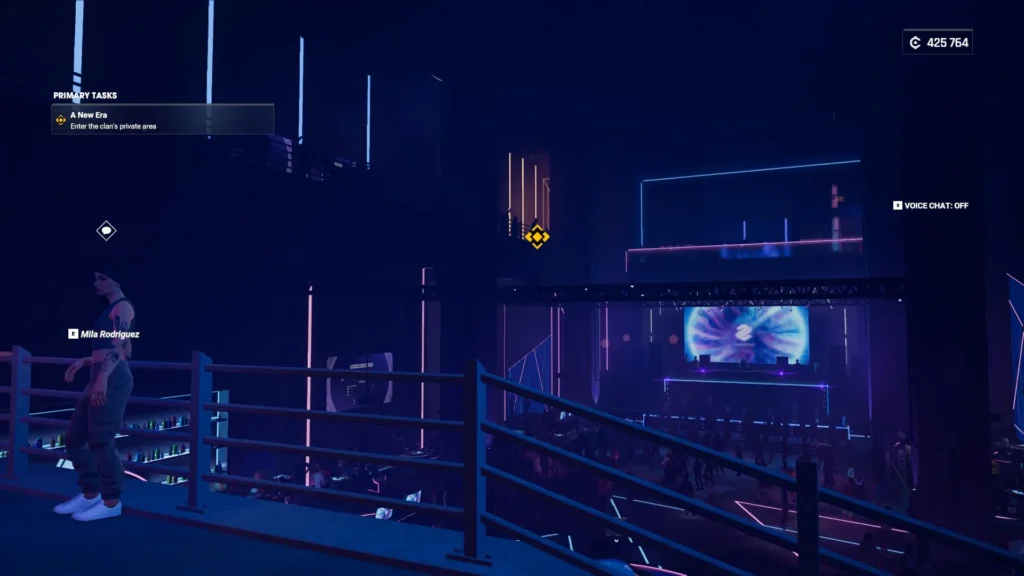
Lastly, there are indoor environments, and my main question is... why? This is a driving/racing game, yet every car showroom, the clan headquarters, your hotel room, the hotel lobby, the workshop where you tune your car, you get the idea. They ALL have walkable areas where you have to park up, go inside, and then slowly stroll over to the console and press a button to do something that should have just popped up as a menu as soon as you entered the building.
Like many things in Test Drive Unlimited Solar Crown, it feels like poor game design and a little pointless. I'm playing a racing game, not an RPG, and I don't want to wander through the interior of buildings, meet NPCs I don't care about, and be given new quests.
Test Drive Unlimited Solar Crown does have some potential. It's billed as a live-service game, as you might expect these days, with the first year's roadmap already planned out, which includes adding an in-game casino and map expansions. But rather than add all this new content, I think they need to fix its underlying faults first by improving the AI, giving us difficulty options, stopping dictating what cars players can and cannot buy, and adding more reasons to explore the game world such as additional activities and buyable houses or worthwhile secrets to find, and at least doing some optimization to what is a mess of a game right now.
Unfortunately, Test Drive Unlimited Solar Crown uses the SARD Anti-Cheat method, an AI-powered Kernel-Level Anti-Cheat that does not, and likely never will, support Linux. Playing it is impossible on Linux devices such as the Steam Deck.
Besides driving assists such as Traction Control, ABS, and a Suggested Racing Line, the only accessibility option in Test Drive Unlimited Solar Crown is the ability to turn subtitles on/off.
Test Drive Unlimited Solar Crown could be so much more than it is. But the game feels rushed, with some poor game design choices here and there, such as locking most of the cars behind a high-level cap, meaning players will need to play hours just to drive... a Corvette... With the lack of activities in the game, you have little choice but to grind races repeatedly to earn credits and reputation to buy a single car.
The reputation gained from exploration is low, and the credits that can be earned are non-existent, with a race earning several times what a single secret credit pickup rewards you. While driving around in free-roam can be fun, there's no progression to be made, unlike in other games in this genre, so it feels largely pointless.
Suppose you have friends who are also going to get the game. In that case, it might be more of a fun time, but as a single-player game in which many people will be given a low player count, I can't recommend you look at Test Drive Unlimited Solar Crown right now. The AI is poor, there's a lack of variety in the activities you can do, and the game's general performance isn't great.
Our review is based on the PC version of this game.
If you enjoyed this review, be sure to check out the rest of the content on SteamDeckHQ! We have a wide variety of game reviews and news that are sure to help your gaming experience. Whether you're looking for news, tips and tutorials, game settings and reviews, or just want to stay up-to-date on the latest trends, we've got your back.
Monster Jam Showdown was provided by PLAION. for review. Thank you!
There's quite a stigma attached to Monster Truck games these days. After having what seems like a deluge of low-quality titles on the PS2 and Wii systems, I certainly had a negative view of any game that was focused on Monster Trucks. Fortunately, Monster Jam Showdown is a game trying to buck the trend, and it was a surprisingly good time.
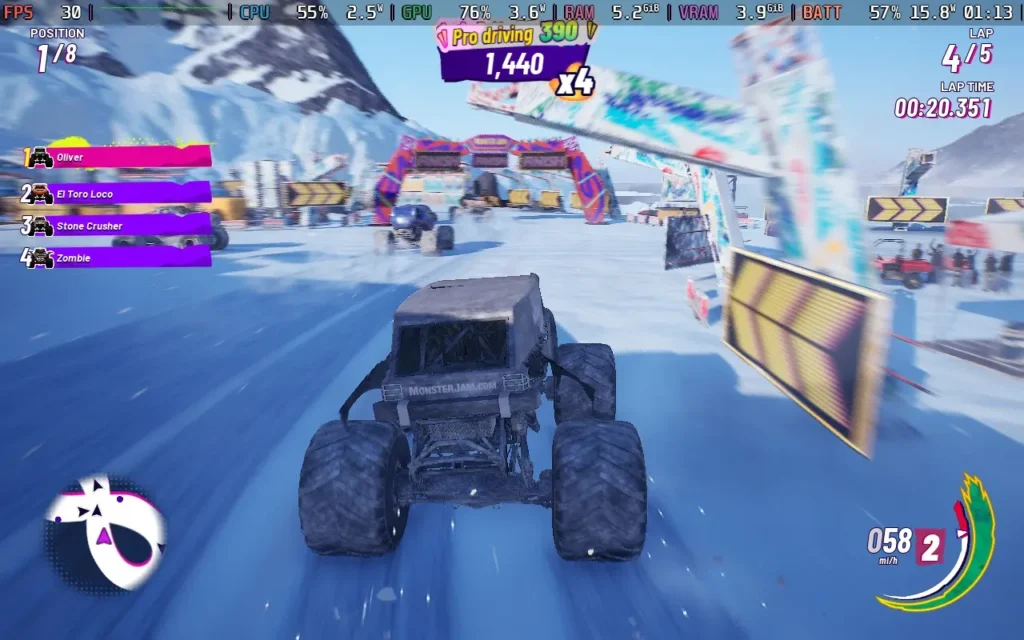
Monster Jam Showdown feels like a love letter to Monster Trucks in general. The driving model feels fun and great, with a bouncy suspension keeping the trucks bouncing after hard landings and drifting around the corners. The game's driving can be complex or simple, depending on how you have your assists set up, with the game asking you to steer both the front and rear wheels with the left and right thumbstick, respectively, although you can ask the game to handle the rear wheels for you if you wish.
The driving is the highlight of Monster Jam Showdown, with a boost system that rewards you for destruction and drifts during races and a fun control scheme that grants you some air control and fine control over the Monster Truck's steering. It all combines to make a good physics-driven racer that rewards skilled driving.
If you are a Monster Truck fan, you'll see famous trucks featured, such as Max-D, Grave Digger, and Higher Education.
The events take place across three environments, namely Colorado, Alaska, and California's Death Valley, with these representing woodland, snow/ice, and desert, respectively. There's a decent variety of tracks, although, during the "Showdown" career mode, you will notice repeats after a few races. These events are spread over a few types: general circuit racing, figure-8 racing with an increased risk of collisions, and stunt events where you must pull off stunts such as back/front flips, drifts, destruction, and more to build up a good combo. There are also a few other event types you can encounter.
The AI is reasonably competent in the hardest difficulty setting. If you are an experienced racing game driver and want a challenge, you should select Hard from the get-go. I played on Medium and generally won most races by 10-20 seconds. Hard should provide a decent challenge for most players, though.
The game mainly has two modes: the Showdown mode, essentially a Career mode, and multiplayer mode. The Showdown mode has over 100 events and should keep you busy for 10 hours or more if you want to 100% it. You'll play pretty much everything the game offers as you go through Showdown mode.
In multiplayer, you have the choice of playing Online or in Split-Screen. I didn't test the split-screen as I was playing on my Steam Deck, but I did get the chance to hop into a couple of online events, and the network code seems solid, with four racers in both events. I didn't notice any lag or unnatural movement of other vehicles. You can also create a party of up to 8 players to do a private event using your settings, allowing you to choose the mode and track yourself.

Visually, I was pleasantly surprised with Monster Jam Showdown. The environments look nice, the vehicles have reflections and good shading on them with the right settings, and the particle effects for dust and water also play their part in bringing together an overall nice picture. You can also cosmetically damage your Monster Truck, with parts bending and flying off of your vehicle, which is a nice touch, even if there is no mechanical penalty.
Sounds are a mixed bag. I enjoyed the music in the game, which has an almost hip-hop flavor, and the vehicle engines are also decent, although not the best I've heard. One thing that did annoy me and resulted in me disabling it was the commentator's voice. Generally, you can't hear the commentator, but in stadium environments during stunt events, they comment during the event, which I found to be pretty annoying. Fortunately, the game allows you to disable commentary without affecting the rest of the game's sound.

Is Monster Jam Showdown a top racing game, then? I'm not sure I would go that far. It's limited in its scope, focusing solely on Monster Trucks, and it does quite well. There is a good selection of tracks and a few game modes, and while it's entertaining to play, I'm not sure the $50 price tag (at the time of this review) is necessarily warranted.
The online mode might add some longevity once you finish the Showdown mode, but player numbers on Steam for the first few hours after launch are quite low, and the multiplayer matches I played only filled up to half the lobby. The game does have cross-platform support, which should help it in the long run, but I would purchase this for its single-player first and foremost.
Monster Jam Showdown is mostly a good experience on the Steam Deck. You get 1280x800 resolution support, and the controller support works well for the most part. However, I did encounter a glitch in the menus that prevented me from selecting some options, necessitating the use of the touchscreen. Also, on the first boot, you must link your Epic Games account, which requires the touchscreen to just hit 1 button if your Steam and Epic accounts are already linked.
There is currently an issue with in-game videos where they appear black. Fortunately, the game doesn't feature many in-game videos. The only time I encountered them was during the intro and the tutorial. If the game appears to be hung on a black screen upon booting, just hit A, as it's likely playing the intro video that isn't being rendered properly.
Regarding SteamOS settings, we'll be applying a frame rate limit of 30 FPS; no TDP Limit for this one.
We're mostly using "Low" settings here, which means we get the basic features of each visual effect, such as some reflections, ambient occlusion, and lens flare/bloom. Texture Detail stays on "High" and Shadows on "Medium." I recommend you keep the Frame Rate Limit option in-game to 120, as the in-game frame limiter is poor, and your framerate can go above and below 30 if you use it.

With these settings, you should get a 99.9% stable 30 FPS throughout the game, I tried these settings on every environment and on multiple tracks, and never really saw any frame drops, so it's a very "smooth" experience, as smooth as 30 FPS can be at least.
The power draw changes depending on the track you're on. Wooded tracks are the highest battery killers, so expect around 16-21W of power draw. Steam Deck LCD owners can expect around 2 hours of battery life, with Steam Deck OLED owners getting around 2.5 hours.
Temperatures hovered between 70-80C, with the fan noise going up and down during play.
If you don't fancy playing a racing game at 30 FPS, I can offer you a preset that allows 40 FPS. You can set a 40 FPS / 40 Hz limit in SteamOS; no TDP Limit again here.
All the settings have to be at their lowest option, except Texture Detail, which we can keep on "High." Again, make sure the in-game frame limiter isn't set to 30 FPS, as it does a poor job of stabilizing the framerate.
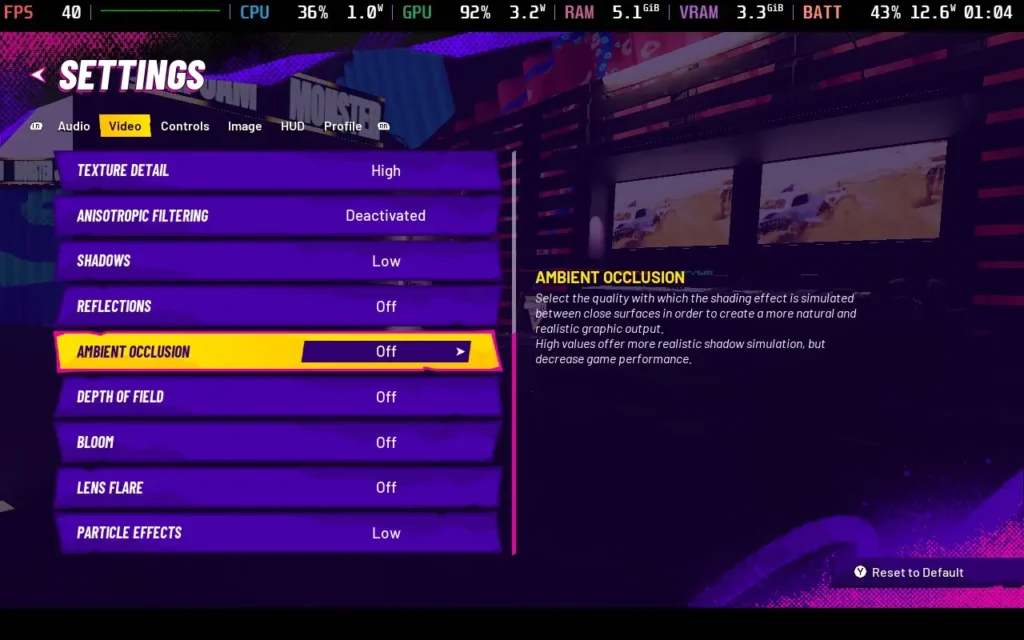
Like the 30 FPS preset, I found these settings to deliver an almost entirely stable 40 FPS experience. You lose out on visual niceties, such as reflections and effects, but you gain some FPS, which might be more important to you.
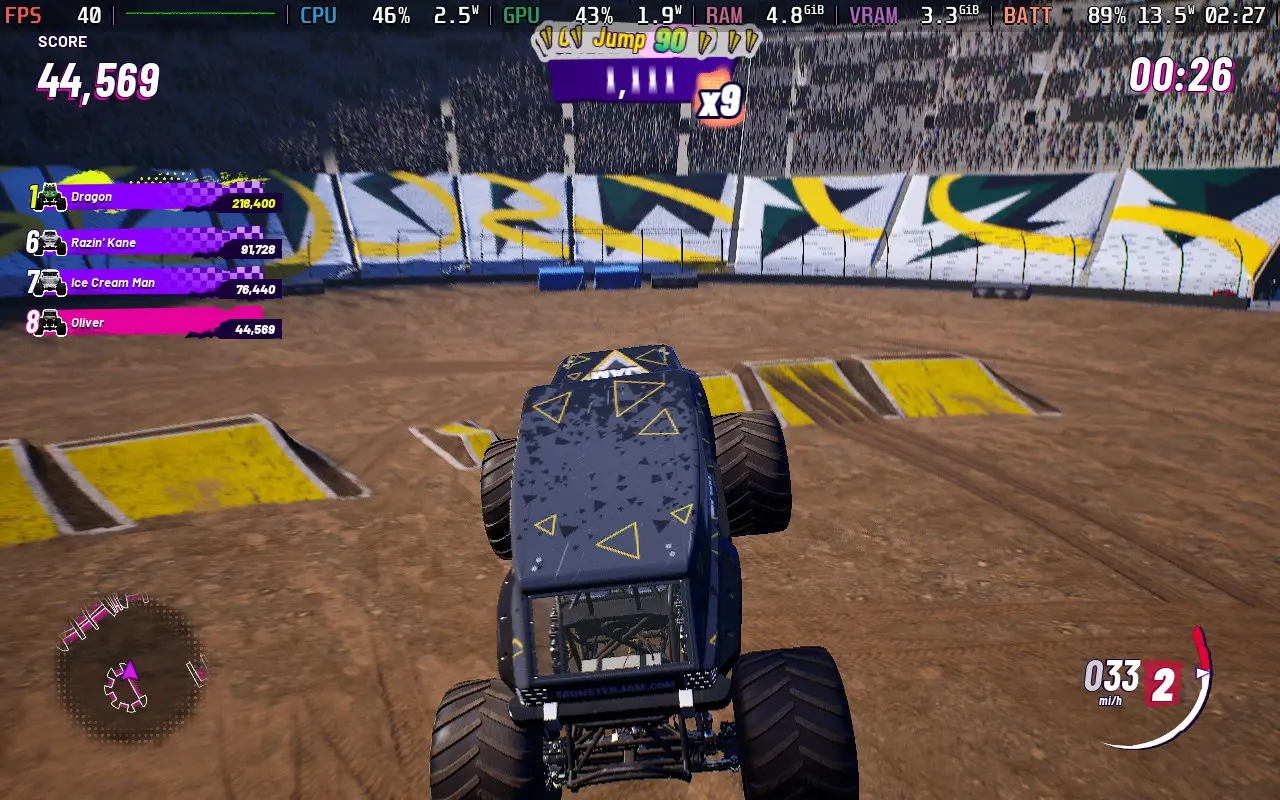
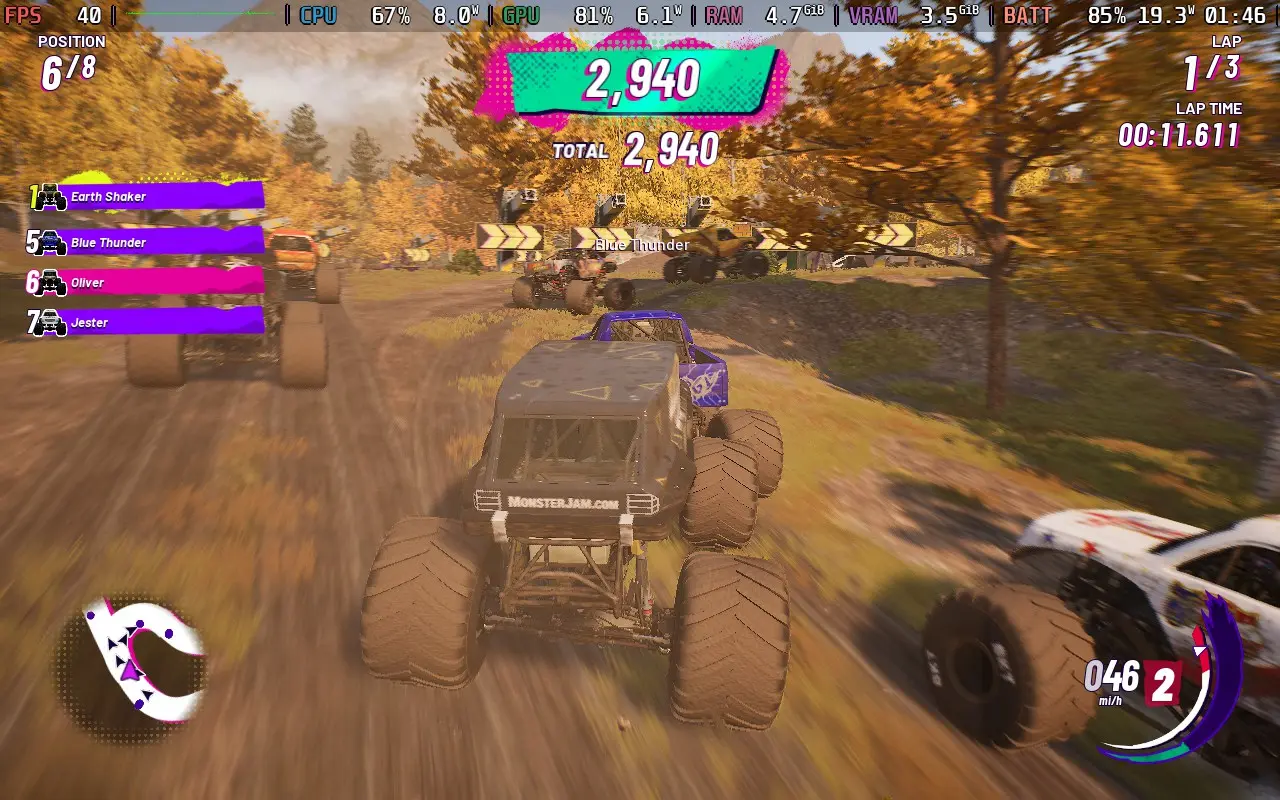
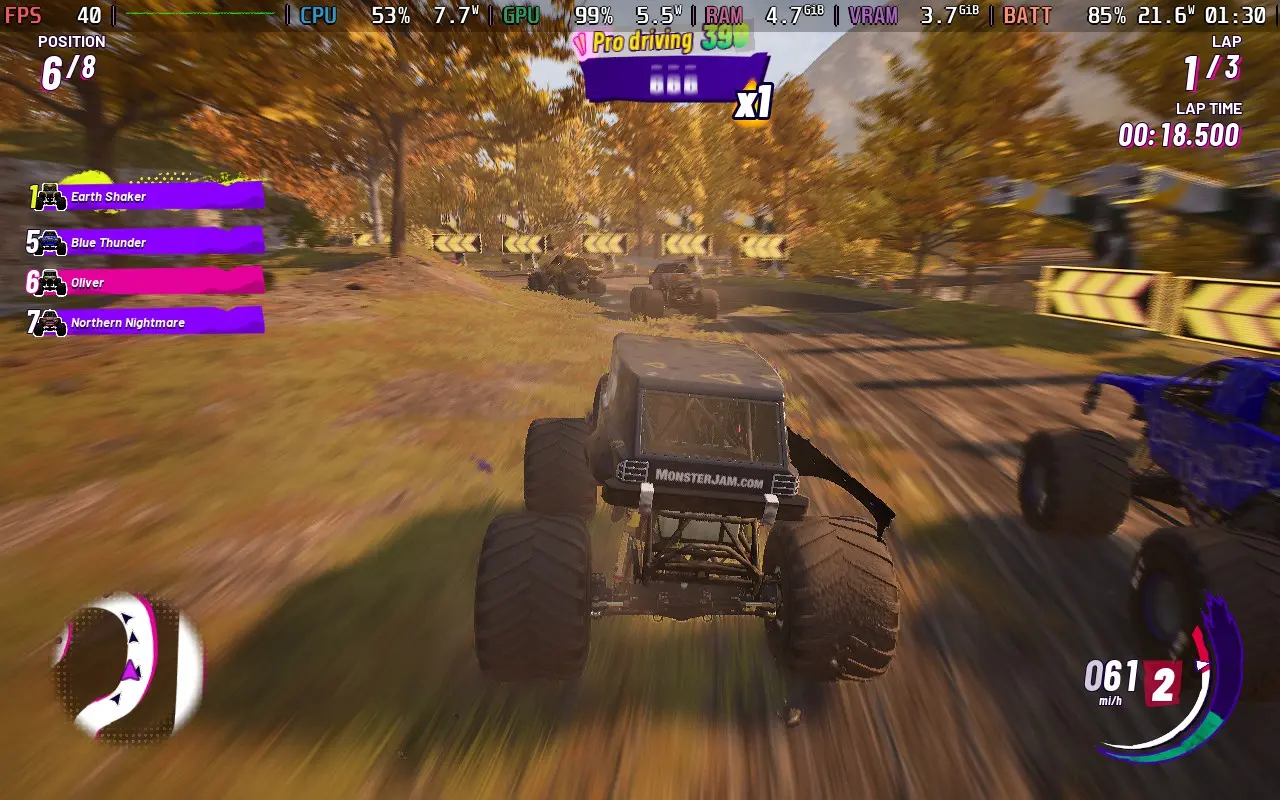
The power draw is a bit higher on this preset, partially because the CPU must work harder to hold 40 FPS. You can expect to see a power draw between 16 and 24W, depending on your track. Therefore, you might struggle to hit even 2 hours of battery life from a Steam Deck LCD, although the OLED should manage 2 hours.
Temperatures were also higher, hanging around 75-85C. The fan was almost always running fast.
Monster Jam Showdown's accessibility mostly falls under the realm of driving aids. This includes braking and steering assist and the ability to slow down offline races if the game is a bit too fast-paced for you.
If Monster Jam Showdown's goal was to become the best Monster Truck game available right now, to my knowledge, that goal has been accomplished. While its focus on the Monster Truck genre may make it a niche product, it should satisfy anyone looking for a game that fills that niche. With satisfying driving physics, different event types, and a good-looking game, Monster Jam Showdown is a competent racer.
The Showdown Tour mode offers a good chunk of gameplay there. Hopefully, the online mode, coupled with cross-platform multiplayer, will stay active for a decent amount of time to allow players that extra piece of replayability.
Regarding Steam Deck compatibility and performance, there are a couple of issues, mainly the need to use a touchscreen at rare points and issues with in-game videos. However, in terms of performance and stability, the game does run quite well on the Steam Deck, and I can give Monster Jam Showdown a thumbs up as a perfectly playable Steam Deck title.
Our review is based on the PC version of this game.
If you enjoyed this review, be sure to check out the rest of the content on SteamDeckHQ! We have a wide variety of game reviews and news that are sure to help your gaming experience. Whether you're looking for news, tips and tutorials, game settings and reviews, or just want to stay up-to-date on the latest trends, we've got your back.