Dog Witch was provided by Mystic Forge for review. Thank you!
Dog Witch is the perfect example of a good game struggling to break through an oversaturated market. Developed by Heckmouse, this is a roguelike deckbuilder at heart and is brave to take on a genre that is heavily represented in the indie scene. I’m saying this without any disappointment or negativity, because Dog Witch is a genuine experience filled with a lot of love. It just struggles to differentiate itself from the growing competition.
That isn’t to say Dog Witch doesn’t offer any innovations. Playing as a doggie sorcerer is as creative as protagonists go, although there isn’t much of a story to speak of. You are a dog who flies along on a broomstick in a gauntlet of rotating enemies. Kill them, die, and repeat with more upgrades. I would have liked some lore on why we’re fighting random slimes and bees as a dog, but the cozy animations and calming music make that desire less critical.
I like how the card deck is implemented. Rather than crafting a deck that grows more bloated and complex as you progress, your doggie avatar has a limited arsenal, with one slot per type of card. There are upgrades and new tools that are available with every battle won, but they involve swapping out what you already have. I prefer this mechanic to what we usually see, as it requires more planning for the player. That upgraded spellbook that turns my spells into an automatic leeching attack sounds good, but is it better than the spell that allows me to hit all enemies at once? There are legitimate choices to be made and numerous options to explore.
One of my favorite runs combined the mentioned sweeping arrow attack, which hit all my enemies at once, with summoning skeletons that revived once they were killed, for additional damage output. I also had an invaluable ring that buffed my minions every time I applied a shield, so it made an excellent combination. I still died in the third boss fight as I ran out of steam, but it was entertaining.
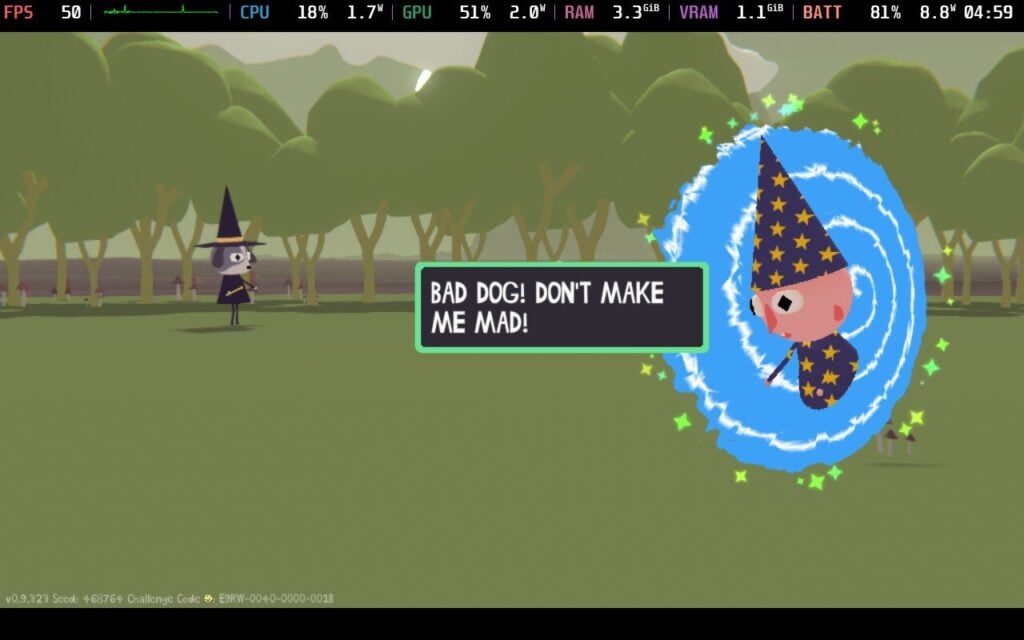
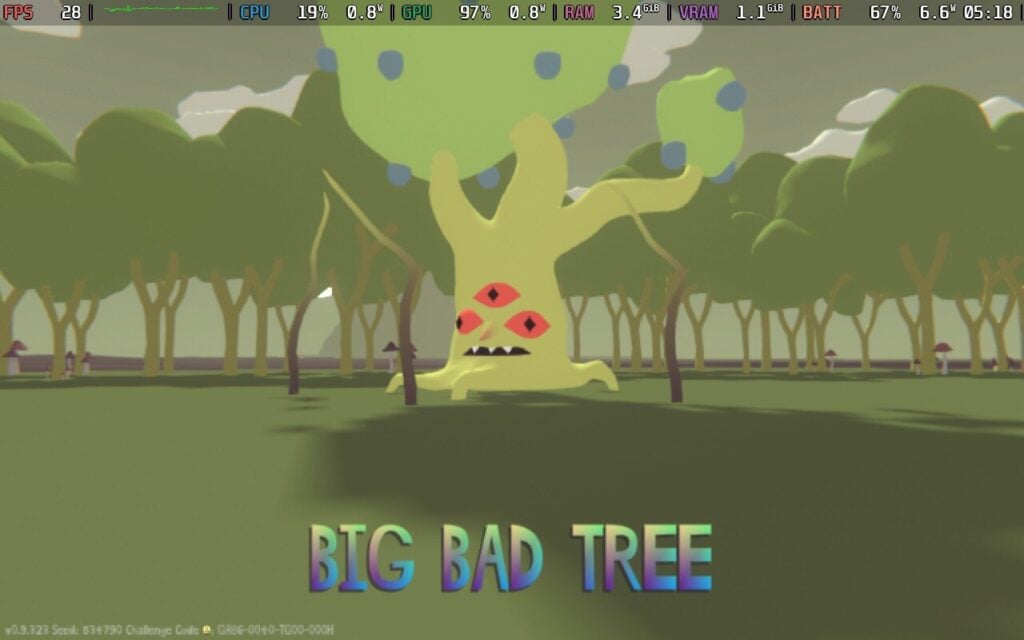
Gameplay-wise, Dog Witch is pretty similar to others in the genre, although it is more of a linear boss rush than the branching paths we see in other deckbuilders like Slay the Spire. There are 13 fights in the standard mode, although an endless game mode is unlockable. After winning a fight, you get to pick new trinkets and cards, upgrade them, and so on. Each boss fight victory heals you, although enemies hit hard with little health for the player’s avatar. Enemies have a range of abilities and attack powers, and there’s some nice creativity in what monsters you have to fight, from slimes to cowboys. Dog Witch isn’t slouching on the enemy variety front! Some choices offer Cursed variants of the cards that are powerful buffs in exchange for damage, which is nice.

Piecing all this together, there is a lot to like with Dog Witch. The graphics and music are nice, the card variety is solid, and there is a fair amount of content to enjoy. So why do I feel so ambivalent towards it? That is mainly down to me playing a lot of deckbuilders this year, and while Dog Witch is a good deckbuilder, it’s fighting against a tsunami of great competition. Overall, though, it did grow on me the more I played it, so that is a plus!
Dog Witch should have a Verified rating by Valve by the time the game launches, although ProtonDB’s rating is currently Unknown.
Dog Witch does live up to its Verified rating, although I found it is not perfect. The controls all work as intended, and the game looks good on the OLED screen of the Steam Deck. Some of the text is a little small on screen, and the lack of accessibility features means we have a case of ‘WYSIWYG’ with Dog Witch’s settings. There isn’t much we can do besides change screen resolution and an overall graphics toggle between low, medium, and high, but with no indication of what is being changed. I would have liked to have more options.

Performance-wise, the Steam Deck doesn’t have any issues playing Dog Witch with stock settings, although I was surprised to see it struggle at a low TDP. Many deckbuilders I have played can run full speed at a 3 or 4 Watt TDP without much trouble. The poor performance at a low TDP is probably due to optimization before release; however, it is a minor nitpick, all things considered. By dropping the graphics to low and capping the FPS to 30, you can typically get away with a 4W TDP in most cases. For now, I recommend sticking to 60 FPS on a medium graphics preset, without adjusting the TDP, for the optimal experience.
With the stock settings in place, I observed an average power draw of around 12 watts, which translates to approximately 4.5 hours of battery life on the Steam Deck OLED. This is still good overall, although it could be better.
Dog Witch is available in English, French, Italian, German, Spanish, Dutch, Japanese, Korean, Polish, Portuguese, Russian, Simplified Chinese, Swedish, and Traditional Chinese.
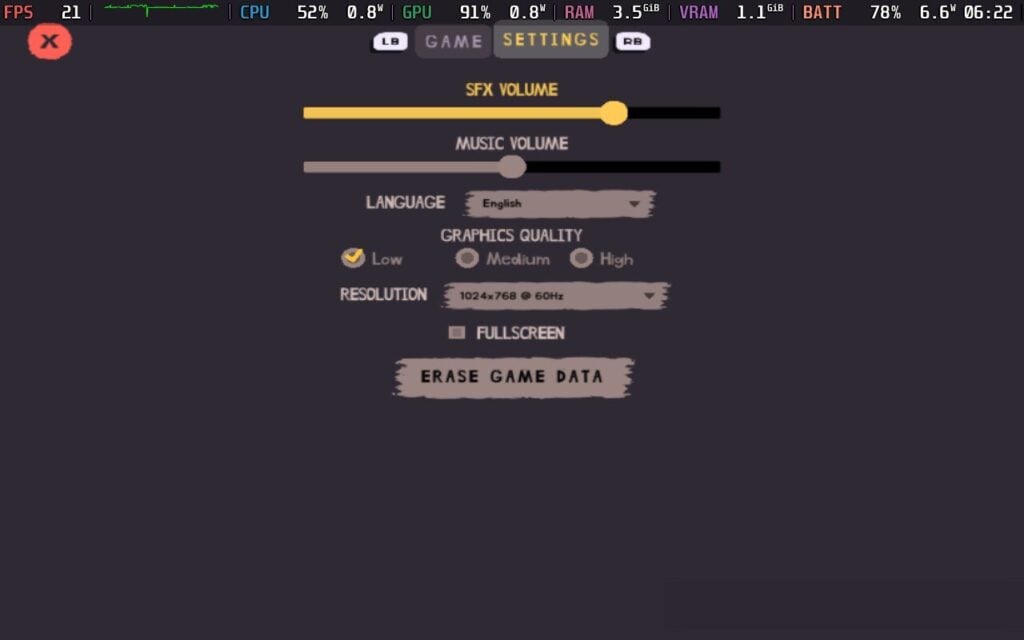
Dog Witch is unfortunately lacking many accessibility features, and all you can really do is adjust the screen resolution and graphics. There doesn’t seem to be a way to change keys, and there is no support for colorblind users or text scaling. You can reroll a battle after death, however, which is a feature I wish more deckbuilders had.
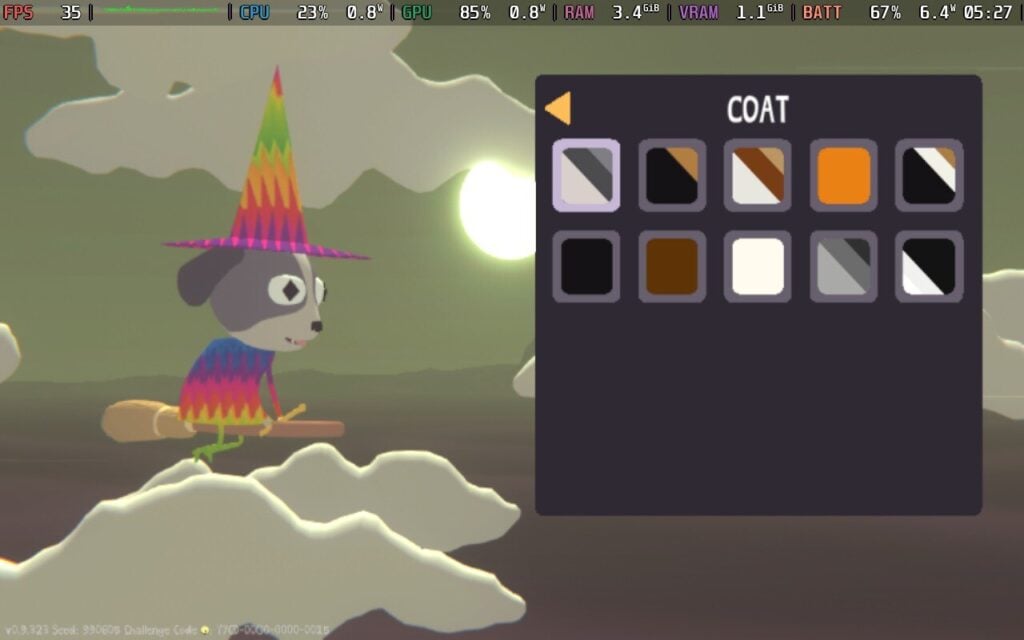
I almost feel bad for not feeling the vibes with Dog Witch, because, all things considered, it is a solid game with plenty to offer. The visuals and music design are excellent; I really like the dog customization feature that allows me to make the avatar my own, and the gameplay is up to scratch. It may not do enough for me to set itself apart from the swathes of roguelites and deckbuilders that roam the indie PC market.
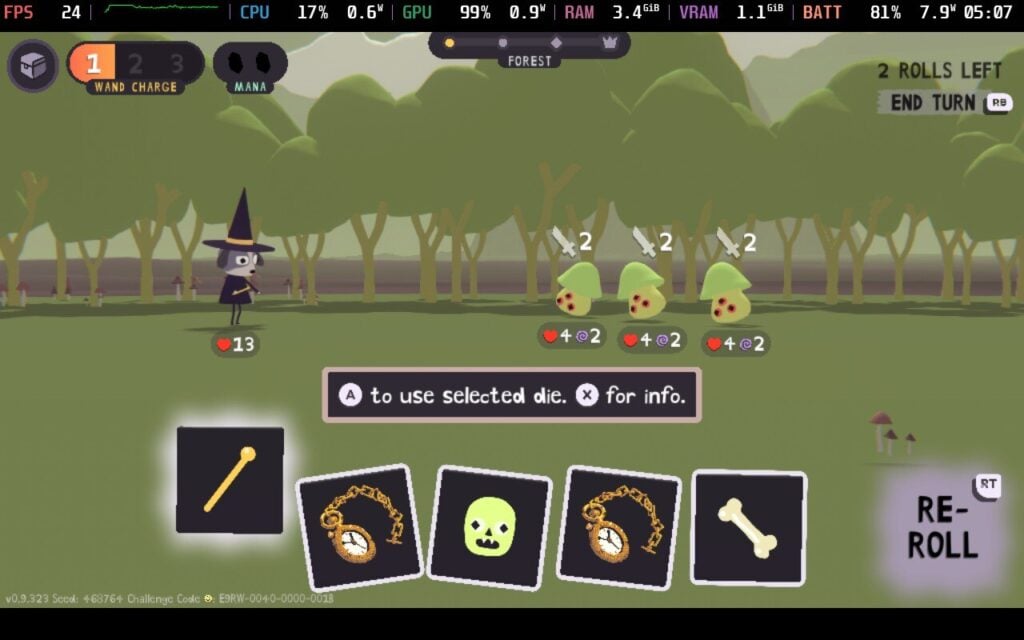
The Steam Deck's performance, while perfectly decent, could benefit from some optimization, and the relative lack of accessibility functions detracts from what is otherwise a pleasant experience. I still recommend it for deckbuilder fans because the gameplay is good.
Our review is based on the PC version of this game.
If you enjoyed this review, be sure to check out the rest of the content on SteamDeckHQ! We have a wide variety of game reviews and news that are sure to help your gaming experience. Whether you're looking for news, tips and tutorials, game settings and reviews, or just want to stay up-to-date on the latest trends, we've got your back.
Knights in Tight Spaces was provided by Raw Fury for review. Thank you!
I never played Fights in Tight Spaces when it first came out, but after playing a bunch of Knights in Tight Spaces, I really wish I had. The game is a thoroughly enjoyable experience with great gameplay mechanics, an interesting art style, and a good amount of content to keep you busy. There are a couple of issues here and there, but there are way more pros than cons.

The basic premise of Knights in Tight Spaces is essentially a tactical battler, where your party is placed on a grid on a small map, and the actions you can take are dictated by the cards you hold in your hand. Each map might have specific objectives, but generally, you aim to defeat all enemies on the map or survive a certain number of turns. The entire gameplay is based on this battling system, so it has to work well, and it surely does.
The cards you can get are varied and allow you to set up some great combos that feel satisfying to pull off. All movement and attacks have to be done by playing a card, so you have to strategize which party member should use which cards to maximize the effectiveness of your turn. For example, one card might let you advance a space and attack, while another could make your character attack and retreat a space. Using these 2 cards in succession could allow you to make an attack on an enemy and then a further attack and pull your party member back to safety for the end of your turn.
You are also alerted to what attacks your opponents plan to take on the next turn, allowing you to try and position your party in a way that protects them from damage by playing your cards right, similar to games like Into the Breach.
Whether or not you can use a card depends on either your "momentum" or "combo" points. Momentum is granted at the start of each turn, and the combo is built by performing successive actions. If you've planned your moves well, you could play every card in your hand for a truly devastating turn. Your hand gets wiped after each turn, and new cards are drawn, so it's best to plan to use as many as you can.
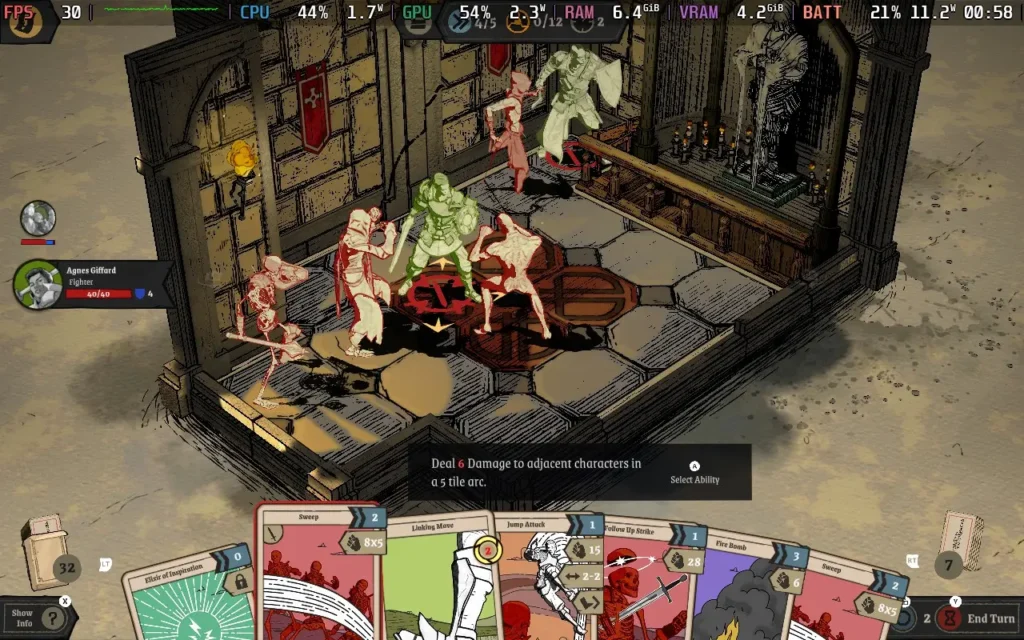
Yes, there is a degree of RNG to all this gameplay, and on one specific occasion, I found the card system frustrating. Namely, it kept giving me attack moves when I was against a boss that could teleport my character around the map, meaning I needed a lot of movement cards to get close to the enemy. This resulted in about 7-8 turns in a row where I couldn't attack my opponent. My character also had enough "block" stat that the boss couldn't deal enough damage to hurt me, resulting in an endless stalemate if the enemy AI had chosen to keep teleporting me.
But generally, the game does a good job of rewarding your strategic skill, and if you lose a battle, you'll probably realize the turning point or action you took that put you in the losing position. There are also many difficulty settings to choose from, so you should be able to find the setting that suits your skill level and is enjoyable for you.
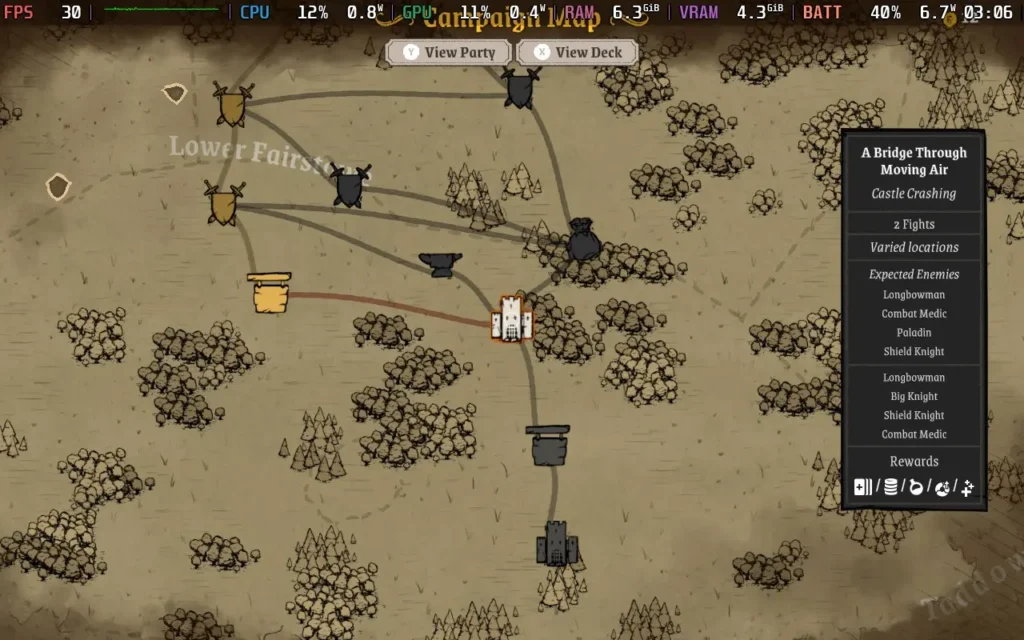
The overworld is where you'll decide what path to take. Most paths result in a battle, but some might result in a tavern where you can heal and recruit additional party members or a blacksmith where you can upgrade or buy new equipment.
Knights in Tight Spaces does have a storyline, which takes place in the form of written dialogue in the overworld as you navigate between certain battles. It's fairly generic as storylines go. Essentially, an unlikely hero is drawn into the action by forces beyond their control, and you now have to protect the kingdom from various threats that are posed to it. It's nothing special, but it serves as a purpose for the battles to take place.
Visually, the game prefers to make clear distinctions for characters rather than flesh them out with detail. The members of the player's party will be in green, neutral parties will be in yellow, and various factions you fight against will be colored red or purple. I much prefer this way of handling it, as it helps you as a player to see the situation and who your targets are immediately, making mistaken identities very unlikely. The environments are fairly detailed but stylized and kept on the more basic side.

Knights in Tight Spaces is an excellent tactical deck-builder. The story mode isn't too long, and if you beat it on your first attempt, it'll likely only take you about 4-5 hours, but there are other modes to try out as well, such as the Endless mode to test how far you can go, and the "Daily Play" mode to compare yourself against others. The balance of the card system and the feeling of satisfaction as you pull off a combo of moves to devastate your enemies or beat a battle without taking any damage is hard to beat.
Knights in Tight Spaces has excellent controller support and supports 1280x800 as a resolution, so there are no black bars around the screen.
There is, unfortunately, some very small text in the game that is hard to read, but it's generally not crucial text, so you can play just fine without it.
There isn't really much in the way of graphics settings. Aside from the resolution, there's just a tickbox for "High-End Graphics," which seems to improve some lighting. However, it also impacts performance quite a bit, so we have to keep it off on the Steam Deck. With those settings, we must limit the game to 30 FPS with the SteamOS Frame Limiter and run a TDP Limit of 11W.
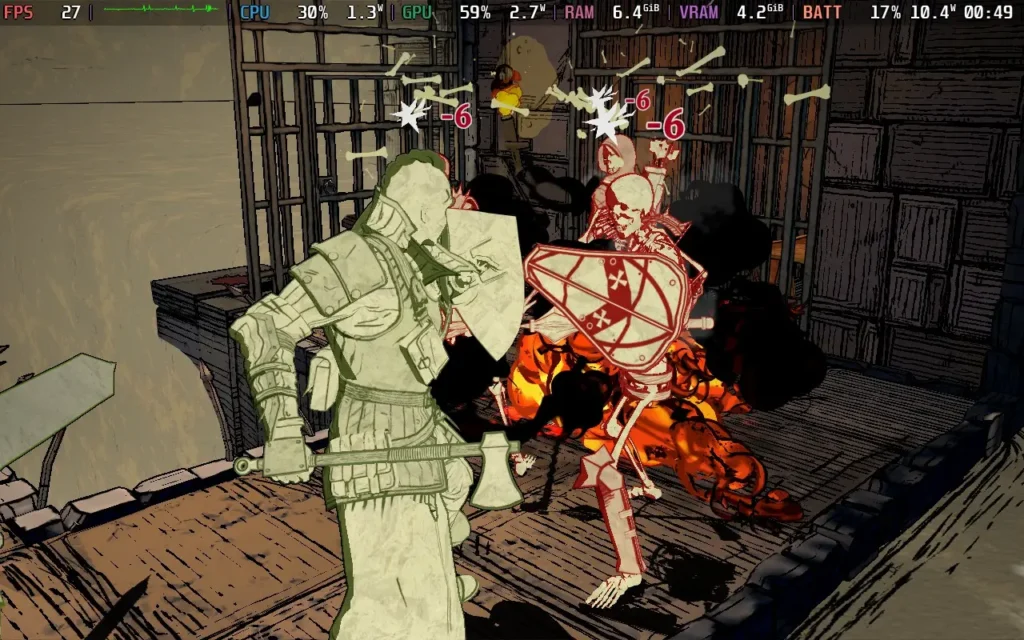
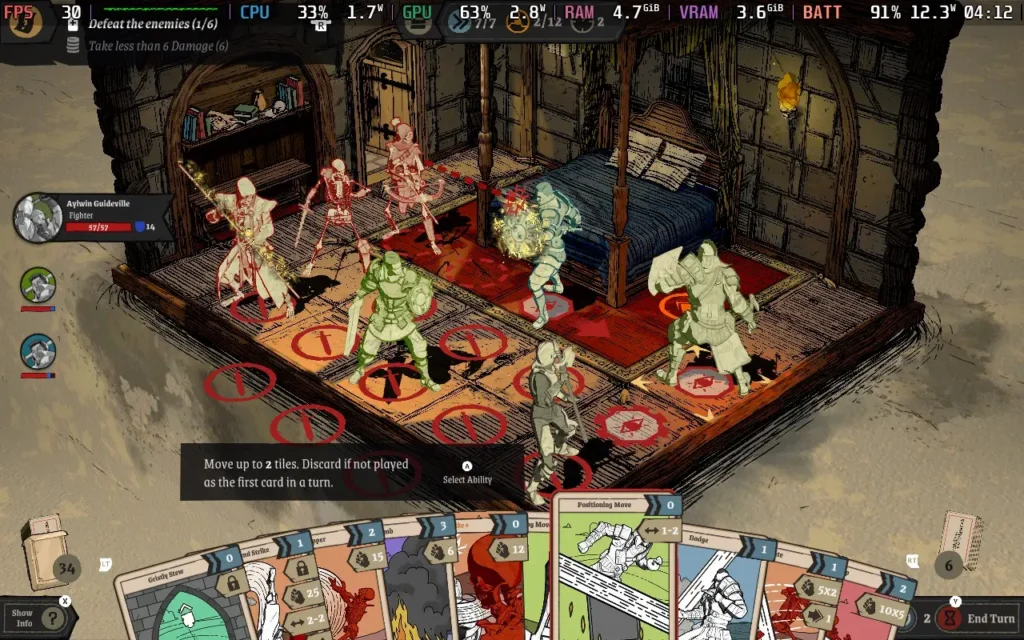
Knights in Tight Spaces holds a steady 30 FPS at this point. While earlier maps and battles can run at 40 FPS, I found that once you reach "Quest 2", the game gets more intense and struggles to hold 40 FPS in battles.
The power draw was around the 10W-13W range, although some maps towards the end of the game can hit 15W, and temperatures were around 55C. So expect around 4 hours of battery life from a Steam Deck OLED and 3 hours from a Steam Deck LCD.
Knights in Tight Spaces isn't very accessible, besides disabling blood and making certain environmental hazards stand out more.
Knights in Tight Spaces does pretty much everything right for a tactical deck-builder. It has many cards, presents information clearly to the player, and has various difficulty options to make the game balanced for everyone. The RNG of drawing cards can be a little frustrating, but it's all part of the game and is a small issue compared to the fun that can be had here.
Performance on Steam Deck isn't the best considering how the game is presented, but it's still perfectly playable, and if you can overlook some small text, you can have a great time playing Knights in Tight Spaces on your Steam Deck.
Our review is based on the PC version of this game.
If you enjoyed this review, be sure to check out the rest of the content on SteamDeckHQ! We have a wide variety of game reviews and news that are sure to help your gaming experience. Whether you're looking for news, tips and tutorials, game settings and reviews, or just want to stay up-to-date on the latest trends, we've got your back.