


Baby Steps was provided by Devolver Digital for review. Thank you!
When I go to play video games, I usually play want to relax and enjoy the experience with compelling gameplay and a meaningful story. However, there are a group of people that want to be tested and challenged by ridiculously overpowered enemies where strategy becomes essential to overcoming these seemingly impossible battles. As for Baby Steps, it lands somewhere in the middle of relaxing and aggravating, which helps make it a more accessible game that will still make you want to throw your computer (or Steam Deck) outside a window.
The entirety of the game sticks around the general concept of “just one more step” and truly encapsulates the meaning of the “walking simulator” genre. All you do is walk. You put one foot in front of the other, controlling each leg individually, and walking up a giant mountain by leaning forward. In a way, it feels like Bossa Studio’s surgeon simulator, but for legs, and nobody is being cut open.
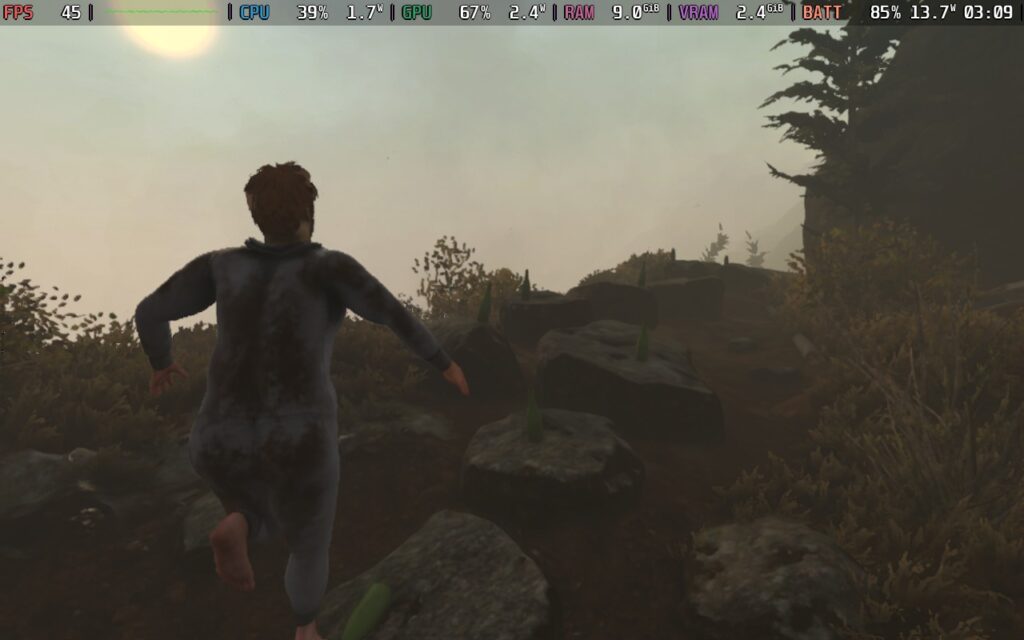
It sounds simple on the surface. I mean, it is literally just walking, and there aren’t any other mechanics to master. However, mastering walking in Baby Steps is no walk in the park. Not only do you have to focus on putting one foot in front of the other without falling flat on your face, you also have to walk across wooden planks, climb over rocks, and slink up slopes and stairs to make your way to the top of this crazy, weird mountain. It requires some precision footwork, with strategic planning on how fast or slow to lift up your foot and move to get over the obstacles that come before you.
It’s really not as easy as it seems. Trying to walk over rocks or stay steady on a singular plank takes careful planning, and going slow is going to help a lot. However, there may also be times you need to act fast before you lose your footing. Environmental hazards like slippery mud and running water can cause your feet to move ever so slightly and force a tumble. Going faster gives a chance to get through it quickly, especially if there’s a more stable footing close by. It still poses a risk that could cost your balance, but at the same time, the right move at the right time can get up that impossible-seeming step of a tower of rocks to get down to the next campsite.
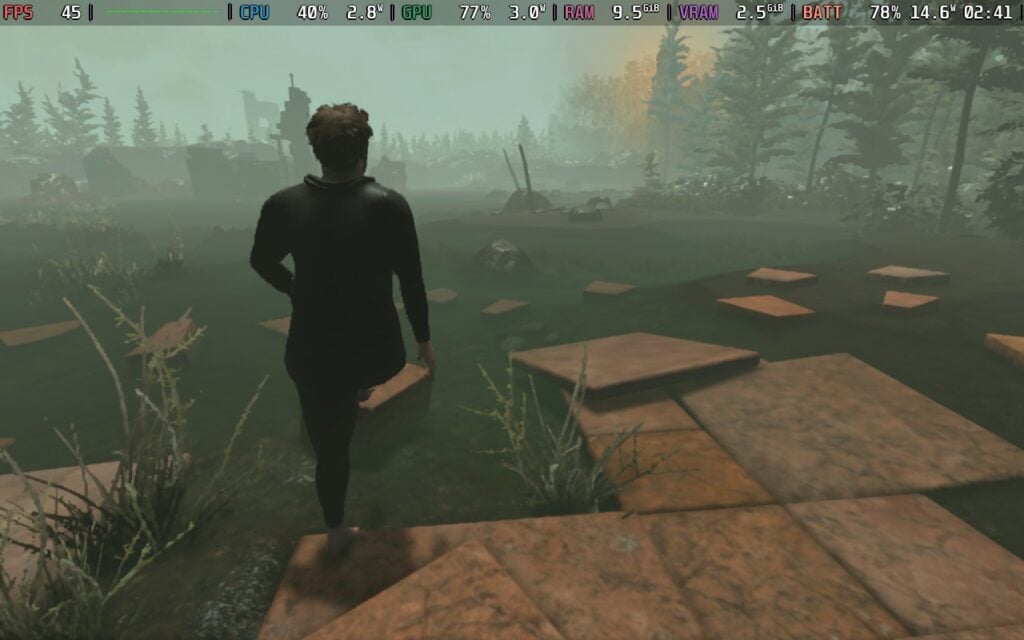
Sometimes, failing to step just makes you fall right down on your face, but because you ragdoll, the possibility of your lifeless body sliding down mud or falling off the cliff side further down the mountain is very real. If you’ve played Getting Over It With Bennett Foddy, you’ll know exactly what you’re getting into, and probably aren’t surprised that Baby Steps is also made by Bennett Foddy, along with Gabe Cuzzillo and Maxi Boch. That possibility of failing and having to re-climb is both a motivation to keep going and a curse that will haunt you. I found it hilarious whenever I fell down and just landed flat on my face or back, but sliding down just filled me with dread as I watched his lifeless body slowly shift downwards, and I prayed it wouldn’t fall too far, but it almost always did.
The gameplay is so simple, with complexity that stems from within, with precise movements and strategic speed. It’s why I love this game so much, even with the aggravating possibility of falling down and ragdolling until hitting the bottom of the mountain to climb my way back up. This team of three devs found a way to make walking feel engaging, while also perfecting that dread I now associate with Bennett Foddy’s works. Even still, it’s worth playing. The general mechanics are extremely fun to take advantage of, and the slower-paced strategic footing can make each challenge that is overcome feel like a victory. It’s true that it can be devastating when falling far down, and it is, but that worry helps make the experience feel worthwhile and heightens that sense of accomplishment.
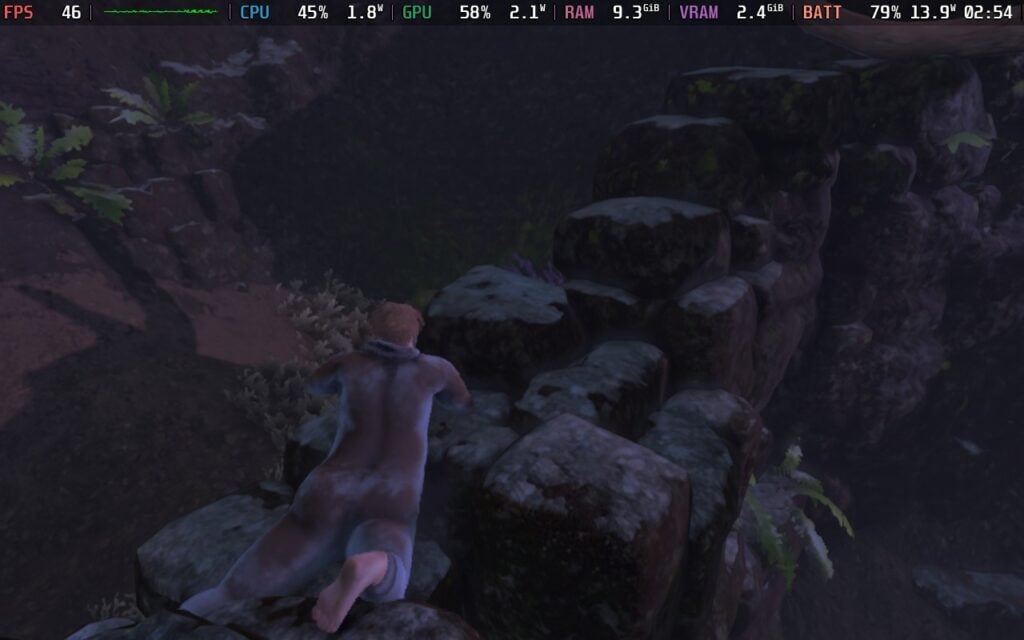
For a game like this, the controls need to be pretty tight and responsive to keep it enjoyable, and for the most part, it is. Controlling each foot is as easy as moving the joystick, combined with the right or left trigger (to note the right or left foot). There's a very small, but noticeable shadow of where your foot will drop, which makes it easy to figure out where it will be placed. The camera angle can get in the way at times, but we can switch which shoulder we are looking over. It ultimately helps a lot and makes the game enjoyable, despite its frustrating premise.
There aren’t any side quests or objectives, primarily just giving us freedom to walk around as we please, but there are random landmarks we can find outside the campsites that further the story along. Whole some could just be random sheds or buildings, others could be more special and trigger optional cutscenes, like the lovely Persimmon tree. It's a pretty open world and there's lots of paths to take, and there's always some challenge or interesting landmark to find. It was pretty fulfilling to just walk around and explore.
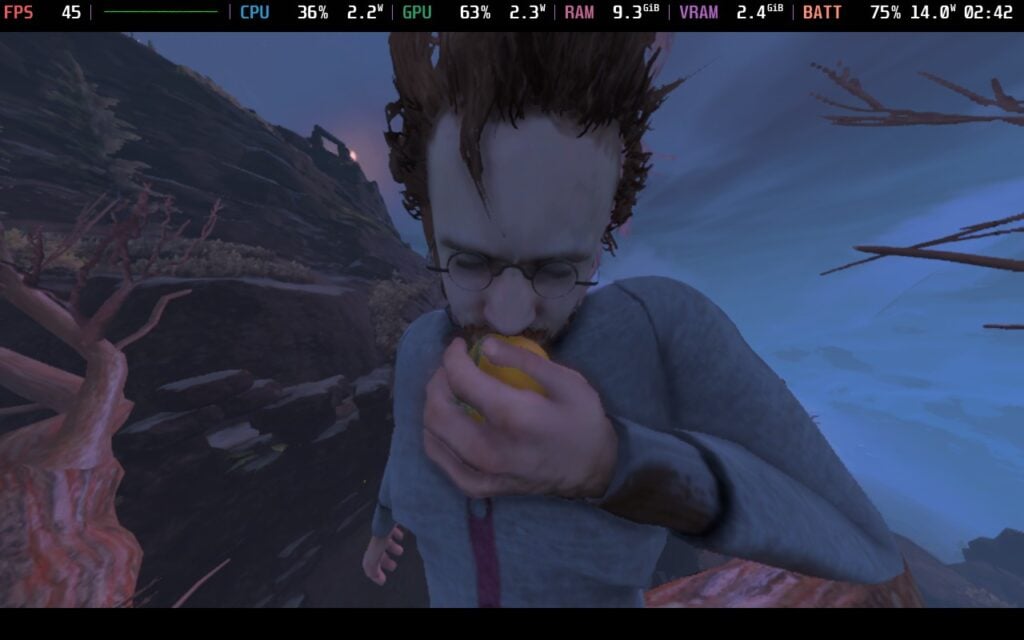
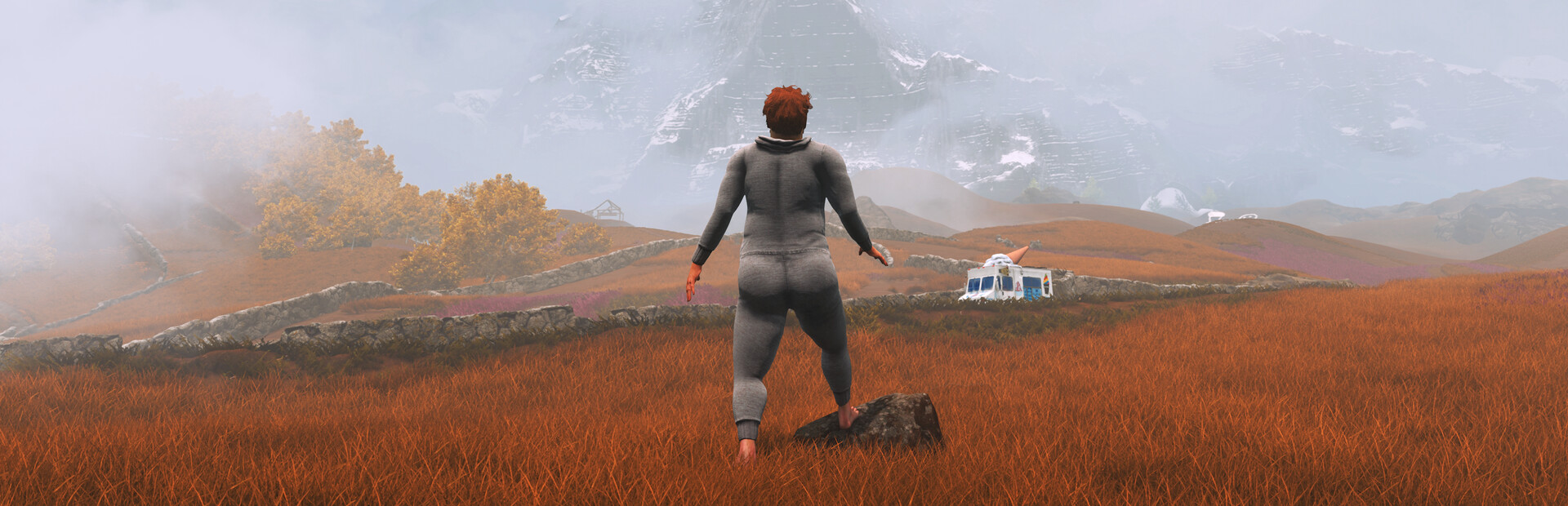
Baby Steps' story is a weird one, and serves mostly to set the scene about why a weird, basement-dwelling man-child is now climbing a mountain in a onesie. We play as Nate, and after being teleported to this mountain, we will need to climb it to hopefully find a way back home…and a bathroom.
The story was more of a means to an end, but it was very entertaining. There are random, short scenes that can play out at landmarks we find, and almost all of them are entertaining. Watching Nate struggle with basic communication adds to his man-child, basement-dwelling image, and it serves as an entertaining break from climbing. The people we will encounter are just as weird, but in wildly different ways. We will encounter an assortment of characters, including a guide who tries to be helpful, a newbie climber who has a grappling hook, and a horseman who just wants some cigarettes. And with each person, Nate will fumble through the conversation, trying to either appease them, get out of the convo, or assert his own confidence that he knows what he’s doing, even when he doesn’t.
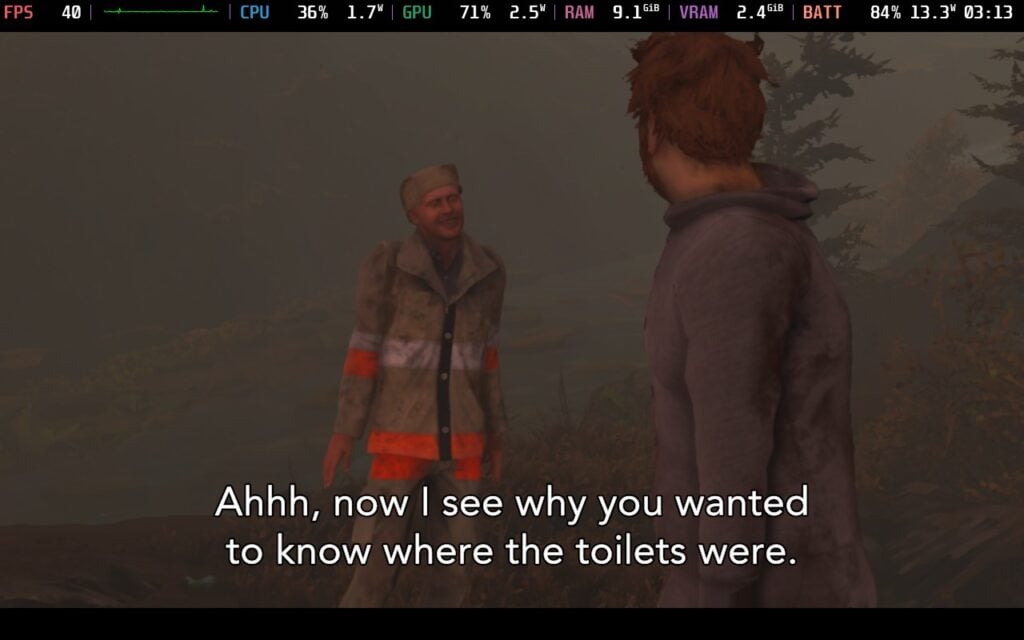
Baby Steps always felt like a game that could be perfect for the Steam Deck, especially when it recommends playing with a controller, and it really is. The game can be wonderfully enjoyable on the go, while still looking relatively good. Thanks to the game’s more basic visuals, it just fits, though there are a few interesting tidbits I discovered while playing.
We can’t change the specific graphical settings; we are only able to choose from Low, Medium, and High presets. After looking through all of them, I almost couldn’t tell the difference between them. Quality levels are very similar to each other, with the most noticeable change coming from view distance for optional objects like random beer bottles. It’s nothing major, though, and I felt running on Low still gave a good image, while saving some battery drain. Going from Medium to Low saved about 2W, while High to Medium saved about 5-6W. This allows us to run the game at 45 FPS and keep it stable as our ascent continues up the mountain.
We also have FSR upscaling that can be turned on, and it defaults to FSR Performance. This was another one where I didn’t notice major differences, and personally, I actually liked the blurriness that comes from it. It fits with the game, while trying to turn on SMAA anti-aliasing just makes everything too sharp.
There are some areas of the world that drain a bit harder than others, so a framerate limit will help. Turning everything onto max settings with no FSR upscaling and SMAA anti-aliasing on High is too much for the Deck, and it will regularly drop below 30. I personally prefer Low + FSR Performance with 45 FPS lock because there are some drops that could go below 60, so this keeps it smooth, battery drain lower, and visuals looking decent despite the lower settings.
Playing on Medium with higher FSR upscaling should be do-able for 45 FPS, while SMAA turned on with Low and Medium visuals should be okay for 30 FPS, but I ultimately preferred the default since the visual changes weren't major and I preferred a stable 45 FPS with lower battery drain.
We can change the language, toggle subtitles, hearing impaired subtitles, nudity, a center dot, modify the UI scale, invert the camera, toggle rumble, and change audio sliders.
The game supports 16:10 resolutions, cloud saves, and controller support. There are no HDR settings.
Baby Steps is a weird, basic game that finds an accessible balance between easy and aggravating. All you do is walk forward, going around or through obstacles, and it still finds a way to be so compelling and enjoyable that it's hard to stop. Even when falling down the mountain and having to climb up again, I still felt excited to get back on it and take a different route on the open mountain or take some extra time to strategically place my footing. The story may not be prominent, but it is entertaining, and I had a blast exploring to find other cutscenes to enjoy.
The game is also wonderfully playable on the Steam Deck at its default settings, and I didn't find many settings that could make it look better. Still, it's definitely worth playing, and it will absolutely be a blast on the go.
Our review is based on the PC version of this game.
If you enjoyed this review, be sure to check out the rest of the content on SteamDeckHQ! We have a wide variety of game reviews and news that are sure to help your gaming experience. Whether you're looking for news, tips and tutorials, game settings and reviews, or just want to stay up-to-date on the latest trends, we've got your back.
Baby Steps is an exceptionally aggravating game that I can't stop playing, and it is wonderfully enjoyable on the Steam Deck.